
Home » College SAT Score Ranges, Costs, and Programs by Major and State » Engineering Colleges by State: SAT Scores, ACT Scores, Costs, and ABET Programs » Engineering Colleges in Virginia: SAT Scores, Costs, and Programs
By Glyn Caddell, BSME · Author of Digital SAT Math Secrets · Tutoring since 2008 — Updated October 26, 2026
Twelve Virginia universities offer ABET-accredited engineering degrees, and this page lists what they cost and the test scores of the students they admit.
At the state’s flagship, an engineering student from New York pays $73,582 a year in tuition and fees for 2026-27, $14,070 more than the Scorecard’s figure for the university and more than MIT charges, under a state law that requires non-residents to pay the full cost of their education.
SAT scores are given by section rather than as a total, because a student at 760 Reading & Writing and 710 Math is in a different position from a student at 710 and 760.
Table of Contents
- Virginia Engineering Colleges by SAT Score
- What Does the University of Virginia Charge an Engineering Student?
- Which Virginia Universities Have ABET-Accredited Engineering Schools?
- What If Your Score Is Below the Range You Want?
Virginia Engineering Colleges by SAT Score
The twelve universities below are the ones in Virginia that hold an ABET-accredited bachelor’s degree in an engineering discipline. The eleven that report SAT ranges are sorted by the midpoint of the Math range, so the order can be checked from the table itself, and there are no ties. Liberty reports no range and is listed last.
| College | SAT Reading & Writing | SAT Math | Cost of attendance | Undergraduates | Admit rate |
|---|---|---|---|---|---|
| University of Virginia | 700 to 760 | 710 to 780 | $39,926 | 17,597 | 17% |
| Virginia Tech | 640 to 710 | 640 to 740 | $36,951 | 30,923 | 55% |
| George Mason University | 580 to 680 | 580 to 680 | $28,604 | 27,752 | 87% |
| James Madison University | 600 to 680 | 570 to 660 | $31,735 | 20,888 | 72% |
| Sweet Briar College | 560 to 670 | 540 to 640 | $43,898 | 443 | 76% |
| Old Dominion University | 570 to 650 | 530 to 630 | $29,446 | 17,514 | 90% |
| Virginia Military Institute | 550 to 630 | 500 to 640 | $34,824 | 1,527 | 71% |
| Virginia Commonwealth University | 520 to 650 | 490 to 620 | $38,954 | 20,753 | 93% |
| Virginia State University | 440 to 550 | 400 to 520 | $27,661 | 5,074 | 89% |
| Hampton University | 411 to 558 | 379 to 532 | $46,027 | 3,727 | 62% |
| Norfolk State University | 430 to 520 | 393 to 510 | $26,633 | 5,392 | 88% |
| Liberty University | Does not report SAT data | Does not report SAT data | $42,025 | 50,012 | 99% |
Each range covers the middle 50% of admitted students who submitted that test. A quarter scored below the lower number, and the top quarter scored at or above the upper one. Being under the lower number does not rule a student out, and being just above it is not as safe as it looks.
Only universities with an ABET-accredited engineering bachelor’s degree are listed. Washington and Lee’s engineering major is not listed pending accreditation confirmation. Liberty’s enrollment figure includes its online students. Liberty reports no SAT or ACT range to the Scorecard and is listed last.
Three things about that table are worth pausing on.
Virginia’s cost of attendance in the table is a Virginian’s, and the university’s tuition figures in the Scorecard are averages across its schools. Its engineering school charges a non-Virginian $73,582 and a Virginian $31,858 for 2026-27, both published, and the next section is about them.
Virginia Tech, at 30,923 undergraduates, is the largest campus on the page and charges a non-resident $37,764, less than George Mason, VCU or VMI, on a Math range above all three. VMI charges a non-resident $52,638, the fourth-highest public figure in the country, for 1,527 cadets.
Three historically Black universities on the page hold accredited engineering degrees, Hampton, Norfolk State and Virginia State, more than any other state on these pages, and Virginia State’s $10,043 is the lowest resident figure on the page.
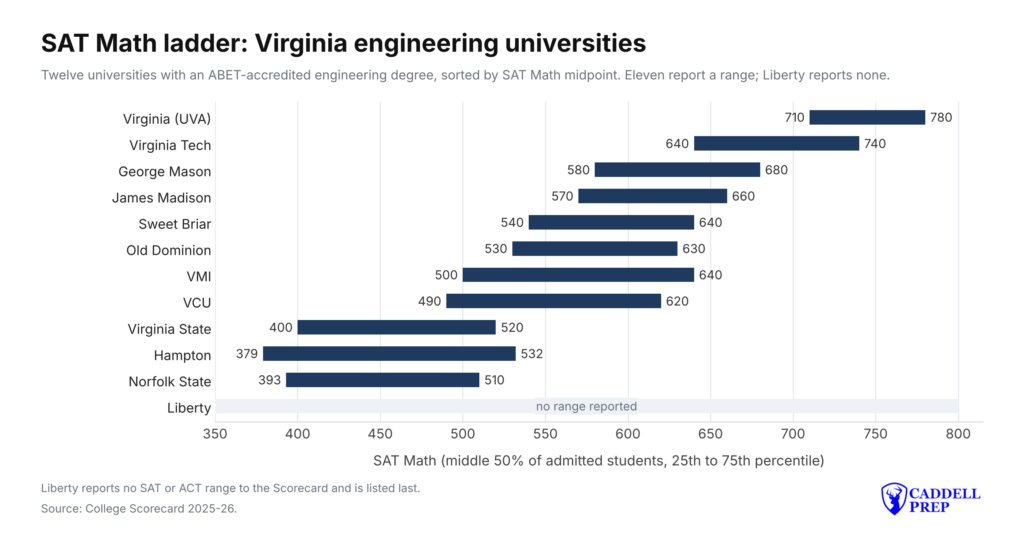
A student can see where his Math score sits on this list in the image above.
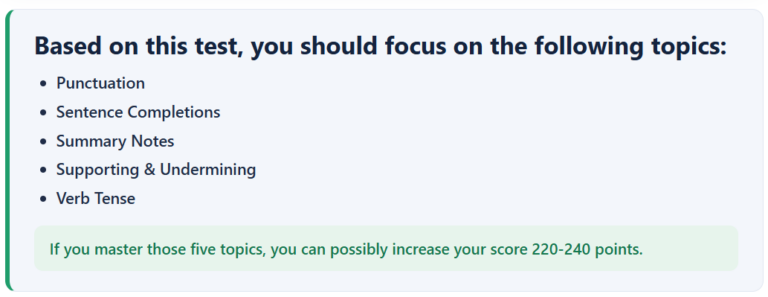
Want to Know What 5 Topics Will Improve Your SAT Score the Most?
Sample Feedback from our Diagnostic Test:
University of Virginia
The University of Virginia’s School of Engineering and Applied Science in Charlottesville holds ABET accreditation in aerospace, biomedical, chemical, civil, computer, electrical, mechanical and systems engineering [VERIFY list on abet.org], and Virginia publishes an engineering tuition that is not the Scorecard’s figure.
Reading & Writing 700 to 760, Math 710 to 780. The top quarter of admitted students scored at or above 780 on Math. Cost of attendance $39,926, with tuition and fees at $21,803 in state and $59,512 out of state in the Scorecard’s university-wide figures. 17,597 undergraduates, 17% admitted.
Virginia is the most selective school on the page by a wide margin and the only public on it with a Math floor above 700. Its engineering school’s own 2026-27 rates, $31,858 for a Virginian and $73,582 for a non-Virginian, are the next section.
Virginia Tech
Virginia Tech’s College of Engineering in Blacksburg holds ABET accreditation in disciplines including aerospace, biological systems, chemical, civil, computer, construction, electrical, industrial and systems, materials science, mechanical, mining and ocean engineering [VERIFY list on abet.org], and Virginia Tech admits first-year engineering students to General Engineering and not to a major.
Reading & Writing 640 to 710, Math 640 to 740. The top quarter of admitted students scored at or above 740 on Math. Cost of attendance $36,951, with tuition and fees at $15,948 in state and $37,764 out of state. 30,923 undergraduates, 55% admitted.
Virginia Tech is the largest campus on the page and charges a non-resident $21,748 less than the Scorecard’s figure for Virginia and $35,818 less than Virginia’s engineering rate, on a Math range 70 points lower at the floor. Its rule for entering a major is described in the next section.
George Mason University
George Mason University’s College of Engineering and Computing in Fairfax holds ABET accreditation in bioengineering, civil, computer, cyber security, electrical, mechanical and systems engineering [VERIFY on abet.org], and George Mason is the second-largest campus on the page.
Reading & Writing 580 to 680, Math 580 to 680. The top quarter of admitted students scored at or above 680 on Math. Cost of attendance $28,604, with tuition and fees at $14,220 in state and $38,688 out of state. 27,752 undergraduates, 87% admitted.
George Mason’s two section ranges are identical, 580 to 680, and it charges a non-resident $924 more than Virginia Tech on a Math range 60 points lower at both ends. It is inside the Washington Beltway’s orbit, twenty miles from the capital.
James Madison University
James Madison University’s College of Integrated Science and Engineering in Harrisonburg holds ABET accreditation for its Bachelor of Science in Engineering [VERIFY on abet.org, and remove the row if not EAC-accredited], and James Madison charges the lowest non-resident tuition among the state’s large publics.
Reading & Writing 600 to 680, Math 570 to 660. The top quarter of admitted students scored at or above 660 on Math. Cost of attendance $31,735, with tuition and fees at $14,250 in state and $31,604 out of state. 20,888 undergraduates, 72% admitted.
James Madison charges a non-resident $31,604, the lowest figure among the five publics on the page with more than 17,000 undergraduates, and its Reading & Writing floor of 600 is the third-highest on the page. It awards one general engineering degree rather than a set of disciplines.
Sweet Briar College
Sweet Briar College’s engineering program holds ABET accreditation in engineering science [VERIFY on abet.org, and remove the row if not EAC-accredited], and Sweet Briar is a women’s college of 443 students.
Reading & Writing 560 to 670, Math 540 to 640. The top quarter of admitted students scored at or above 640 on Math. Cost of attendance $43,898, with tuition and fees at $26,160 for all students. 443 undergraduates, 76% admitted.
Sweet Briar is the smallest school on any page in this series [VERIFY against drafted pages] and the only women’s college on this one, and it charges $26,160, below every public non-resident figure on the page. It is in Amherst County, north of Lynchburg.
Old Dominion University
Old Dominion University’s Batten College of Engineering and Technology in Norfolk holds ABET accreditation in civil, computer, electrical, mechanical and modeling, simulation and visualization engineering [VERIFY on abet.org], and Old Dominion is one of two accredited engineering schools in Norfolk.
Reading & Writing 570 to 650, Math 530 to 630. The top quarter of admitted students scored at or above 630 on Math. Cost of attendance $29,446, with tuition and fees at $12,750 in state and $33,780 out of state. 17,514 undergraduates, 90% admitted.
Old Dominion admits 90% and charges a non-resident $33,780, $2,176 more than James Madison for a Math range 40 points lower at the floor and 30 lower at the ceiling. Its engineering technology degrees do not count toward its row.
Virginia Military Institute
Virginia Military Institute’s engineering departments in Lexington hold ABET accreditation in civil, electrical and computer, and mechanical engineering [VERIFY on abet.org], and VMI charges a non-resident the fourth-highest public tuition in the country.
Reading & Writing 550 to 630, Math 500 to 640. The top quarter of admitted students scored at or above 640 on Math. Cost of attendance $34,824, with tuition and fees at $21,046 in state and $52,638 out of state. 1,527 undergraduates, 71% admitted.
VMI is a public military college whose every student is a cadet, founded in 1839 as the first state military college in the country [VERIFY on vmi.edu], and its non-resident figure is described in the next section. Its resident figure of $21,046 is the second-highest on the page.
Virginia Commonwealth University
Virginia Commonwealth University’s College of Engineering in Richmond holds ABET accreditation in biomedical, chemical, computer, electrical and mechanical engineering [VERIFY on abet.org], and VCU is the least selective reporting school on the page.
Reading & Writing 520 to 650, Math 490 to 620. The top quarter of admitted students scored at or above 620 on Math. Cost of attendance $38,954, with tuition and fees at $16,945 in state and $40,109 out of state. 20,753 undergraduates, 93% admitted.
VCU admits 93% and charges a non-resident $40,109, more than Virginia Tech or George Mason, on the lowest Math range among the large publics. Its cost of attendance is the second-highest among the publics on the page.
Virginia State University
Virginia State University’s College of Engineering and Technology in Petersburg holds ABET accreditation in computer and manufacturing engineering [VERIFY on abet.org], and Virginia State charges the lowest resident tuition on the page.
Reading & Writing 440 to 550, Math 400 to 520. The top quarter of admitted students scored at or above 520 on Math. Cost of attendance $27,661, with tuition and fees at $10,043 in state and $22,650 out of state. 5,074 undergraduates, 89% admitted.
Virginia State is the state’s land-grant historically Black university, one of three Virginia HBCUs with accredited engineering, and it charges a resident $10,043 and a non-resident $22,650, the lowest public figures on the page in both columns. It is one of the three institutions the state exempts from its non-resident enrollment cap.
Hampton University
Hampton University’s School of Engineering, Architecture and Aviation holds ABET accreditation in chemical and electrical engineering [VERIFY on abet.org], and Hampton is the one private historically Black university on the page.
Reading & Writing 411 to 558, Math 379 to 532. The top quarter of admitted students scored at or above 532 on Math. Cost of attendance $46,027, with tuition and fees at $30,592 for all students. 3,727 undergraduates, 62% admitted.
Hampton admits 62%, the third-lowest rate on the page, and charges $30,592, below what Old Dominion across the water charges a non-resident. Its odd-numbered percentiles are printed as the Scorecard reports them.
Norfolk State University
Norfolk State University’s College of Engineering in Norfolk holds ABET accreditation in electronics engineering and optical engineering [VERIFY on abet.org], and Norfolk State holds the only accredited optical engineering degree on these pages [VERIFY].
Reading & Writing 430 to 520, Math 393 to 510. The top quarter of admitted students scored at or above 510 on Math. Cost of attendance $26,633, with tuition and fees at $10,180 in state and $21,682 out of state. 5,392 undergraduates, 88% admitted.
Norfolk State is the second of Norfolk’s two accredited engineering schools, two miles from Old Dominion, and it charges a non-resident $21,682, the lowest public figure on the page. It is exempt from the state’s non-resident enrollment cap.
Liberty University
Liberty University’s School of Engineering in Lynchburg holds ABET accreditation in civil, computer, electrical, industrial and systems, and mechanical engineering [VERIFY on abet.org, and remove the row if not EAC-accredited], and Liberty reports no admitted score range.
Cost of attendance $42,025, with tuition and fees at $22,465 for all students. 50,012 undergraduates, including online students, 99% admitted.
Liberty’s 50,012 undergraduates include its online enrollment, so the figure is not compared with the campuses on this page. It admits 99% and charges $22,465, and it reports no SAT or ACT range to the Scorecard.
Eleven ranges and one blank say who got in. At the school at the top of the table, the price in the Scorecard is not the price, and the next section is about the one that is.
What Does the University of Virginia Charge an Engineering Student?
The University of Virginia charges an engineering student $31,858 a year in tuition and fees as a Virginian and $73,582 as a non-Virginian for 2026-27, in every year of the program.
The figures are the university’s own. Its Student Financial Services page lists, for the School of Engineering, tuition of $27,906 and fees of $3,952 for a Virginian and tuition of $68,948 and fees of $4,634 for a non-Virginian, the same in the first year and every year after, approved by the Board of Visitors on April 16, 2026. The same page lists the College of Arts and Sciences at $20,782 for a Virginian first-year and $62,054 for a non-Virginian first-year. An engineering student pays $11,076 more than an Arts and Sciences first-year as a Virginian and $11,528 more as a non-Virginian.
The Scorecard reports one pair of figures for the university, $21,803 and $59,512, and those are 2025-26 averages across every school. A New York family reading $59,512 and planning on engineering is $14,070 short.
The state wrote the rule the price follows. Virginia’s Appropriation Act, in the section that governs the universities, requires that tuition and fees for non-resident students “cover at least 100 percent of the average cost of their education,” and it directs boards that they “shall not increase the current proportion of nonresident undergraduate students” where that proportion exceeds 25 percent, with Norfolk State, VMI and Virginia State exempt [VERIFY the current biennium carries the same text]. A non-resident seat at Virginia is therefore capped in number and priced at full cost by law, and an engineering seat costs more because the school costs more to run.
Set the figure in the series. On our page on engineering colleges in Michigan, a non-resident in Michigan Engineering pays $67,488 a year in his lower-division years and $75,718 in his upper-division years under the proposed fall 2026 rates. Virginia’s $73,582 sits between them, above Michigan’s first two years and below its last two, and it is above MIT’s $62,396 on our page on engineering colleges in Massachusetts and above Washington and Lee’s $68,045 down the road in Lexington. On the resident side, $31,858 is the highest resident engineering figure on these pages, $8,847 above Temple’s $23,011 at the head of the chain on our page on engineering colleges in Pennsylvania.
| Rate | Virginian | Non-Virginian |
|---|---|---|
| Virginia, School of Engineering, 2026-27 | $31,858 | $73,582 |
| Virginia, Arts and Sciences first-year, 2026-27 | $20,782 | $62,054 |
| Virginia, Scorecard university-wide, 2025-26 | $21,803 | $59,512 |
| Virginia Tech, Scorecard, 2025-26 | $15,948 | $37,764 |
| Michigan Engineering, upper division, fall 2026 | $26,022 | $75,718 |
| MIT, 2025-26 | $62,396 | $62,396 |
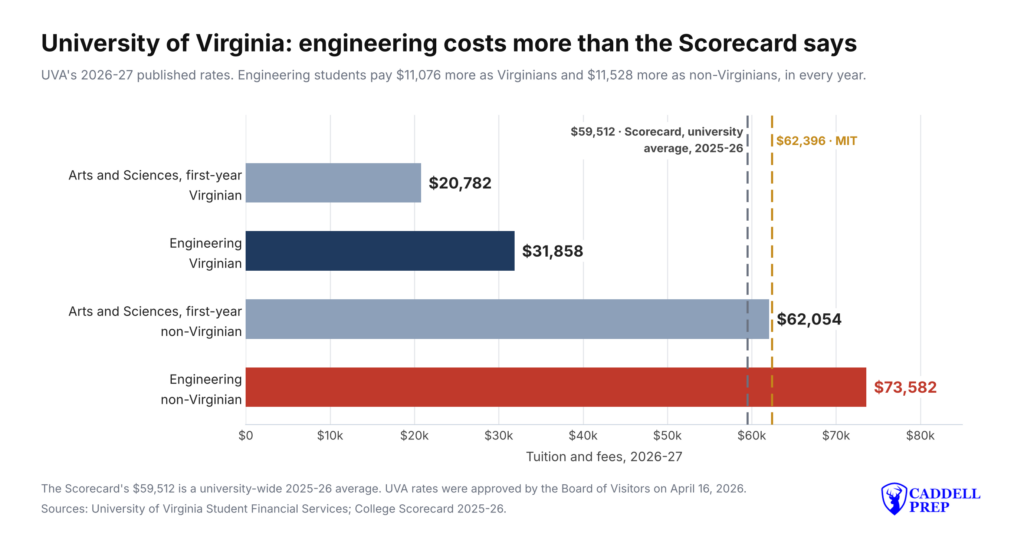
The image above puts Virginia’s four published rates beside the Scorecard’s one figure and MIT’s.
Take a New York student with a 720 on SAT Math. At Virginia he is in the lower half of 710 to 780, admitted at 17% if at all, and pays $73,582 for engineering in 2026-27 before aid. At Virginia Tech he is in the upper half of 640 to 740 and pays $37,764. At George Mason he is 40 points above the ceiling of 580 to 680 and pays $38,688. At James Madison he is 60 above the ceiling of 570 to 660 and pays $31,604. At VMI he is 80 above the ceiling of 500 to 640, pays $52,638, and spends four years in the Corps. At Old Dominion he is 90 above the ceiling of 530 to 630 and pays $33,780. The spread from James Madison to Virginia is $41,978 a year, and the school at the top of it is the one whose Scorecard figure understates its engineering price by $14,070.
VMI’s number is the law’s other half. VMI charges a non-resident $52,638 in the Scorecard, the fourth-highest public figure in the country after Michigan’s $60,946, Virginia’s $59,512 and William & Mary’s $51,038, and William & Mary awards no engineering degree. VMI is one of the three Virginia institutions the Appropriation Act exempts from the non-resident proportion cap, so it may enroll as many non-residents as it chooses and charges each of them $52,638 for an accredited civil, electrical and computer, or mechanical engineering degree in uniform. The Citadel, on our South Carolina page, and Norwich, on our Vermont page, are the other senior military colleges on these pages, and VMI is the oldest state one.
Virginia Tech’s number is a gate inside the college. Virginia Tech admits first-year engineering students to General Engineering, and a student enters a restricted major after ENGE 1215 and 1216, MATH 1225 and 1226 and ENGL 1105, with at least 12 graded hours at Virginia Tech, a minimum overall GPA of 2.0, and a guarantee at 3.0. In the college’s words, most engineering majors accept students below the guarantee, and aerospace and mechanical engineering have historically been the exceptions. A student with a 720 who wants mechanical engineering at Blacksburg is reading a 3.0, and the shape of that gate is the one on our page on engineering colleges in Texas, where Texas A&M’s automatic line is 3.75.
The third number is a count. Three Virginia universities on this page are historically Black institutions with accredited engineering degrees: Hampton, with chemical and electrical engineering, Norfolk State, with electronics and optical engineering, and Virginia State, with computer and manufacturing engineering. No other state on these pages has three [VERIFY against the Alabama, Texas and Maryland drafts]. Virginia State charges a resident $10,043 and Norfolk State $10,180, the two lowest resident figures on the page, and both are exempt from the non-resident cap, with non-resident figures of $22,650 and $21,682 that are the two lowest public figures on the page in that column too.
The honest version is that $73,582 is a 2026-27 figure and the Scorecard’s are 2025-26, and the page gives each with its year and source. Virginia says it “meets 100% of demonstrated financial need for all eligible undergraduate students,” “whether you are a Virginian or from out-of-state,” so a New York family’s net price may be far below the sticker, and the income-based AccessUVA commitments are for in-state students only. Virginia admits 17% on a Math floor of 710, and the engineering school admits by school at the door [VERIFY direct admission to SEAS]. The non-resident cap explains why the seats are scarce and expensive at once. And the page does not say the price is wrong. It says what the state’s law requires and what the university publishes, and that Michigan’s upper division is the one figure on these pages above it.
Families who have read the Scorecard’s figure frequently ask whether it is the engineering figure.
Does the University of Virginia Charge Engineering Students More Than Other Students?
The University of Virginia charges engineering students more than other students. For 2026-27 an engineering student pays $31,858 as a Virginian against $20,782 for an Arts and Sciences first-year, and $73,582 as a non-Virginian against $62,054, $11,076 and $11,528 more, in every year of the engineering program.
The Scorecard’s $21,803 and $59,512 are averages across the university’s schools, and an engineering applicant should read the school’s own page and not the average.
The price is Virginia’s. The degrees are what the next section lists.
Which Virginia Universities Have ABET-Accredited Engineering Schools?
Twelve Virginia universities hold ABET-accredited engineering bachelor’s degrees, nine public and three private, and all twelve are in the table above.
In Charlottesville, Virginia’s School of Engineering and Applied Science. In Blacksburg, Virginia Tech’s College of Engineering, the state’s largest. In Fairfax, George Mason’s College of Engineering and Computing, twenty miles from Washington. In Harrisonburg, James Madison. In Norfolk, Old Dominion’s Batten College and Norfolk State’s College of Engineering, two miles apart, with Hampton across the water. In Lexington, VMI. In Richmond, VCU. In Petersburg, Virginia State. In Lynchburg, Liberty, and north of it, Sweet Briar.
Accreditation matters for a reason that is easy to miss at seventeen. Licensure as a professional engineer normally requires a degree from an ABET-accredited engineering program, and that is why Old Dominion’s engineering technology degrees do not count toward its row and why Washington and Lee’s engineering major is not on the list pending that confirmation. Christopher Newport, Richmond, Mary Washington, Radford, Longwood, UVA-Wise, Roanoke, Bridgewater, Randolph-Macon, Regent, Lynchburg, Marymount, Shenandoah, Averett, Emory & Henry, Mary Baldwin, Virginia Wesleyan and Virginia Union award no engineering degree.
Nothing on this page ranks the twelve. The table’s order is a stated, verifiable number where one exists, and the choice among accredited programs comes down to cost, discipline and where a student’s score places him.
What If Your Score Is Below the Range You Want?
In Virginia twelve schools cover Math ranges from a 379 floor to a 780 ceiling, nine of them are public, and a New York student’s price among the nine runs from $21,682 to $73,582 for engineering at the flagship. The score decides Charlottesville or not. The law decides what Charlottesville costs him.
The gap from a 720 to the upper half at Virginia is 25 points of SAT Math, two questions, and the student who closes it is in the upper half at every school on the page. The gap from a 720 to Virginia Tech’s top quarter is 20 points.
The first step is finding out where the score actually is, section by section. A free diagnostic SAT gives a score that can be set against the Math column in the table.
The Math section rewards the same handful of topics on every test date, and a student who knows which of them he is missing can close a gap of 50 to 100 points in weeks rather than months. The method is on our page on improving your SAT Math score, and the topics it covers are the ones MATH 1225 assumes.
How to Read These Score Ranges
Every range on this page covers the middle 50% of admitted students who submitted that test. The lower number is the 25th percentile and the upper number is the 75th, so a quarter of admitted students scored at or above it.
The Scorecard’s tuition is a university average, and an engineering school can publish its own. Virginia’s range describes who got into the university, and its engineering school’s rates describe what an engineering student pays there, and a student should read the range for admission and the school’s own page for the price.
Because most colleges are now test-optional, the ranges that are published describe only the students who chose to submit at all. Students with strong scores submit and students with weak ones don’t, so a published range sits higher than the range for everyone who was actually admitted. More on what SAT score you need for college and on test-optional colleges.
Should You Take the ACT Instead?
Virginia gives neither the SAT nor the ACT as a statewide test [VERIFY with the Virginia Department of Education], and eleven of the twelve universities on this page report an SAT range while nine report an ACT range.
That is why the table carries SAT columns and is sorted by Math. All twelve universities accept either test, and a student who holds an ACT should convert it and read the same columns.
Engineering Programs in Nearby States
Virginia borders Maryland, North Carolina, Tennessee, Kentucky and West Virginia, and Washington sits on its northern line.
See engineering colleges in Maryland, engineering colleges in North Carolina, and engineering colleges in Tennessee.
Engineering Colleges in Other States
We publish the same breakdown for engineering programs in every state.
See engineering colleges by state for the full list.

Glyn Caddell
Glyn Caddell holds a BS in Mechanical Engineering from NJIT and has been tutoring New York City students since 2008. He founded Caddell Prep in 2012 and is the author of Digital SAT Math Secrets: Lessons & Tricks to Quickly Improve to a Perfect 800 on the Math Test, which contains over 900 practice problems and is used in Caddell Prep’s SAT math classes. He is founding president of the Staten Island Technical High School alumni association and teaches every lesson on this site personally.
Finally, an SAT course that students actually understand
Every question has a video explanation. Not most — every one.
The on-demand Digital SAT course covers all 17 math topics and 15 reading and writing topics, with 5 full-length practice tests and a 100-point score increase guarantee. Keep access for the rest of high school. No subscription.
Want to Know What 5 Topics Will Improve Your SAT Score the Most?
Sample Feedback from our Diagnostic Test: