
Home » College SAT Score Ranges, Costs, and Programs by Major and State » Engineering Colleges by State: SAT Scores, ACT Scores, Costs, and ABET Programs » Engineering Colleges in Pennsylvania: SAT Scores, Costs, and Programs
By Glyn Caddell, BSME · Author of Digital SAT Math Secrets · Tutoring since 2008 — Updated October 25, 2026
Twenty-three Pennsylvania universities offer ABET-accredited engineering degrees, and this page lists what they cost and the test scores of the students they admit.
A Pennsylvania resident pays more for a public engineering degree than a resident of any other state in this series, because three of the state’s four public engineering universities are not owned by the state, and the one that is charges a New Yorker less than the other three charge a Pennsylvanian.
SAT scores are given by section rather than as a total, because a student at 700 Reading & Writing and 600 Math is in a different position from a student at 600 and 700.
Table of Contents
- Pennsylvania Engineering Colleges by SAT Score
- Why Does a Pennsylvania Resident Pay More for Public Engineering Than Anyone Else?
- Which Pennsylvania Universities Have ABET-Accredited Engineering Schools?
- What If Your Score Is Below the Range You Want?
Pennsylvania Engineering Colleges by SAT Score
The twenty-three universities below are the ones in Pennsylvania that hold an ABET-accredited bachelor’s degree in an engineering discipline. The seventeen that report SAT ranges are sorted by the midpoint of the Math range, so the order can be checked from the table itself, and the six that do not are listed last in alphabetical order.
| College | SAT Reading & Writing | SAT Math | Cost of attendance | Undergraduates | Admit rate |
|---|---|---|---|---|---|
| University of Pennsylvania | 740 to 770 | 770 to 800 | $89,028 | 10,650 | 5% |
| Carnegie Mellon University | 730 to 770 | 770 to 800 | $83,654 | 7,304 | 12% |
| Swarthmore College | 740 to 770 | 750 to 790 | $84,103 | 1,613 | 7% |
| Villanova University | 685 to 740 | 710 to 770 | $84,793 | 6,938 | 27% |
| Lehigh University | 680 to 730 | 690 to 770 | $80,856 | 5,898 | 26% |
| Lafayette College | 670 to 740 | 680 to 760 | $83,133 | 2,757 | 31% |
| Bucknell University | 650 to 730 | 660 to 740 | $83,756 | 3,876 | 29% |
| University of Pittsburgh | 640 to 720 | 640 to 740 | $38,105 | 20,370 | 58% |
| Drexel University | 620 to 700 | 620 to 740 | $76,835 | 13,233 | 79% |
| Pennsylvania State University | 620 to 700 | 620 to 720 | $39,694 | 42,284 | 61% |
| Duquesne University | 600 to 670 | 580 to 670 | $67,776 | 5,350 | 84% |
| Grove City College | 583 to 703 | 558 to 685 | Not reported | 2,216 | 72% |
| Messiah University | 570 to 680 | 540 to 670 | $55,875 | 2,259 | 79% |
| Elizabethtown College | 560 to 660 | 545 to 650 | $50,865 | 1,868 | 78% |
| Widener University | 550 to 650 | 530 to 640 | $70,621 | 2,951 | 71% |
| York College of Pennsylvania | 520 to 640 | 500 to 630 | $37,319 | 3,265 | 74% |
| Wilkes University | 530 to 630 | 490 to 620 | $56,765 | 1,985 | 91% |
| Gannon University | Does not report SAT data | Does not report SAT data | $52,869 | 2,365 | 74% |
| Geneva College | Does not report SAT data | Does not report SAT data | $45,407 | 1,096 | Not reported |
| Point Park University | Does not report SAT data | Does not report SAT data | $52,643 | 2,331 | 97% |
| Robert Morris University | Does not report SAT data | Does not report SAT data | $51,621 | 2,896 | 90% |
| Shippensburg University | Does not report SAT data | Does not report SAT data | $30,785 | 4,086 | 86% |
| Temple University | Does not report SAT data | Does not report SAT data | $40,903 | 20,970 | 80% |
Each range covers the middle 50% of admitted students who submitted that test. A quarter scored below the lower number, and the top quarter scored at or above the upper one. Being under the lower number does not rule a student out, and being just above it is not as safe as it looks.
Penn and Carnegie Mellon share a Math range and are ordered by the Reading & Writing midpoint. Only universities with an ABET-accredited engineering bachelor’s degree are listed. Penn State’s other campuses award Penn State degrees and are counted under Penn State. Pitt-Johnstown’s and PennWest’s engineering technology degrees are accredited under a separate ABET commission and do not qualify them for the list. Grove City reports no cost of attendance to the Scorecard because it takes no federal aid. Shippensburg reports an ACT range and no SAT range. Gannon, Geneva, Point Park, Robert Morris, Shippensburg and Temple are listed last in alphabetical order.
Three things about that table are worth pausing on.
A Pennsylvania resident pays $23,011 in tuition and fees at Temple, $21,926 at Pitt and $20,644 at Penn State, the first, second and fifth highest resident figures at a public engineering school in this series, and a New York student pays Shippensburg $15,974. The next section is about why.
Penn and Carnegie Mellon report the same Math range, 770 to 800, so the top quarter of admitted students at both scored a perfect 800. Swarthmore, a liberal arts college of 1,613 students, holds an accredited engineering degree on a Math range of 750 to 790 and a 7% admit rate.
Penn State, at 42,284 undergraduates, is the second-largest university in this series after Ohio State, and Grove City, at $21,700 for every student, is the only private on the page that charges every student less than Pitt or Temple charges a Pennsylvanian.
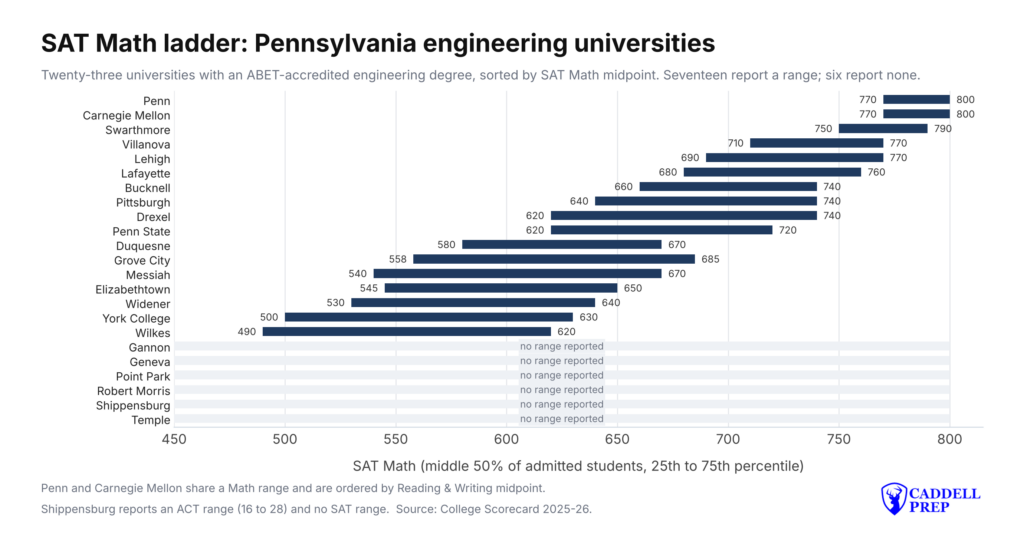
A student can see where his Math score sits on this list in the image above.
Want to Know What 5 Topics Will Improve Your SAT Score the Most?
Sample Feedback from our Diagnostic Test:

University of Pennsylvania
The University of Pennsylvania’s School of Engineering and Applied Science holds ABET accreditation in bioengineering, chemical and biomolecular, computer, electrical, materials science, mechanical, and systems engineering [VERIFY on abet.org], and Penn is the most selective school on the page.
Reading & Writing 740 to 770, Math 770 to 800. The top quarter of admitted students scored 800 on Math. Cost of attendance $89,028, with tuition and fees at $68,686 for all students. 10,650 undergraduates, 5% admitted.
Penn admits one applicant in twenty, has the highest cost of attendance on the page, and shares its Math range with Carnegie Mellon. It is listed first on a Reading & Writing midpoint of 755 to 750.
Carnegie Mellon University
Carnegie Mellon University’s College of Engineering in Pittsburgh holds ABET accreditation in chemical, civil, electrical and computer, materials science, and mechanical engineering [VERIFY on abet.org], and Carnegie Mellon’s Math floor of 770 is the highest on the page, tied with Penn’s.
Reading & Writing 730 to 770, Math 770 to 800. The top quarter of admitted students scored 800 on Math. Cost of attendance $83,654, with tuition and fees at $66,246 for all students. 7,304 undergraduates, 12% admitted.
Carnegie Mellon admits 12%, more than twice Penn’s rate, on the same Math range. Its cost of attendance is $5,374 below Penn’s.
Swarthmore College
Swarthmore College’s Department of Engineering holds ABET accreditation for its Bachelor of Science in Engineering [VERIFY on abet.org], and Swarthmore is the smallest school on the page with a Math floor above 700.
Reading & Writing 740 to 770, Math 750 to 790. The top quarter of admitted students scored at or above 790 on Math. Cost of attendance $84,103, with tuition and fees at $65,494 for all students. 1,613 undergraduates, 7% admitted.
Swarthmore is a liberal arts college that awards an accredited engineering degree, one of the few in the country that does, and it is the second most selective school on the page. Its Reading & Writing range matches Penn’s exactly.
Villanova University
Villanova University’s College of Engineering holds ABET accreditation in chemical, civil, computer, electrical and mechanical engineering [VERIFY on abet.org], and Villanova has the highest Math floor on the page after Penn, Carnegie Mellon and Swarthmore.
Reading & Writing 685 to 740, Math 710 to 770. The top quarter of admitted students scored at or above 770 on Math. Cost of attendance $84,793, with tuition and fees at $67,776 for all students. 6,938 undergraduates, 27% admitted.
Villanova is an Augustinian Catholic university on the Main Line whose Math range sits 20 points above Lehigh’s at the floor and even with it at the ceiling. It admits 27%, one point above Lehigh.
Lehigh University
Lehigh University’s P.C. Rossin College of Engineering and Applied Science in Bethlehem holds ABET accreditation in disciplines including bioengineering, chemical, civil, computer, electrical, environmental, industrial and systems, materials science, and mechanical engineering [VERIFY on abet.org], and Lehigh has the lowest cost of attendance among the seven schools at the top of the table.
Reading & Writing 680 to 730, Math 690 to 770. The top quarter of admitted students scored at or above 770 on Math. Cost of attendance $80,856, with tuition and fees at $64,980 for all students. 5,898 undergraduates, 26% admitted.
Lehigh’s Math ceiling of 770 ties Villanova’s, and its cost of attendance is the lowest of the seven schools above Pitt in the table, $3,937 below Villanova’s. Bethlehem Steel’s former headquarters is across the river from campus.
Lafayette College
Lafayette College’s engineering division in Easton holds ABET accreditation in chemical, civil, electrical and computer, and mechanical engineering [VERIFY on abet.org], and Lafayette is the second liberal arts college on the page with accredited engineering degrees.
Reading & Writing 670 to 740, Math 680 to 760. The top quarter of admitted students scored at or above 760 on Math. Cost of attendance $83,133, with tuition and fees at $65,398 for all students. 2,757 undergraduates, 31% admitted.
Lafayette is fifteen miles from Lehigh and admits 31% on a Math range 10 points below Lehigh’s at both ends. Its Reading & Writing ceiling of 740 is the highest on the page outside the top three.
Bucknell University
Bucknell University’s College of Engineering in Lewisburg holds ABET accreditation in biomedical, chemical, civil, computer, electrical, environmental and mechanical engineering [VERIFY on abet.org], and Bucknell is the third liberal arts institution on the page with an engineering college.
Reading & Writing 650 to 730, Math 660 to 740. The top quarter of admitted students scored at or above 740 on Math. Cost of attendance $83,756, with tuition and fees at $67,812 for all students. 3,876 undergraduates, 29% admitted.
Bucknell charges the second-highest tuition on the page, $874 below Penn’s, and its Math ceiling of 740 is shared with Pitt and Drexel. It is on the Susquehanna, three hours from Philadelphia.
University of Pittsburgh
The University of Pittsburgh’s Swanson School of Engineering holds ABET accreditation in bioengineering, chemical, civil, computer, electrical, environmental, industrial, materials science, and mechanical engineering [VERIFY on abet.org], and Pitt charges a Pennsylvania resident the second-highest public tuition in this series.
Reading & Writing 640 to 720, Math 640 to 740. The top quarter of admitted students scored at or above 740 on Math. Cost of attendance $38,105, with tuition and fees at $21,926 in state and $41,430 out of state. 20,370 undergraduates, 58% admitted.
Pitt is the most selective public on the page and has the highest Math range of the four, and its resident price is explained in the next section. Its non-resident tuition is $360 below Penn State’s.
Drexel University
Drexel University’s College of Engineering in Philadelphia holds ABET accreditation in disciplines including architectural, chemical, civil, computer, electrical, environmental, materials science, and mechanical engineering [VERIFY on abet.org], and Drexel builds its engineering degree around a five-year plan with three six-month co-ops.
Reading & Writing 620 to 700, Math 620 to 740. The top quarter of admitted students scored at or above 740 on Math. Cost of attendance $76,835, with tuition and fees at $62,412 for all students. 13,233 undergraduates, 79% admitted.
Drexel is the fourth-largest school on the page and the largest private, and its Math range is the widest among the ten schools above Duquesne, 120 points. Its co-op is dated in the next section.
Pennsylvania State University
Pennsylvania State University’s College of Engineering at University Park holds ABET accreditation in disciplines including aerospace, architectural, biological, biomedical, chemical, civil, computer, electrical, engineering science, industrial, mechanical and nuclear engineering [VERIFY on abet.org], and Penn State admits first-year students to the college and not to the major.
Reading & Writing 620 to 700, Math 620 to 720. The top quarter of admitted students scored at or above 720 on Math. Cost of attendance $39,694, with tuition and fees at $20,644 in state and $41,790 out of state. 42,284 undergraduates, 61% admitted.
Penn State is the largest school on the page by a factor of two over Temple, the second-largest university in this series, and the holder of the highest non-resident tuition among the four publics. Its entrance-to-major rule is described in the next section.
Duquesne University
Duquesne University’s School of Science and Engineering in Pittsburgh holds ABET accreditation in biomedical engineering [VERIFY on abet.org, and remove the row if the degree is not EAC-accredited], and Duquesne is on this page for that one degree.
Reading & Writing 600 to 670, Math 580 to 670. The top quarter of admitted students scored at or above 670 on Math. Cost of attendance $67,776, with tuition and fees at $48,986 for all students. 5,350 undergraduates, 84% admitted.
Duquesne is a Catholic university of the Spiritan order on a bluff above downtown Pittsburgh, and its Reading & Writing floor sits 20 points above its Math floor. Its cost of attendance matches Villanova’s tuition figure to the dollar, $67,776.
Grove City College
Grove City College’s engineering programs hold ABET accreditation in electrical and mechanical engineering [VERIFY on abet.org], and Grove City is the only school on this page that reports no cost of attendance to the Scorecard.
Reading & Writing 583 to 703, Math 558 to 685. The top quarter of admitted students scored at or above 685 on Math. Cost of attendance not reported to the Scorecard, with tuition and fees at $21,700 for all students. 2,216 undergraduates, 72% admitted.
Grove City takes no federal student aid, so the Scorecard carries no cost of attendance for it, and its tuition of $21,700 is the lowest of any private on the page by $3,888. Its odd-numbered percentiles are printed as the Scorecard reports them.
Messiah University
Messiah University’s engineering department in Mechanicsburg holds ABET accreditation for its Bachelor of Science in Engineering [VERIFY degree name and concentrations on abet.org], and Messiah has a Math range 130 points wide, from 540 to 670.
Reading & Writing 570 to 680, Math 540 to 670. The top quarter of admitted students scored at or above 670 on Math. Cost of attendance $55,875, with tuition and fees at $42,240 for all students. 2,259 undergraduates, 79% admitted.
Messiah is a Christian university outside Harrisburg whose Math ceiling of 670 matches Duquesne’s on a floor 40 points lower. It admits 79%, the same rate as Drexel.
Elizabethtown College
Elizabethtown College’s engineering program holds ABET accreditation for its Bachelor of Science in Engineering [VERIFY on abet.org], and Elizabethtown is the least expensive private on the page after Grove City and York by cost of attendance.
Reading & Writing 560 to 660, Math 545 to 650. The top quarter of admitted students scored at or above 650 on Math. Cost of attendance $50,865, with tuition and fees at $37,950 for all students. 1,868 undergraduates, 78% admitted.
Elizabethtown is in Lancaster County, and its Math floor of 545 is printed as reported. Its cost of attendance is $5,010 below Messiah’s.
Widener University
Widener University’s School of Engineering in Chester holds ABET accreditation in biomedical, chemical, civil, electrical, mechanical and robotics engineering [VERIFY on abet.org], and Widener has the highest cost of attendance on the page among schools with a Math ceiling below 700.
Reading & Writing 550 to 650, Math 530 to 640. The top quarter of admitted students scored at or above 640 on Math. Cost of attendance $70,621, with tuition and fees at $55,730 for all students. 2,951 undergraduates, 71% admitted.
Widener is the former Pennsylvania Military College, ten miles south of Philadelphia, and its cost of attendance is $19,756 more than Elizabethtown’s for a Math range 10 points lower at both ends.
York College of Pennsylvania
York College of Pennsylvania’s Kinsley School of Engineering, Sciences and Technology holds ABET accreditation in civil, computer, electrical and mechanical engineering [VERIFY on abet.org], and York has a lower cost of attendance than Pitt.
Reading & Writing 520 to 640, Math 500 to 630. The top quarter of admitted students scored at or above 630 on Math. Cost of attendance $37,319, with tuition and fees at $25,588 for all students. 3,265 undergraduates, 74% admitted.
York is a private college whose cost of attendance, $37,319, is $786 below Pitt’s and $2,375 below Penn State’s, and whose tuition is the second-lowest private figure on the page. Its engineering students complete a required co-op.
Wilkes University
Wilkes University’s engineering programs in Wilkes-Barre hold ABET accreditation in electrical, environmental and mechanical engineering [VERIFY on abet.org], and Wilkes has the lowest Math floor among the reporting schools, 490.
Reading & Writing 530 to 630, Math 490 to 620. The top quarter of admitted students scored at or above 620 on Math. Cost of attendance $56,765, with tuition and fees at $43,496 for all students. 1,985 undergraduates, 91% admitted.
Wilkes admits 91% of applicants, the highest rate among the seventeen reporting schools, and its Math range is 130 points wide. Its Reading & Writing floor is 40 points above its Math floor.
Gannon University
Gannon University’s engineering programs in Erie hold ABET accreditation in biomedical, electrical, environmental, industrial, mechanical and software engineering [VERIFY on abet.org], and Gannon reports no admitted score range.
Cost of attendance $52,869, with tuition and fees at $40,656 for all students. 2,365 undergraduates, 74% admitted.
Gannon is a Catholic university on Lake Erie, the only school on the page in the state’s northwest corner other than Grove City and Geneva, and it reports no SAT or ACT range to the Scorecard.
Geneva College
Geneva College’s engineering department in Beaver Falls holds ABET accreditation for its Bachelor of Science in Engineering [VERIFY on abet.org], and Geneva reports neither a score range nor an admit rate.
Cost of attendance $45,407, with tuition and fees at $33,450 for all students. 1,096 undergraduates, admit rate not reported.
Geneva is a Reformed Presbyterian college thirty miles from Pittsburgh and the second-smallest school on the page, and the Scorecard carries no admit rate for it.
Point Park University
Point Park University’s engineering program in downtown Pittsburgh holds ABET accreditation in civil engineering [VERIFY on abet.org, and remove the row if the degree is not EAC-accredited. Its other engineering programs are technology degrees], and Point Park reports no admitted score range.
Cost of attendance $52,643, with tuition and fees at $39,570 for all students. 2,331 undergraduates, 97% admitted.
Point Park admits 97% of applicants, the highest rate on the page, and its campus is a set of downtown office buildings a few blocks from Duquesne. It reports no SAT or ACT range to the Scorecard.
Robert Morris University
Robert Morris University’s School of Engineering, Mathematics and Science in Moon Township holds ABET accreditation in biomedical, industrial, manufacturing, mechanical and software engineering [VERIFY on abet.org], and Robert Morris reports no admitted score range.
Cost of attendance $51,621, with tuition and fees at $35,970 for all students. 2,896 undergraduates, 90% admitted.
Robert Morris is near the Pittsburgh airport, charges $35,970, the fourth-lowest private tuition on the page, and reports no SAT or ACT range to the Scorecard.
Shippensburg University
Shippensburg University of Pennsylvania’s engineering programs hold ABET accreditation in civil, computer, electrical, mechanical and software engineering, and Shippensburg is the only one of Pennsylvania’s fourteen state-owned universities with an accredited engineering degree.
Shippensburg reports an ACT range of 16 to 28 and no SAT range. Cost of attendance $30,785, with tuition and fees at $13,720 in state and $15,974 out of state. 4,086 undergraduates, 86% admitted.
Shippensburg has the lowest cost of attendance on the page, the lowest tuition in both columns, and a non-resident price below what a Pennsylvanian pays at any of the other three publics. Its civil engineering degree is, in the university’s words, “the only civil engineering degree offered in the Pennsylvania State System.” The next section is about what that means.
Temple University
Temple University’s College of Engineering in Philadelphia holds ABET accreditation in bioengineering, civil, electrical, environmental and mechanical engineering [VERIFY on abet.org], and Temple charges a Pennsylvania resident the highest public tuition in this series.
Temple reports no SAT or ACT range. Cost of attendance $40,903, with tuition and fees at $23,011 in state and $38,958 out of state. 20,970 undergraduates, 80% admitted.
Temple is the second-largest school on the page and the one public that reports no range, and its resident figure of $23,011 is $9,291 more than Shippensburg’s. Its non-resident figure is the lowest of the three state-related universities.
Seventeen ranges and six blanks say who got in. Four of the twenty-three are public, and a Pennsylvania family looking at three of them is paying a price no other state’s residents pay. The next section is about why.
Why Does a Pennsylvania Resident Pay More for Public Engineering Than Anyone Else?
A Pennsylvania resident pays more for public engineering than a resident of any other state in this series because three of Pennsylvania’s four public engineering universities are state-related rather than state-owned, and the price of that word shows up in the resident column.
The figures first. Temple charges a resident $23,011, Pitt $21,926 and Penn State $20,644. Across the thirty-eight states drafted so far on these pages, those are the first, second and fifth highest resident tuition figures at any public university with an ABET-accredited engineering degree. Colorado School of Mines, at $21,914, is third, and UConn, at $21,044, is fourth. On our page on engineering colleges in New Jersey, seven public engineering schools in the series charged residents more than $17,900, three of them New Jersey’s, and no other state had more than one. Pennsylvania has three, and holds the top two.
The reason is a category of university that exists in Pennsylvania and almost nowhere else. Penn State, Pitt, Temple and Lincoln are not owned by the Commonwealth. They are “state-related,” the four members of what the state calls the Commonwealth System of Higher Education. The state appoints a share of each university’s trustees, twelve at Pitt, and gives each one an appropriation that is “non-preferred,” meaning it is not part of the general budget: each university’s funding needs its own bill, and each bill needs a two-thirds vote of the General Assembly every year. Pitt’s own page on the arrangement says state funding reduces tuition by $15,000 a year for an in-state Pitt student, and the resident figure in the table is what is left after that reduction.
The universities the Commonwealth does own are the fourteen in the Pennsylvania State System of Higher Education, and exactly one of them holds an ABET-accredited engineering degree. Shippensburg’s bachelor’s degrees in civil, computer, electrical, mechanical and software engineering are accredited by ABET, in the university’s words, and its civil engineering degree is “the only civil engineering degree offered in the Pennsylvania State System.” Shippensburg charges a Pennsylvania resident $13,720 and a student from any other state $15,974.
| University | Status | Resident | Non-resident | Difference |
|---|---|---|---|---|
| Temple University | State-related | $23,011 | $38,958 | $15,947 |
| University of Pittsburgh | State-related | $21,926 | $41,430 | $19,504 |
| Pennsylvania State University | State-related | $20,644 | $41,790 | $21,146 |
| Shippensburg University | State-owned | $13,720 | $15,974 | $2,254 |
Read the resident column against the last row. A Pennsylvanian pays Temple $9,291 more than Shippensburg, Pitt $8,206 more and Penn State $6,924 more. Then read the non-resident column against it. A New York student pays Shippensburg $15,974, $4,670 less than a Pennsylvanian pays Penn State, $5,952 less than a Pennsylvanian pays Pitt and $7,037 less than a Pennsylvanian pays Temple. The state-owned university charges an out-of-state student less than the state-related universities charge their own residents.
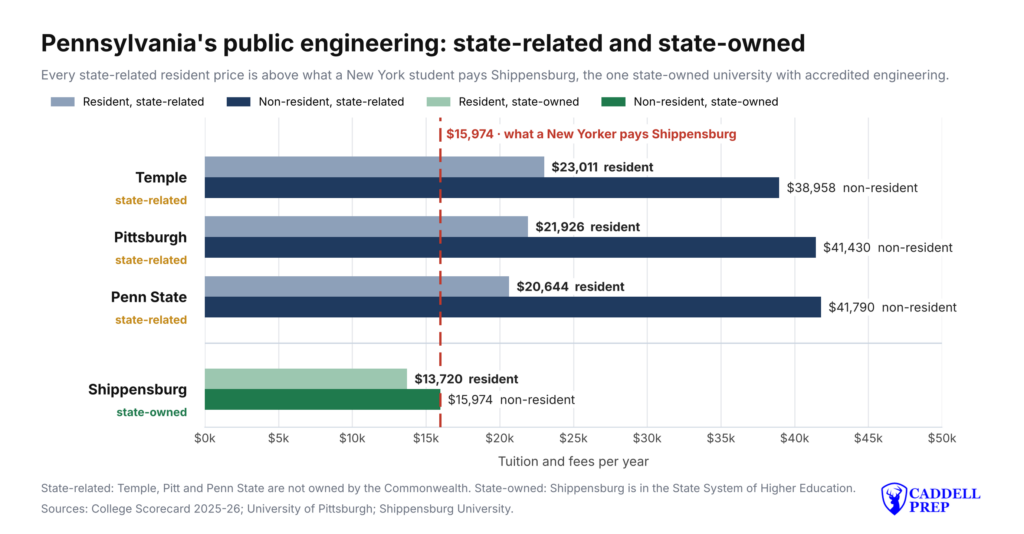
The image above shows the two kinds of public university in Pennsylvania and what each charges.
Take a New York student with a 680 on SAT Math. At Penn State he is in the upper half of 620 to 720 and pays $41,790, and he still has to enter his major, under a rule described below. At Pitt he is in the lower half of 640 to 740 and pays $41,430. At Temple there is no range to read and he pays $38,958. At Drexel he is at the middle of 620 to 740 and pays $62,412. At Lehigh he is 10 points below the floor of 690 to 770 and pays $64,980. At Shippensburg there is no SAT range to read and he pays $15,974. The three state-related universities charge him within $2,832 of one another, and each of the three charges a Pennsylvanian more than Shippensburg charges him.
Penn State’s number is a gate at the second door. The College of Engineering admits a first-year student to the college and not to a major, and the student applies to the major after 29 graded Penn State credits and, in the college’s words, “must request your major change before you have completed more than 55 graded Penn State credits.” He needs “a C or better” in CHEM 110, EDSGN 100, MATH 140, MATH 141 and PHYS 211, and a cumulative GPA “at or above the published minimum GPA for the major.” The minimum is 2.60 for most majors, including chemical, civil, electrical, industrial and nuclear engineering. It is 3.20 for aerospace engineering, computer engineering and mechanical engineering at University Park. Mechanical engineering at Penn State Scranton, the same degree, carries a 2.60. A student who is admitted to Penn State engineering with a 680 and wants mechanical engineering at University Park is not in yet. He is in a college with a 3.20 in front of him, and the shape of that gate is the one on our page on engineering colleges in Maryland, where College Park sets the number at 2.0 or 3.0 depending on the door.
Drexel’s number is a calendar. Drexel’s engineering students normally follow a five-year plan with three co-ops, each spanning two terms, about six months, and a four-year plan with one co-op exists where the major allows it. The university’s engineering co-op fast facts page puts the median co-op wage at $24.00 an hour, with a 25th percentile of $21.00 and a 75th of $26.50, and says 97% of the positions were paid. The page does not say which year those figures describe, and this page does not multiply them into a six-month total. The arrangement is the one Cincinnati invented, on our page on engineering colleges in Ohio, and Drexel has run it since 1919.
The honest version is that the resident-tuition ranking is scoped to thirty-eight drafted states and to the Scorecard’s university-wide tuition figures, which are not engineering figures. Penn State and Pitt both charge engineering students a differential above the base rate [VERIFY the current engineering differential at each], so the real resident price of engineering at both is higher than the table shows, and the ranking would only widen. Virginia is not yet drafted, and the University of Virginia’s $21,803 will sit between Pitt and Mines when it is. Shippensburg’s engineering programs are new, its civil and mechanical degrees accredited in 2024 [VERIFY the date and the retroactive coverage from the university’s release], and it reports an ACT range of 16 to 28 to the Scorecard and no SAT range. And state-related is a description of governance and funding, not a judgment of three universities that are, by score and by size, the public engineering schools of the state.
Families from outside Pennsylvania frequently ask the question underneath all of this.
Is Penn State a State University?
Penn State is a state-related university, not a state-owned one. It is one of the four members of the Commonwealth System with Pitt, Temple and Lincoln, the state appoints a share of its board, and its appropriation is “non-preferred,” passed in its own bill by a two-thirds vote of the General Assembly each year.
The fourteen state-owned universities are the Pennsylvania State System of Higher Education, and one of them, Shippensburg, awards an accredited engineering degree. A family that says “state school” and means Penn State is describing a different arrangement from the one in New York or New Jersey, and the resident tuition figure is where the difference is visible.
The price is the state’s. The degrees are what the next section lists.
Which Pennsylvania Universities Have ABET-Accredited Engineering Schools?
Twenty-three Pennsylvania universities hold ABET-accredited engineering bachelor’s degrees, four public and nineteen private, and all twenty-three are in the table above.
In Philadelphia and its suburbs, Penn’s School of Engineering and Applied Science and Drexel’s College of Engineering are a few blocks apart in University City, Temple’s College of Engineering is in North Philadelphia, Swarthmore and Widener are to the southwest, and Villanova is on the Main Line. In Pittsburgh, Carnegie Mellon’s College of Engineering and Pitt’s Swanson School are neighbors in Oakland, Duquesne and Point Park are downtown, and Robert Morris is by the airport. Lehigh’s Rossin College and Lafayette are fifteen miles apart in the Lehigh Valley. Penn State’s College of Engineering is at University Park in the center of the state, with Bucknell forty miles east on the Susquehanna, Shippensburg, Messiah, Elizabethtown and York in the south-central counties, Wilkes in the northeast, and Gannon, Grove City and Geneva in the northwest. Penn State Behrend in Erie awards a Penn State plastics engineering degree [VERIFY on abet.org], among the few accredited in the country.
Accreditation matters for a reason that is easy to miss at seventeen. Licensure as a professional engineer normally requires a degree from an ABET-accredited engineering program, and that is why Pitt-Johnstown’s and PennWest’s engineering technology degrees do not put those campuses on the list. Haverford, Bryn Mawr, Dickinson, Franklin & Marshall, Gettysburg, Muhlenberg, Ursinus, Allegheny, Juniata, Scranton, Saint Joseph’s, Lincoln and the thirteen other State System universities award no engineering degree.
Nothing on this page ranks the twenty-three. The table’s order is a stated, verifiable number where one exists, and the choice among accredited programs comes down to cost, discipline and where a student’s score places him.
What If Your Scores Are Below the Range You Want?
In Pennsylvania twenty-three schools cover Math ranges from a 490 floor to an 800 ceiling, four of them are public, and a New York student’s price among the four runs from $15,974 to $41,790. The score decides the row. The state’s structure decides what a Pennsylvanian pays, and a New Yorker pays Shippensburg less than that.
The gap from a 680 to the upper half at Pitt is 10 points of SAT Math, one question, and the student who closes it is in the upper half at both state-related universities that report a range and in the lower half at Drexel. The gap from a 680 to Lehigh’s floor is 10 points as well. The gap from a 680 to Penn’s floor of 770 is ninety points and a different page.
The first step is finding out where the score actually is, section by section. A free diagnostic SAT gives a score that can be set against the Math column in the table.
The Math section rewards the same handful of topics on every test date, and a student who knows which of them he is missing can close a gap of 50 to 100 points in weeks rather than months. The method is on our page on improving your SAT Math score, and the topics it covers are the ones MATH 140 assumes.
How to Read These Score Ranges
Every range on this page covers the middle 50% of admitted students who submitted that test. The lower number is the 25th percentile and the upper number is the 75th, so a quarter of admitted students scored at or above it. At Penn and Carnegie Mellon the upper number is 800, so the top quarter scored exactly 800.
A tuition figure on this page is a legal status made visible. The three state-related universities and the one state-owned one admit on similar terms and charge on different ones, and a student should read the resident column as a fact about Pennsylvania rather than about any one school.
Because most colleges are now test-optional, the ranges that are published describe only the students who chose to submit at all. Students with strong scores submit and students with weak ones don’t, so a published range sits higher than the range for everyone who was actually admitted. More on what SAT score you need for college and on test-optional colleges.
Should You Take the ACT Instead?
Pennsylvania gives neither the SAT nor the ACT as a statewide test, and its students normally take the SAT [VERIFY the state-test status with the Pennsylvania Department of Education]. Seventeen of the twenty-three universities on this page report an SAT range, and one, Shippensburg, reports an ACT range and no SAT range.
That is why the table carries SAT columns and is sorted by Math. All twenty-three universities accept either test, and a student who holds an ACT should convert it and read the same columns, and should read Shippensburg’s 16 to 28 directly.
Engineering Programs in Nearby States
Pennsylvania borders New York, New Jersey, Delaware, Maryland, West Virginia and Ohio, and students cross every one of those lines in both directions for engineering.
See engineering colleges in New York, engineering colleges in New Jersey, and engineering colleges in Ohio.
Engineering Colleges in Other States
We publish the same breakdown for engineering programs in every state.
See engineering colleges by state for the full list.

Glyn Caddell
Glyn Caddell holds a BS in Mechanical Engineering from NJIT and has been tutoring New York City students since 2008. He founded Caddell Prep in 2012 and is the author of Digital SAT Math Secrets: Lessons & Tricks to Quickly Improve to a Perfect 800 on the Math Test, which contains over 900 practice problems and is used in Caddell Prep’s SAT math classes. He is founding president of the Staten Island Technical High School alumni association and teaches every lesson on this site personally.
Finally, an SAT course that students actually understand
Every question has a video explanation. Not most — every one.
The on-demand Digital SAT course covers all 17 math topics and 15 reading and writing topics, with 5 full-length practice tests and a 100-point score increase guarantee. Keep access for the rest of high school. No subscription.
Want to Know What 5 Topics Will Improve Your SAT Score the Most?
Sample Feedback from our Diagnostic Test: