
Home » College SAT Score Ranges, Costs, and Programs by Major and State » Engineering Colleges by State: SAT Scores, ACT Scores, Costs, and ABET Programs » Engineering Colleges in New Jersey: SAT Scores, Costs, and Programs
By Glyn Caddell, BSME · Author of Digital SAT Math Secrets · Tutoring since 2008 — Updated October 24, 2026
Eight New Jersey universities offer ABET-accredited engineering degrees, and this page lists what they cost and the SAT scores of the students they admit.
New Jersey’s four public engineering schools charge their own residents more than any other state’s in this series, and two of them charge a New York student only a few thousand dollars more than a resident, a comparison worked out below the table.
Scores are given by section and the table is sorted by Math, with the one university that reports no range listed last.
Table of Contents
- New Jersey Engineering Colleges by SAT Math Score
- How Much Does Engineering Cost at New Jersey’s Public Universities for a Resident and for a New Yorker?
- Which New Jersey Universities Have ABET-Accredited Engineering Schools?
- What If Your Score Is Below the Range You Want?
New Jersey Engineering Colleges by SAT Math Score
The eight universities below are the ones in New Jersey that hold an ABET-accredited bachelor’s degree in an engineering discipline. The seven that report scores are sorted by the midpoint of the SAT Math range, so the order can be checked from the table itself, and the one that does not is listed last.
| College | SAT Reading & Writing | SAT Math | Cost of attendance | Undergraduates | Admit rate |
|---|---|---|---|---|---|
| Princeton University | 740 to 780 | 770 to 800 | $84,040 | 5,709 | 5% |
| Stevens Institute of Technology | 670 to 735 | 710 to 770 | $79,790 | 4,222 | 48% |
| Rutgers University-New Brunswick | 650 to 730 | 660 to 770 | $36,993 | 37,751 | 58% |
| New Jersey Institute of Technology | 600 to 710 | 610 to 750 | $32,859 | 9,019 | 65% |
| The College of New Jersey | 570 to 670 | 570 to 670 | $38,860 | 7,105 | 62% |
| Monmouth University | 580 to 660 | 560 to 650 | $62,904 | 3,684 | 89% |
| Rowan University | 560 to 660 | 550 to 650 | $35,842 | 15,841 | 78% |
| Fairleigh Dickinson University | Does not report SAT data | Does not report SAT data | $50,305 | 2,627 | 91% |
Each range covers the middle 50% of admitted students who submitted the SAT. A quarter scored below the lower number, and the top quarter scored at or above the upper one. Being under the lower number does not rule a student out, and being just above it is not as safe as it looks.
Only universities with an ABET-accredited engineering bachelor’s degree are listed. Fairleigh Dickinson’s figures are for its Metropolitan Campus in Teaneck, where its engineering degrees are taught, and it reports no SAT or ACT range to the Scorecard. Rutgers-Newark and Rutgers-Camden award no engineering degree.
Three things about that table are worth pausing on.
New Jersey’s four public universities charge residents $16,574 at Rowan, $17,929 at Rutgers, $19,632 at TCNJ and $19,974 at NJIT. Seven public engineering schools in this series so far charge residents more than $17,900, and three of the seven are New Jersey’s. No other state has more than one.
Rutgers and NJIT charge a student from New York $37,441 and $37,664, $223 apart, for two engineering schools thirty miles apart on the Turnpike. The next section is about what the other two publics charge him.
Rutgers-New Brunswick, at 37,751 undergraduates, is the second-largest university on any page in this series, behind only Michigan State, and its Math ceiling of 770 is 20 points above NJIT’s and 100 above TCNJ’s.
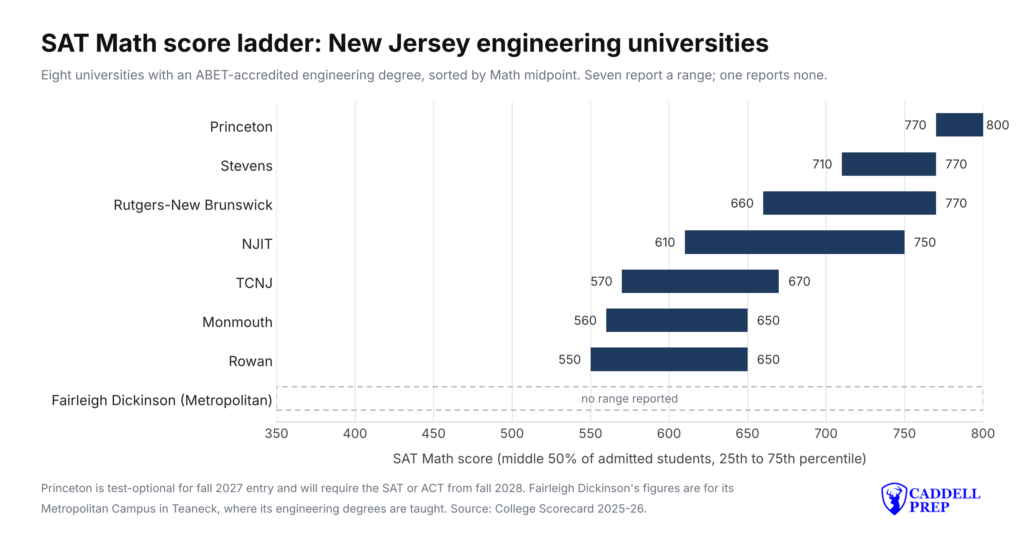
A student can see where his Math score sits on this list in the image above.
Want to Know What 5 Topics Will Improve Your SAT Score the Most?
Sample Feedback from our Diagnostic Test:

Princeton University
Princeton University’s School of Engineering and Applied Science holds ABET accreditation in disciplines including chemical and biological, civil and environmental, electrical and computer, and mechanical and aerospace engineering, and Princeton is test-optional for students entering in fall 2027 and will require an SAT or ACT from students entering in fall 2028.
Reading & Writing 740 to 780, Math 770 to 800. The top quarter of admitted students scored 800 on Math. Cost of attendance $84,040, with tuition and fees at $62,688 for all students. 5,709 undergraduates, 4.6% admitted.
Princeton is the most selective school on the page by a factor of ten and the most expensive, and the fifth school in this series whose Math floor sits at 770 or above. Its engineering degree is the Bachelor of Science in Engineering, applied to separately from the AB.
Stevens Institute of Technology
Stevens Institute of Technology’s Schaefer School of Engineering and Science in Hoboken holds ABET accreditation in disciplines including biomedical, chemical, civil, computer, electrical, environmental, mechanical, naval and software engineering, and Stevens has the second-highest Math range on the page.
Reading & Writing 670 to 735, Math 710 to 770. The top quarter of admitted students scored at or above 770 on Math. Cost of attendance $79,790, with tuition and fees at $63,462 for all students. 4,222 undergraduates, 48% admitted.
Stevens is the second-smallest reporting school on the page and the only private that admits fewer than half of its applicants other than Princeton. Its Math floor of 710 is 50 points above Rutgers’ and 100 above NJIT’s, and its tuition is $774 above Princeton’s.
Rutgers University-New Brunswick
Rutgers University’s School of Engineering in Piscataway holds ABET accreditation in disciplines including aerospace, biomedical, chemical, civil, electrical and computer, industrial and systems, materials, and mechanical engineering, and Rutgers requires every newly admitted first-year engineering student to take the university’s placement tests before his first semester is set.
Reading & Writing 650 to 730, Math 660 to 770. The top quarter of admitted students scored at or above 770 on Math. Cost of attendance $36,993, with tuition and fees at $17,929 in state and $37,441 out of state. 37,751 undergraduates, 58% admitted.
Rutgers is the largest school on the page by a factor of two and the state’s flagship, with a Math ceiling that matches Stevens’ on a floor 50 points lower. Its in-state tuition is the seventh-highest public resident charge in this series.
New Jersey Institute of Technology
New Jersey Institute of Technology’s Newark College of Engineering holds ABET accreditation in disciplines including biomedical, chemical, civil, computer, electrical, industrial and mechanical engineering, and NJIT charges the highest in-state tuition of the four New Jersey publics.
Reading & Writing 600 to 710, Math 610 to 750. The top quarter of admitted students scored at or above 750 on Math. Cost of attendance $32,859, with tuition and fees at $19,974 in state and $37,664 out of state. 9,019 undergraduates, 65% admitted.
NJIT has the lowest cost of attendance on the page, the third-highest public resident tuition in this series after Colorado School of Mines and UConn, and a Math range 140 points wide, from 610 to 750, the widest among the reporting schools. Its out-of-state tuition is $223 above Rutgers’.
The College of New Jersey
The College of New Jersey’s School of Engineering in Ewing holds ABET accreditation in biomedical, civil, computer, electrical and mechanical engineering, and TCNJ charges a student from outside New Jersey $6,120 more than a resident, the smallest difference among the state’s four public engineering schools.
Reading & Writing 570 to 670, Math 570 to 670. The top quarter of admitted students scored at or above 670 on Math. Cost of attendance $38,860, with tuition and fees at $19,632 in state and $25,752 out of state. 7,105 undergraduates, 62% admitted.
TCNJ’s two section ranges are identical, its out-of-state tuition is the lowest on the page, and its in-state tuition is the fourth-highest public resident charge in this series. The difference between the two, $6,120, is one third of Rutgers’ $19,512.
Monmouth University
Monmouth University’s Department of Computer Science and Software Engineering in West Long Branch holds ABET accreditation for its Bachelor of Science in Software Engineering, and Monmouth is on this page for that one degree.
Reading & Writing 580 to 660, Math 560 to 650. The top quarter of admitted students scored at or above 650 on Math. Cost of attendance $62,904, with tuition and fees at $46,552 for all students. 3,684 undergraduates, 89% admitted.
Monmouth is the least selective reporting school on the page and the only one whose accredited engineering degree is in software. Its Math ceiling of 650 matches Rowan’s on a floor 10 points higher.
Rowan University
Rowan University’s Henry M. Rowan College of Engineering in Glassboro holds ABET accreditation in biomedical, chemical, civil and environmental, electrical and computer, and mechanical engineering, and Rowan has the lowest in-state tuition of the four New Jersey publics.
Reading & Writing 560 to 660, Math 550 to 650. The top quarter of admitted students scored at or above 650 on Math. Cost of attendance $35,842, with tuition and fees at $16,574 in state and $26,932 out of state. 15,841 undergraduates, 78% admitted.
Rowan is the second-largest school on the page, the cheapest public for a New Jersey resident, and the second-cheapest for a New Yorker. Its Math range is the lowest among the reporting schools, 110 points under Rutgers’ at the floor.
Fairleigh Dickinson University
Fairleigh Dickinson University’s Gildart Haase School of Computer Sciences and Engineering at the Metropolitan Campus in Teaneck holds ABET accreditation in civil, electrical and mechanical engineering, and Fairleigh Dickinson reports no admitted score range.
Cost of attendance $50,305, with tuition and fees at $38,004 for all students. 2,627 undergraduates, 91% admitted.
Fairleigh Dickinson is the least selective school on the page and the smallest, and it reports no SAT or ACT range to the Scorecard.
Seven ranges and one blank say who got in. The four public universities also have two prices each, and the next section is about the gap between them.
How Much Does Engineering Cost at New Jersey's Public Universities for a Resident and for a New Yorker?
A New Jersey resident pays $16,574 a year in tuition and fees at Rowan, $17,929 at Rutgers, $19,632 at TCNJ and $19,974 at NJIT, and a New York student pays $26,932, $37,441, $25,752 and $37,664 at the same four universities.
The table below is the four publics on both prices, with the difference between them.
| University | Resident | Non-resident | Difference | Ratio |
|---|---|---|---|---|
| The College of New Jersey | $19,632 | $25,752 | $6,120 | 1.31 |
| Rowan University | $16,574 | $26,932 | $10,358 | 1.62 |
| New Jersey Institute of Technology | $19,974 | $37,664 | $17,690 | 1.89 |
| Rutgers University-New Brunswick | $17,929 | $37,441 | $19,512 | 2.09 |
Read the resident column first. Seven public engineering schools in this series so far charge their own residents more than $17,900 a year: Colorado School of Mines, UConn, NJIT, TCNJ, UNH, Michigan Tech and Rutgers. Three of the seven are New Jersey’s, no other state has more than one, and New Jersey is the only state in the series where every public engineering school charges residents more than $16,500. A Trenton family pays $19,632 for TCNJ. A Michigan family pays $17,736 for Ann Arbor, and a Maryland family $11,809 for College Park.
Now read the non-resident column. The two universities a New York student is most likely to have heard of, Rutgers and NJIT, charge him $37,441 and $37,664, $223 apart, and approximately double what a resident pays. The two he is less likely to have heard of charge him $25,752 and $26,932, and at TCNJ the whole difference between what he pays and what the student from Ewing pays is $6,120. A New York student at TCNJ’s School of Engineering pays $7,823 more than a New Jersey student pays at Rutgers, and $11,689 less than a New York student pays there.
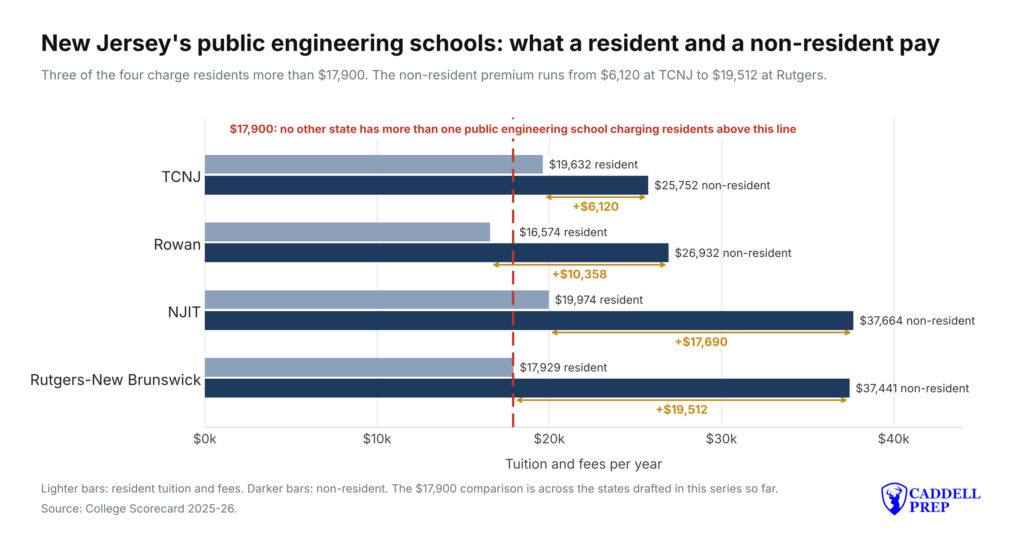
The image above shows what a New Jersey student pays and what a New York student pays for the same seat, at each of the four.
Take a Staten Island student with a 680 on Math. At Rutgers he is 20 points above the floor and pays $37,441. At NJIT he is in the upper half of the range and pays $37,664. At TCNJ he is 10 points above the ceiling and pays $25,752. At Rowan he is 30 above the ceiling and pays $26,932. At Stevens he is 30 below the floor and pays $63,462. The two universities where his score sits above the whole admitted range are the two that charge him within $7,000 of what a resident pays, and the two where he is inside the range charge him nineteen and seventeen thousand more. On our page on engineering colleges in Michigan the out-of-state premium at the flagship was more than $40,000 for an engineering junior. On our page on engineering colleges in Louisiana it was $1,500 at McNeese. New Jersey’s four sit between, and the spread among them is the point.
Three rules apply to the class this page is written for. Princeton is test-optional for students entering in fall 2027 and will require an SAT or ACT, with no minimum score and an exception for active-duty military, from the 2027-28 admission cycle, for students entering in fall 2028. The current junior class is the last Princeton class that can apply without a score. Rutgers’ School of Engineering requires all newly admitted first-year students to take the university’s placement tests, says the math test is “particularly” important because the first-semester curriculum “is entirely dependent on” the results, allows two attempts, and encourages a student under 85 on the first attempt to complete its learning modules and retake. Exemptions based on standardized tests are posted around March 1 each year. NJIT places first-year students into mathematics by its own placement test as well, and the line it uses is NJIT’s to state [VERIFY: NJIT math placement rules and any SAT Math exemption. Insert the figures or cut the sentence.].
The honest version is that the resident superlative is a comparison within this series, thirty states in, and New York, Pennsylvania and Vermont have not been drafted. TCNJ’s $6,120 premium is small by New Jersey’s standards and not by the series’ (McNeese’s is $1,500 and Central Connecticut’s $3,500). Monmouth is on the page for one accredited degree, software engineering, and Fairleigh Dickinson for three at one campus. And the price is not the range: a New Yorker at TCNJ pays $11,689 less than a New Yorker at Rutgers, and he is also applying to a school whose Math ceiling is 100 points under Rutgers’.
Families on both sides of the Hudson reading Princeton’s testing page frequently ask whether it has changed yet.
Is Princeton Still Test-Optional for Engineering Applicants?
Princeton is still test-optional for students applying in the 2026-27 cycle to enter in fall 2027. From the 2027-28 cycle, for students entering in fall 2028, Princeton will require an SAT or ACT score from every applicant other than active-duty military, with no minimum.
The current junior class is the last one that can apply to Princeton without a score, and a BSE applicant should treat the score as required anyway. The admitted Math range is 770 to 800, and an applicant without a score is asking the committee to assume one.
The four publics’ prices are the state’s. The degrees are what the next section lists.
Which New Jersey Universities Have ABET-Accredited Engineering Schools?
Eight New Jersey universities hold ABET-accredited engineering bachelor’s degrees, four public and four private, and all eight are in the table above.
In Princeton, the School of Engineering and Applied Science holds six departments’ degrees. In Hoboken, Stevens holds nine disciplines on the Hudson across from Manhattan. In Piscataway, Rutgers’ School of Engineering holds eight, with Johnson & Johnson in New Brunswick and Merck in Rahway the largest employers in the corridor. In Newark, NJIT’s Newark College of Engineering holds seven, a block from Prudential and twenty minutes from the Port. In Ewing, TCNJ holds five. In Glassboro, Rowan holds five, with Lockheed Martin in Moorestown the largest engineering employer in South Jersey. In West Long Branch, Monmouth holds software engineering. In Teaneck, Fairleigh Dickinson holds three. Nokia Bell Labs in Murray Hill and Picatinny Arsenal in Morris County hire from all eight.
Accreditation matters for a reason that is easy to miss at seventeen. Licensure as a professional engineer normally requires a degree from an ABET-accredited engineering program, and that is why Fairleigh Dickinson’s engineering technology degrees are not the programs that place it on the list. Rutgers-Newark, Rutgers-Camden, Seton Hall, Caldwell, Drew, Rider, Ramapo, Stockton, Montclair State, Kean, William Paterson, New Jersey City University and Saint Peter’s award no engineering degree.
Nothing on this page ranks the eight. The table’s order is a stated, verifiable number where one exists, and the choice among accredited programs comes down to cost, discipline and where a student’s score places him.
What If Your Scores Are Below the Range You Want?
In New Jersey the score decides which of two prices a New York student is choosing between as much as which school. A 680 is above the whole admitted range at the two publics that charge a New Yorker $25,752 and $26,932, inside the range at the two that charge him $37,441 and $37,664, and 30 points under the floor at Stevens.
The gap from a 680 to Rutgers’ midpoint of 715 or Stevens’ floor of 710 is closed by the same algebra, functions and trigonometry on every test date, and a New Jersey student who closes it is choosing among four publics that all cost him more than any other state’s. At Rutgers the next number after admission is the placement test, with two attempts, and the same material carries it.
The first step is finding out where the score actually is, section by section. A free diagnostic SAT gives a Math score that can be set against the table.
The Math section rewards the same handful of topics on every test date, and a student who knows which of them he is missing can close a gap of 50 to 100 points in weeks rather than months. The method is on our page on improving your SAT Math score, and the topics are the ones Rutgers’ placement test asks about.
How to Read These Score Ranges
Every range on this page covers the middle 50% of admitted students who submitted the SAT. The lower number is the 25th percentile and the upper number is the 75th, so a quarter of admitted students scored at or above it.
A resident price and a non-resident price are two numbers for one seat, and the gap between them is set by the state and the university, not by how selective the school is. On this page the two schools with the smallest gap are the two with the lowest ranges among the publics.
Because most colleges are now test-optional, the ranges that are published describe only the students who chose to submit at all. Students with strong scores submit and students with weak ones don’t, so a published range sits higher than the range for everyone who was actually admitted. More on what SAT score you need for college and on test-optional colleges.
Should You Take the ACT Instead?
New Jersey is an SAT state. Sixteen New Jersey institutions report an SAT range and thirteen report an ACT range, and most New Jersey students take the SAT.
All eight universities on this page accept either test, and a student should take whichever he scores higher on. From fall 2028, Princeton will require one or the other.
Engineering Programs in Nearby States
New Jersey borders New York, Pennsylvania and Delaware, and New Jersey students apply across those lines in numbers even with eight accredited programs at home, because the four publics cost them more than most other states’ do.
See engineering colleges in New York, engineering colleges in Pennsylvania, and engineering colleges in Delaware.
Engineering Colleges in Other States
We publish the same breakdown for engineering programs in every state.
See engineering colleges by state for the full list.

Glyn Caddell
Glyn Caddell holds a BS in Mechanical Engineering from NJIT and has been tutoring New York City students since 2008. He founded Caddell Prep in 2012 and is the author of Digital SAT Math Secrets: Lessons & Tricks to Quickly Improve to a Perfect 800 on the Math Test, which contains over 900 practice problems and is used in Caddell Prep’s SAT math classes. He is founding president of the Staten Island Technical High School alumni association and teaches every lesson on this site personally.
Finally, an SAT course that students actually understand
Every question has a video explanation. Not most — every one.
The on-demand Digital SAT course covers all 17 math topics and 15 reading and writing topics, with 5 full-length practice tests and a 100-point score increase guarantee. Keep access for the rest of high school. No subscription.
Want to Know What 5 Topics Will Improve Your SAT Score the Most?
Sample Feedback from our Diagnostic Test: