
Home » College SAT Score Ranges, Costs, and Programs by Major and State
By Glyn Caddell, BSME · Author of Digital SAT Math Secrets · Tutoring since 2008 — Updated September 13, 2026
This is a collection of SAT score ranges, annual costs, enrollment numbers, and program information for colleges across the United States.
It’s organized two ways. By major, because the program you’re applying to matters more than most students expect. And by state, because plenty of families are deciding how far from home they’re willing to go.
Start with whichever matters more to you. But there’s a reason the major comes first in how these pages are built, and it’s worth understanding before you compare yourself to any number.
Table of Contents
Why Look at Colleges by Major Rather Than by Name?
When a university publishes an SAT range, that range covers everyone it admitted. Every program, every school within the university, every applicant.
It is not the range for the engineering school. It is not the range for nursing. It is not the range for the honors college.
Competitive programs admit on tighter numbers than the institution as a whole, and the gap is sometimes large. A university reporting a range of 1150 to 1350 may be admitting engineering students at 1300 to 1450, and a student comparing himself to the university-wide number is looking at something that has very little to do with the decision he’s waiting on.
That works in both directions. A student applying to a program that’s less competitive than the university average may be in better shape than the headline number suggests.
So the useful question isn’t “what score does this school want.” It’s “what score does this program want.” That’s why these pages are built major first and state second.
Before you start comparing, here’s what’s actually in each one.
What Each Page Covers
Every school entry includes:
- The program. What it offers, how it’s structured, and what’s distinctive about it.
- Annual cost. In-state and out-of-state, where the school distinguishes between them.
- Total enrollment. Which tells you something about class sizes and how easy it is to get attention.
- The SAT range. The middle 50% of admitted students.
Two things to keep in mind while reading.
Costs and score ranges change every year. These are drawn from published data and they’re a starting point, not a substitute for checking the school’s own admissions page before you apply.
And the SAT range is the middle 50%, not a minimum and maximum. A quarter of admitted students scored below the lower number and a quarter scored above the upper one.
With that in mind, here’s where to start.
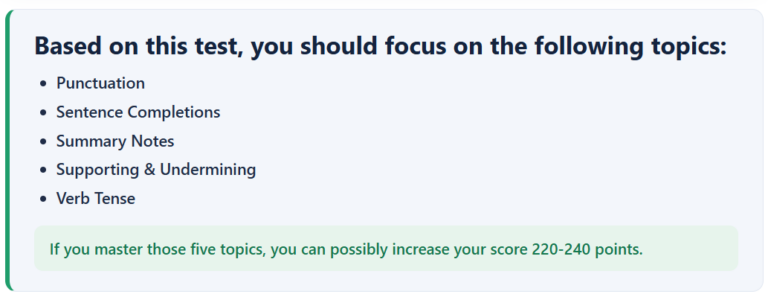
Want to Know What 5 Topics Will Improve Your SAT Score the Most?
Sample Feedback from our Diagnostic Test:
Which Major Are You Looking At?
Our deepest coverage is in the fields where program-specific admissions differ most from the university as a whole.
Pre-Med — the largest collection here, with state-by-state breakdowns. Pre-med isn’t normally a major, it’s a track, so the relevant details are advising, research access, and medical school placement rather than a department.
Architecture — also covered state by state. Architecture is an accredited professional degree, so accreditation and portfolio requirements matter as much as test scores.
Nursing — programs with their own admission processes, often more competitive than the universities holding them.
Engineering — normally the tightest score ranges at any given university.
Computer Science — admissions have tightened sharply at many schools as demand has grown.
Business — many schools admit to the business school separately from the university.
The rest of our coverage:
Biology · Finance · Accounting · Economics · Mathematics · Political Science · Liberal Arts · Information Technology
If you’re set on a field, start there. If you’re not, the other entry point may be more useful.
Or Start From a State?
Plenty of students aren’t choosing a major yet, and plenty have already decided how far from home they’re going.
The state pages cover the colleges in each state with their costs, enrollment, and score ranges, without sorting by field.
- Alabama
- Alaska
- Arizona
- Arkansas
- California
- Colorado
- Connecticut
- Delaware
- Florida
- Georgia
- Hawaii
- Idaho
- Illinois
- Indiana
- Iowa
- Kansas
- Kentucky
- Louisiana
- Maine
- Maryland
- Massachusetts
- Michigan
- Minnesota
- Mississippi
- Missouri
- Montana
- Nebraska
- Nevada
- New Hampshire
- New Jersey
- New Mexico
- New York
- North Carolina
- North Dakota
- Ohio
- Oklahoma
- Oregon
- Pennsylvania
- Rhode Island
- South Carolina
- South Dakota
- Tennessee
- Texas
- Utah
- Vermont
- Virginia
- Washington
- West Virginia
- Wisconsin
- Wyoming
Both routes end at the same place. You’ll have a list of schools and a set of numbers, and then one question.
What Score Do You Need for the Schools on Your List?
Browsing produces a list. A list produces a number. The number is the part you can still change.
Once you know which schools you’re looking at, the next step is working out where your score puts you against each one, and that turns a single score into three groups of schools rather than a verdict.
How to Turn a Score Into a School List
Compare your score to each school’s published range. Below the 25 percentile is a reach. Inside the middle 50% is a target. Above the 75 percentile is likely.
A list needs all three, and the mix depends on how much you’re willing to gamble.
More on what SAT score you need for college, including why a school’s overall range may not be the one that applies to you.
Does a Higher Score Change What You Pay?
It can, and students rarely factor this in.
Merit aid responds to test scores. Need-based aid doesn’t. And merit thresholds normally sit above admission thresholds, because aid is competitive among students who were already admitted.
So a score that turns a target school into a likely one may also turn a no-aid offer into an offer. More on SAT scores and merit scholarships.
What If the Schools You Want Are Test-Optional?
Then the published range is telling you something slightly different.
At a test-optional school, the range only includes students who chose to submit a score. Students with strong scores submit and students with weak ones don’t, so the range describes a self-selected group and sits higher than the real range for everyone admitted.
Use it as a bar for whether submitting helps, rather than as a description of who got in. More on test-optional colleges.
If the Score Needs to Move
By this point you have two numbers. The score you have and the score your list needs.
A free diagnostic SAT gives an accurate score based on College Board scoring, plus a ranked list of which of the 32 tested topics are costing you the most points. The gap tells you how far. The topic list tells you where to start.
From there, how to improve your SAT score covers the method, including how long a given improvement normally takes and why splitting your time evenly between sections is normally the wrong approach.

Glyn Caddell
Glyn Caddell holds a BS in Mechanical Engineering from NJIT and has been tutoring New York City students since 2008. He founded Caddell Prep in 2012 and is the author of Digital SAT Math Secrets: Lessons & Tricks to Quickly Improve to a Perfect 800 on the Math Test, which contains over 900 practice problems and is used in Caddell Prep’s SAT math classes. He is founding president of the Staten Island Technical High School alumni association and teaches every lesson on this site personally.
Finally, an SAT course that students actually understand
Every question has a video explanation. Not most — every one.
The on-demand Digital SAT course covers all 17 math topics and 15 reading and writing topics, with 5 full-length practice tests and a 100-point score increase guarantee. Keep access for the rest of high school. No subscription.
Want to Know What 5 Topics Will Improve Your SAT Score the Most?
Sample Feedback from our Diagnostic Test:
Best Colleges by Major
- Engineering
- Pre-Med
- Nursing
- Computer Science
- Liberal Arts
- Architecture
- Business
- Economics
- Mathematics
- Political Science
- Finance
- Biology
- Accounting
- Information Technology
Best Colleges by Type
Best Colleges by State
- Alabama
- Alaska
- Arizona
- Arkansas
- California
- Colorado
- Connecticut
- Delaware
- Florida
- Georgia
- Hawaii
- Idaho
- Illinois
- Indiana
- Iowa
- Kansas
- Kentucky
- Louisiana
- Maine
- Maryland
- Massachusetts
- Michigan
- Minnesota
- Mississippi
- Missouri
- Montana
- Nebraska
- Nevada
- New Hampshire
- New Jersey
- New Mexico
- New York
- North Carolina
- North Dakota
- Ohio
- Oklahoma
- Oregon
- Pennsylvania
- Rhode Island
- South Carolina
- South Dakota
- Tennessee
- Texas
- Utah
- Vermont
- Virginia
- Washington
- West Virginia
- Wisconsin
- Wyoming