
Home » The Digital SAT: What’s Tested, How It’s Scored, and How to Improve Your Score » SAT Scores: How Scoring Works, What’s a Good Score, and How to Raise Yours » How to Improve Your SAT Score: Study the Topics With the Most Room, Not the Weakest
By Glyn Caddell, BSME · Author of Digital SAT Math Secrets · Tutoring since 2008 — Published September 9, 2026
Improving an SAT score is a process, not a matter of studying more. Students who gain 150 points and students who gain 20 points often put in similar hours. The difference is what they spent those hours on.
The topics worth studying are the ones with the most room for improvement, and those are not the same as the topics a student is worst at. This page covers what that means, how to find your own list, and how many hours a given improvement normally takes.
Table of Contents
- Study the Topics With the Most Room, Not the Weakest Ones
- Step 1: Find Out Where Your Points Are Going
- Step 2: Decide Which Section to Work On First
- Step 3: Put In the Hours, and Know What Counts
- Step 4: Retest and Reprioritize
- Why the Last 50 Points Cost More Than the First 50
- Which Guide Should You Read Next?
Study the Topics With the Most Room, Not the Weakest Ones
Students are normally told to work on what they’re worst at. For the SAT, that’s the wrong instruction.
The points available in a topic depend on two things: how weak you are in it, and how often it appears on the test. Multiply them, don’t look at either one alone.
Here’s what that looks like with real numbers.
Linear functions is 15% of the math questions, so approximately 7 questions out of 44. Exponents is 1.3%, which is closer to one question, and some tests have none.
Say a student is 80% accurate on linear functions and 40% accurate on exponents. Exponents feels far worse, and it is. But 80% accuracy across about 7 questions means he’s losing approximately 1.3 questions there. 40% accuracy on well under one question means he’s losing approximately 0.3.
There are more points sitting in the topic he’s better at.
That’s not an argument for ignoring weak topics. It’s an argument for ordering. A student with 40 hours should spend them where the points are, and a student who works down his list of most-hated topics will spend those hours on questions that appear once every other test.
To do this you need two things: how often each topic appears, and how accurate you are on each. We publish the first. See the frequency data for the 17 Digital SAT math topics and the 15 Reading & Writing topics.
The second is what a diagnostic is for.
Step 1: Find Out Where Your Points Are Going
Most students can tell you which topics they find hard. Very few can tell you which topics are costing them points. Those lists are different, and only the second one matters.
The difference comes from how the two feel. A topic a student struggles with is memorable. A topic he gets wrong through a careless error feels like it went fine. He walks out of a practice test thinking geometry hurt him, when he actually lost more points to transitions and never noticed.
A free diagnostic SAT gives an accurate score based on College Board scoring, plus a ranked list showing which of the 32 topics are costing the most points. That list is the study plan. Everything else on this page is what to do with it.
Step 2: Decide Which Section to Work On First
Most students split their time evenly between math and Reading & Writing. That’s normally the wrong approach.
A 100-point gain can normally come out of one section. Splitting the hours means making two half-sized improvements instead of one full-sized one, and half-sized improvements are harder to hold onto because neither section gets enough attention to become automatic.
Which section to pick isn’t obvious. It’s the one with more recoverable points, and that’s rarely the one that feels worse. A student who is uncomfortable in math and losing points in Reading & Writing grammar should work on grammar first, even though math is the section he dreads.
There’s a second reason to work one section at a time. Many colleges superscore, which means they take your highest math score and your highest Reading & Writing score across different test dates and add them together. If the schools on your list superscore, a student can spend one preparation cycle entirely on math and a second one entirely on Reading & Writing, and end up with a combined score neither test produced on its own.
More on superscoring and score choice and how it changes what a retake should target.
Step 3: Put In the Hours, and Know What Counts
Based on the students we’ve worked with since 2008:
- To improve 70 to 130 points, students need approximately 40 hours of effective studying.
- To improve 130 to 250 points, students need approximately 80 hours of effective studying.
The word doing the work in both of those is “effective.”
Watching a lesson is not effective studying. Reading a solution is not effective studying. Highlighting a review book is not effective studying. All three feel productive, and none of them puts a student in the position he’ll be in on test day.
Effective studying means attempting problems under test conditions, getting some wrong, and then working out why. One hour of that is worth approximately three hours of reading.
This matters more than the hours figure itself. The most common reason a study plan fails isn’t that a student didn’t put in 40 hours. It’s that he put in 40 hours of the wrong kind and expected the result the number promised. A student who watches every video in a course and never does a timed problem set has not done 40 hours of preparation.
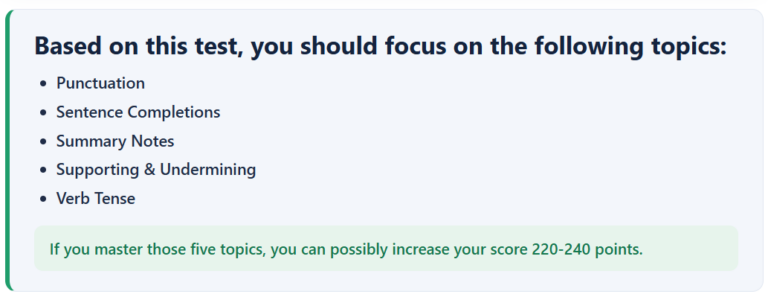
Want to Know What 5 Topics Will Improve Your SAT Score the Most?
Sample Feedback from our Diagnostic Test:
Step 4: Retest and Reprioritize
A priority list built in June is wrong by August.
That’s not a flaw in the list. It’s what improvement looks like. A student who works on his three weakest high-frequency topics and closes them has changed which topics now hold the most available points. The list has to be rebuilt.
Practice tests do two jobs here. The obvious one is showing whether the score is moving. The one students skip is showing whether the studying is still pointed at the right topics.
A student who takes a practice test, sees the score went up, and carries on with the same plan is studying yesterday’s weaknesses. Take the test, rebuild the list, and work from the new one.
Why the Last 50 Points Cost More Than the First 50
Going from 1000 to 1200 and going from 1400 to 1600 are both 200-point improvements. They are not the same job.
At the lower end, the points are in content gaps. A student doesn’t know how to handle exponential growth, gets taught it, and can now answer those questions. Content gaps are easy to find and they close cleanly.
At the top end, the content is mostly there. What’s left is errors that appear once every few tests. A misread question, a sign dropped in the third step, an answer choice that was defensible and wrong. Those don’t get fixed by doing more practice problems, because the student can already do the problems. They get fixed by finding the pattern in the mistakes, which takes more tests and more careful review of each one.
That’s why the guides below give different advice depending on where a student is starting. The method is the same. The application isn’t.
Which Guide Should You Read Next?
The process on this page applies at every score level. What changes is which topics are worth your hours and how much of the work is content versus accuracy.
Below are the guides for the four most common starting points. For guides organized by a specific score target, see the full list of SAT score guides.
Starting From a Low Score
How to Improve a Low SAT Math Score A low math score is the easiest score to raise, because there’s more unlearned material and the scaled score curve is steeper at the lower end. This guide covers how to use Desmos to answer questions you can’t solve on paper yet, and which of the 17 math topics to study first.
How to Improve a Low SAT Reading & Writing Score A low Reading & Writing score is normally not a reading problem. Approximately 25% of the section is grammar, and grammar questions have a right answer that follows from a rule. This guide covers why punctuation alone is worth about one question in seven, and which reading topics to study after the grammar is closed.
Raising Your Score by a Set Amount
How to Improve Your SAT Score by 100 Points A 100-point improvement takes approximately 40 hours and is achievable in about a month if the test date is close. Most students can get all 100 points out of one section. This guide includes two study plans depending on how much time is left.
How to Improve Your SAT Score by 200 Points A 200-point improvement takes approximately 80 hours and moves a student at the median score from the 50 percentile to approximately the 83 percentile. This guide covers which section to work on first and how to spend 80 hours so that they count.
How Long Do You Have?
The method doesn’t change with the timeline. The scope does.
A student with four months can work down the full priority list, retest, and rebuild it twice. A student with three weeks should take the top three topics, work those until they’re automatic, and leave the rest. Trying to cover everything in three weeks produces a student who has seen all 32 topics and mastered none.
Getting Help
The method is the same whether a student works alone, in a class, with a tutor, or through the on-demand course. What differs is who keeps the priority list current and who notices when the plan has stopped working.
A student who will do that himself doesn’t need to pay anyone. A student who won’t is normally better off with a schedule and someone expecting him. See all SAT prep options to compare, or start with a free diagnostic SAT to get the list first.
Frequently Asked Questions
How long does it take to improve 100 points on the SAT?
Approximately 40 hours of effective studying, based on the students we’ve worked with. That’s achievable in about a month at 10 hours a week, or over a longer stretch at a slower pace.
Can I improve my SAT score in a month?
Yes, if the target is around 100 points and the studying is focused. A month is not enough for a 250-point gain, which normally takes approximately 80 hours plus time between practice tests to rebuild the plan.
Should I focus on one section or both?
Normally one. Most students can get a 100-point gain out of a single section, and splitting the hours produces two half-sized improvements instead of one full one. If your colleges superscore, one section at a time is also the better retake strategy.
How many practice tests should I take?
Enough to rebuild your priority list as you improve. A test every two to three weeks during an active study period is normally right. Taking tests without reviewing them carefully afterward doesn’t help.
Does taking the SAT more than once look bad to colleges?
No. Most students take it two or three times. Many colleges superscore, and most allow Score Choice, which lets you decide which test dates to send.
Is it better to study the topics I'm worst at?
Not necessarily. The topics worth studying are the ones with the most available points, which means weakness multiplied by how often the topic appears. A topic you’re very weak in that appears on one question is worth less than a topic you’re slightly weak in that appears on eight.

Glyn Caddell
Glyn Caddell holds a BS in Mechanical Engineering from NJIT and has been tutoring New York City students since 2008. He founded Caddell Prep in 2012 and is the author of Digital SAT Math Secrets: Lessons & Tricks to Quickly Improve to a Perfect 800 on the Math Test, which contains over 900 practice problems and is used in Caddell Prep’s SAT math classes. He is founding president of the Staten Island Technical High School alumni association and teaches every lesson on this site personally.
Finally, an SAT course that students actually understand
Every question has a video explanation. Not most — every one.
The on-demand Digital SAT course covers all 17 math topics and 15 reading and writing topics, with 5 full-length practice tests and a 100-point score increase guarantee. Keep access for the rest of high school. No subscription.
Want to Know What 5 Topics Will Improve Your SAT Score the Most?
Sample Feedback from our Diagnostic Test: