
Home » The Digital SAT: What’s Tested, How It’s Scored, and How to Improve Your Score » SAT Scores: How Scoring Works, What’s a Good Score, and How to Raise Yours
By Glyn Caddell, BSME · Author of Digital SAT Math Secrets · Tutoring since 2008 — Updated September 8, 2026

The Digital SAT is scored from 400 to 1600. Most students want to know three things: what their score means, whether it’s good enough for the schools they’re applying to, and how much they can realistically raise it.
There’s a fourth thing most students don’t know until it’s too late. Your first module sets a ceiling on your score for that section. Answer 14 questions correctly on math module 1 and you’ll finish with approximately a 660, even if you get every question in module 2 right.
This page covers how the scoring works, what score falls at each percentile, and approximately how long it takes to improve a score. If you already have a specific score goal, there are separate guides for those further down.
Table of Contents
- How is the Digital SAT Scored?
- How Do the Adaptive Modules Work?
- SAT Score Percentiles
- What Is a Good SAT Score?
- How Much Can You Raise Your SAT Score?
- Guides for Specific Score Goals
- Superscoring and Score Choice
- When Do SAT Scores Come Out?
- How Do I Send My SAT Scores?
- Frequently Asked Questions
- Take a Free Diagnostic SAT
How Is the Digital SAT Scored?
The SAT has two sections. Reading & Writing is scored from 200 to 800, and Math is scored from 200 to 800. The two are added together for a total score from 400 to 1600.
Your raw score is the number of questions you answer correctly. That raw score is converted to a scaled score. There is no penalty for a wrong answer, so you should answer every question, even if you have to guess.
The conversion from raw score to scaled score is not the same on every test. Each test form has its own conversion, so the same number of correct answers can produce slightly different scaled scores on different test dates.
Use our free SAT score calculator to see how a raw score converts to a scaled score.
How Do the Adaptive Modules Work?
This is the part of Digital SAT scoring that surprises students the most.
Each section has two modules. Every student gets the same first module. How you perform on the first module determines whether your second module is the harder version or the easier version.
The routing matters more than most students expect, because it sets a ceiling on your score. If you’re routed to the easier second module, there is a maximum score you can earn even if you answer every remaining question correctly.
Here is what that ceiling looks like.
| If you get this many correct on module 1 | Your maximum section score is approximately |
|---|---|
| 14 on Math (normally the most you can get right and still receive the easier module 2) | 660 |
| 17 on Reading & Writing | 640 |
These figures come from score reports our own students have shared with us since the Digital SAT launched in 2024, compared against their module 1 performance. The College Board has not published the routing thresholds, so treat these as close estimates rather than exact cutoffs.
That’s why a student can walk out feeling like they answered most questions correctly and still get a score lower than they expected. The first module carries more weight than the number of questions in it suggests.
It also changes what a student should prioritize during the test. On module 1, accuracy matters more than finishing. Getting through every question with four careless mistakes is worse than working carefully and guessing on one.
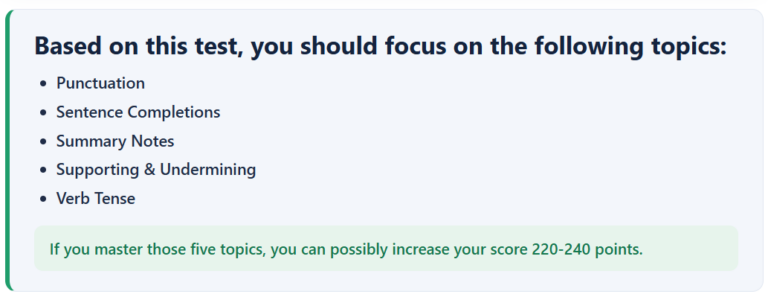
Want to Know What 5 Topics Will Improve Your SAT Score the Most?
Sample Feedback from our Diagnostic Test:
SAT Score Percentiles
A percentile tells you what percentage of students scored below you. If your score is at the 81 percentile, you scored higher than approximately 81% of test takers.
Here are the total scores at each percentile.
| SAT Score (Total) | Percentile |
|---|---|
| 1600 | 99+ |
| 1550 | 99+ |
| 1500 | 99 |
| 1450 | 99 |
| 1400 | 97 |
| 1350 | 94 |
| 1300 | 91 |
| 1250 | 86 |
| 1200 | 81 |
| 1150 | 74 |
| 1100 | 69 |
| 1050 | 58 |
| 1000 | 48 |
Percentiles are from the College Board’s Understanding SAT Scores report. The national average is approximately 1030, and the median is 1010, which is the 50 percentile.
The College Board publishes updated percentiles each year and the numbers shift. This table was last checked against current data in September 2026.
What the Table Tells You About Improving
A 200-point improvement means something very different depending on where you start.
Going from 1000 to 1200 moves you from the 48 percentile to the 81 percentile. Going from 1400 to 1600 moves you from the 97 percentile to 99+.
The same 200 points, but the first one moves you past a third of all test takers and the second one moves you past two percent of them. That’s because most students score in the middle of the range, so there are far more students packed between 1000 and 1200 than between 1400 and 1600.
Notice also that 1450 and 1500 are both the 99 percentile, and 1550 and 1600 are both 99+. Above 1450, additional points stop changing your percentile much, even though each one gets harder to earn.
Section Percentiles
There’s one asymmetry between the two sections worth knowing about. According to the College Board’s Understanding SAT Scores data, a 760 in math is the 99 percentile. In Reading & Writing, the 99 percentile is a 730.
That means fewer students reach the top of the Reading & Writing scale. Most students assume math is the harder section to perfect. At the very top, it normally isn’t.
What Is a Good SAT Score?
It depends on where you’re applying. A score that’s excellent for one school is below average at another.
There is one absolute floor. The College Board’s College and Career Readiness Benchmarks are 480 on Reading & Writing and 530 on Math. Those two add up to 1010, which is also the median score, so a student at the exact middle of all test takers sits exactly at the readiness threshold.
Beyond that, here’s a general guide.
| Total score | What it normally means |
|---|---|
| 1600 | A perfect score |
| 1500 and above | Competitive at the most selective schools, and the 99 percentile |
| 1350 and above | The 94 percentile, and above average for four-year colleges |
| 1200 | The 81 percentile |
| 1010 | The median, and the readiness benchmark |
Comparing your score to a school’s average is the wrong approach, and the number to aim for is the 75 percentile of the schools on your list rather than the bottom of their published range.
See what counts as a good SAT score for the benchmark in full, why the 75 percentile is the number that matters, and what a good score means for scholarships and test-optional schools.
Finally, an SAT course that students actually understand
Every question has a video explanation. Not most — every one.
The on-demand Digital SAT course covers all 17 math topics and 15 reading and writing topics, with 5 full-length practice tests and a 100-point score increase guarantee. Keep access for the rest of high school. No subscription.
How Much Can You Raise Your SAT Score?
Based on the students we’ve worked with since 2008, a 70 to 130 point improvement takes approximately 40 hours of effective studying, and a 130 to 250 point improvement takes approximately 80 hours.
Effective studying is doing the work under test conditions, not reading about it. That distinction matters more than the hours figure, and it’s the most common reason a study plan produces less than a student expected.
More on how to improve your SAT score, including how to decide which topics to study first and which section to work on.
Guides for Specific Score Goals
Below are guides for specific score goals, grouped by where you’re starting and where you want to end up. Each one covers how long it takes, which topics to study first, and what changes at that score level.
Starting From a Low Score
How to Improve a Low SAT Math Score A low math score is the easiest score to raise, because there’s more unlearned material and the scaled score curve is steeper at the lower end. This guide covers how to use Desmos to answer questions you can’t solve on paper yet, which is the largest source of recoverable points at this level, along with which of the 17 math topics to study first.
How to Improve a Low SAT Reading & Writing Score A low Reading & Writing score is normally not a reading problem. Approximately 25% of the section is grammar, and grammar questions have a right answer that follows from a rule. This guide covers why punctuation alone is worth about one question in seven, and which reading topics to study after the grammar is closed.
Raising Your Score
How to Improve Your SAT Score by 100 Points A 100-point improvement takes approximately 40 hours of effective studying, and it’s achievable in about a month if your test date is close. Most students can get all 100 points out of one section rather than splitting their time between both. This guide includes two study plans depending on how much time you have left.
How to Improve Your SAT Score by 200 Points A 200-point improvement takes approximately 80 hours and moves a student at the median score from the 50 percentile to approximately the 83 percentile. This guide covers which section to work on first, why splitting your time evenly is normally the wrong approach, and how to spend 80 hours so that they count.
How to Go From a 1200 to a 1400 The same 200-point jump, but from a specific starting point, which changes the advice. At a 1200 the most common topics are normally already closed, so the points come from the middle of the frequency table and from getting routed to the harder second module consistently. This guide also covers what a 1400 actually means for the colleges on your list.
Perfect Scores
How to Get an 800 on SAT Math An 800 in math is achievable for most students already scoring above 650. At that level the problem is normally careless errors rather than content. This guide covers how many questions you can miss, which of the 17 math topics to study first based on how often each appears, and what separates a 750 from an 800.
How to Get an 800 on SAT Reading & Writing For most students, an 800 in Reading & Writing is harder to get than an 800 in math. Vocabulary has no defined endpoint, and the wrong answers are designed to be defensible. This guide covers the topic frequency data for all 15 Reading & Writing topics and the wrong answer patterns that repeat across them.
How to Get a Perfect 1600 Fewer than 1 in every 1,000 students earns a perfect score. At a 1500 you’re already answering about 90% of questions correctly, so what’s left isn’t a topic you can study. This guide covers why the answer at this level is taking more full-length practice tests rather than reviewing more content, and whether you need a 1600 at all.
Superscoring and Score Choice
Many colleges superscore the SAT. That means they take your highest Math score and your highest Reading & Writing score across all of your test dates, then add them together, even if those scores came from different tests.
For example, if you scored 700 math and 650 Reading & Writing in March, then 660 math and 720 Reading & Writing in May, a school that superscores would use 700 and 720 for a total of 1420. Neither test produced that total on its own.
This has a practical consequence. If you’re taking the SAT more than once, you can focus your studying on one section at a time instead of trying to improve both at once.
Score Choice is different. Score Choice lets you decide which test dates to send to a college. Some colleges require you to send all of your scores, so Score Choice isn’t available everywhere.
Policies vary by school, and they change. Check the admissions page of each college on your list instead of assuming.
Want to Know What 5 Topics Will Improve Your SAT Score the Most?
Sample Feedback from our Diagnostic Test:
When Do SAT Scores Come Out?
Scores are normally released about two to four weeks after the test date. The exact release date for each administration is published in advance.
How Do I Send My SAT Scores?
You can send scores to colleges when you register for the test, or afterward through your College Board account. You can send up to four score reports to four colleges for free. After that, there’s a fee for each additional report, which was $15 as of 2026. Fees change, so check the College Board’s current fee page before sending.
If you’re planning to take the SAT more than once, it’s normally worth waiting until you’ve seen your scores before deciding where to send them.
Frequently Asked Questions
Students looking at their SAT scores frequently ask what the average score is and whether a particular score is good enough for the colleges on their list.
Is the SAT scored out of 1600?
Yes. The Digital SAT is scored from 400 to 1600. Each of the two sections, Math and Reading & Writing, is scored from 200 to 800.
Is there a penalty for guessing on the SAT?
No. There is no penalty for a wrong answer, so you should answer every question. Never leave a question blank.
What is the average SAT score?
The national average is approximately 1030, and the median score is 1010, which falls at the 50 percentile.
Can you still get a good score if you get the easier second module?
You can get a good score, but not a top one. Being routed to the easier second module sets a ceiling on that section, so a student who answers 14 correct on math module 1 finishes at approximately a 660 in math regardless of how the second module goes. A strong total score normally requires reaching the harder second module in at least one section.
What is the SAT college readiness benchmark?
480 on Reading & Writing and 530 on Math, according to the College Board. Meeting a section benchmark means a 75% chance of earning at least a C in a related first-semester college course. The two benchmarks add to 1010, which is also the median SAT score.
Is a 1200 a good SAT score?
A 1200 is at approximately the 81 percentile, which means you scored higher than about 81% of test takers. It’s competitive at many four-year colleges. Whether it’s good enough depends on the schools on your list, so compare it to the 25 and 75 percentile scores those schools publish.
What SAT score is in the top 10%?
A 1290 is approximately the 90 percentile. A 1300 is the 91 percentile.
Can you get a 0 on the SAT?
No. The lowest possible score is 400, which is 200 on each section.
How many times can you take the SAT?
There’s no limit. Most students take it two or three times. Students normally take it for the first time in the spring of junior year, which leaves time to take it again in the fall of senior year if needed.
Do colleges see all of my SAT scores?
It depends on the college. Some allow Score Choice, which lets you send only the test dates you want. Others require all scores. Check each school’s policy.
Take a Free Diagnostic SAT
The best way to find out where your points are is to take a diagnostic test with a full assessment. Students can take a free practice SAT with Caddell Prep to get an accurate score based on College Board scoring, along with an assessment showing exactly which topics to study.
If you’d rather work through the material on your own schedule, our on-demand Digital SAT course covers all 17 math topics and all 15 Reading & Writing topics with a video explanation for every practice question, and it comes with a 100-point score increase guarantee.

Glyn Caddell
Glyn Caddell holds a BS in Mechanical Engineering from NJIT and has been tutoring New York City students since 2008. He founded Caddell Prep in 2012 and is the author of Digital SAT Math Secrets: Lessons & Tricks to Quickly Improve to a Perfect 800 on the Math Test, which contains over 900 practice problems and is used in Caddell Prep’s SAT math classes. He is founding president of the Staten Island Technical High School alumni association and teaches every lesson on this site personally.
Need Help Preparing for the SAT?
Use the only SAT prep course built with an engineer’s approach and taught in a way that students actually understand.
100-point score increase guarantee
Take a Free Diagnostic SAT
Discover the 5 Topics That Could Make the Biggest Difference in Your Score.
Take our free diagnostic and receive a personalized assessment showing exactly what to study next.