
Home » The Digital SAT: What’s Tested, How It’s Scored, and How to Improve Your Score » SAT Scores: How Scoring Works, What’s a Good Score, and How to Raise Yours » How to Get a Perfect 1600 on the SAT: What It Takes From 1500
By Glyn Caddell, BSME · Author of Digital SAT Math Secrets · Tutoring since 2008 — Published August 25, 2026
The gap between a 1500 and a 1600 is smaller than most students expect. At a 1500 you’re already answering approximately 90% of the questions correctly. A 1600 is normally five to eight more correct answers across the entire test.
What makes those last few answers hard is that they aren’t in a topic you can study. At this level, the questions you miss are the ones you haven’t seen before.
This page covers whether you need a 1600, what separates a 1500 from a perfect score, and why the answer at this level is taking more practice tests rather than reviewing more content.
Do You Need a 1600?
For almost every student, no.
A 1500 clears the testing bar essentially everywhere. At the most selective colleges in the country, the middle of the admitted class scores in the low-to-mid 1500s, not 1600. Admissions is holistic, and a student who is already above 1550 will normally get more out of an additional 40 hours spent on their application than on their test score.
A 1550 and a 1600 aren’t going to create much of a swing for most students. I’ve had a student score a 1600 and get rejected from an Ivy, while other students with scores between 1450 and 1550 were accepted. He was accepted to other Ivies, so the score wasn’t a problem. It just didn’t make him a shoe-in anywhere.
A high SAT score can offset parts of your application. But at the most selective colleges, every part of your application matters, and a perfect score doesn’t change that.
That said, some students want a 1600 anyway. Some want the challenge, and some are close enough that the last few points feel worth going after. Both are good reasons.
The rest of this page assumes you’ve made that decision.
How Rare Is a Perfect 1600?
Fewer than 0.1% of students who take the SAT earn a perfect score. That’s fewer than 1 in every 1,000.
One thing worth knowing is that percentiles stop distinguishing at the top. A 1600 is the 99+ percentile. So is a 1550. So is a 1520. As far as percentile reporting is concerned, those scores are the same, even though the work required to move between them is not.
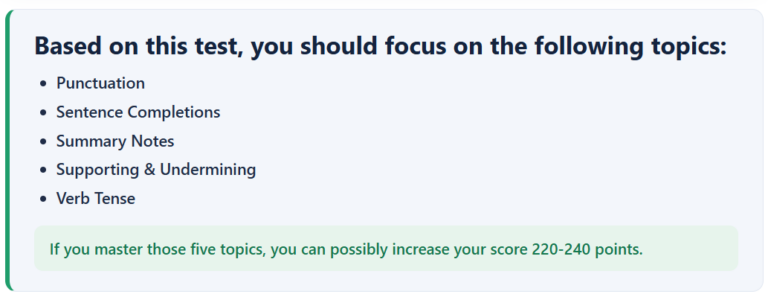
Want to Know What 5 Topics Will Improve Your SAT Score the Most?
Sample Feedback from our Diagnostic Test:
What Separates a 1500 From a 1600?
Three things, and only one of them is content.
Questions you haven’t seen before. This is the main one. At a 1500 you know the topics. What you don’t know is the one question on linear functions that’s set up in a way you’ve never encountered, or the geometry question that combines two ideas you’ve only practiced separately. Those questions exist, and there’s no topic to study to prepare for them.
Careless errors. At a 1500, a student normally loses more points to misreading a question than to not knowing how to answer it. Solving for x when the question asks for x + 3. Answering the first half of a two-part question. We cover a method for finding and fixing these on our 800 math page.
Consistency across both sections on the same day. A student who scored an 800 in math on one test and an 800 in Reading & Writing on a different test still hasn’t scored a 1600. Doing both on the same morning, in the same three hours, is its own skill.
It’s worth knowing what you’re signing up for. Going from a 1500 to a 1600 normally takes about as much work as going from a 1200 to a 1400, and it’s worth half as many points.
Why You Have to Keep Taking Practice Tests
At lower score levels, studying by topic works. A student at a 1200 who studies data and probability will get more data and probability questions right, and that shows up in the score.
At a 1500, that stops working, because you already know the topics.
The questions you’re missing aren’t concentrated anywhere. They’re spread across question types you’ve seen once or never. The Digital SAT has a large question bank, and any single practice test shows you a sample of it. There are setups and phrasings that appear on one form out of five, and you will not run into them by doing ten more practice problems on a topic you already know.
The only way to close that gap is exposure. You take enough full-length tests that by test day, nothing you see is new.
This is the opposite of the advice that works at a 1200, and it’s why students who plateau at 1500 often plateau while studying hard. They’re studying the right way for a score they already have.
Volume Alone Does Nothing
A practice test diagnoses. It doesn’t teach.
A student who takes ten practice tests and reviews none of them will score the same on the eleventh as they did on the first. The exposure only pays off if every missed question gets analyzed before the next test.
At this level that’s a manageable amount of work, because you’re only missing one or two questions per test. For each one, figure out two things: why the correct answer is correct, and why the wrong answer you chose was tempting. The second part matters more. A wrong answer you picked confidently tells you something about how you read the question, and that pattern will show up again.
Keep an error log. With only a handful of misses per test, patterns become visible quickly.
Use the Official Tests First
Start with the College Board’s practice tests in Bluebook. They’re the closest match to the real test, and they should be the first material you go through.
After that, you’ll need more volume than the official tests provide. That’s where third-party material comes in, as a supplement rather than a replacement.
Our on-demand Digital SAT course includes full-length practice tests and a large bank of practice problems, and every question has a video explanation. At this level that combination matters, because you need volume and you need to understand every miss.
Finally, an SAT course that students actually understand
Every question has a video explanation. Not most — every one.
The on-demand Digital SAT course covers all 17 math topics and 15 reading and writing topics, with 5 full-length practice tests and a 100-point score increase guarantee. Keep access for the rest of high school. No subscription.
How Many Questions Can You Miss?
Normally none. Depending on the test form, you can sometimes miss one and still get an 800 in a section.
Each section has its own answer, and we cover both in more detail:
The practical approach is to plan on missing nothing.
A Study Plan to Reach a 1600
This plan is built around full-length tests rather than hours, because at this level the work is repetition and review rather than learning new material.
| Weeks | What you do |
|---|---|
| 1-2 | Take two full official practice tests. Start an error log and categorize every missed question. |
| 3-6 | One full test per week. After each one, work only on the specific question types you missed. |
| 7-8 | Two tests per week, alternating with review days. The goal is zero content misses. |
| Final 2 weeks | One test per week, focused entirely on module 1 accuracy and pacing. |
That’s roughly 12 to 16 full-length tests, which is more than most students take. That’s the point.
Common Mistakes Students Make Chasing a 1600
Common mistakes students make when going for a perfect score include taking practice tests without reviewing them and studying by topic instead of by question type.
1. Taking Practice Tests Without Reviewing Them
This is the biggest one at this level. A test tells you what you got wrong. It doesn’t tell you why, and it doesn’t fix it. If you’re going to take 14 practice tests, you need to spend as much time reviewing them as taking them.
2. Studying by Topic Instead of by Question Type
At a 1500 you know the topics. Going back through a topic lesson you’ve already mastered feels productive and isn’t. What you need is more questions, not more explanation.
3. Over-Practicing Hard Questions
Hard questions feel like the right preparation for a perfect score. But module 1 decides your ceiling, and module 1 has the easier questions. A student who can solve the hardest problem on the test but misses two easy ones won’t get a 1600.
4. Not Using Desmos to Check Work
At this level, Desmos isn’t primarily for solving. It’s for verifying. Graphing an equation to confirm an answer you already found algebraically takes a few seconds and catches the careless errors that are costing you the score.
5. Chasing a 1600 When the Application Needs the Time More
Worth saying again. If you’re above a 1550, the next 40 hours are normally worth more spent on essays, activities, or grades than on the SAT.
Want to Know What 5 Topics Will Improve Your SAT Score the Most?
Sample Feedback from our Diagnostic Test:
Frequently Asked Questions
Students going for a perfect score frequently ask how rare a 1600 is and whether they need one for admission to a top college.
How rare is a perfect 1600 on the SAT?
Fewer than 0.1% of students who take the SAT score a 1600. That’s fewer than 1 in every 1,000 test takers.
Do I need a 1600 to get into an Ivy League school?
No. The middle of the admitted class at the most selective colleges scores in the low-to-mid 1500s. A 1500 clears the testing bar, and admissions decisions are made on much more than a test score.
How long does it take to go from a 1500 to a 1600?
It varies more than at other score levels, because it depends on how many unfamiliar question types you still have left to encounter. Plan on 8 to 12 weeks and 12 to 16 full-length practice tests. The work is comparable to going from a 1200 to a 1400.
How many practice tests should I take?
More than you think. At this level, 12 to 16 full-length tests is a reasonable target, as long as you review every one of them. Ten tests reviewed carefully will do more than twenty taken and forgotten.
Can you miss a question and still get a 1600?
Sometimes, depending on the test form. On many forms you need every question correct. Plan on missing nothing.
Is a 1600 harder to get on the Digital SAT than on the old SAT?
No. It was harder to get a 1600 on older versions of the SAT. For starters, a calculator wasn’t allowed for all math questions. Desmos wasn’t allowed at all. Secondly, all older versions of the SAT had many more questions.
Take a Free Diagnostic SAT
Even at a 1500, it’s worth confirming where your remaining points are rather than assuming. Students can take a free practice SAT with Caddell Prep to get an accurate score based on College Board scoring, along with an assessment showing exactly which topics are still costing points.
If you’d rather work through the material on your own schedule, our on-demand Digital SAT course covers all 17 math topics and all 15 Reading & Writing topics with a video explanation for every practice question, and it comes with a 100-point score increase guarantee.

Glyn Caddell
Glyn Caddell holds a BS in Mechanical Engineering from NJIT and has been tutoring New York City students since 2008. He founded Caddell Prep in 2012 and is the author of Digital SAT Math Secrets: Lessons & Tricks to Quickly Improve to a Perfect 800 on the Math Test, which contains over 900 practice problems and is used in Caddell Prep’s SAT math classes. He is founding president of the Staten Island Technical High School alumni association and teaches every lesson on this site personally.
Need Help Preparing for the SAT?
Use the only SAT prep course built with an engineer’s approach and taught in a way that students actually understand.
100-point score increase guarantee
Take a Free Diagnostic SAT
Discover the 5 Topics That Could Make the Biggest Difference in Your Score.
Take our free diagnostic and receive a personalized assessment showing exactly what to study next.