
Home » The Digital SAT: What’s Tested, How It’s Scored, and How to Improve Your Score » SAT Scores: How Scoring Works, What’s a Good Score, and How to Raise Yours » How to Get an 800 on SAT Reading & Writing: Lesson, Study Plan & Topic Breakdown
By Glyn Caddell, BSME · Author of Digital SAT Math Secrets · Tutoring since 2008 — Published August 23, 2026
An 800 on the Digital SAT Reading & Writing section is achievable, but for most students it’s harder than an 800 in math.
The reason is that the wrong answers are designed to be defensible. In math, a wrong answer is simply wrong. In Reading & Writing, two answers can both be supported by the text, and one of them is better. Telling them apart under time pressure is a different skill than knowing the material.
This page covers how many questions you can miss, which of the 15 Reading & Writing topics to study first, how many hours it takes, and what separates a 750 from an 800.
Table of Contents
- Can You Miss Any Questions and Still Get an 800?
- What Percentile is an 800 in SAT Reading & Writing?
- Why an 800 in Reading & Writing Is Harder Than an 800 in Math
- How Long Does It Take to Get an 800?
- Which Reading & Writing Topics Should You Study First?
- What Separates a 750 From an 800?
- The Wrong Answer Patterns That Repeat
- A Study Plan to Get an 800
- Common Mistakes Students Make Going for an 800
- Frequently Asked Questions
- Take a Free Diagnostic Test
Can You Miss Any Questions and Still Get an 800?
Normally you cannot miss any questions. Sometimes you can miss one and still get an 800, depending on the test form.
The Digital SAT is section-adaptive. The Reading & Writing section has two modules. Every student gets the same first module. Your performance on the first module determines whether the second module is the harder version or the easier version.
Getting routed to the harder second module is required for an 800. If a student is routed to the easier second module, the highest score they can earn is below 800, no matter how many questions they answer correctly. To illustrate, if you answer 17 correct on Reading & Writing module 1 (normally the most you can get right and still get the easier module 2), you’ll only end up with approximately a 640 on Reading & Writing if you answer all of Reading & Writing module 2 correct.
Each test form has its own raw score to scaled score conversion, so there is no single answer to how many questions you can miss. However, you generally have to get every question correct to get an 800.
The best approach is to plan on missing zero.
Use our free SAT score calculator to see how a raw score converts to a scaled score.
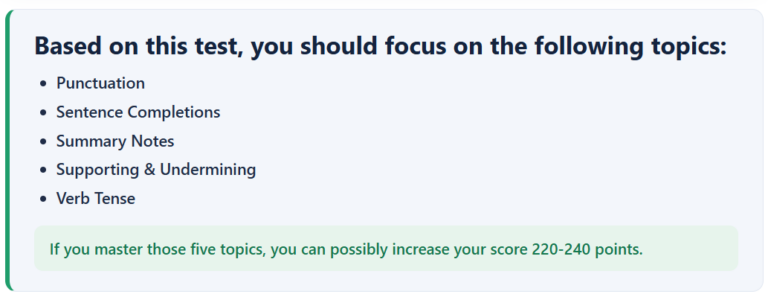
Want to Know What 5 Topics Will Improve Your SAT Score the Most?
Sample Feedback from our Diagnostic Test:
What Percentile Is an 800 in SAT Reading & Writing?
According to data from the College Board, an 800 on Reading & Writing is in the 99+ percentile. A 730 is considered the 99 percentile.
For comparison, a 760 is the 99 percentile in math. Fewer students reach the top of the Reading & Writing scale.
Why an 800 in Reading & Writing Is Harder Than an 800 in Math
Most students assume math is the harder section to perfect. For students who already know the math content, it usually isn’t. There are three reasons.
First, vocabulary doesn’t have a defined endpoint. The math section covers 17 topics. That’s a finite list, and a student can work through all of it. Words in Context questions are about 16.5% of the Reading & Writing section, and there is no vocabulary list that guarantees you’ll know every word that appears. The words do repeat across official tests, which is why our flashcards are built from words that have actually appeared rather than from a general vocabulary list. But you can’t close the gap completely the way you can close a math topic.
Second, the wrong answers are built to be defensible. On a math question, three answers are wrong. On a Reading & Writing question, two answers can both be supported by something in the passage, and one of them is better supported. That’s a judgment, and a judgment takes longer than a calculation.
Third, you can’t check your work the same way. In math, you can substitute an answer back into the equation or graph it in Desmos to confirm. There is no way to check a Reading & Writing answer before you submit it.
An 800 is still achievable. However, the studying looks different, and the last 50 points take longer.
How Long Does It Take to Get an 800?
Based on the students we’ve worked with since 2008:
- To improve 70-130 points, students need approximately 40 hours of effective studying.
- To improve 130-250 points, students need approximately 80 hours of effective studying.
Working backwards from an 800:
| Current R&W score | Points needed | Approximate hours |
|---|---|---|
| 700-730 | 70-100 | ~40 |
| 650-690 | 110-150 | 40-80 |
| 600-640 | 160-200 | ~80 |
There is one important difference from math. In math, a student can close a topic in an evening. Exponents is a handful of rules. Vocabulary doesn’t work that way. It’s cumulative, and it responds to a small amount of review spread over many weeks rather than a large amount of review in one week.
That means vocabulary study should start on day one of your plan, not in the last month. A student who leaves it until the end won’t have enough time for it to work, no matter how many hours they put in.
Which Reading & Writing Topics Should You Study First?
You don’t need to study all 15 topics equally.
We categorized every question on the ten full-length practice tests released by the College Board. Here is how often each topic appears.
| Topic | % of Section |
|---|---|
| Words in Context | 16.50% |
| Punctuation | 13.60% |
| Summary Notes | 10.80% |
| Transitions | 9.70% |
| Verb-Tense | 8.20% |
| Function & Purpose | 8.00% |
| Supporting & Undermining | 7.30% |
| Graphs & Charts | 7.00% |
| Text Completions | 6.40% |
| Fact or Detail | 3.60% |
| Main Idea & Structure | 3.50% |
| Pronouns | 1.70% |
| Modifiers | 1.50% |
| Paired Passages | 1.50% |
| Inference | 0.80% |
Words in Context alone is about one question in six. A student who is inconsistent on those questions has a ceiling, no matter how strong the rest of the section is. That’s where the first block of studying goes.
Start With the Grammar Topics
Don't Skip the Least Common Topics
This is where studying for an 800 is different from studying for a 700.
A student going for a 700 can afford to be weak on a topic that appears in 1.5% of the questions. A student going for an 800 cannot, because one question is the difference.
Paired passages and pronouns are each a small, well-defined skill. A student can get through both in a couple of hours. For an 800, that’s some of the best time you can spend.
See all 15 Digital SAT Reading & Writing topics with lessons and practice questions
Finally, an SAT course that students actually understand
Every question has a video explanation. Not most — every one.
The on-demand Digital SAT course covers all 17 math topics and 15 reading and writing topics, with 5 full-length practice tests and a 100-point score increase guarantee. Keep access for the rest of high school. No subscription.
What Separates a 750 From an 800?
In math, students at 750 are normally losing points to careless errors. In Reading & Writing, they’re losing points to picking the second-best answer.
1. Two Answers Look Right
This is the defining problem at this level. Both choices are supported by something in the passage, and one of them is supported better.
The fix is a decision rule, not more reading. For each of the two choices, find the specific words in the passage that support it. Then ask which one requires you to assume something the passage doesn’t say. That’s the wrong answer.
If you can’t point to the specific line in the passage that supports your choice, you’re guessing.
2. The Vocabulary Ceiling
At 750, most remaining Words in Context misses aren’t misread context. They’re words the student doesn’t know.
This is the one place in Reading & Writing where there’s a genuine content gap to close, and it’s the reason vocabulary study has to start early. Our SAT vocabulary flashcards are built from words that have appeared on College Board SATs, rather than from a general list of “SAT words,” because the words repeat. For example, “obscure”, “indecipherable”, and “substantial” appeared at least three times on Digital SATs.
3. Over-Inferring
On inference questions, correct answers are normally cautious. They use words like “some,” “may,” and “likely.” Wrong answers overreach with “all,” “most,” “never,” and “only.”
Students at 750 who miss inference questions are almost always choosing the stronger claim. If a choice states something more confidently than the passage does, that’s a reason to eliminate it.
4. Answering What the Question Didn't Ask
On function and purpose questions, the most common wrong answer accurately describes what a sentence says instead of what it does. The statement is true, but it doesn’t answer the question.
The same pattern shows up on summary notes questions, where a choice can accurately reflect the notes while serving a different goal than the one the question stated.
Before selecting an answer, reread what the question actually asked.
5. Pacing on the Second Module
The harder second module gives you the same amount of time with more difficult passages.
In math, students lose time by working too long on one problem. In Reading & Writing, they lose it by rereading. A student who reads a passage three times has spent the time they needed for two other questions.
Decide in advance how many times you’ll return to a passage, and stick to it.
Want to Know What 5 Topics Will Improve Your SAT Score the Most?
Sample Feedback from our Diagnostic Test:
The Wrong Answer Patterns That Repeat
Across the 15 Reading & Writing topics, the wrong answers fail in a small number of predictable ways. Learning the patterns is faster than learning each topic separately.
- Inference — the wrong answer states something more strongly than the passage supports.
- Paired Passages — the wrong answer has the second text rejecting the first, when it normally only qualifies it.
- Function & Purpose — the wrong answer describes the content of a sentence instead of its function.
- Supporting & Undermining — the wrong answer addresses the general topic instead of the specific mechanism in the claim.
- Summary Notes — the wrong answer is accurate but serves a different goal than the one stated.
- Fact/Detail — the wrong answer repeats wording from the passage but makes a statement the passage doesn’t.
Matching words are not evidence that an answer is correct. For example, a choice can repeat a phrase from the passage and still make a statement the passage never made.
A Study Plan to Get an 800
This assumes a starting score above about 650 and about 8 to 12 weeks.
- Take a diagnostic test. Get a baseline and find out which topics are costing you points. Take a free diagnostic SAT
- Start vocabulary on day one. Not in the last month. It’s cumulative and it needs weeks of short, regular review to work.
- Get the grammar topics to certainty. Punctuation, verb tense, pronouns, and modifiers are rule-based. Two to three weeks.
- Work the highest-frequency reading topics. Words in Context, transitions, and function & purpose.
- Take full-length practice tests, timed. In one sitting, in Bluebook if possible.
- Categorize every missed question. Vocabulary, judgment, or pacing. Keep track of the counts.
- Spend the last few weeks on whichever category is biggest.
If you’re starting below 650, there’s more content work to do and the plan takes longer.
Common Mistakes Students Make Going for an 800
1. Memorizing General Vocabulary Lists
Most “SAT word lists” were written for a version of the test that no longer exists. The Digital SAT tests words in context, and the words that appear tend to repeat across official tests. Studying words that have actually appeared is a better use of time than studying a list of 1,000 words chosen because they sound difficult.
2. Reading the Passage Twice Before Looking at the Question
It feels thorough, but it costs time and rarely changes the answer. Read once, read the question, then go back to the specific part of the passage that matters.
3. Studying With Outdated Material
There was a significant change in content between the old SAT and the Digital SAT. The old test had an essay, “NO CHANGE” answer choices, and questions about combining sentences. None of those exist on the Digital SAT. A student using a pre-2024 book is practicing question types that won’t appear.
4. Treating Grammar as Something You Either Know or Don't
Grammar is the most rule-based part of the section and the fastest to improve. A student who thinks they’re “bad at grammar” is normally missing four or five specific rules. Those can be learned in a few hours.
5. Practicing Untimed
Untimed practice tells you whether you can answer the questions. The test measures whether you can answer them in 32 minutes per module.
If you’re working through problems to learn the material, timing doesn’t matter. But you have to take timed practice tests to build the pace.
Frequently Asked Questions
Is an 800 on SAT Reading & Writing hard to get?
It’s difficult, and for most students it’s harder than an 800 in math. The math content is a defined set of 17 topics. Reading & Writing has a vocabulary component with no fixed endpoint and wrong answers that are designed to be defensible.
Do I need to memorize vocabulary lists?
You need to know vocabulary, but a general list isn’t the most efficient way to get there. Words repeat across official tests, so studying words that have actually appeared is a better use of time.
Is Reading & Writing harder than math?
For a perfect score, normally yes. At lower score ranges, math is normally the harder section because content gaps are larger.
How much should I read to improve my score?
Reading widely helps over a period of years. However, it doesn’t reliably move a score in eight weeks. If your test is soon, targeted practice on the question types you’re missing will do more than general reading.
Can I get an 800 in three months?
Starting from above a 700, normally yes. That’s about 40 hours of effective studying. Starting from a 600, three months is possible but takes about 80 hours, which is a real weekly commitment.
Take a Free Diagnostic SAT
The best way to find out which topics are costing you points is to take a diagnostic test with a full assessment. Students can take a free practice SAT with Caddell Prep to get an accurate score based on College Board scoring, along with an assessment showing exactly which topics to study.
If you’d rather work through the material on your own schedule, our on-demand Digital SAT course covers all 15 Reading & Writing topics with a video explanation for every practice question, and it comes with a 100-point score increase guarantee.

Glyn Caddell
Glyn Caddell holds a BS in Mechanical Engineering from NJIT and has been tutoring New York City students since 2008. He founded Caddell Prep in 2012 and is the author of Digital SAT Math Secrets: Lessons & Tricks to Quickly Improve to a Perfect 800 on the Math Test, which contains over 900 practice problems and is used in Caddell Prep’s SAT math classes. He is founding president of the Staten Island Technical High School alumni association and teaches every lesson on this site personally.
Need Help Preparing for the SAT?
Use the only SAT prep course built with an engineer’s approach and taught in a way that students actually understand.
100-point score increase guarantee
Take a Free Diagnostic SAT
Discover the 5 Topics That Could Make the Biggest Difference in Your Score.
Take our free diagnostic and receive a personalized assessment showing exactly what to study next.