
Home » The Digital SAT: What’s Tested, How It’s Scored, and How to Improve Your Score » SAT Scores: How Scoring Works, What’s a Good Score, and How to Raise Yours » How to Improve a Low SAT Reading & Writing Score: Where to Start
By Glyn Caddell, BSME · Author of Digital SAT Math Secrets · Tutoring since 2008 — Published August 26, 2026
A low Reading & Writing score is normally not a reading problem.
Approximately 25% of the Reading & Writing section is grammar. Grammar questions have a right answer that follows from a rule, and once you know the rule you get the question right every time. That makes them the fastest points on the test to gain, and they have nothing to do with how fast you read.
This page covers why a low score improves faster than a high one, why grammar comes first, which reading topics to study after that, and how long it takes.
Table of Contents
- Why Is a Low Reading & Writing Score Easier to Raise Than a High One?
- Start With Grammar
- Then Study the Highest-Frequency Reading Topics
- Which Topics Should You Study First?
- How Long Does It Take to Raise a Low Reading & Writing Score?
- A Study Plan for a Low Reading & Writing Score
- Common Mistakes Students Make With a Low Reading & Writing Score
- Frequently Asked Questions
- Take a Free Diagnostic SAT
Why Is a Low Reading & Writing Score Easier to Raise Than a High One?
There are two reasons why it’s easier to raise a lower score than a higher one.
First, you have more unlearned material left. Unlearned topics are the fastest points to get, because you’re going from missing a question every time to getting it right every time.
Second, the scaled score curve is steeper in the lower part of the range. The same number of additional correct answers is worth more points at a 450 than at a 650.
There’s also a reason specific to this section. At a high score, the questions a student misses are normally judgment calls between two answers that both look defensible. Those are slow to fix. At a low score, most missed questions are rules that haven’t been learned yet, and rules are fast to learn.
Start With Grammar
Most students with a low Reading & Writing score assume the problem is reading speed. Sometimes that’s part of it, and reading speed improves slowly.
But approximately 25% of the section isn’t reading at all. It’s grammar, and grammar is rule-based.
We categorized every question on the ten full-length practice tests released by the College Board. Here’s how the four grammar topics break down.
| Topic | % of section |
|---|---|
| Punctuation | 13.6% |
| Verb Tense | 8.2% |
| Pronouns | 1.7% |
| Modifiers | 1.5% |
A student who is guessing on these questions is guessing on a quarter of the section. That’s where the recoverable points are.
Punctuation Comes First
Punctuation is 13.6% of the Reading & Writing section on its own, which is more than the other three grammar topics combined. It’s also about one question in seven on the whole section.
The rules are a defined set. Commas, semicolons, colons, dashes, and apostrophes, and the situations where each one is used. A student can learn them in a few sessions and then get those questions right consistently.
If you only have time to study one thing in this section, study this.
Verb Tense and Subject-Verb Agreement
At 8.2%, verb tense is the second-largest grammar topic.
Two things account for most of the missed questions. The first is changing tense when the passage doesn’t call for it. The second is subject-verb agreement when there are words between the subject and the verb, like “one of the students.” The subject there is “one,” not “students.”
Pronouns
At 1.7%, pronouns is a small topic, which means it’s fast to close.
Its versus it’s, their versus there, who versus whom. There are only a handful of rules, and once you know them the questions are straightforward.
Modifiers
At 1.5%, modifiers is the smallest of the four.
Almost every modifier question follows the same pattern. A descriptive phrase at the start of a sentence has to describe the noun that comes right after the comma. Once you can recognize that pattern, you can answer these questions quickly.
What Grammar Won't Do
Grammar is approximately a quarter of the section, not all of it.
Closing it produces a real jump in your score, and then it stops. After that, the remaining points are in the reading topics, and those take longer because they require judgment rather than a rule.
So grammar is where to start, not where to finish.
Then Study the Highest-Frequency Reading Topics
| Topic | % of section |
|---|---|
| Words in Context | 16.5% |
| Summary Notes | 10.8% |
| Transitions | 9.7% |
| Function & Purpose | 8.0% |
Words in Context is the largest topic in the entire section at 16.5%, which is about one question in six. It’s also the reading topic that responds fastest to studying, because vocabulary is learnable content rather than a judgment skill.
Transitions is worth noting as well. Those questions are closer to grammar than to reading. You’re deciding what relationship exists between two sentences and picking the word that matches, which is a rule you can learn rather than a judgment you have to develop.
See all 15 Digital SAT Reading & Writing topics with lessons and practice questions
Which Topics Should You Study First?
A student with a low Reading & Writing score normally has several topics with a lot of room to improve. The question is which ones.
The General Answer
Start with grammar, then work down the reading topics by how often they appear. Grammar is approximately 25% of the section and the rules are learnable. Words in Context is another 16.5%.
If you don’t know anything else about where your points are, that’s the right order.
The Better Answer
Find out which topics are actually costing you the most points.
The most common topics are the right guess when you have no other information. They aren’t necessarily your topics. A student might already be solid on punctuation and losing most of their points on Words in Context, and studying punctuation again wouldn’t move their score.
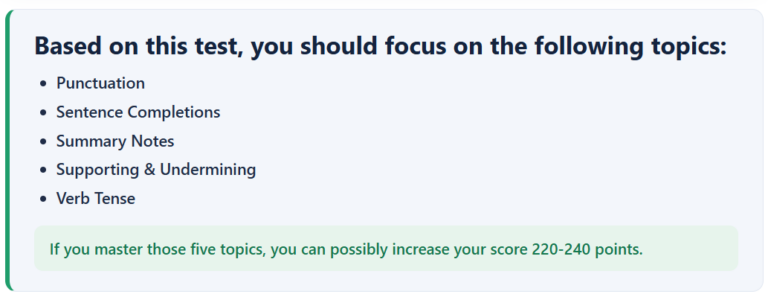
Take a free diagnostic SAT and you’ll get an assessment showing exactly which topics to study to raise your score the most, based on your own test rather than on averages.
Want to Know What 5 Topics Will Improve Your SAT Score the Most?
Sample Feedback from our Diagnostic Test:
How Long Does It Take to Raise a Low Reading & Writing Score?
Based on the students we’ve worked with since 2008:
- To improve 70-130 points, students need approximately 40 hours of effective studying.
- To improve 130-250 points, students need approximately 80 hours of effective studying.
Here’s what that looks like depending on how much time you can put in each week.
| Hours per week | Weeks to reach 40 hours | Weeks to reach 80 hours |
|---|---|---|
| 5 | 8 weeks | 16 weeks |
| 8 | 5 weeks | 10 weeks |
| 10 | 4 weeks | 8 weeks |
There’s one part of this section that doesn’t follow the normal timeline. Vocabulary is cumulative. It responds to a small amount of review spread over many weeks rather than a large amount in one week, so it should start on day one of your plan even though it pays off last.
Everything else on this page works on a normal schedule. Grammar rules can be learned in a few sessions and applied immediately.
There’s one thing to understand about the hours. Effective studying is not the same as studying. Watching a lesson is not effective studying. Reading a solution is not effective studying. Effective studying means attempting problems under test conditions, getting some wrong, and then figuring out why. One hour of that is worth about three hours of reading.
A Study Plan for a Low Reading & Writing Score
| What you do | Hours |
|---|---|
| Take a diagnostic test and review the results | 3 |
| Learn the punctuation rules and practice them | 5 |
| Learn the other three grammar topics and practice them | 12 |
| Start vocabulary review, and keep it going throughout | 2 |
| Study Words in Context and the next highest-frequency reading topics | 6 |
| Take three full-length practice tests, timed | 6 |
| Review each test and figure out why you missed what you missed | 6 |
That’s a total of 40 hours.
Grammar comes before the reading topics on purpose. It’s a quarter of the section, the rules are learnable in a few sessions, and getting those questions right consistently raises your score while you’re still working on the slower parts.
To study those topics, take practice tests, and review your mistakes, you need an SAT course that you can actually understand.
Finally, an SAT course that students actually understand
Every question has a video explanation. Not most — every one.
The on-demand Digital SAT course covers all 17 math topics and 15 reading and writing topics, with 5 full-length practice tests and a 100-point score increase guarantee. Keep access for the rest of high school. No subscription.
Common Mistakes Students Make With a Low Reading & Writing Score
Common mistakes students make when trying to raise a low Reading & Writing score include assuming it’s a reading speed problem and guessing on the grammar questions.
1. Assuming It's a Reading Speed Problem
Approximately a quarter of the section is grammar, and reading speed has nothing to do with those questions. A student who decides the problem is how fast they read will spend their studying on the slowest part of the section to improve and skip the fastest.
2. Guessing on Grammar Questions Instead of Learning the Rules
Grammar questions have a right answer that follows from a rule. A student who is guessing on punctuation is guessing on 13.6% of the section, and that’s recoverable in a few sessions.
3. Trying to Fix Vocabulary by Reading More
Reading widely helps over a period of years. However, it doesn’t reliably move a score in eight weeks. Studying words that have actually appeared on official tests is a better use of the time you have.
4. Reading the Passage Twice Before Looking at the Question
It feels thorough, but it costs time and rarely changes the answer. Read once, read the question, then go back to the specific part of the passage that matters.
5. Using Outdated Material
There was a significant change in content between the old SAT and the Digital SAT. The old test had an essay, “NO CHANGE” answer choices, and questions about combining sentences. None of those exist on the Digital SAT. A student using a pre-2024 book is practicing question types that won’t appear.
Want to Know What 5 Topics Will Improve Your SAT Score the Most?
Sample Feedback from our Diagnostic Test:
Frequently Asked Questions
Students with a low Reading & Writing score frequently ask what counts as a low score and how to improve if they’re a slow reader.
Can you improve a low SAT Reading & Writing score?
Yes, and it’s easier than improving a high one. There’s more unlearned material to cover, and the scaled score curve is steeper at the lower end, so the same amount of studying produces a bigger increase.
What is a low SAT Reading & Writing score?
According to the information the College Board has created for K12 educators, a score below 480 on Reading & Writing is below the SAT College and Career Readiness Benchmark.
How do I improve if I'm a slow reader?
Start with grammar. Approximately 25% of the section is grammar, and those questions don’t depend on reading speed. Learning the punctuation rules alone covers 13.6% of the section. After that, work on the reading topics, starting with Words in Context.
Do I need to memorize vocabulary lists?
You need to know vocabulary, but a general list isn’t the most efficient way to get there. Words repeat across official tests, so studying words that have actually appeared is a better use of time than working through a list of 1,000 words chosen because they sound difficult.
Is Reading & Writing harder to improve than math?
At a low score, no. A quarter of the section is rule-based, which makes it comparable to math in how quickly it responds to studying. At a high score, Reading & Writing is normally harder to improve, because what’s left is judgment rather than rules.
How long does it take to raise my Reading & Writing score 100 points?
Approximately 40 hours of effective studying. At 8 hours a week, that’s about 5 weeks. Read our full guide on how to improve your SAT score by 100 points.
Take a Free Diagnostic SAT
The fastest way to raise a low Reading & Writing score is to find out which topics are actually costing you points instead of guessing. Students can take a free practice SAT with Caddell Prep to get an accurate score based on College Board scoring, along with an assessment showing exactly which topics to study.
If you’d rather work through the material on your own schedule, our on-demand Digital SAT course covers all 15 Reading & Writing topics with a video explanation for every practice question, and it comes with a 100-point score increase guarantee.
If your math score also needs work, see how to improve a low SAT math score.

Glyn Caddell
Glyn Caddell holds a BS in Mechanical Engineering from NJIT and has been tutoring New York City students since 2008. He founded Caddell Prep in 2012 and is the author of Digital SAT Math Secrets: Lessons & Tricks to Quickly Improve to a Perfect 800 on the Math Test, which contains over 900 practice problems and is used in Caddell Prep’s SAT math classes. He is founding president of the Staten Island Technical High School alumni association and teaches every lesson on this site personally.
Need Help Preparing for the SAT?
Use the only SAT prep course built with an engineer’s approach and taught in a way that students actually understand.
100-point score increase guarantee
Take a Free Diagnostic SAT
Discover the 5 Topics That Could Make the Biggest Difference in Your Score.
Take our free diagnostic and receive a personalized assessment showing exactly what to study next.