
Home » The Digital SAT: What’s Tested, How It’s Scored, and How to Improve Your Score » SAT Scores: How Scoring Works, What’s a Good Score, and How to Raise Yours » How to Improve a Low SAT Math Score: Where to Start and What to Study First
By Glyn Caddell, BSME · Author of Digital SAT Math Secrets · Tutoring since 2008 — Published August 25, 2026
A low SAT math score is the easiest score to raise. There’s more unlearned material to cover, and points come faster at the bottom of the range than at the top.
A low math score is also normally not about being bad at math. It’s about a specific set of topics not being learned yet, and about not knowing that the calculator built into the test can answer questions the algebra can’t.
This page covers why a low score improves faster than a high one, how to use Desmos to solve problems you don’t know how to solve on paper, which topics to study first, and how long it takes.
Table of Contents
Why Is a Low SAT Score Easier to Raise Than a High One?
There are two reasons why a low SAT score is easier to raise than a high one.
First, you have more unlearned material left. Unlearned topics are the fastest points to get, because you’re going from missing a question every time to getting it right every time. A student at a 750 has already learned almost everything and is working on consistency, which is slower.
Second, the scaled score curve is steeper in the lower part of the range. The same number of additional correct answers is worth more points at a 450 than at a 650.
That’s why the same 80 hours of studying produces a bigger score increase for a student starting low than for a student starting high.
Learn Desmos First
Desmos is built into the Bluebook application and is available for every question in both math modules. Most students with a low math score either don’t use it or only use it for arithmetic.
That’s the single biggest source of recoverable points at this level, because Desmos can answer questions you don’t know how to solve on paper.
This is different from how a student going for an 800 uses it. At a high score, Desmos is for checking work you’ve already done. At a low score, it’s for getting questions right that you couldn’t otherwise get right at all.
Here are five things it does that students normally don’t know about.
Solve a System of Equations Without Doing Any Algebra
Enter both equations and look at where the two lines cross. That point is the solution.
You don’t need substitution and you don’t need elimination. If the question asks for the value of x, read the x-coordinate of the intersection.
Find the Zeros of a Quadratic Without Factoring
Enter the quadratic and look at where the graph crosses the x-axis. Those are the zeros, also called the roots or the solutions.
Factoring is faster once you’re good at it. Until then, graphing gets you the same answer.
Solve an Equation With Variables on Both Sides
Enter the left side as one equation and the right side as another. Where the two graphs intersect is where the two sides are equal, so the x-coordinate is your answer.
Check Whether a Point Is on a Line
Enter the equation, then enter the point in parentheses. If the point sits on the line, it’s a solution. If it doesn’t, it isn’t.
This works for any question that asks whether a given point satisfies an equation.
Count How Many Solutions an Equation Has
Enter both sides and count how many times the graphs intersect. No intersections means no solution. One intersection means one solution. If the two graphs sit on top of each other, there are infinite solutions.
What Desmos Won't Do
Desmos isn’t a replacement for understanding the math.
It won’t help you on a word problem you can’t set up, because you have to know what to enter before you can graph anything. It can’t tell you what a question is asking for. And it doesn’t help on questions where the work is arithmetic or reasoning rather than an equation.
What it does is stop you from losing points on questions where you know what the problem is asking but can’t do the algebra yet. Use it while you’re learning the algebra, not instead of learning it.
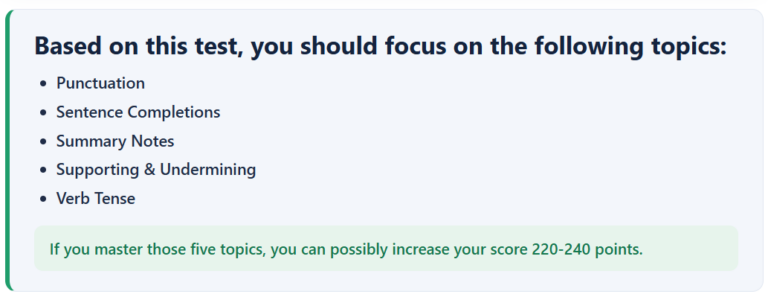
Want to Know What 5 Topics Will Improve Your SAT Score the Most?
Sample Feedback from our Diagnostic Test:
Which Math Topics Should You Study First?
A student with a low math score normally has about five topics with a lot of room to improve. The question is which five.
The General Answer
Study the five topics that appear most often on the test.
We categorized every question on the ten full-length practice tests released by the College Board. These five make up about 56% of the math section.
| Rank | Topic | % of test |
|---|---|---|
| 1 | Linear Functions | 15.0% |
| 2 | Combining Like Terms & Solving Equations | 11.7% |
| 3 | Angles, Polygons & 3-D Shapes | 10.4% |
| 4 | Quadratic Functions | 9.6% |
| 5 | Functions | 8.9% |
If you don’t know anything else about where your points are, this is the right place to start.
The Better Answer
Find out which five topics are costing you the most points.
The five most common topics are the right guess when you have no other information. They aren’t necessarily your five. A student might already be solid on linear functions and losing most of their points on geometry, and studying linear functions again wouldn’t move their score at all.
Take a free diagnostic SAT and you’ll get an assessment showing exactly which topics to study to raise your score the most, based on your own test rather than on averages.
See all 17 Digital SAT math topics with lessons and practice problems
How Long Does It Take to Raise a Low Math Score?
Based on the students we’ve worked with since 2008:
- To improve 70-130 points, students need approximately 40 hours of effective studying.
- To improve 130-250 points, students need approximately 80 hours of effective studying.
Here’s what that looks like depending on how much time you can put in each week.
| Hours per week | Weeks to reach 40 hours | Weeks to reach 80 hours |
|---|---|---|
| 5 | 8 weeks | 16 weeks |
| 8 | 5 weeks | 10 weeks |
| 10 | 4 weeks | 8 weeks |
Those numbers are the same at every score level, but they go further at a low one. A student starting at a 450 gets more out of 80 hours than a student starting at a 650, because there’s more unlearned material to convert into points.
There’s one thing to understand about the hours. Effective studying is not the same as studying. Watching a lesson is not effective studying. Reading a solution is not effective studying. Effective studying means attempting problems under test conditions, getting some wrong, and then figuring out why. One hour of that is worth about three hours of reading.
A Study Plan for a Low Math Score
| What you do | Hours |
|---|---|
| Take a diagnostic test and review the results | 3 |
| Learn Desmos | 0.5 |
| Study your five weakest high-frequency topics with practice problems & Practice using Desmos when possible | 25-30 |
| Take three full-length practice tests, timed | 6 |
| Review each test and figure out why you missed what you missed | 8 |
That is a total of 42.5-47.5 hours.
If you are only concerned about your math score, then you can cut times for the diagnostic test, three practice tests, and review of each test in half. That brings the total down to 34-39 hours. It’s worth continuing to practice Reading & Writing, though, to keep your Reading & Writing score where it is, or even improve it.
Desmos comes second, right after the diagnostic. That’s on purpose. Learning it early means you’re using it on every practice problem you do while studying the topics, instead of learning it at the end and never getting comfortable with it.
Finally, an SAT course that students actually understand
Every question has a video explanation. Not most — every one.
The on-demand Digital SAT course covers all 17 math topics and 15 reading and writing topics, with 5 full-length practice tests and a 100-point score increase guarantee. Keep access for the rest of high school. No subscription.
Common Mistakes Students Make With a Low Math Score
Common mistakes students make when trying to raise a low math score include deciding they’re bad at math and not using Desmos.
1. Deciding They're Bad at Math
A low math score is a set of topics that haven’t been learned yet. It’s countable, and it’s fixable. A student who says they’re bad at math has normally never seen the list of what’s actually on the test, which is 17 topics, not an infinite amount of material.
2. Not Using Desmos
The single biggest source of recoverable points at this level. A student who doesn’t use Desmos is losing points on questions they could get right today, without learning anything new.
3. Studying Topics in the Order They Appear in a Book
Books normally go in curriculum order. The test doesn’t. Studying in book order means spending the same amount of time on a topic that’s under 1% of the test as one that’s 15%.
4. Skipping Easy Questions to Save Time for Hard Ones
At a low score, the easier questions are your score. A student who rushes through them to spend four minutes on a hard problem normally loses more points than they gain.
5. Trying to Cover All 17 Topics
Five topics studied well beats 17 studied shallowly. That’s true at any score, and it’s most true at a low one.
Want to Know What 5 Topics Will Improve Your SAT Score the Most?
Sample Feedback from our Diagnostic Test:
Frequently Asked Questions
Students with a low math score frequently ask whether they can improve and how to study if they’ve never been good at math.
Can you improve a low SAT math score?
Yes, and it’s easier than improving a high one. There’s more unlearned material to cover, and the scaled score curve is steeper at the lower end, so the same amount of studying produces a bigger increase.
What is a low SAT math score?
According to the information the College Board has created for K12 educators, a score below 530 on Math is below the SAT College and Career Readiness Benchmark.
How do I improve if I'm bad at math?
Start by learning Desmos, which will get you points on questions you can’t solve on paper yet. Then study the specific topics that are costing you the most, rather than trying to get better at math in general. The Digital SAT tests 17 math topics, which is a finite list.
Do I need to know calculus for the SAT?
No. The Digital SAT math section covers algebra, advanced math, problem-solving and data analysis, and geometry and trigonometry. There is no calculus on the test.
Can I use Desmos on the whole math section?
Yes. Desmos is built into Bluebook and is available for every question in both math modules.
How long does it take to raise my math score 100 points?
Approximately 40 hours of effective studying. At 8 hours a week, that’s about 5 weeks. Read our full guide on how to improve your SAT score by 100 points.
Take a Free Diagnostic SAT
The fastest way to raise a low math score is to find out which topics are actually costing you points instead of guessing. Students can take a free practice SAT with Caddell Prep to get an accurate score based on College Board scoring, along with an assessment showing exactly which topics to study.
If you’d rather work through the material on your own schedule, our on-demand Digital SAT course covers all 17 math topics with a video explanation for every practice question, and it comes with a 100-point score increase guarantee.
If you’re looking for a target rather than a starting point, see how to improve your SAT score by 200 points.

Glyn Caddell
Glyn Caddell holds a BS in Mechanical Engineering from NJIT and has been tutoring New York City students since 2008. He founded Caddell Prep in 2012 and is the author of Digital SAT Math Secrets: Lessons & Tricks to Quickly Improve to a Perfect 800 on the Math Test, which contains over 900 practice problems and is used in Caddell Prep’s SAT math classes. He is founding president of the Staten Island Technical High School alumni association and teaches every lesson on this site personally.
Need Help Preparing for the SAT?
Use the only SAT prep course built with an engineer’s approach and taught in a way that students actually understand.
100-point score increase guarantee
Take a Free Diagnostic SAT
Discover the 5 Topics That Could Make the Biggest Difference in Your Score.
Take our free diagnostic and receive a personalized assessment showing exactly what to study next.