Home » The Digital SAT: What’s Tested, How It’s Scored, and How to Improve Your Score » The 17 Digital SAT Math Topics: How Often Each Is Tested and What to Study First » SAT Linear Functions: 15% of Digital SAT Math — Lesson, Practice & Video Explanations
By Glyn Caddell, BSME · Author of Digital SAT Math Secrets · Tutoring since 2008 — Updated August 29, 2026
Linear functions appear on approximately 15% of Digital SAT math questions, which is 6 to 7 of the 44 questions across the two math modules. These questions fall under Algebra according to the College Board. Linear functions questions test students’ knowledge of the linear equation y = mx + b and how slope applies to rate of change and the y-intercept applies to the initial value.
Table of Contents
- What Are Linear Functions on the Digital SAT?
- How Often Do Linear Functions Appear on the Digital SAT?
- The 7 Forms of Linear Functions Questions on the Digital SAT
- How to Answer a Linear Functions Question in 5 Steps
- Slope-Intercept Form and the Equation of a Line
- Parallel and Perpendicular Lines on the Digital SAT
- Interpreting Linear Functions in Word Problems
- Using the Desmos Calculator on Linear Functions Questions
- Digital SAT Linear Functions Example with Video Explanation
- Linear Functions Practice Problems with Video Explanations
- 3 Common Mistakes on Digital SAT Linear Functions Questions
- What Should You Study After Linear Functions?
What Are Linear Functions on the Digital SAT?
A linear function is a function that changes at a constant rate and graphs as a straight line. On the Digital SAT it is almost always written as , where
is the slope and
is the
-intercept.
The word linear refers to the straight-line shape. The word function means that each input produces exactly one output, which is why the SAT often writes these as or
rather than
. The letter chosen for the function and the letter chosen for the input both change from question to question, and neither changes the math.
The two features the Digital SAT tests most often are the slope and the -intercept. The slope tells you how fast the output changes for each unit of input. The
-intercept tells you the output when the input is zero, which in a word problem is the starting value before anything happens.
How Often Do Linear Functions Appear on the Digital SAT?
Linear functions appear on 15.0% of Digital SAT math questions, making them the most common of the 17 math topics tested.
These figures come from our analysis of the ten full-length practice tests the College Board has released for the Digital SAT. We categorized every math question on all ten tests into 17 topics, then calculated how often each topic appeared overall and the range across individual tests.
| Math topic | Overall | Minimum | Maximum |
|---|---|---|---|
| Linear Functions | 15.0% | 13.0% | 18.5% |
| Combining Like Terms & Solving Equations | 11.7% | 5.6% | 14.8% |
| Angles, Polygons, & 3-D Shapes | 10.4% | 5.6% | 16.7% |
Linear functions appeared on at least 13.0% of questions on every test we analyzed, and on as many as 18.5% of one test. In question counts, that is between 6 and 8 questions out of 44. No other topic reached 15%, and the second most common topic appeared about a third less often.
That frequency is why linear functions are the first topic we teach and the first topic we recommend studying. A student who answers every linear functions question correctly has secured roughly one seventh of the math section. You can see how the remaining topics rank on our full breakdown of the 17 Digital SAT math topics and how often each appears.
The 7 Forms of Linear Functions Questions on the Digital SAT
The Digital SAT asks linear functions questions in seven recognizable forms, and recognizing the form is usually faster than working out the math from scratch. Each of the following is a form we have seen repeatedly across the released practice tests.
- A linear function models a real-world scenario, and the question asks identify the slope (rate) or
-intercept (starting value).
- Two values of a linear function are given, and the question asks which equation defines the function.
- A function is defined algebraically, and the question asks for the x-intercept, the y-intercept, or the sum of the two.
- A graph of a transformed linear function is shown, and the question asks which equation defines the original function.
- A scatterplot is shown, and the question asks which equation best represents the line of best fit.
- The equation of a line is given, and the question asks for the equation of a line perpendicular to it.
- The equation of a line is given, and the question asks for the equation of a line parallel to it.
Forms 1, 2, and 5 appear most often in the word-problem and data contexts, while forms 6 and 7 tend to be short algebraic questions that can be answered in under a minute once you know the rule.
How to Answer a Linear Functions Question in 5 Steps
Nearly every linear functions question on the Digital SAT can be answered with the same five steps: identify the form of the equation, find the slope, find the y-intercept, write or interpret the equation, and check that the units make sense. Working the steps in this order keeps you from calculating values you do not need.
Step 1 — Identify the Form of the Equation
Three forms appear on the Digital SAT:
- Slope-intercept form, y = mx + b. Here m is the slope, or the rate of change, and b is the y-intercept, the value of y when x = 0. This is the form the SAT uses most.
- Point-slope form, y − y₁ = m(x − x₁). Useful when the question gives you the slope and one point.
- Standard form, Ax + By = C. When the SAT gives you standard form, rearranging into slope-intercept form is usually the fastest first move.
Step 2 — Find the Slope
If the question gives two points (,
) and 9
.
), the slope is:
If the question gives a graph, count the rise and the run between two points where the line crosses the gridlines cleanly. Before you count, check the scale on each axis. The Digital SAT frequently uses different scales on the -axis and
-axis, which is the single most common way students lose points on this topic. We cover that trap in detail in the common mistakes section below.
Step 3 — Find the y-Intercept
If you have the slope and any point on the line, substitute both into and solve for
.
If the question gives a graph, read the y-intercept directly from where the line crosses the y-axis. This is faster than substituting, and it is worth checking the graph first before doing any algebra.
Step 4 — Write or Interpret the Equation
Substitute and
into
to write the equation.
More often, the Digital SAT asks you to interpret an equation you have already been given rather than build one. A question may show you and ask what the 55 represents. In these questions,
is the rate of change and
is the starting value, and naming them correctly in the context of the problem is the entire answer. Interpretation questions outnumber construction questions on the released tests, so practice reading equations, not just writing them.
Step 5 — Check Units and Meaning
In a word problem, restate and
in the language of the situation. If
is 55 and the problem is about a landscaping job priced by the hour, then
is 55 dollars per hour. If
is 30, it is a 30 dollar fixed fee. A quick check that your slope and intercept make sense in context will catch most sign errors and most mixed-up values.
Slope-Intercept Form and the Equation of a Line
The equation of a line is typically written in slope-intercept form:
It is called slope-intercept form because both the slope and the -intercept can be read directly from the equation, with no rearranging.
Example. In the equation , the slope is 2 and the
-intercept is 3.
A slope of 2 means the slope is . Moving from left to right, the line goes up 2 units for every 1 unit across. A
-intercept of 3 means the line crosses the
-axis at 3, which is a useful starting point when graphing.
Example. In the equation , the slope is
and the
-intercept is 1.
A slope of means that moving from left to right, the line goes down 3 units for every 2 units across. The negative sign is what tells you the line falls rather than rises. A
-intercept of 1 means the line crosses the
-axis at 1.
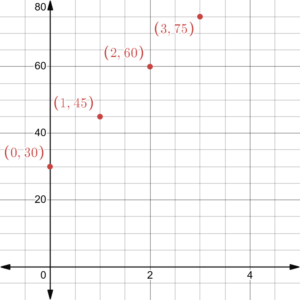
Linear functions describe quantities that increase or decrease at a constant rate, such as the amount of money paid for a gym membership. The membership may require an initial payment to join, followed by a monthly payment. The total amount of money paid increases at a constant rate since each month the total increases by the set monthly payment.
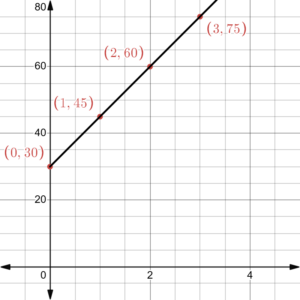
For example, it may cost $30 to join a gym plus $15 each month. After one month of membership you may have paid $45 ($30 to join and $15 monthly payment). The next month you’ll pay another $15, so the total paid will then be $60. The following month will be another $15, so the total paid will then be $75. Each month the total increases by $15. Let’s graph it.
Because the starting value is $30 and the rate of increase is $15 per month, the function is .
The key point is that if something increases at a constant rate, it can be modeled using the equation of a line as a linear function. The rate of change will be the slope and the initial value is typically the y-intercept.
Note about the variables: Keep in mind that the variables used in a linear function do not have to be and
. The variables can be any letter. In the previous example, the total cost may be represented by
and each month by
. The function would be written as
. In this case m is the variable for number of months and 15 is the slope.
The function is sometimes also written as instead of just
.
is simply just a way of stating that the cost
is dependent on the months,
. In other words,
is a function of
.
Example
A company’s monthly expense is $20,000 each month for rent and other fixed costs. The products that the company creates cost $120 to produce. Write a function that represents the total cost in terms of the number of products produced,
.
In this case, the cost increases at a constant rate. It increases by $120 for each product produced, so the slope is $120. Even if no products are produced, there is a cost of $20,000, so that is the starting value or -intercept.

Parallel and Perpendicular Lines on the Digital SAT
Lines that are parallel have the same slope.
For example, if the equation of one line is , a line parallel to it could have the equation
. As long as the lines have the same slope and different
-intercepts, they’re parallel.
Lines that are perpendicular have slopes that are the negative reciprocal of each other.
For example, if the slope of one line is , then the slope of a line perpendicular to it will be
. To find a negative reciprocal, flip the fraction and change the sign.
These are some of the fastest points on the Digital SAT math section. The test almost always gives one line’s equation and asks for the equation of a parallel or perpendicular line through a specific point. Once students know whether to keep the slope or flip it, the rest is plugging in the point to find the new -intercept.
Interpreting Linear Functions in Word Problems
Word problems are where students lose the most points on this topic. The math is easy. The reading is not.
Every linear function word problem on the Digital SAT has a rate of change and an initial value. The job is to figure out which number is which.
The rate of change is the amount that repeats. Look for words like each, per, every, and for each additional. The initial value is the amount that happens once, before anything repeats. Look for fixed fee, starting, initial, membership fee, or flat rate.
Three types show up often.
Cost and pricing. A service charges a fixed fee plus a rate per hour, per mile, or per item. The fixed fee is the -intercept and the rate is the slope.
Distance and time. Something moves at a constant speed from a starting position. The speed is the slope and the starting position is the -intercept. If it’s moving toward the reference point, the slope is negative.
Filling and emptying. A tank drains at a constant rate, or a savings account grows by a fixed deposit. Draining gives a negative slope. Growing gives a positive one.
Once students name the rate of change and the initial value, they can write the function and answer whatever the question is actually asking.
Using the Desmos Calculator on Linear Functions Questions
The Digital SAT has the Desmos graphing calculator built into the Bluebook app, and it’s available during both math modules. On linear functions questions, Desmos is often faster than doing the algebra.
Graphing to read the slope and y-intercept. Type the equation into Desmos and the line appears. Click where the line crosses the y-axis and Desmos labels the point, which gives the y-intercept with no calculation.
Finding the equation from two points. Enter the two points as a table in Desmos, then add a linear regression. Desmos gives the slope and the y-intercept. This is normally faster than the slope formula, and it takes out the arithmetic mistakes that come from subtracting negatives.
Finding where two lines intersect. Graph both equations and click the point where they cross. Desmos gives the exact coordinates. This helps on linear functions questions that are really systems questions.
Checking answer choices. When a question asks which equation matches a graph, graphing each answer choice takes a few seconds and confirms the answer.
Desmos is slower in two cases. The first is when the numbers are simple enough to do in your head. The second is when the question asks what a number means instead of asking students to calculate something. No calculator answers that. Knowing when to skip Desmos matters as much as knowing how to use it.
Digital SAT Linear Functions Example with Video Explanation
A landscaping company charges a fixed fee plus an hourly rate. A 3-hour job costs $195, and a 7-hour job costs $415. Which equation represents the total cost C(h), in dollars, for a job that takes h hours?
A)
B)
C)
D)
Video Explanation
Text Explanation
Answer: C
The hourly rate is the slope:
,
So the cost increases by $55 per hour. Use and substitute (3,195) to solve for
:
,
,
Therefore, the equation is:
Choice C is correct.
Linear Functions Practice Problems with Video Explanations
Here is a set of practice Digital SAT linear-function practice problems. After selecting an answer, press “See Answer” to see the correct answer and a video explanation showing how to properly solve the questions. At the end of the set, after you press “Submit”, you’ll be able to see all of the questions, answers, and video explanations to review.
Please wait…![]()
For more linear functions practice with a video explanation for every question, our on-demand SAT prep course covers all 17 Digital SAT math topics with lessons, practice sets, and full-length practice tests.
Common Mistakes
Three common mistakes students make when answering linear-function questions are assuming the -axis and
-axis use the same scale, not accounting for a negative slope in word problems, and not accounting for the first rate in the starting amount in word problems.
Assuming the x-axis and y-axis use the same scale
The Digital SAT tries to trick students by using different scales for the -axis and
-axis. For example, the marks on the
-axis may count by twos, but the marks on the
-axis may count by ones. Therefore students may make a mistake when determining the slope, because a difference in three marks on the
-axis is really a difference in six units.
For word problems, not accounting for a negative slope when an amount is decreasing
Linear function questions often involve treating a real-world scenario as a linear function. When an amount decreases by a constant rate, the rate is the slope. Make sure to use a negative slope when the rate represents a constant decrease.
For word problems, not accounting for the first rate in the starting amount (y-intercept)
Linear functions represent real-world scenarios that involve a constant rate of change and a starting value. Some questions provide the starting value as a number that includes the first increase.
For example:
A taxi charges $8 for the first mile and $3/mile after the first mile.
Students may assume that the rate (slope) is 3 and the starting value is 8 (-intercept). Resulting in:
However, the $8 is for the first mile, so the $3 per mile is included in it. The extra fee (starting value) is $5.
Therefore the function should be:
What Should You Study After Linear Functions?
Linear functions connect to three other Digital SAT math topics. The slope and y-intercept skills on this page are used in all three, so studying them next builds on what you just learned.
Topics Related to Linear Functions
Solving for a Variable in Terms of Another
Some linear functions questions give an equation in a form students can’t read the slope from, so it has to be rearranged first. Getting an equation into form means solving for
in terms of
, which is what solving for a variable in terms of others questions ask students to do.
Infinite Solutions and No Solution
A system of equations has no solution when the graphs don’t intersect. One of the times that happens is when two lines are parallel. To answer infinite solutions and no solution questions correctly, students have to be able to identify and compare slopes, which is a linear functions skill.
System of Equations
Most systems questions on the Digital SAT are made up of two linear functions. Once students can find a slope and a y-intercept, system of equations questions come down to deciding whether to substitute, eliminate, or graph.
Frequently Asked Questions About SAT Linear Functions
Here are the frequently asked questions that I get from students when reviewing linear functions.
What does a perpendicular line mean?
If two linear functions are perpendicular, then they intersect at right angles. For the question, though, you are normally asked to find the equation of a perpendicular line. To do so, you need to use the concept that the slopes of perpendicular lines are negative reciprocals of each other. For example, if one slope is , then the other slope is
.
How do I solve linear function word problems on the Digital SAT?
To solve linear function word problems on the Digital SAT, identify the constant rate of change (this will be the slope, ) and the starting value (this will be the
-intercept,
).
Substitute the values into the slope-intercept equation of the line:
Then read the question again to see what it’s actually asking for, which is often an interpretation instead of a number.

Find Out Which Math Topics Are Costing You the Most Points
Linear functions are 15% of Digital SAT math, but the topics costing you the most points are specific to you. A student who already answers every linear functions question correctly should be studying something else.
Our free diagnostic SAT with a topic assessment gives you a scaled score based on College Board scoring, plus a ranked list of which of the 17 math topics you are losing the most points on. That list tells you what to study first.
All 17 Digital SAT Math Topics
Linear functions is the most common of the 17 Digital SAT math topics, but every topic has its own lessons, practice problems, and video explanations.
Raise Your Score on the Topics That Matter Most
Most students don’t need to study everything. Studying the most common topics that you’re weakest in gives you the biggest score increase for the time you put in. Our guide to improving your SAT score covers how to build a study plan around your diagnostic results.
Glyn Caddell
Glyn Caddell holds a BS in Mechanical Engineering from NJIT and has been tutoring New York City students since 2008. He founded Caddell Prep in 2012 and is the author of Digital SAT Math Secrets: Lessons & Tricks to Quickly Improve to a Perfect 800 on the Math Test, which contains over 900 practice problems and is used in Caddell Prep’s SAT math classes. He is founding president of the Staten Island Technical High School alumni association and teaches every lesson on this site personally.