
Home » The Digital SAT: What’s Tested, How It’s Scored, and How to Improve Your Score » The 17 Digital SAT Math Topics: How Often Each Is Tested and What to Study First » SAT No Solution & Infinite Solutions: Lesson, Practice Problems & Video Explanations
By Glyn Caddell, BSME · Author of Digital SAT Math Secrets · Tutoring since 2008 — Updated August 18, 2026
The SAT may ask questions regarding two functions that have no solution or infinite solutions. No Solution & Infinite Solution questions test students on the graphs of functions, properties of linear functions, and properties of quadratic functions. No Solution & Infinite Solutions questions appear on approximately 0.9% of the Digital SAT. No Solution & Infinite Solution questions fall under Algebra according to the College Board.
No Solution & Infinite Solutions Lesson
The lesson covers the types of No Solution & Infinite Solutions questions that show up on the Digital SAT. It covers no solutions to a system of equations and infinite solutions to a system of equations.
What Do No Solution & Infinite Solutions Questions Look Like?
Here are some examples of No Solution & Infinite Solutions questions from the Digital SAT.
- If the system has no solution, what is the value of
?
- In the given equation,
is a constant. THe equation has no solutions. What is the value of
?
- One of the two equations in a system of linear equations is given. The system has infinitely many solutions. Which equation could be the second equation in this system?
1. No Solution to a System of Equations
If you think of the two equations as functions, they would be two functions that never intersect.
If they are both linear equations, they will have the same slope but different y-intercepts.
For example, if we had the system of equations and
, we could graph them and see that they never intersect.
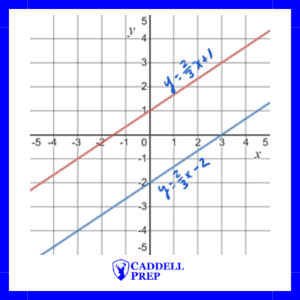
Here is an example of two linears equation that never intersect.
,
It isn’t easy to immediately notice, but both equations have the same slope. Solve for y in the second equation.
Divide both sides by 3 to get
Both functions have a slope of
Here is a graph of both functions.
How to Identify a System of Linear Equations with No Solutions
A system of linear equations has no solution when the two lines are parallel. This means they:
Have the same slope
But different y-intercepts
Put both equations into slope-intercept form:
If
(slope) is the same but
(
-intercept) is different → no solution
Example:
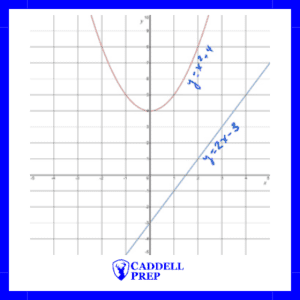
Equation 1:
Equation 2:
Both linear functions have a slope of 2. Same slope and different y-intercepts, so there’s no solution.
How Can I Check If There is No Solution to a System of Linear Functions By Using Desmos?
You can graph the two functions in Desmos and see if they ever intersect. If the lines are parallel, then they will never intersect. Therefore, if they are parallel, there is no solution.
Infinite Solutions
On the Digital SAT, infinite solutions only appear in a system of linear equations or as a single equation in which a linear function equals a linear function.
A system of linear equations has infinite solutions when the two equations represent the same exact line. That means:
Same slope
Same y-intercept
Every point on one line is also on the other
What the Graph Looks Like
It looks like just one line, even though it came from two equations.
How to Recognize It Algebraically
Write both equations in slope-intercept form:
y = mx + b
If both equations are exactly the same after simplifying → infinite solutions
Example
For example, the following system of equations has infinite solutions.
,
Solve for in both equations, and you’ll see that both equations are actually the same:
.
If both functions were graphed, they would be graphed right on top of each other, so there would be infinite solutions.
Digital SAT Tips
You can also graph both equations in Desmos:
If they intersect → one solution
If they don’t intersect → no solution
If they overlap → infinite solutions
Example
In the given equation, is a constant. If the equation has infinitely many solutions, what is the value of
?
A) 0
B) 4
C) 9
D) 13
Video Explanation
Text Explanation
Answer: B) 4
For an equation to have infinitely many solutions, both sides must be identical for every value of . The left side is
, so the right side must also be
. Therefore,
.
Common Mistakes
Two common mistakes students make when answering No Solution & Infinite Solution questions are not using Desmos and reorganizing equations by solving for .
Not Using Desmos
Most system of equations questions can be solved quickly using Desmos. Simply enter both equations into Desmos and click on the point of intersection(s). Wherever the equations intersect is the solution(s).
Reorganizing Equations by Solving for y
A common mistake is reorganizing the equations to graph them in Desmos. This isn’t inherently a math mistake, but it’s a test-taking mistake for two reasons:
- It wastes time. The equations do not need to be solved for
or in any specific form in order to graph them in Desmos. Simply enter them as they are provided.
- It introduces an opportunity for an error. When you try to reorganize an equation, you introduce a chance to make a mistake. There’s no reason to introduce a chance for a mistake when the equations can be graphed as-is.

Frequently Asked Questions
Here are two frequently asked questions that I get from students when reviewing No Solution & Infinite Solutions.
How do you find the number of solutions to a system of equations from a graph?
The number of solutions to a system of equations can be found from a graph by identifying the point(s) of intersection. The number of times the graphs of the equations intersect with each other is the number of solutions.
How many solutions does a system of equations have?
Each system of equations can have a different number of solutions.
Two linear functions
Two linear functions can have zero, one, or infinitely many solutions.
They will have zero if they are parallel lines because they will never intersect.
They will have one if they are lines with different slopes. They will intersect once.
They will have infinitely many solutions if they are the same lines. It may not be obvious that they are the same equations until you graph them.
A linear function and a quadratic function
A linear function and a quadratic function can have zero, one, or two solutions.
Related Topics
System of Equations and Quadratic Functions are topics related to No Solution & Infinite Solutions.
System of Equations
The topic systems of equations is related to the topic of no solution & infinite solutions because no solution & infinite solution questions always involve a system of equations. The no solution & infinite solution questions are based on system of equations concepts. but take those concepts a step further.
Quadratic Functions
The topic quadratic functions is related to the topic of no solution & infinite solutions because occasionally one of the equations included in the no solution & infinite solution question is a quadratic function. The quadratic equation, normally paired with a linear equation. Some of the methods to solve quadratic function questions can be applied to solving no solution & infinite solution questions.
All Math Topics
All of our math topics are available here: https://caddellprep.com/sat/math/ for you to review and improve on your SAT. There are lessons, practice problems, and video explanations for you. If you need more help, try our on-demand SAT course with video lessons, practice tests, and sets of questions for each topic: https://caddellprep.com/sat/prep/on-demand/
Glyn Caddell
Glyn Caddell holds a BS in Mechanical Engineering from NJIT and has been tutoring New York City students since 2008. He founded Caddell Prep in 2012 and is the author of Digital SAT Math Secrets: Lessons & Tricks to Quickly Improve to a Perfect 800 on the Math Test, which contains over 900 practice problems and is used in Caddell Prep’s SAT math classes. He is founding president of the Staten Island Technical High School alumni association and teaches every lesson on this site personally.