Give us a call (917) 722-0677

You can excel with Caddell!

By Glyn Caddell, BSME · Author of Digital SAT Math Secrets · Tutoring since 2008 — Updated August 18, 2026

Digital SAT Quadratic Functions

Quadratic function questions test students on the forms of the quadratic function, the zeros and vertex of the function, and the properties of the function’s roots. Quadratic function questions appear on approximately 9.6% of the Digital SAT. Quadratic function questions fall under Advanced Math according to the College Board. 

Quadratic Functions Lesson

The lesson covers the types of quadratic functions questions that show up on the Digital SAT. This lesson covers how to identify a quadratic function, the key features of the graph, how to solve quadratic function problems, common SAT problem types, and ways to solve a quadratic equation.

What Do Quadratic Functions Questions Look Like?

Here are some examples of Quadratic Functions questions from the Digital SAT.

  • Given a quadratic equation, what is the positive solution to the given equation?
  • Which number represents the height, in meters, from which the object was kicked/fired?
  • Given a quadratic function, for what value of x does f(x) reach its minimum?
  • Given a quadratic function, for what value of x does f(x) reach its maximum?
  • Given a quadratic equation, how many distinct real solutions does the given equation have?
  • Given a quadratic equation, what is the sum of the solutions to the given equation?
  • One solution to the given equation can be written as 1+\sqrt{k} where k is a constant. What is the value of k?
  • Which of the following is the best interpretation of the vertex of the graph y=f(x) in the xy-plane?

1. Graph of a Quadratic Function

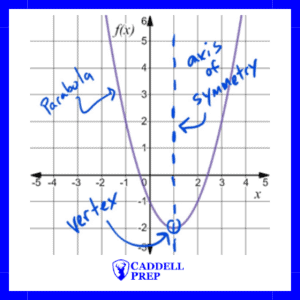
A graph of a quadratic function is a parabola (U-shaped).

The vertex is the point on the graph where the parabola changes from decreasing to increasing or from increasing to decreasing.

Parabolas are symmetric over the axis- of-symmetry, which passes through the vertex.

Graph of a Quadratic Function

Key Features of the Graph

A graph of a quadratic function is a parabola (U-shaped).

A quadratic function can be written as: y = ax^2 + bx + c. From this, we can use a formula to identify the vertex and axis of symmetry.

The vertex is the point on the graph where the parabola changes from decreasing to increasing or from increasing to decreasing.

  • Formula for the x-coordinate of the vertex:  x = -\dfrac{b}{2a}
  • Plug this x back into the equation to find the y-coordinate.

Parabolas are symmetric over the axis of symmetry, which passes through the vertex.

  • Use the formula x = –\dfrac{b}{2a} to find the equation of the axis of symmetry.

2. Forms of a Quadratic Function

Three forms of a quadratic function are standard form, vertex form, and factored form. Each form gives specific information about the function.

Standard Form

A quadratic function can be written as: y = ax^2 + bx + c

Where:

  • a determines the direction of the parabola (opens up if a > 0, down if a < 0.
  • b affects the axis of symmetry and position.
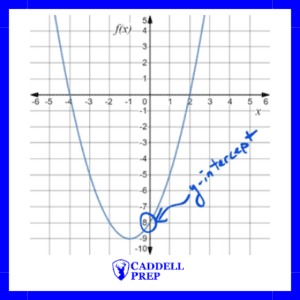
  • c is the y-intercept.

The quadratic function y= x^2+2x-8 is graphed below. From this form, we can immediately identify the y-intercept as -8.

Graph showing the y-intercept of a quadratic function

Vertex Form

A quadratic function can be written in vertex form, written as y=a(x-h)^2+k

Where (h, k) is the vertex.

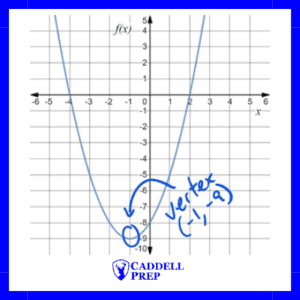
The quadratic function y= x^2+2x-8 can be written in vertex form y=(x+1)^2-9. From this form the vertex can immediately be identified as (-1, -9).

Graph showing the vertex of a function

Factored Form

A quadratic function can be written in factored form, written as y=(x+p)(x+q)

Where -p and -q are the zeros (roots) of the quadratic function.

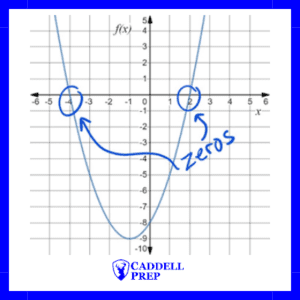
The quadratic function y= x^2+2x-8 can be written in factored form as y=(x+4)(x-2). From this form the zeros (roots) can immediately be identified as -4 and 2.

Graph showing the zeros of a quadratic function

3. Solving Quadratic Function Problems

Depending on what’s given, you might:

  • Find the vertex: Use -\dfrac{b}{2a} and substitute into the equation.
  • Find intercepts:
    • y-intercept: (0, c). Substitute 0 in for x and the value of the function is the y-intercept.
    • x-intercepts: Solve for x when y = 0. To solve algebraically, you need to factor the equation and set each factor equal to zero, then solve for x. You can also solve for the x-intercepts by using the quadratic formula.
    • For most questions, the x and y intercepts can be found by graphing the function in Desmos and clicking on the intercepts to see the coordinates.
  • Write the equation from points:
    • If vertex form is given: y = a (x - h)^2 + k, where (h, k) is the vertex.
    • If standard form is needed: Expand and simplify.

4. Common SAT problem types

  • Matching equations to graphs: Look at a, b, and c to determine shape and intercepts.
  • Word problems: Often about maximum/minimum values, which are at the vertex.
5. Zeros (Roots) of a Quadratic Function

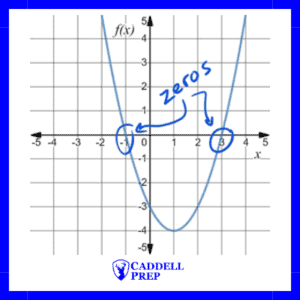
The zeros, sometimes referred to as roots, of a function are the x-values that make the function (y-value) equal to zero.
We can easily identify the zeros of a function from its graph. The graph below is zero (intersects the x-axis) at -1 and 3.

Zeros of a Quadratic Function on a Graph

One Zero and No Zeros

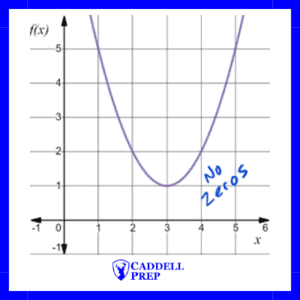
The graph of a quadratic function has a U shape, so it’s also possible that it will only touch the x-axis once or even not at all, resulting in one zero or no zeros.
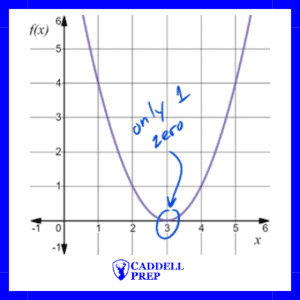
Graph of a quadratic function with one zero
The function only intersects the x-axis once, so there is only one zero (root).
Graph of a quadratic function with no zeroThe function doesn’t intersect the x-axis, so there are no zeros (roots).
Example of One Zero

The function f(x)=x^2-6x+9 only has one zero. We can see by factoring or using the quadratic formula.

From factoring:

x^2-6x+9=0,

(x-3)(x-3)=0,

x=3, x=3

From the quadratic formula:

x^2-6x+9=0,

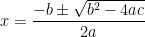
x=\dfrac{-b\pm\sqrt{b^2-4ac}}{2a},

x=\dfrac{-(-6)\pm\sqrt{(-6)^2-4(1)(9)}}{2a},

x=\dfrac{6\pm\sqrt{36-36}}{2},

x=\dfrac{6\pm-0}{2}

so, our solutions become

x=\dfrac{6+0}{2} and x=\dfrac{6-0}{2}

but we end up with the same solution

x=3
Example of No Zeros

The function f(x)=x^2-6x+10 doesn’t have a zero.

We can’t factor it, so let’s look at it by using the quadratic formula.

x=\dfrac{-b\pm\sqrt{b^2-4ac}}{2a},

x=\dfrac{-(-6)\pm\sqrt{(-6)^2-4(1)(10)}}{2(1)},

x=\dfrac{-(-6)\pm\sqrt{36-40}}{2},

x=\dfrac{-(-6)\pm\sqrt{-4}}{2},

We end up with the square root of a negative number, which is not real, so there are no real roots.

Finding the Number of Zeros

Sometimes on the SAT, a question will ask for the number of roots or a similar question.

The following questions are all asking the same thing:

  • To find the number of real solutions to x^2+3x+4=0
  • To find the number of zeros the function f(x)=x^2+3x+4 has
  • To find number of roots of the function f(x)=x^2+3x+4 has

In each of the above questions, we would find the zeros using a graph, factoring, or the quadratic formula.

6. Ways to Solve a Quadratic Equation

Three ways to solve a quadratic equation are factoring, using the quadratic formula, and using Desmos.

Factoring

One way to solve a quadratic equation involves factoring.

In order to factor, you first must use inverse operations to get one side of the equation equal to zero, so you have the form:

ax^2+bx+c=0

where a, b, and c are constants.

Almost all factoring on the Digital SAT is done when a=1, so that is what we will cover.

The equation will have this form:

x^2+bx+c

The goal is to change the left-hand side of the equation into the product of two binomials like this:

(x+p)(x+q)=0

The rules for determining p and q are that

  • they must multiply to equal c
  • they must add up to equal b

For example,
x^2+5x+6=0
Factors to
(x+3)(x+2)=0
because 3\times 2=6 and 3+2=5

After you factor, set each factor equal to 0 and solve for x

x+3=0

subtract 3 from both sides

x=-3
x+2=0

subtract 2 from both sides

x=-2

The solutions are x=-3 and x=-2.

Another example,
x^2+4x-12=0
Factors to
(x+6)(x-2)=0
because 6 \times -2=-12 and 6+(-2)=4

After you factor, set each factor equal to 0 and solve for x

x+6=0

subtract 6 from both sides

x=-6
x-2=0

add 2 to both sides

x=2

The solutions are x=-6 and x=2.

Quadratic Formula

Sometimes an equation does not factor. In that case the quadratic formula can be used. It’s also helpful to use the quadratic formula if the coefficient in front of the x^2 is a number other than 1.

To use the quadratic formula, one side of the equation must equal 0.

The equation will have the form:

ax^2+bx+c=0

The quadratic formula is

x=\dfrac{-b\pm \sqrt{b^2-4ac}}{2a}

Substitute the values of a, b, and c into the formula and evaluate.

The \pm symbol means you have to evaluate it once as a + and once as a -. You will potentially end up with two answers.

x=\dfrac{-b+ \sqrt{b^2-4ac}}{2a}

and

x=\dfrac{-b- \sqrt{b^2-4ac}}{2a}
Example

What are the zeros of the function f(x)=x^2-7x+6?

f(x)=x^2-7x+6

a=1, b=-7, c=6,

 x=\dfrac{-b+-\sqrt{b^2-4ac}}{2a},

 x=\dfrac{-(-7)+-\sqrt{(-7)^2-4(1)(6)}}{2(1)},

 x=\dfrac{7+-\sqrt{49-24}}{2},

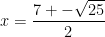
 x=\dfrac{7+-\sqrt{25}}{2},

 x=\dfrac{7+-5}{2},

From this, we get two possible solutions

 x=\dfrac{7+5}{2} and  x=\dfrac{7-5}{2}

which results in 

 x=\dfrac{12}{2} and  x=\dfrac{2}{2}

simplified to 

 x=6 and  x=1

Desmos

Since quadratic equations are single-variable equations, they can be solved in Desmos by entering the quadratic equation into Desmos. The solutions will be the vertical lines. Click on the x-intercepts of the vertical lines to see the x-values that are solutions to the equation.

7. Formulas for Product of the Roots and Sum of the Roots

To find the sum or product of the roots of a quadratic function, you could solve for the roots and then add them together to find the sum or multiply them to find the product.

The problem is that if the roots are irrational, such as 3+\sqrt{5}and 3-\sqrt{5}, it could be a little difficult to find the sum or product.

Instead, we can use two formulas to find the sum or product of the roots immediately.

If the function is in the form f(x)=ax^2+bx+c, we can use the following formulas:

sum of roots=\dfrac{-b}{a}

product of roots=\dfrac{c}{a}

Example

Find the sum and product of the roots of the function g(x)=2x^2+3x-8.

Explanation & Solution

sum of roots=\dfrac{-b}{a}=\dfrac{-3}{2}

product of roots=\dfrac{c}{a}=\dfrac{-8}{2}=-4

8. Projectile Motion

A question that appears on the SAT has to do with using a quadratic function to represent the height of a projectile with respect to time.

Let’s look at an example.

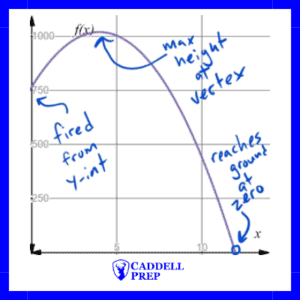
The height of a projectile fired off a cliff can be determined using the function h(t)=-16t^2+128t+768, for 0 \leq t \leq 12. From what height was the projectile fired?

Graph of projectile motion showing max height and max distance(quadratic)

From the graph, we can see that the starting heigh is 768, the y-intercept.

Tips

  1. You can find the vertex of a quadratic function by modifying the equation to get it into vertex form, by using the equation for the axis of symmetry and then substituting the x-value into the function to get the y-value, or by simply graphing the function in Desmos and clicking on the vertex to see the coordinates.
  2. You can find the zeros (roots) of a quadratic function algebraically or simply by graphing the function in Desmos. You can then click on the x-intercepts to get the coordinates of the zeros.
  3. If a question asks for the number of real solutions to a quadratic equation, you can enter the equation into Desmos and see how many solutions (vertical lines) are graphed.
  4. Memorize the quadratic formula. The formula is not provided on the Digital SAT. Make the effort to memorize it. There are some questions in which the formula is necessary. The formula is: x=\dfrac{-b\pm \sqrt{b^2-4ac}}{2a}
  5. If a question asks to find the number of real solutions to a quadratic equation, the answer can only be 0, 1, or 2. It can never be 3, which is commonly one of the answer choices.

Digital SAT Example

f(x)=-(x-5)^2+18

The function f is defined by the given equation. What is the maximum value of f(x)?

A) 5
B) 13
C) 18
D) 23

Video Explanation

Text Explanation

Answer: C) 18

The function is written in vertex form:

f(x)=a(x-h)^2+k

The vertex of the parabola is (h,k).

In the equation

f(x)=-(x-5)^2+18

the vertex is (5,18).

Since the coefficient of (x-5)^2 is negative, the parabola opens downward. Therefore, the vertex gives the maximum value of the function. The value of a function always refers to the y-value.

The maximum value of f(x) is 18. The correct answer is C.

Practice Problems with Video Explanations

Here is a set of practice Digital SAT quadratic function practice problems. After selecting an answer, press “See Answer” to see the correct answer and a video explanation showing how to properly solve the questions. At the end of the set, after you press “Submit”, you’ll be able to see all of the questions, answers, and video explanations to review.

For more practice like this, enroll in our on-demand SAT prep course here: https://caddellprep.com/sat/prep/on-demand/

1. (x+5)(x-9)=0

What is the positive solution to the given equation?

Question 1 of 3

2. The height h, in feet, of a ball t seconds after it is thrown upward is modeled by the equation h(t)=-16t^2+80t+6. What is the maximum height, in feet, reached by the ball?

Question 2 of 3

3. The graphs of the equations y=x^2-8x+19 and y=4x+k intersect at exactly one point, where k is a constant. What is the value of k?

Question 3 of 3


Common Mistakes

Three common mistakes students make when answering quadratic function questions are trying to derive information from the wrong form of a quadratic function, reorganizing a quadratic function to graph it in Desmos, and evaluating the discriminant incorrectly because negative signs were left out.

Trying to Derive Information from the Wrong Form of a Quadratic Function

A common mistake is trying to derive information from the wrong form of a quadratic function. For example, if a function is written in standard form: f(x)=ax^2+bx+c, the y-intercept is c. However, if the function is written in vertex form, f(x)=a(x-h)^2+k, the last constant, k, represents the y-coordinate of the vertex, not the y-intercept.

Here’s an example with numbers:

f(x)=x^2-6x+13

and

f(x)=(x-3)^2+4

are the same function, written differently. 

In the first function, 13 represents the y-intercept. In the second function, 4 is not the y-intercept, it’s the y-coordinate for the vertex, (3, 4).

Reorganizing a Quadratic Function to Graph It in Desmos

A common mistake is reorganizing a quadratic function to graph it in Desmos. This isn’t inherently a math mistake, but it’s a test-taking mistake for two reasons:

  1. It wastes time. The function does not need to be solved for y or in any specific form in order to graph it in Desmos. Simply enter the function as it is provided.
  2. It introduces an opportunity for an error. When you try to reorganize the function, you introduce a chance to make a mistake. There’s no reason to introduce a chance for a mistake when the function can be graphed as-is.

Evaluating the Discriminant Incorrectly Because Negative Signs Were Left Out

A common mistake is incorrectly substituting values into b^2-4ac by leaving off the negative signs associated with a or c.

Frequently Asked Questions

Here are three frequently asked questions that I get from students when reviewing quadratic functions.

What is the discriminant, and why is it important?

The discriminant is the expression under the square root in the quadratic formula.

The quadratic formula is:

x=\dfrac{-b\pm \sqrt{b^2-4ac}}{2a}

The discriminant is:

b^2-4ac

The discriminant is important because it can be used to determine the number of real solutions to a quadratic equation.

Because the numerator is -b \pm \sqrt{discriminant}, a quadratic can have 2, 1, or 0 real solutions.

If the discriminant is positive there will be 2 real solutions.

If the discriminant is 0, there will be 1 real solution.

If the discriminant is negative, there will be no real solutions.

How do I find the minimum or maximum value of a quadratic function?

The minimum or maximum value of a quadratic function will be the y-value at the vertex. Simply graph the function in Desmos and click on the vertex to find the minimum/maximum value. Note that a quadratic function can only have a minimum or a maximum value; it can’t have both.

What kind of functions can quadratic functions represent?

Quadratic functions can represent the height of an object that is thrown, launched, or shot from a specific height. Because the trajectory of a thrown object follows a parabolic shape, a quadratic function matches it correctly. Note that for most quadratic functions that model the height of an object, the y-value typically represents the height of the object and the x-value typically represents the time in minutes or seconds, not the horizontal distance.

Related Topics

Solve for a variable in terms of others and system of equations are related to quadratic functions.

Solve for a Variable in Terms of Others

Solving for a variable in terms of others is a topic related to quadratic functions. Sometimes quadratic functions need to be rearranged in order to get the function in a specific format, such as vertex form. Mastering how to solve for a variable in terms of others helps when rearranging a quadratic function. Therefore, practicing how to solve for a variable in terms of other variable can help improve the number of quadratic function questions a student gets correct.

System of Equations

Quadratic functions sometimes appear in a system of equations question. Sometimes it is one of the equations included, normally with a linear function. The SAT question typically will ask how many solutions the system of equations has.

All Math Topics

All of our math topics are available here: https://caddellprep.com/sat/math/ for you to review and improve on your SAT. There are lessons, practice problems, and video explanations for you. If you need more help, try our on-demand SAT course with video lessons, practice tests, and sets of questions for each topic: https://caddellprep.com/sat/prep/on-demand/

Glyn Caddell

Glyn Caddell holds a BS in Mechanical Engineering from NJIT and has been tutoring New York City students since 2008. He founded Caddell Prep in 2012 and is the author of Digital SAT Math Secrets: Lessons & Tricks to Quickly Improve to a Perfect 800 on the Math Test, which contains over 900 practice problems and is used in Caddell Prep’s SAT math classes. He is founding president of the Staten Island Technical High School alumni association and teaches every lesson on this site personally.