
Home » The Digital SAT: What’s Tested, How It’s Scored, and How to Improve Your Score » SAT Scores: How Scoring Works, What’s a Good Score, and How to Raise Yours » How to Improve Your SAT Score by 200 Points: Study Plan & Topic Breakdown
By Glyn Caddell, BSME · Author of Digital SAT Math Secrets · Tutoring since 2008 — Published August 24, 2026

A 200-point improvement takes approximately 80 hours of effective studying. It’s realistic for most students, as long as they start early enough.
The two things that determine whether it happens are how you spend those hours and which section you spend them on. Most students at this level split their time evenly between Math and Reading & Writing, and that’s normally the wrong approach.
This page covers how long a 200-point improvement takes, which section to work on first, which topics to study, and how to spend 80 hours so that they count.
Table of Contents
- Is a 200-Point Improvement Realistic?
- How Long Does It Take to Improve 200 Points?
- Start With the Section You’re Weaker In
- Which Math Topics to Study First
- Which Reading & Writing Topics to Study First
- How to Spend 80 Hours of Studying
- How to Study So the Hours Count
- Common Mistakes Students Make Trying to Gain 200 Points
- Frequently Asked Questions
- Take a Free Diagnostic SAT
Is a 200-Point Improvement Realistic?
For most students, yes. It’s a larger jump than most students attempt, but it’s a normal result for a student who starts early and studies the right way.
Where you start makes a difference. The same 200 points is easier to get at a 1000 than at a 1400, because there’s more unlearned material left to cover.
It’s also worth knowing what 200 points does to your percentile. The median SAT score is 1010. A student who goes from 1010 to 1210 moves from the 50 percentile to approximately the 83 percentile. That means scoring higher than about a third more of the students who take the test.
How Long Does It Take to Improve 200 Points?
Based on the students we’ve worked with since 2008:
- To improve 70-130 points, students need approximately 40 hours of effective studying.
- To improve 130-250 points, students need approximately 80 hours of effective studying.
Here’s what 80 hours looks like depending on how much time you can put in each week.
| Hours per week | Weeks to reach 80 hours |
|---|---|
| 5 | 16 weeks |
| 8 | 10 weeks |
| 10 | 8 weeks |
80 hours in four weeks is not realistic for most students. That’s 20 hours a week on top of school and everything else. A student taking the SAT in March should start in December.
There’s one more thing to understand about that number. Effective studying is not the same as studying. Watching a lesson is not effective studying. Reading a solution is not effective studying. Effective studying means attempting problems under test conditions, getting some wrong, and then figuring out why. One hour of that is worth about three hours of reading.
A student who counts passive review as studying can put in 80 hours and not move.
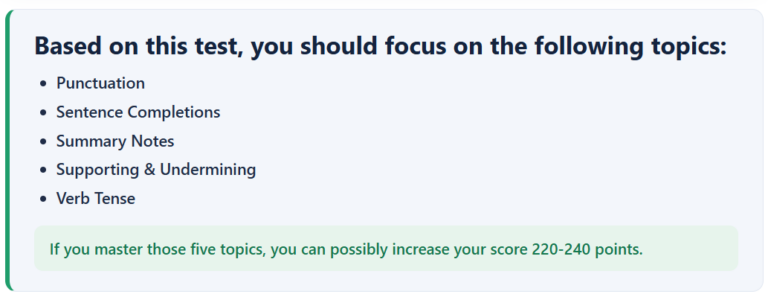
Want to Know What 5 Topics Will Improve Your SAT Score the Most?
Sample Feedback from our Diagnostic Test:
Start With the Section You're Weaker In
Most students at this score level are not balanced between the two sections. A 1010 is rarely a 505 in Math and a 505 in Reading & Writing. It’s more often a 560 and a 450.
The first block of points comes faster out of the weaker section, for two reasons.
First, there’s more unlearned material left in it. Unlearned topics are the fastest points to get, because you’re going from missing a question every time to getting it right every time.
Second, the scaled score curve is steeper in the middle of the range. The same number of additional correct answers is worth more points at a 450 than at a 560.
So the first step is to take a diagnostic test and look at your two section scores separately, not just your total. Then put the first block of hours into the lower one.
Which Math Topics to Study First
You don’t need to study all 17 math topics.
We categorized every question on the ten full-length practice tests released by the College Board. The five most common topics make up about 56% of the math section.
| Rank | Topic | % of test |
|---|---|---|
| 1 | Linear Functions | 15.0% |
| 2 | Combining Like Terms & Solving Equations | 11.7% |
| 3 | Angles, Polygons & 3-D Shapes | 10.4% |
| 4 | Quadratic Functions | 9.6% |
| 5 | Functions | 8.9% |
For a student going for an 800, every topic matters, because one question is the difference. For a student going for 200 points, that’s not the case. Closing the five most common topics covers more than half the math section, and it’s where the first block of hours should go.
See all 17 Digital SAT math topics with lessons and practice problems
Which Reading & Writing Topics to Study First
| Rank | Topic | % of test |
|---|---|---|
| 1 | Words in Context | 16.5% |
| 2 | Punctuation | 13.6% |
| 3 | Summary Notes | 10.8% |
| 4 | Transitions | 9.7% |
| 5 | Verb-Tense | 8.2% |
There’s an important difference between the two halves of the Reading & Writing section.
The grammar questions work like math. There are specific grammar rules. There’s a correct answer that follows from a rule, and once you know the rule you get the question right every time. Those four grammar topics account for approximately 25% of the Reading & Writing section.
The reading topics require judgment, and judgment improves more slowly.
For a student trying to gain 200 points in a set number of weeks, the grammar topics are the fastest way to gain points per hour of studying. They should come first.
See all 15 Digital SAT Reading & Writing topics with lessons and practice questions
How to Spend 80 Hours of Studying
This assumes about 8 hours a week over 10 weeks.
| What you do | Hours |
|---|---|
| Take a diagnostic test and review the results | 3 |
| Study the most common topics in your weaker section | 25 |
| Get the grammar topics to certainty | 12 |
| Study the most common topics in your stronger section | 20 |
| Take four full-length practice tests, timed | 12 |
| Review each test and categorize what you missed | 8 |
The order matters more than the exact hours. Diagnose first, work on the weaker section first, and leave enough time at the end for full practice tests.
How to Study So the Hours Count
Four things separate 80 hours that work from 80 hours that don’t.
1. Attempt Problems Before Reading the Explanation
Reading an explanation for a problem you haven’t tried feels productive. It isn’t. You have to get it wrong first to find out what you don’t know.
2. Categorize Every Question You Miss
After every practice test, put each missed question into one of three categories:
- Content — I didn’t know how to do it
- Careless — I knew how to do it and made a mistake
- Pacing — I ran out of time or rushed
Then count them. At this score level, most misses will be content. That’s good news, because content is the fastest of the three to fix.
3. Retake Missed Questions About a Week Later
Retaking a question right away normally means you’re remembering the answer instead of the method. Waiting about a week tells you whether you actually learned it.
4. Take Timed Practice Tests in One Sitting
Untimed practice tells you whether you can answer the questions. The test measures whether you can answer them in the time you’re given.
Finally, an SAT course that students actually understand
Every question has a video explanation. Not most — every one.
The on-demand Digital SAT course covers all 17 math topics and 15 reading and writing topics, with 5 full-length practice tests and a 100-point score increase guarantee. Keep access for the rest of high school. No subscription.
Common Mistakes Students Make Trying to Gain 200 Points
Common mistakes students make when trying to improve 200 points on the SAT include starting too late and studying both sections equally.
1. Starting Too Late
80 hours over four weeks is 20 hours a week on top of school. Most students can’t sustain that, and the ones who try normally end up doing 30 hours and getting 100 points.
2. Studying Both Sections Equally
Splitting your time evenly between Math and Reading & Writing ignores where the points actually are. Look at your two section scores separately and put more time into the lower one.
3. Taking Practice Tests Without Reviewing Them
If you don’t review a practice test, you spent three hours to get a score and nothing else. The review is where the improvement comes from.
4. Studying Every Topic in Order
Working through topics from first to last means spending the same amount of time on a topic that’s 15% of the test as one that’s under 1%. We categorized the questions so you know which topics matter most.
5. Using Outdated Material
There was a significant change in content between the old SAT and the Digital SAT. For example, questions with imaginary numbers appeared on the old version of the test but haven’t appeared on the Digital SAT. The old test also had an essay and “NO CHANGE” answer choices, neither of which exist now. A student using a pre-2024 book is spending hours on material that won’t be on the test.
6. Studying Topics That Don't Have Much Room for Improvement
If you want to make a big jump in your SAT score, you need to work on topics that have the most room for improvement.
However, studying the topics with only a small room for improvement is important if you want to score an 800 on math or an 800 on Reading & Writing.
Want to Know What 5 Topics Will Improve Your SAT Score the Most?
Sample Feedback from our Diagnostic Test:
Frequently Asked Questions
Students who want to raise their score by 200 points frequently ask whether that’s realistic, how long it takes, and which section to focus on first.
Can you really improve your SAT score by 200 points?
Yes. It takes approximately 80 hours of effective studying, and it’s a normal result for a student who starts early enough and studies the right topics.
How long does it take to improve 200 points?
Approximately 80 hours of effective studying. At 8 hours a week, that’s about 10 weeks. At 5 hours a week, it’s about 16 weeks.
Is it easier to improve in Math or Reading & Writing?
It depends on the student, but the faster points are normally in whichever section you’re currently weaker in. For most students, the grammar topics in Reading & Writing are the fastest single group of points on the test, because they’re rule-based.
How many times should I take the SAT?
Most students take it two or three times. Students normally take it for the first time in the spring of junior year, which leaves time to study and take it again in the fall of senior year.
Will 200 points change which colleges I can apply to?
It can. Going from 1010 to 1210 moves a student from the 50 percentile to approximately the 83 percentile. Whether that changes your list depends on the schools you’re considering, so compare your score to the 25 and 75 percentile scores those schools publish.
What if I only have a month to prepare for the SAT?
A month is normally enough for 70 to 130 points, not 200. Approximately 40 hours of effective studying is a reasonable target in a month. Focus on the most common topics in your weaker section and don’t try to cover everything.
Take a Free Diagnostic SAT
The first step is finding out where your points are. Students can take a free practice SAT with Caddell Prep to get an accurate score based on College Board scoring, along with an assessment showing exactly which topics to study.
If you’d rather work through the material on your own schedule, our on-demand Digital SAT course covers all 17 math topics and all 15 Reading & Writing topics with a video explanation for every practice question. It comes with a 100-point score increase guarantee, and this page covers what it takes to double that.

Glyn Caddell
Glyn Caddell holds a BS in Mechanical Engineering from NJIT and has been tutoring New York City students since 2008. He founded Caddell Prep in 2012 and is the author of Digital SAT Math Secrets: Lessons & Tricks to Quickly Improve to a Perfect 800 on the Math Test, which contains over 900 practice problems and is used in Caddell Prep’s SAT math classes. He is founding president of the Staten Island Technical High School alumni association and teaches every lesson on this site personally.
Need Help Preparing for the SAT?
Use the only SAT prep course built with an engineer’s approach and taught in a way that students actually understand.
100-point score increase guarantee
Take a Free Diagnostic SAT
Discover the 5 Topics That Could Make the Biggest Difference in Your Score.
Take our free diagnostic and receive a personalized assessment showing exactly what to study next.