
Home » College SAT Score Ranges, Costs, and Programs by Major and State » Test-Optional Colleges: Should You Submit Your SAT Score?
By Glyn Caddell, BSME · Author of Digital SAT Math Secrets · Tutoring since 2008 — Published September 10, 2026
Updated September 10, 2026. Test-optional policies change from one admissions cycle to the next. Check the current policy on each school’s own admissions page before deciding anything.
Test-optional means a school will consider an SAT score if you send one, and won’t hold it against you if you don’t. The decision is yours.
That sounds simple and it isn’t. Whether submitting helps depends on your score, the school, and what you want the score to do, and there are situations where the right answer is to leave it out.
This page covers what the terms mean, how to decide, and what test-optional doesn’t cover.
A note about who’s telling you this. Caddell Prep sells SAT preparation. A page from us saying test scores matter is a page with an interest in the answer, and you should read it that way.
Here’s the standard we’re holding to. The advice below is what we’d give if we sold nothing, and there are cases on this page where the right move is not to submit a score at all. If you get to the end and we never told you that, we didn’t do our job.
Table of Contents
Test-Optional, Test-Blind, and Test-Flexible Are Different Things
These three terms get used interchangeably in casual writing. They lead to completely different decisions.
Test-optional. The school will consider a score if you send one and won’t penalize you for not sending one. Sending is a choice, and this page is mostly about how to make it.
Test-blind, also called test-free. The school won’t look at a score even if you send it. Both terms mean the same thing and both are in use. If a school is test-blind, there’s no decision to make. Sending a score accomplishes nothing.
Test-flexible. The school accepts alternatives in place of the SAT or ACT, commonly AP or IB scores. This matters for a student with strong AP results and a weak SAT, because he may have something to submit that he didn’t realize counted.
The distinction is worth ten minutes of checking. A student who sends a score to a test-blind school has wasted the effort. A student who withholds from a test-flexible school may have had an option he never used.
Optional for Admission Is Not Optional for Everything
This is the part families miss most often, and it’s the part that costs money.
A school can be test-optional for admission and still use test scores for:
- Merit scholarships. Common, and expensive to get wrong.
- Honors programs and honors colleges.
- Course placement, particularly in math and foreign language.
- Specific majors, such as nursing, engineering, or other programs with their own admission requirements.
- Homeschooled applicants, who are sometimes asked for scores when other applicants are not.
- International applicants, who may face different requirements entirely.
The merit aid case is the one worth checking carefully. A student who withholds a score under a test-optional policy may be withholding himself from an award he would have qualified for, without ever knowing the award existed.
This isn’t universal. Some schools genuinely don’t look at scores for anything. But it’s common enough that the admissions policy and the aid policy should be checked separately, because they’re often written by different offices and they don’t always match.
More on SAT scores and merit scholarships and how merit grids work.
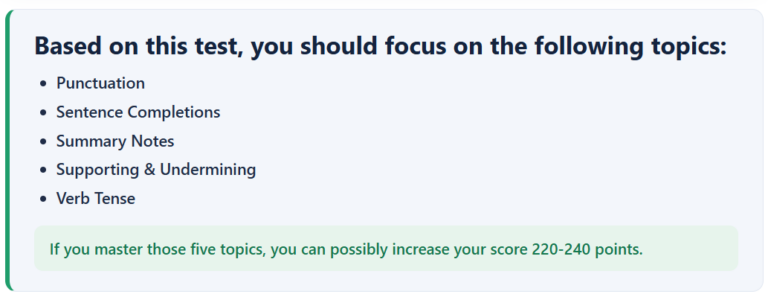
Want to Know What 5 Topics Will Improve Your SAT Score the Most?
Sample Feedback from our Diagnostic Test:
When Submitting Helps and When It Doesn't
Here’s the rule.
Submit if your score is at or above the 75 percentile of that school’s admitted range. A score in that range strengthens the application.
Don’t submit if your score is below the 25 percentile. At a test-optional school you’re not required to, and a score in that range doesn’t help. Leaving it out is the right call.
In between is a judgment call. It depends on the rest of the application. A student with a strong transcript and weak scores is normally better off letting the transcript speak. A student whose transcript is uneven may find a mid-range score adds something.
That middle band is genuinely ambiguous and anyone who tells you otherwise is guessing. If you’re in it, ask a counselor who knows your full application rather than following a rule from a website.
There’s one thing worth saying plainly. If your score is below the 25 percentile at every school on your list, the honest answer is not to submit it anywhere, and no amount of test preparation changes that between now and a January deadline. The score isn’t what’s holding the application back at that point.
Why a Test-Optional School's Published Range Is Misleading
Most students compare their score to the range a school publishes. At a test-optional school, that range is not what it appears to be.
The published range comes only from students who chose to submit. Students with strong scores submit. Students with weak scores don’t. So the range describes a self-selected group, not the admitted class.
That means the published range at a test-optional school is normally higher than the range for everyone the school actually admitted. A student comparing his score to it is comparing himself to the strongest slice of the class.
The practical consequence is that the bar for a score to help is higher than the number suggests. A score sitting at the middle of a test-optional school’s published range is not middling for that school. It’s middling among the students who were confident enough to send one.
That’s why the rule above uses the 75 percentile rather than the middle. More on what counts as a good SAT score and how to set a target.
What Has Changed Since 2020
Many colleges suspended their testing requirements in 2020, when the pandemic made sitting the test difficult or impossible for a lot of students.
Since 2024, a number have reinstated them. Dartmouth was the first Ivy League school to do so, announcing in February 2024, and others followed.
The result is a landscape that’s genuinely mixed. Some schools require scores, some are permanently test-optional, some are test-blind, and some have announced changes that take effect for a future entering class rather than the current one.
Whether test-optional admissions are good policy is an argument with serious people on both sides, and it isn’t what this page is for. What matters for a student applying next year is what a specific school requires for that specific entering class, and that’s a question with a factual answer.
Check the school. Don’t assume a policy carries over from a friend’s application two years ago.
How Do You Check a Specific School's Policy?
None of this is decidable in general. Policies are set school by school, they differ between programs at the same school, and they change between cycles.
The work is per school and it takes a few minutes each.
Where to Look
Start with the school’s own admissions page for the entering class you’re applying to. That’s the only authority. A policy stated for one entry year doesn’t necessarily hold for the next.
Then check the financial aid page separately. As above, the aid policy and the admissions policy don’t always match, and the aid one is the expensive one to get wrong.
If a program you’re applying to has its own admission process, check that too. Nursing and engineering programs commonly do.
Third-party lists are useful for a first pass and there are good ones maintained by organizations that do this full time. Use them to narrow down, then confirm on the school’s site before you act.
SAT Score Ranges by College
You need the school’s published range before you can apply the rule above.
We publish SAT score ranges by college, organized by major and by state, along with cost and program information.
If You're Not Sure Whether Your Score Helps
You can’t make this decision without a real score. A practice test taken casually at the kitchen table isn’t one.
A free diagnostic SAT gives an accurate score based on College Board scoring. That’s the number to compare against your school list.
If You Decide Your Score Is Worth Improving
This only makes sense if two things are true: there’s time before your deadlines, and the gap is closable.
A student with four months and a 60-point gap has a reasonable plan. A student with three weeks and a 200-point gap does not, and would be better off putting those hours into the rest of the application.
If the numbers work, how to improve your SAT score covers the method.
Frequently Asked Questions
Does test-optional really mean optional?
At a genuinely test-optional school, yes. Not submitting won’t count against you in admissions. Where it can matter is elsewhere in the process, including merit aid and honors programs, so check those separately.
Will not submitting my score hurt my application?
Not at a test-optional school. That’s what the policy means. Applications without scores are read on the rest of the file, which is what the school has committed to doing.
What's the difference between test-optional and test-blind?
Test-optional means the school will look at a score if you send one. Test-blind means it won’t look at a score even if you send one. At a test-blind school, sending accomplishes nothing.
Do test-optional schools use SAT scores for scholarships?
Many do. A score can be optional for admission and required to be considered for merit aid at the same school. Check the aid policy separately from the admissions policy.
Should I still take the SAT if my schools are test-optional?
Taking it gives you a decision to make. Not taking it takes the decision away. If you have time, sitting the test and then deciding whether to submit leaves you with more options than skipping it. If you don’t have time, a strong application without a score is a normal application at these schools.
Which colleges have reinstated the SAT requirement?
The list has grown since 2024 and it continues to change. Rather than working from a list that may be out of date, check the admissions page of each school you’re applying to for the entering class you’re applying to.

Glyn Caddell
Glyn Caddell holds a BS in Mechanical Engineering from NJIT and has been tutoring New York City students since 2008. He founded Caddell Prep in 2012 and is the author of Digital SAT Math Secrets: Lessons & Tricks to Quickly Improve to a Perfect 800 on the Math Test, which contains over 900 practice problems and is used in Caddell Prep’s SAT math classes. He is founding president of the Staten Island Technical High School alumni association and teaches every lesson on this site personally.
Finally, an SAT course that students actually understand
Every question has a video explanation. Not most — every one.
The on-demand Digital SAT course covers all 17 math topics and 15 reading and writing topics, with 5 full-length practice tests and a 100-point score increase guarantee. Keep access for the rest of high school. No subscription.
Want to Know What 5 Topics Will Improve Your SAT Score the Most?
Sample Feedback from our Diagnostic Test: