
Home » College SAT Score Ranges, Costs, and Programs by Major and State » SAT Scores and Merit Scholarships: What a Higher Score Is Actually Worth
By Glyn Caddell, BSME · Author of Digital SAT Math Secrets · Tutoring since 2008 — Published September 8, 2026
SAT scores affect merit aid. They don’t affect need-based aid, and families mix the two up constantly.
At schools that award merit aid on a published scale, moving up one score band can be worth thousands of dollars a year. That makes studying for the SAT one of the better-paying things a high school junior can do with a weekend, though only for students sitting near a band boundary.
This page covers how merit aid works, how to find out what a specific school offers, and how to calculate what raising your score is worth.
Table of Contents
Merit Aid and Need-Based Aid Are Not the Same Thing
Merit aid is awarded for what a student did. Grades, test scores, activities, and sometimes an essay or an interview.
Need-based aid is awarded for what a family can pay. It’s calculated from financial forms, and it has nothing to do with a student’s record.
Test scores affect the first and not the second. A higher SAT score will not reduce a need-based package, and it will not increase one either. Families sometimes worry about the first and hope for the second, and neither is how it works.
Most students receive a combination. What matters here is that only one of the two responds to test preparation.
How Automatic Merit Scholarships Work
Some schools award merit aid through a committee. Others publish a grid.
A merit grid is a table. One axis is GPA, the other is test score, and the cells contain dollar amounts. A student who meets both numbers receives that award automatically. There’s no separate application, no essay, and no committee decision.
This is common at public universities, particularly for out-of-state students, and it’s the most concrete answer to “what score do I need for a scholarship” that exists anywhere in this subject. The requirements are published in advance and they’re the same for everyone.
The important feature of a grid is that it works in bands, not on a slope. A student who is one point below a band boundary receives the lower award. A student one point above receives the higher one. There’s no partial credit for being close.
Not every school has a grid. Private colleges more often award merit aid case by case, and the amounts aren’t published. Ask anyway, because plenty of schools will tell you.
What Raising Your Score Is Actually Worth
This is the calculation most families never do, and it’s worth doing before deciding how much SAT preparation is reasonable.
Here’s the method, using round numbers as an illustration rather than any real school’s figures.
Say a school’s merit grid awards $4,000 a year at one score band and $8,000 a year at the next one up. That’s a $4,000 difference per year, or $16,000 across four years.
Based on the students we’ve worked with since 2008, a 70 to 130 point improvement takes approximately 40 hours of effective studying. If 40 hours moves a student across that boundary, those 40 hours were worth $16,000.
That’s $400 an hour.
Now the qualifications, because that number is only true in specific circumstances.
It applies to a student sitting just below a band boundary. A student in the middle of a band can gain 100 points and receive exactly the same award, because grids pay by band and not by point.
It applies at schools with grids. At a school that awards merit aid case by case, the connection between score and money is real but not calculable in advance.
And it doesn’t apply at all if a student’s score is already at the top band or well below the lowest one.
So the calculation is worth doing per school, not in general. Look up the grid for the schools on your list, find where the current score sits relative to the nearest boundary, and work out the gap. If the gap is 30 points, that’s a very different decision from a gap of 200.
If the number comes out in your favor, how to improve your SAT score covers what the work actually involves.
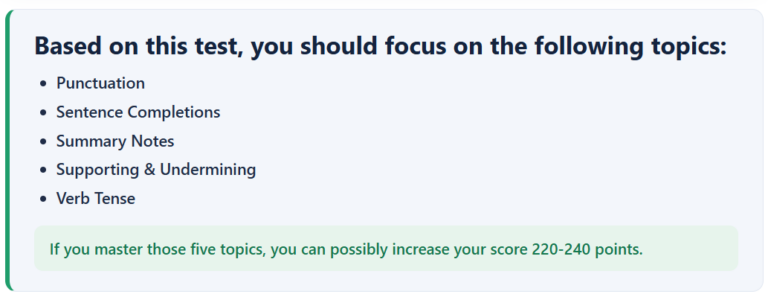
Want to Know What 5 Topics Will Improve Your SAT Score the Most?
Sample Feedback from our Diagnostic Test:
Merit Thresholds Are Higher Than Admission Thresholds
A score that gets a student admitted is not necessarily a score that pays for anything.
Merit aid is competitive within the pool of students who were already admitted. So the school is choosing among students who all cleared the admission bar, and the aid goes to the stronger end of that group.
This changes what a target score should be. A student aiming only for admission can work toward the 75 percentile of a school’s published range. A student who needs aid to attend should aim higher than that, because the students receiving awards are drawn from above the middle of the admitted class.
Two students applying to the same school with the same list should not necessarily have the same target. More on what counts as a good SAT score and how to set one.
National Merit Comes From the PSAT, Not the SAT
This is the most common misunderstanding in this subject, and it costs students the opportunity every year.
National Merit qualification comes from the PSAT/NMSQT, taken in 11th grade. No SAT score qualifies a student for it. A student planning to earn National Merit by doing well on the SAT has already missed it, because the qualifying test was the one he took in October of junior year.
The practical consequence depends on when a family learns this. A sophomore who knows has time to prepare for a test that most students walk into cold. A senior who just found out has no move available.
Qualifying scores vary by state and change each year, so check the current cutoff for your state rather than working from a number you read somewhere.
How Do You Find Out What Your Schools Offer?
None of this is decidable in the abstract. Grids, thresholds, and programs are set school by school, and two similar universities can handle merit aid completely differently.
The work is per school, and it isn’t difficult.
Where to Look for a School's Merit Policy
Start with the school’s financial aid page, then the admissions page. Search the school name along with “automatic merit scholarship” and see whether a grid comes up.
If nothing is published, call or email the admissions office and ask directly. Asking is normal and expected, and the answer sometimes exists without being on the website.
Do this before applying, not after. If a school’s grid boundary is 40 points above a student’s current score and the test is still four months away, that’s a plan. If the applications are already in, it’s just information.
SAT Score Ranges by College
A student working out an aid target needs the school’s admitted score range first, since merit thresholds sit above it.
We publish SAT score ranges by college, organized by major and by state, along with cost and program information.
Test-Optional Schools and Merit Aid
Here’s a trap worth knowing about.
At many test-optional schools, submitting a test score is still required to be considered for merit aid, even though it isn’t required for admission. A student who withholds a score under a test-optional policy may be withholding himself from an award without realizing it.
This isn’t universal, and policies change. But it’s common enough that a student with a decent score should check the aid policy specifically, rather than assuming test-optional means the score doesn’t matter anywhere. More on test-optional colleges.
If Your Score Isn't Where It Needs to Be
The gap between a current score and a band boundary is a number. So is the work required to close it.
A free diagnostic SAT gives an accurate score based on College Board scoring, plus a breakdown of which topics are costing the most points. That tells you the size of the gap and where the points would come from.
From there, how to improve your SAT score covers the method.
Frequently Asked Questions
What SAT score do I need for a full ride?
It depends entirely on the school. Full-ride awards normally require the top band of a merit grid combined with a high GPA, and some schools also require an interview or a separate application. A handful publish exact requirements. Check the schools on your list rather than working from a general number, because the range across schools is enormous.
Do SAT scores affect financial aid?
They affect merit aid, which is awarded for a student’s record. They don’t affect need-based aid, which is calculated from a family’s finances.
Is National Merit based on the SAT?
No. National Merit comes from the PSAT/NMSQT taken in 11th grade. No SAT score qualifies a student for it.
Do test-optional schools use SAT scores for scholarships?
Many do. At a number of test-optional schools, a score is optional for admission but required to be considered for merit aid. Check each school’s aid policy specifically.
Does a higher SAT score always mean more money?
No. At schools with merit grids, awards move in bands, so gaining points within a band changes nothing. At schools that award case by case, a higher score helps but the amount isn’t predictable. And at schools with no merit aid, the score affects admission only.
Should I retake the SAT for scholarship money?
Work out the gap first. If your score is close to a published band boundary at a school you want, retaking is often the highest-return work available. If you’re in the middle of a band or the schools on your list don’t publish grids, the calculation is less clear.

Glyn Caddell
Glyn Caddell holds a BS in Mechanical Engineering from NJIT and has been tutoring New York City students since 2008. He founded Caddell Prep in 2012 and is the author of Digital SAT Math Secrets: Lessons & Tricks to Quickly Improve to a Perfect 800 on the Math Test, which contains over 900 practice problems and is used in Caddell Prep’s SAT math classes. He is founding president of the Staten Island Technical High School alumni association and teaches every lesson on this site personally.
Finally, an SAT course that students actually understand
Every question has a video explanation. Not most — every one.
The on-demand Digital SAT course covers all 17 math topics and 15 reading and writing topics, with 5 full-length practice tests and a 100-point score increase guarantee. Keep access for the rest of high school. No subscription.
Want to Know What 5 Topics Will Improve Your SAT Score the Most?
Sample Feedback from our Diagnostic Test: