
Home » The Digital SAT: What’s Tested, How It’s Scored, and How to Improve Your Score » About the SAT: What It Is, Who Runs It, Who Takes It, and What It Costs » The PSAT: What It Is, What Your Score Means, and What to Do With It
By Glyn Caddell, BSME · Author of Digital SAT Math Secrets · Tutoring since 2008 — Published September 10, 2026
The PSAT is a shorter version of the SAT, taken in school, and it doesn’t go to colleges.
It’s useful for two things. It qualifies students for National Merit, which only the 11th grade version does, and it tells a student where he stands on the same track that ends with the SAT, with time left to do something about it.
This page covers what the different PSATs are, how to read a score, and what the score is actually telling you.
Table of Contents
- There Are Three Different PSATs
- The PSAT Is Not Scored Out of 1600
- Is Your Child on Track? The Grade-Level Benchmarks
- What Your PSAT Score Tells You About Your SAT Score
- Your PSAT Score Report Is a Free Diagnostic
- National Merit Comes From the 11th Grade PSAT and Nothing Else
- If You’re Chasing National Merit, Reading & Writing Points Are Worth Double
- Should You Prepare for the PSAT?
There Are Three Different PSATs
Schools normally just say “the PSAT,” which leaves families holding a score report without knowing which test produced it.
| Test | Grade | Total score | Per section | Counts for National Merit |
|---|---|---|---|---|
| PSAT 8/9 | 8 and 9 | 240 to 1440 | 120 to 720 | No |
| PSAT 10 | 10 | 320 to 1520 | 160 to 760 | No |
| PSAT/NMSQT | 11 | 320 to 1520 | 160 to 760 | Yes |
The PSAT 10 and the PSAT/NMSQT are scored identically. The only difference between them is that one counts for National Merit and the other doesn’t.
That matters more than it sounds. A sophomore’s PSAT 10 score is directly comparable to the National Merit cutoff he’ll face a year later. No conversion, no estimating. He can look up his state’s recent cutoff and see exactly how far away he is, with twelve months to close the gap.
The PSAT Is Not Scored Out of 1600
The PSAT/NMSQT tops out at 1520, with each section running 160 to 760. The SAT tops out at 1600, with each section running 200 to 800.
Each PSAT section ceiling sits 80 points below the SAT’s, because the test is shorter and doesn’t reach the same difficulty.
So a 1200 PSAT is not a 1200 SAT. A 1200 against a 1520 ceiling sits considerably higher than a 1200 against a 1600 ceiling, and a family reading them as equivalent is underestimating the student.
There’s no official conversion table between the two. What you can use instead are the benchmarks below, which are published for both tests.
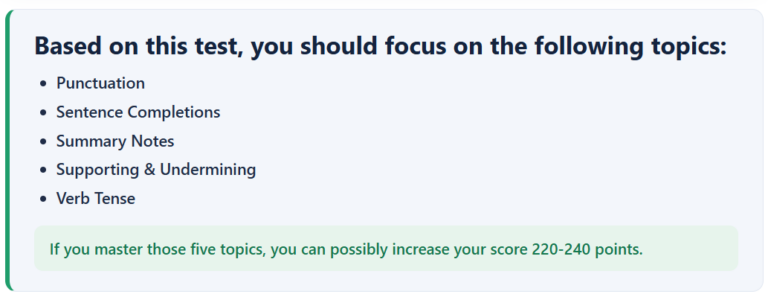
Want to Know What 5 Topics Will Improve Your SAT Score the Most?
Sample Feedback from our Diagnostic Test:
Is Your Child on Track? The Grade-Level Benchmarks
The College Board publishes a college readiness benchmark for each grade. A score at or above the benchmark means a student is on track for college-level work.
| Test | Grade | Reading & Writing | Math | Total |
|---|---|---|---|---|
| PSAT 8/9 | 8 | 390 | 430 | 820 |
| PSAT 8/9 | 9 | 410 | 450 | 860 |
| PSAT 10 | 10 | 430 | 480 | 910 |
| PSAT/NMSQT | 11 | 460 | 510 | 970 |
| SAT | 11 or 12 | 480 | 530 | 1010 |
Look at the totals down the right-hand column. 820, 860, 910, 970, 1010. The benchmark rises 40 to 60 points a year in a straight line.
These aren’t five unrelated thresholds. They’re one track with a checkpoint at each grade, which means a family can find out in 8th grade whether a student is on it. That’s four years before anyone starts thinking about SAT preparation.
The most useful number in that table is the distance between the last two rows. The 11th grade benchmark is 970 and the SAT benchmark is 1010. Forty points apart.
So a junior sitting exactly at his PSAT benchmark is 40 points from the College Board’s own readiness standard, with a year to find them. That’s a small and specific gap. A junior below the benchmark has those 40 points plus his own shortfall, and it’s better to know that in December than in May.
Compare Each Section to Its Own Benchmark
Here’s a trap in that table.
The Math benchmark is higher than the Reading & Writing benchmark at every grade, by 40 to 50 points. In 11th grade it’s 460 and 510.
That means a student needs a higher Math score than Reading & Writing score just to be equally on track. Both sections at benchmark means Math sitting 50 points ahead.
So equal section scores mean a student is behind in Math. A junior with 500 and 500 looks balanced, and he’s actually 40 points above the Reading & Writing benchmark and 10 points below the Math one.
It gets worse when Math already trails. A junior at 500 Reading & Writing and 470 Math is 40 above in one section and 40 below in the other. That’s an 80-point spread against the standards, from a 30-point difference in raw scores.
Compare each section to its own benchmark. Don’t compare the sections to each other.
This is also the answer to what counts as a good PSAT score. Above the benchmark for the grade means on track for college-level work. For National Merit the relevant number is different, and much higher, and it’s covered below.
What Your PSAT Score Tells You About Your SAT Score
A PSAT score is a starting position, not a forecast.
Most students improve between the two tests without doing anything deliberate, from a year of coursework alone. So a PSAT score isn’t a prediction of an SAT score, and anyone who converts one to the other with a formula is guessing.
What the benchmarks give you instead is a direction. A junior at his grade benchmark has approximately 40 points to find to reach the SAT benchmark. A junior well below it has considerably more, and now knows in December rather than in May.
For a fuller picture of what a score means once you’re on the SAT scale, see what counts as a good SAT score.
Your PSAT Score Report Is a Free Diagnostic
This is the part almost nobody uses, and it’s the most valuable thing on the score report.
The PSAT and the SAT are the same test suite. The content is the same. The question types are the same. What differs is length and difficulty range.
That means a PSAT score report can be read the same way an SAT diagnostic can. The topics a student is losing points on in December of junior year are the topics he’ll lose points on in March, unless he does something about them.
We categorized every question on the released College Board practice tests into 32 specific topics, 17 in math and 15 in Reading & Writing, and measured how often each one appears. That categorization applies to the PSAT too.
So take the score report, find the weak areas, and check them against how often each topic is tested. See the 17 Digital SAT math topics and the 15 Reading & Writing topics for the frequency data.
One honest limit. A PSAT score report is less detailed than a full diagnostic and it won’t break results into all 32 topics. It’s a starting point, not a substitute.
National Merit Comes From the 11th Grade PSAT and Nothing Else
Only the PSAT/NMSQT taken in 11th grade qualifies a student for National Merit. The 10th grade test doesn’t, no matter the score. Neither does any SAT score.
This is the most common misunderstanding about the PSAT, and it’s the one that can’t be fixed after the fact. A student who plans to earn National Merit by doing well on the SAT has already missed it.
It Runs on the Selection Index, Not the Total Score
National Merit doesn’t use the total score. It uses the Selection Index.
Selection Index = (Reading & Writing × 2 + Math) ÷ 10
The maximum is 228, from a 760 in each section.
Approximately 1.4 million students take the PSAT/NMSQT each year. Approximately 17,000 become Semifinalists and approximately 40,000 more are named Commended Students.
The Cutoffs Change Every Year
Cutoffs vary by state, because National Merit allocates Semifinalists to states based on the number of high school graduates. They also change every year.
For the Class of 2027, the Commended cutoff was 208 and state Semifinalist cutoffs ran from 208 to 223. New York’s cutoff was 220, down three points from the previous year.
Compass Education Group tracks and publishes the state-by-state cutoffs and updates them as reports come in. Check their National Merit Semifinalist cutoffs page for the current year rather than working from a number you read somewhere.
Percentiles Don't Tell You Whether You Qualified
A 99th percentile score does not mean a student made Semifinalist, and students assume it does.
Percentiles are based on section and total scores, not the Selection Index. They’re rounded, so the difference between the top 0.5% and the top 1.5% disappears. And they’re calculated from the previous three years of results, not from the current year’s test.
Use the Selection Index and your state’s recent cutoffs. Ignore the percentile for this purpose.
If You're Chasing National Merit, Reading & Writing Points Are Worth Double
This follows directly from the formula, and it changes how a student should prepare.
Because Reading & Writing is doubled, ten points of Reading & Writing is worth two Selection Index points. Ten points of Math is worth one.
Here’s what that looks like with real numbers.
| Reading & Writing | Math | Total score | Selection Index |
|---|---|---|---|
| 720 | 700 | 1420 | 214 |
| 700 | 720 | 1420 | 212 |
| 760 | 730 | 1490 | 225 |
| 730 | 760 | 1490 | 222 |
Identical total scores. Two and three points apart on the index.
Three points is normally the difference between qualifying and missing. Two students with the same 1490 can end up on opposite sides of a state cutoff based only on which section their points came from.
So a student chasing National Merit shouldn’t prepare evenly. A student three Selection Index points short needs 15 Reading & Writing points, not 30 Math points. That’s a smaller job, and it’s a different one.
This is the only situation where we’d tell a student to weight his preparation toward one section. On the SAT itself both sections count equally and this advice reverses completely.
If you’re in that position, the 15 Reading & Writing topics with their frequency data are where to start. The topics are the same on both tests.
Should You Prepare for the PSAT?
For most students, no. For a specific group, yes. Here’s the honest split.
A note about who’s telling you this. Caddell Prep sells test preparation. We’re about to tell most of you not to buy any for this test, which should tell you something about how seriously we mean it.
For Most Students, No
The PSAT doesn’t go to colleges. Nothing about a PSAT score appears in an application.
The value of taking it comes from sitting it, not from studying for it. A student who walks in cold still learns what the format feels like, still gets a score report he can read, and still finds out where he stands against the benchmark. All of that happens without any preparation.
So for a student who isn’t near a National Merit cutoff, the PSAT is a free measurement. Take it, read the report, and put the preparation hours into the SAT where they count for something.
For Students Within Reach of National Merit, Yes
This is the exception, and it’s a real one.
National Merit is a threshold with money attached. It can’t be retaken. And it’s decided by one test on one morning in October of junior year.
A sophomore scoring near his state’s recent cutoff on the PSAT 10 has a specific, measurable, time-limited reason to prepare. He knows the number he needs, he knows approximately where he is, and he has a year.
What that preparation looks like is SAT preparation, weighted toward Reading & Writing for the reason above.
There are two questions families ask at this point, and the answers change the plan.
Does the 10th Grade PSAT Count for National Merit?
No. Only the PSAT/NMSQT taken in 11th grade qualifies anyone.
The PSAT 10 is still worth taking, because it’s scored on the identical scale. A sophomore’s score is directly comparable to the cutoff he’ll face a year later, which is the clearest early read available.
Should a Student Take the PSAT More Than Once?
Most students take one in 10th grade and one in 11th, and schools normally arrange both.
Only the 11th grade test counts for National Merit, so a student taking it twice isn’t getting two chances at qualification. What he’s getting is a year of warning, which is the whole value of the earlier test.
What to Do When the Score Arrives
Read it for topics, not for the total.
Compare each section to the benchmark for that grade, not to the other section.
If the gap to a target SAT score is large, junior spring is when to start rather than senior fall.
A free diagnostic SAT gives a fuller topic breakdown than a PSAT score report does, and it puts the student on the SAT scale so the numbers are directly comparable to a target.
Most students take the SAT for the first time in spring of junior year, a few months after the PSAT. That gap is the preparation window, and it’s the reason the PSAT score matters at all. See SAT test dates.
Do Colleges See PSAT Scores?
No. A PSAT score is not part of a college application, and nothing about it reaches an admissions office.
The one exception is National Merit. A student who earns recognition reports it himself, the same way he’d report any other honor. The score behind it still isn’t sent anywhere.
Students worry about this more than they need to. A bad PSAT score costs nothing except the information it gives you, and that information is the reason to take the test.

Glyn Caddell
Glyn Caddell holds a BS in Mechanical Engineering from NJIT and has been tutoring New York City students since 2008. He founded Caddell Prep in 2012 and is the author of Digital SAT Math Secrets: Lessons & Tricks to Quickly Improve to a Perfect 800 on the Math Test, which contains over 900 practice problems and is used in Caddell Prep’s SAT math classes. He is founding president of the Staten Island Technical High School alumni association and teaches every lesson on this site personally.
Finally, an SAT course that students actually understand
Every question has a video explanation. Not most — every one.
The on-demand Digital SAT course covers all 17 math topics and 15 reading and writing topics, with 5 full-length practice tests and a 100-point score increase guarantee. Keep access for the rest of high school. No subscription.
Want to Know What 5 Topics Will Improve Your SAT Score the Most?
Sample Feedback from our Diagnostic Test: