
Home » College SAT Score Ranges, Costs, and Programs by Major and State » Engineering Colleges by State: SAT Scores, ACT Scores, Costs, and ABET Programs » Engineering Colleges in Michigan: SAT Scores, Costs, and Programs
By Glyn Caddell, BSME · Author of Digital SAT Math Secrets · Tutoring since 2008 — Updated October 24, 2026
Nineteen Michigan universities offer ABET-accredited engineering degrees, and this page lists what they cost and the SAT scores of the students they admit.
The University of Michigan sets tuition by school and by division, and an out-of-state engineering student in his last two years pays more than MIT charges, a figure the Scorecard’s single number does not show and this page works out below the table.
Scores are given by section and the table is sorted by Math, with the three universities that report no range listed last.
Table of Contents
- Michigan Engineering Colleges by SAT Math Score
- How Much Does an Out-of-State Student Pay for Engineering at the University of Michigan?
- Which Michigan Universities Have ABET-Accredited Engineering Schools?
- What If Your Score Is Below the Range You Want?
Michigan Engineering Colleges by SAT Math Score
The nineteen universities below are the ones in Michigan that hold an ABET-accredited bachelor’s degree in an engineering discipline. The sixteen that report scores are sorted by the midpoint of the SAT Math range, so the order can be checked from the table itself, and the three that do not are listed last in alphabetical order.
| College | SAT Reading & Writing | SAT Math | Cost of attendance | Undergraduates | Admit rate |
|---|---|---|---|---|---|
| University of Michigan | 680 to 750 | 680 to 780 | $34,654 | 34,177 | 16% |
| Michigan State University | 590 to 680 | 590 to 680 | $32,198 | 40,922 | 85% |
| Kettering University | 580 to 660 | 580 to 670 | $61,250 | 1,205 | 79% |
| Michigan Technological University | 570 to 680 | 560 to 670 | $34,152 | 5,955 | 92% |
| Hope College | 550 to 670 | 550 to 670 | $55,646 | 3,288 | 79% |
| Calvin University | 550 to 660 | 533 to 670 | $54,222 | 3,193 | 71% |
| Wayne State University | 540 to 640 | 520 to 630 | $27,350 | 15,587 | 81% |
| University of Detroit Mercy | 520 to 630 | 510 to 630 | $42,211 | 2,438 | 75% |
| University of Michigan-Dearborn | 500 to 625 | 490 to 630 | $24,040 | 5,952 | 56% |
| Andrews University | 520 to 660 | 470 to 630 | $45,218 | 1,224 | 82% |
| Oakland University | 540 to 640 | 490 to 590 | $25,182 | 12,351 | 88% |
| University of Michigan-Flint | 500 to 633 | 470 to 610 | $20,915 | 4,411 | 70% |
| Central Michigan University | 490 to 610 | 470 to 590 | $30,681 | 10,035 | 90% |
| Grand Valley State University | 480 to 600 | 460 to 590 | $28,367 | 18,854 | 83% |
| Eastern Michigan University | 480 to 600 | 440 to 570 | $29,640 | 10,055 | 80% |
| Saginaw Valley State University | 480 to 600 | 440 to 570 | $24,936 | 5,989 | 72% |
| Lake Superior State University | Does not report SAT data | Does not report SAT data | $27,154 | 1,325 | Not reported |
| Lawrence Technological University | Does not report SAT data | Does not report SAT data | $58,166 | 1,668 | 56% |
| Western Michigan University | Does not report SAT data | Does not report SAT data | $29,237 | 12,568 | 85% |
Each range covers the middle 50% of admitted students who submitted the SAT. A quarter scored below the lower number, and the top quarter scored at or above the upper one. Being under the lower number does not rule a student out, and being just above it is not as safe as it looks.
Oakland and UM-Flint share a Math midpoint and are ordered by the Reading & Writing midpoint. Eastern Michigan and Saginaw Valley share both and are ordered alphabetically. Only universities with an ABET-accredited engineering bachelor’s degree are listed. Ferris State’s, Northern Michigan’s and Baker College’s technology degrees are accredited under a separate ABET commission and do not qualify them for the list. Lake Superior State, Lawrence Tech and Western Michigan report no SAT or ACT range to the Scorecard and are listed last. The University of Michigan’s cost figures are the university’s averages, and its engineering rates are given below the table.
Three things about that table are worth pausing on.
The University of Michigan’s out-of-state tuition in the Scorecard, $60,946, is the highest public out-of-state figure in this series, $19,760 above the next one, Maryland’s $41,186, and $17,104 above Michigan State’s. It is also an average across the university’s schools and divisions, and the engineering student’s number is higher.
Central Michigan and Eastern Michigan charge every student the same tuition, $14,760 and $16,240, in state or out, as four Illinois universities do. A New York student at Central Michigan’s engineering college pays less than a Michigan student pays at any of the three University of Michigan campuses.
Michigan State is the largest school on any page in this series so far, 40,922 undergraduates, and admits 85% of them on a Math range of 590 to 680 whose two ends sit exactly 90 points under the flagship’s.
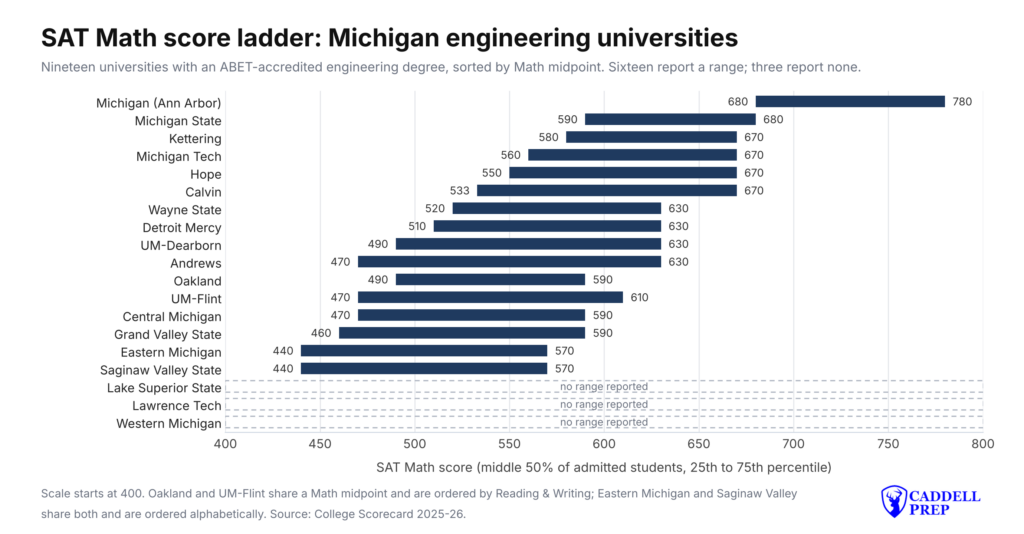
A student can see where his Math score sits on this list in the image above.
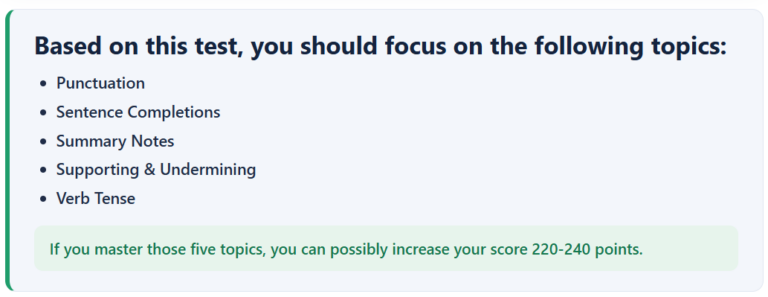
Want to Know What 5 Topics Will Improve Your SAT Score the Most?
Sample Feedback from our Diagnostic Test:
University of Michigan
The University of Michigan’s College of Engineering in Ann Arbor holds ABET accreditation in disciplines including aerospace, biomedical, chemical, civil, computer, electrical, environmental, industrial and operations, materials, mechanical, naval architecture and marine, and nuclear engineering, and Michigan charges engineering students a tuition rate of their own that rises at the upper division.
Reading & Writing 680 to 750, Math 680 to 780. The top quarter of admitted students scored at or above 780 on Math. Cost of attendance $34,654, with tuition and fees at $17,736 in state and $60,946 out of state in the Scorecard’s university-wide figures. 34,177 undergraduates, 15.6% admitted.
Michigan is the most selective school on the page by a wide margin and the second-largest. Its Math ceiling of 780 is 100 points above Michigan State’s and Kettering’s, and its out-of-state tuition is the highest public figure in this series before the engineering rate is applied.
Michigan State University
Michigan State University’s College of Engineering in East Lansing holds ABET accreditation in disciplines including applied engineering sciences, biosystems, chemical, civil, computer, electrical, environmental, materials and mechanical engineering, and Michigan State admits students to the university first and to the College of Engineering through a secondary admission after enrollment.
Reading & Writing 590 to 680, Math 590 to 680. The top quarter of admitted students scored at or above 680 on Math. Cost of attendance $32,198, with tuition and fees at $16,458 in state and $43,842 out of state. 40,922 undergraduates, 85% admitted.
Michigan State is the largest school on the page and in this series, and its two section ranges are identical. Its out-of-state tuition is the second-highest public figure on the page and $17,104 below the flagship’s university-wide average.
Kettering University
Kettering University in Flint holds ABET accreditation in chemical, computer, electrical, industrial and mechanical engineering, and Kettering alternates classroom terms with paid co-op terms from the first year.
Reading & Writing 580 to 660, Math 580 to 670. The top quarter of admitted students scored at or above 670 on Math. Cost of attendance $61,250, with tuition and fees at $48,470 for all students. 1,205 undergraduates, 79% admitted.
Kettering is the smallest school on the page, the most expensive by total cost, and the former General Motors Institute. Its Math floor of 580 is the highest on the page after Michigan’s and 20 above Michigan Tech’s.
Michigan Technological University
Michigan Technological University in Houghton holds ABET accreditation in disciplines including biomedical, chemical, civil, computer, electrical, environmental, geological, materials, mechanical and mining engineering, and Michigan Tech admits 92% of applicants to a university most of whose students are engineering majors.
Reading & Writing 570 to 680, Math 560 to 670. The top quarter of admitted students scored at or above 670 on Math. Cost of attendance $34,152, with tuition and fees at $19,123 in state and $42,988 out of state. 5,955 undergraduates, 92% admitted.
Michigan Tech is the least selective school on the page and charges the highest in-state tuition of any public on it, $1,387 above the flagship’s university-wide figure. It holds the only accredited geological and mining engineering degrees in the state.
Hope College
Hope College’s engineering department in Holland holds ABET accreditation for its Bachelor of Science in Engineering, and Hope has the highest Math range among the private colleges on the page other than Kettering.
Reading & Writing 550 to 670, Math 550 to 670. The top quarter of admitted students scored at or above 670 on Math. Cost of attendance $55,646, with tuition and fees at $41,970 for all students. 3,288 undergraduates, 79% admitted.
Hope is a Reformed Christian college whose two section ranges are identical and whose Math ceiling matches Kettering’s and Michigan Tech’s on a floor 10 points lower than Michigan Tech’s.
Calvin University
Calvin University’s engineering program in Grand Rapids holds ABET accreditation for its Bachelor of Science in Engineering with chemical, civil and environmental, electrical and computer, and mechanical concentrations, and Calvin has the lowest admit rate among the private schools on the page.
Reading & Writing 550 to 660, Math 533 to 670. The top quarter of admitted students scored at or above 670 on Math. Cost of attendance $54,222, with tuition and fees at $39,350 for all students. 3,193 undergraduates, 71% admitted.
Calvin is a Reformed Christian university ten miles from Hope, with the same Math ceiling and a floor 17 points lower, and it charges $2,620 less in tuition.
Wayne State University
Wayne State University’s College of Engineering in Detroit holds ABET accreditation in disciplines including biomedical, chemical, civil, computer, electrical, industrial and mechanical engineering, and Wayne State has the lowest cost of attendance among the publics on the page other than the two University of Michigan regional campuses.
Reading & Writing 540 to 640, Math 520 to 630. The top quarter of admitted students scored at or above 630 on Math. Cost of attendance $27,350, with tuition and fees at $15,190 in state and $32,037 out of state. 15,587 undergraduates, 81% admitted.
Wayne State is the third-largest school on the page and the only engineering college inside Detroit’s city limits other than Detroit Mercy’s. Its Math ceiling of 630 is shared with Detroit Mercy, UM-Dearborn and Andrews.
University of Detroit Mercy
The University of Detroit Mercy’s College of Engineering and Science holds ABET accreditation in civil, electrical, mechanical, and robotics and mechatronics engineering, and Detroit Mercy has the lowest tuition among the private universities on the page.
Reading & Writing 520 to 630, Math 510 to 630. The top quarter of admitted students scored at or above 630 on Math. Cost of attendance $42,211, with tuition and fees at $32,946 for all students. 2,438 undergraduates, 75% admitted.
Detroit Mercy is a Jesuit and Mercy university whose tuition, $32,946, is $909 above Wayne State’s out-of-state figure, and whose Math range sits 10 points under Wayne State’s at the floor.
University of Michigan-Dearborn
The University of Michigan-Dearborn’s College of Engineering and Computer Science holds ABET accreditation in disciplines including bioengineering, computer, electrical, industrial and systems, manufacturing, mechanical and robotics engineering, and UM-Dearborn has the lowest admit rate on the page after the Ann Arbor campus.
Reading & Writing 500 to 625, Math 490 to 630. The top quarter of admitted students scored at or above 630 on Math. Cost of attendance $24,040, with tuition and fees at $15,640 in state and $32,896 out of state. 5,952 undergraduates, 56% admitted.
UM-Dearborn admits 56% of applicants, a share it shares with Lawrence Tech, on a Math range whose ceiling is 150 points below Ann Arbor’s. Ford’s headquarters are two miles from campus.
Andrews University
Andrews University’s engineering department in Berrien Springs holds ABET accreditation for its Bachelor of Science in Engineering, and Andrews has the widest Math range on the page.
Reading & Writing 520 to 660, Math 470 to 630. The top quarter of admitted students scored at or above 630 on Math. Cost of attendance $45,218, with tuition and fees at $35,056 for all students. 1,224 undergraduates, 82% admitted.
Andrews is a Seventh-day Adventist university and the second-smallest school on the page, 19 students larger than Kettering. Its Math range is 160 points wide, against 100 at the flagship.
Oakland University
Oakland University’s School of Engineering and Computer Science in Rochester holds ABET accreditation in bioengineering, computer, electrical, industrial and systems, and mechanical engineering, and Oakland has the lowest out-of-state tuition of the reporting public universities on the page other than Grand Valley.
Reading & Writing 540 to 640, Math 490 to 590. The top quarter of admitted students scored at or above 590 on Math. Cost of attendance $25,182, with tuition and fees at $15,262 in state and $23,188 out of state. 12,351 undergraduates, 88% admitted.
Oakland’s out-of-state tuition of $23,188 is $4,065 above Michigan Tech’s in-state figure and $37,758 below Ann Arbor’s university-wide out-of-state figure. Its Reading & Writing range sits 50 points above its Math range at both ends, the widest such gap on the page.
University of Michigan-Flint
The University of Michigan-Flint’s College of Innovation and Technology holds ABET accreditation in mechanical engineering, and UM-Flint has the lowest cost of attendance on the page.
Reading & Writing 500 to 633, Math 470 to 610. The top quarter of admitted students scored at or above 610 on Math. Cost of attendance $20,915, with tuition and fees at $14,704 in state and $28,320 out of state. 4,411 undergraduates, 70% admitted.
UM-Flint is the cheapest school on the page by total cost and the cheapest University of Michigan campus for a resident by $936 a year against Dearborn. It holds one accredited engineering degree, accredited since 2014.
Central Michigan University
Central Michigan University’s School of Engineering and Technology in Mount Pleasant holds ABET accreditation in computer, electrical and mechanical engineering, and Central Michigan charges every student the same tuition.
Reading & Writing 490 to 610, Math 470 to 590. The top quarter of admitted students scored at or above 590 on Math. Cost of attendance $30,681, with tuition and fees at $14,760 for all students. 10,035 undergraduates, 90% admitted.
Central Michigan’s $14,760 is the lowest price on the page for a student from outside Michigan, and it is below the in-state tuition at nine of the thirteen public universities on the page. Its Math range matches UM-Flint’s at the floor and sits 20 under it at the ceiling.
Grand Valley State University
Grand Valley State University’s Padnos College of Engineering and Computing in Allendale and Grand Rapids holds ABET accreditation in computer, electrical, interdisciplinary, mechanical, and product design and manufacturing engineering, and Grand Valley is the largest school on the page after the two flagships and Wayne State.
Reading & Writing 480 to 600, Math 460 to 590. The top quarter of admitted students scored at or above 590 on Math. Cost of attendance $28,367, with tuition and fees at $15,140 in state and $21,548 out of state. 18,854 undergraduates, 83% admitted.
Grand Valley’s out-of-state tuition of $21,548 is the lowest among the reporting universities that charge one, below Oakland’s by $1,640, and its engineering program requires paid co-op terms of every student.
Eastern Michigan University
Eastern Michigan University’s College of Engineering and Technology in Ypsilanti holds ABET accreditation in mechanical engineering, and Eastern Michigan charges every student the same tuition.
Reading & Writing 480 to 600, Math 440 to 570. The top quarter of admitted students scored at or above 570 on Math. Cost of attendance $29,640, with tuition and fees at $16,240 for all students. 10,055 undergraduates, 80% admitted.
Eastern Michigan’s flat tuition of $16,240 is $1,480 above Central Michigan’s and below the in-state tuition at Ann Arbor, Michigan State and Michigan Tech. Its Math range of 440 to 570 is the lowest on the page, shared with Saginaw Valley, and its one accredited degree is mechanical engineering.
Saginaw Valley State University
Saginaw Valley State University’s College of Science, Engineering and Technology in University Center holds ABET accreditation in electrical and mechanical engineering, and Saginaw Valley has the lowest in-state tuition on the page.
Reading & Writing 480 to 600, Math 440 to 570. The top quarter of admitted students scored at or above 570 on Math. Cost of attendance $24,936, with tuition and fees at $12,930 in state and $30,450 out of state. 5,989 undergraduates, 72% admitted.
Saginaw Valley’s in-state tuition of $12,930 is the lowest resident charge on the page, $1,774 under UM-Flint’s, and Dow’s headquarters in Midland are twelve miles away. Its Math range is identical to Eastern Michigan’s.
Lake Superior State University
Lake Superior State University’s School of Engineering and Technology in Sault Ste. Marie holds ABET accreditation in computer, electrical, mechanical and robotics engineering, and Lake Superior State reports no admitted score range and no admit rate.
Cost of attendance $27,154, with tuition and fees at $14,890 for all students. 1,325 undergraduates, admit rate not reported.
Lake Superior State is the northernmost school on the page, charges a flat tuition like Central and Eastern Michigan, and had its robotics engineering degree accredited for the first time in 2025. It reports no SAT or ACT range to the Scorecard.
Lawrence Technological University
Lawrence Technological University’s College of Engineering in Southfield holds ABET accreditation in disciplines including biomedical, civil, computer, electrical, mechanical and robotics engineering, and Lawrence Tech reports no admitted score range.
Cost of attendance $58,166, with tuition and fees at $44,760 for all students. 1,668 undergraduates, 56% admitted.
Lawrence Tech is the second most expensive school on the page and shares the second-lowest admit rate with UM-Dearborn. It reports no SAT or ACT range to the Scorecard.
Western Michigan University
Western Michigan University’s College of Engineering and Applied Sciences in Kalamazoo holds ABET accreditation in disciplines including aerospace, chemical, civil, computer, electrical, industrial, mechanical and paper engineering, and Western Michigan reports no admitted score range.
Cost of attendance $29,237, with tuition and fees at $15,252 in state and $19,034 out of state. 12,568 undergraduates, 85% admitted.
Western Michigan holds the state’s only accredited aerospace engineering degree outside Ann Arbor and the only paper engineering degree in this series, and its out-of-state tuition of $19,034 is the lowest on the page among universities that charge one. It reports no SAT or ACT range to the Scorecard.
Sixteen ranges and three blanks say who got in. The flagship’s price for a student from outside Michigan is not the number in the table, and the next section is about the number it is.
How Much Does an Out-of-State Student Pay for Engineering at the University of Michigan?
A non-resident in the University of Michigan’s College of Engineering pays $33,744 a term in his lower-division years and $37,859 a term in his upper-division years under the proposed Fall 2026 rates, $67,488 and $75,718 a year, and the Scorecard’s $60,946 is the university’s average across all of its schools and divisions.
The provost’s FY2027 tuition table sets the rates by school and by division. The table below is the engineering rates beside the rates for the College of Literature, Science and the Arts, per term and per year.
| School and division | Resident, per term | Resident, per year | Non-resident, per term | Non-resident, per year |
|---|---|---|---|---|
| Engineering, lower division | $10,101 | $20,202 | $33,744 | $67,488 |
| Engineering, upper division | $13,011 | $26,022 | $37,859 | $75,718 |
| LSA, lower division | $9,448 | $18,896 | $33,548 | $67,096 |
| LSA, upper division | $10,634 | $21,268 | $35,899 | $71,798 |
Read the right-hand column against the Massachusetts page. MIT’s tuition and fees are $62,396. Tufts’, the highest on that page, are $70,704. A New York student in his third year of Michigan Engineering pays $13,322 a year more than an MIT student and $5,014 more than a Tufts student, at a public university that admits 15.6% of applicants on a Math range of 680 to 780. The figures are on our page on engineering colleges in Massachusetts, and none of them rises at the upper division.
The engineering premium inside Ann Arbor is its own number. An upper-division non-resident pays $1,960 a term more in engineering than in LSA, and a resident pays $2,377 a term more, $4,754 a year. A Michigan family pays approximately $4,750 a year more for a mechanical engineering major than for a mathematics major in the building next door, and the difference is written into the rate table, not into fees.
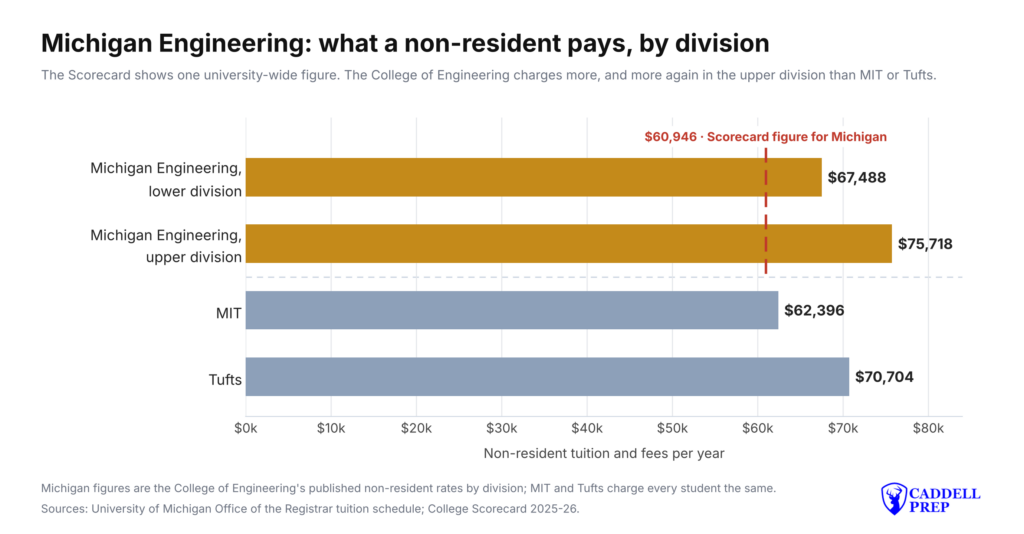
The image above shows what a New York engineering student pays in Ann Arbor by year, and how far the Scorecard’s single figure sits to the left of both of his bars.
Take a New York student with a 740 on Math. At Michigan he is in the upper half of the admitted range, and if he is admitted to the College of Engineering his four years of tuition run $67,488, $67,488, $75,718 and $75,718. That is $286,412 before housing, food or books. At Michigan Tech he is 70 points above the ceiling and pays $42,988 a year. At Michigan State he is 60 above the ceiling and pays $43,842. At MIT, if he were admitted, he would be 40 below the floor and pay $62,396. Ann Arbor’s is the only bill on that list that goes up in junior year, and it is the only one the Scorecard understates.
The other gates in the state are the ordinary kind. Michigan State admits a first-year student to the university and not to a college, and a student who wants engineering completes a secondary admission after enrollment on a GPA computed from specified courses [VERIFY the course list and the GPA thresholds by major on engineering.msu.edu and write them here]. Michigan Tech admits 92% of applicants to a university whose students are mostly engineers, the least selective engineering-focused public in this series. Kettering puts every student into a paid co-op rotation from the first year, and Grand Valley requires co-op of its engineering majors. At those three the score is read at the door and the price does not move. On our page on engineering colleges in Maryland, the flagship’s gate was a grade a year in. Michigan’s is a bill that rises a year in.
The honest version is that the FY2027 table is labeled proposed, and the regents approve the final rates in June. The figures above are the proposed Fall 2026 rates and should be read that way. Upper division begins at 55 credits, not at the start of junior year, so a student who arrives with AP credit reaches the higher rate sooner. Michigan offers need-based aid to non-residents and this page does not model it, but the sticker is what most New York families are quoted, and the sticker for an engineering junior is $75,718.
Families reading the rate table frequently ask whether the engineering rate starts on the first day.
Does the Engineering Rate Apply From the First Year?
The engineering rate applies from the first term a student is enrolled in the College of Engineering. The college has its own lower-division rate, $10,101 a term for a resident and $33,744 for a non-resident, and both are above LSA’s lower-division rates of $9,448 and $33,548.
The upper-division rate begins at 55 credits. A student who enters with 20 credits of AP work crosses that line in the middle of his second year rather than the start of his third, and pays $37,859 a term from that point. The rate follows the credit count, not the calendar.
The flagship’s rates are its own. The degrees are what the next section lists.
Which Michigan Universities Have ABET-Accredited Engineering Schools?
Nineteen Michigan universities hold ABET-accredited engineering bachelor’s degrees, thirteen public and six private, and all nineteen are in the table above.
The University of Michigan holds engineering colleges on all three of its campuses, Ann Arbor, Dearborn and Flint, with Ford’s headquarters two miles from Dearborn. Michigan State’s College of Engineering is in East Lansing. In the Detroit area, Wayne State and Detroit Mercy are in the city, Lawrence Tech is in Southfield, Oakland is in Rochester, and Kettering is in Flint on the campus General Motors built for it, with GM’s technical center in Warren and Stellantis’s headquarters in Auburn Hills between them. In Houghton, Michigan Tech holds the state’s geological and mining engineering degrees. In Kalamazoo, Western Michigan holds aerospace and paper engineering. In West Michigan, Grand Valley, Calvin and Hope hold engineering programs within twenty miles of one another. Central Michigan is in Mount Pleasant, Saginaw Valley in University Center near Dow’s headquarters in Midland, Eastern Michigan in Ypsilanti, Andrews in Berrien Springs, and Lake Superior State in Sault Ste. Marie at the Canadian border.
Accreditation matters for a reason that is easy to miss at seventeen. Licensure as a professional engineer normally requires a degree from an ABET-accredited engineering program, and that is why Ferris State’s, Northern Michigan’s and Baker College’s engineering technology degrees do not put those schools on the list. Hillsdale, Albion, Alma, Aquinas, Adrian, Spring Arbor, Madonna and Siena Heights award no engineering degree, and Kalamazoo College’s students reach one through a three-two arrangement that finishes at another university.
Nothing on this page ranks the nineteen. The table’s order is a stated, verifiable number where one exists, and the choice among accredited programs comes down to cost, discipline and where a student’s score places him.
What If Your Scores Are Below the Range You Want?
In Michigan a student under the flagship’s floor of 680 has eighteen other accredited programs, and a student above it should price Ann Arbor by division before he prices anything else, because the number he is quoted elsewhere is $15,000 a year below the one he will pay as an engineering junior.
The gap between a 600 and Michigan’s 680 is the gap most students on this page face, and the same algebra, functions and trigonometry close it. A student at 600 is above the ceiling at six universities on the page and in the middle of Michigan State’s range, so the question for him is not whether he has an engineering school but which price he wants to pay for one. A New York applicant has sixteen ranges and a spread of out-of-state tuition from $14,760 at Central Michigan to $75,718 in an Ann Arbor engineering classroom in junior year.
The first step is finding out where the score actually is, section by section. A free diagnostic SAT gives a Math score that can be set against the table.
The Math section rewards the same handful of topics on every test date, and a student who knows which of them he is missing can close a gap of 50 to 100 points in weeks rather than months. The method is on our page on improving your SAT Math score, and an 80-point gap is inside it.
How to Read These Score Ranges
Every range on this page covers the middle 50% of admitted students who submitted the SAT. The lower number is the 25th percentile and the upper number is the 75th, so a quarter of admitted students scored at or above it.
The Scorecard’s tuition figure is one number per university. A university that charges by school and by division can sit $15,000 a year above that number for the student this page is about, and the only way to know is to read the university’s own rate table. The section above does that for Ann Arbor.
Because most colleges are now test-optional, the ranges that are published describe only the students who chose to submit at all. Students with strong scores submit and students with weak ones don’t, so a published range sits higher than the range for everyone who was actually admitted. More on what SAT score you need for college and on test-optional colleges.
Should You Take the ACT Instead?
Michigan administers the SAT to every public-school junior, and twenty-five Michigan institutions report an SAT range against twenty-one for the ACT, so most Michigan applicants already hold an SAT score.
All nineteen universities on this page accept either test, and a student should take whichever he scores higher on. A student from outside Michigan who holds an ACT should convert it before reading the table.
Engineering Programs in Nearby States
Michigan borders Ohio, Indiana and Wisconsin, and Michigan students apply across those lines in numbers even with nineteen accredited programs at home.
See engineering colleges in Ohio, engineering colleges in Indiana, and engineering colleges in Wisconsin.
Engineering Colleges in Other States
We publish the same breakdown for engineering programs in every state.
See engineering colleges by state for the full list.

Glyn Caddell
Glyn Caddell holds a BS in Mechanical Engineering from NJIT and has been tutoring New York City students since 2008. He founded Caddell Prep in 2012 and is the author of Digital SAT Math Secrets: Lessons & Tricks to Quickly Improve to a Perfect 800 on the Math Test, which contains over 900 practice problems and is used in Caddell Prep’s SAT math classes. He is founding president of the Staten Island Technical High School alumni association and teaches every lesson on this site personally.
Finally, an SAT course that students actually understand
Every question has a video explanation. Not most — every one.
The on-demand Digital SAT course covers all 17 math topics and 15 reading and writing topics, with 5 full-length practice tests and a 100-point score increase guarantee. Keep access for the rest of high school. No subscription.
Want to Know What 5 Topics Will Improve Your SAT Score the Most?
Sample Feedback from our Diagnostic Test: