
Home » College SAT Score Ranges, Costs, and Programs by Major and State » Engineering Colleges by State: SAT Scores, ACT Scores, Costs, and ABET Programs » Engineering Colleges in Indiana: SAT Scores, Costs, and Programs
By Glyn Caddell, BSME · Author of Digital SAT Math Secrets · Tutoring since 2008 — Updated October 23, 2026
Eleven Indiana universities offer ABET-accredited engineering degrees, and this page lists what they cost and the SAT scores of the students they admit.
Purdue requires a test score from every applicant, has not raised in-state tuition in fourteen years, and admits every engineering student to a common first year before sorting them into majors on their college grades. All three rules are covered below the table.
Scores are given by section, and the table is sorted by Math because that is the section engineering programs use.
Table of Contents
- Indiana Engineering Colleges by SAT Math Score
- What Does Purdue Require for Engineering?
- Which Indiana Universities Have ABET-Accredited Engineering Schools?
- What If Your Score Is Below the Range You Want?
Indiana Engineering Colleges by SAT Math Score
The eleven universities below are the ones in Indiana that hold an ABET-accredited bachelor’s degree in an engineering discipline. They are sorted by the midpoint of the SAT Math range, with the three that report no range at the bottom.
| College | SAT Reading & Writing | SAT Math | Cost of attendance | Undergraduates | Admit rate |
|---|---|---|---|---|---|
| University of Notre Dame | 720 to 770 | 735 to 790 | $83,271 | 8,818 | 11% |
| Rose-Hulman Institute of Technology | 650 to 730 | 670 to 770 | $77,890 | 2,309 | 77% |
| Purdue University | 600 to 720 | 600 to 760 | $24,591 | 44,503 | 50% |
| Taylor University | 540 to 670 | 530 to 660 | $53,405 | 2,025 | 74% |
| Valparaiso University | 540 to 640 | 520 to 640 | $58,437 | 2,083 | 89% |
| Purdue University Fort Wayne | 490 to 610 | 480 to 610 | $22,183 | 5,484 | 84% |
| Indiana Wesleyan University | 480 to 600 | 480 to 580 | $44,776 | 1,974 | 89% |
| Purdue University Northwest | 450 to 570 | 440 to 570 | $15,571 | 5,671 | 72% |
| Trine University | Does not report SAT data | Does not report SAT data | $51,109 | 2,324 | 85% |
| University of Evansville | Does not report SAT data | Does not report SAT data | $57,451 | 1,539 | 78% |
| Indiana Institute of Technology | Does not report SAT data | Does not report SAT data | $45,879 | 1,441 | 70% |
Each range covers the middle 50% of admitted students who submitted the SAT. A quarter scored below the lower number, and the top quarter scored at or above the upper one. Being under the lower number does not rule a student out, and being just above it is not as safe as it looks.
Only universities with an ABET-accredited engineering bachelor’s degree are listed. Purdue, Purdue Fort Wayne and Purdue Northwest are three universities in one system with separate admission. Purdue’s figures include its Indianapolis location. Purdue requires a test score from every applicant.
Three things about that table are worth pausing on.
Rose-Hulman admits 77% of applicants with the second highest Math range in the state, 670 to 770. Every Rose-Hulman student is an engineering, science or mathematics student, so the applicants select themselves, and a high range at a high admit rate is the signature of that, as it is at Colorado School of Mines.
Purdue’s in-state tuition and fees are $9,992, and the figure has not changed since 2013-14. Its out-of-state tuition of $28,794 is below the tuition at every private university on the page and below the out-of-state figure at the flagships of the neighboring states.
Purdue Northwest’s cost of attendance of $15,571 is the lowest for an accredited engineering degree on any page in this series so far, and its in-state tuition of $8,675 is the lowest on the page.
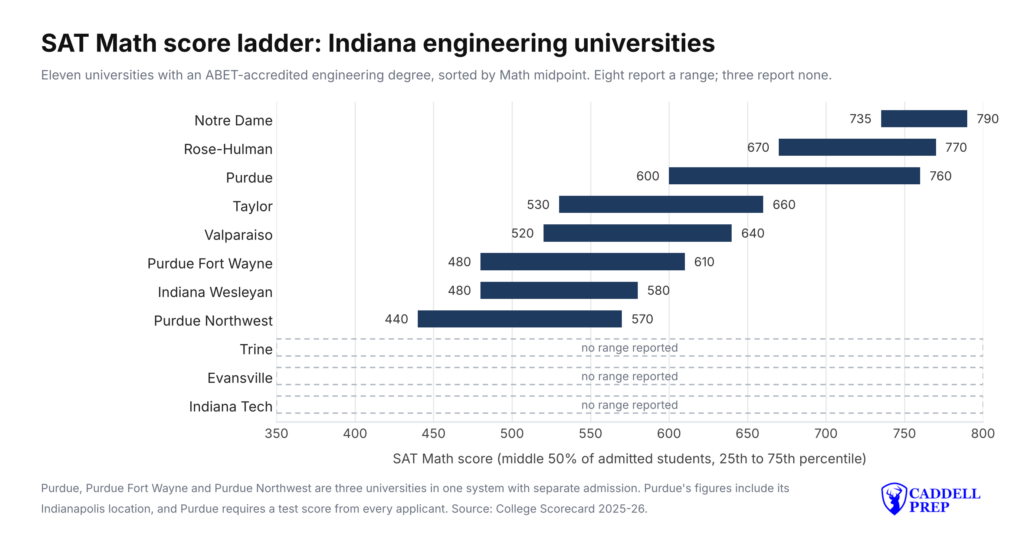
A student can see where his Math score sits on this list in the image above.
Want to Know What 5 Topics Will Improve Your SAT Score the Most?
Sample Feedback from our Diagnostic Test:

University of Notre Dame
The University of Notre Dame’s College of Engineering in Notre Dame holds ABET accreditation in aerospace, chemical, civil, computer, electrical, environmental and mechanical engineering, and Notre Dame has the highest Math range on the page.
Reading & Writing 720 to 770, Math 735 to 790. The top quarter of admitted students scored at or above 770 and 790. Cost of attendance $83,271, with tuition and fees at $65,025 for all students. 8,818 undergraduates, 11% admitted.
Notre Dame is the most selective and the most expensive school on the page, and it is a Catholic university.
Rose-Hulman Institute of Technology
The Rose-Hulman Institute of Technology in Terre Haute is a private institute of engineering, science and mathematics, and Rose-Hulman admits more than three applicants in four with the second highest Math range in Indiana.
Reading & Writing 650 to 730, Math 670 to 770. The top quarter scored at or above 730 and 770. Cost of attendance $77,890, with tuition and fees at $58,649 for all students. 2,309 undergraduates, 77% admitted.
Rose-Hulman’s ACT Math range of 29 to 35 reaches a perfect score at the top quarter, and the institute awards no degree outside engineering, science and mathematics.
Purdue University
Purdue University’s College of Engineering in West Lafayette is one of the largest engineering colleges in the United States, and Purdue requires an SAT or ACT score from every applicant.
Reading & Writing 600 to 720, Math 600 to 760. The top quarter scored at or above 720 and 760. Cost of attendance $24,591, with tuition and fees at $9,992 in-state and $28,794 out-of-state. 44,503 undergraduates, 50% admitted.
Purdue’s engineering degrees are also offered at Purdue University in Indianapolis, on the same admission standards, and the next section is about how Purdue admits an engineer and what happens after.
Taylor University
Taylor University’s engineering program in Upland holds ABET accreditation, and Taylor has the highest Math range on the page among the universities below Purdue.
Reading & Writing 540 to 670, Math 530 to 660. The top quarter scored at or above 670 and 660. Cost of attendance $53,405, with tuition and fees at $40,490 for all students. 2,025 undergraduates, 74% admitted.
Taylor is an interdenominational Christian university, and its Math ceiling of 660 is 20 points above Valparaiso’s.
Valparaiso University
Valparaiso University’s College of Engineering holds ABET accreditation in civil, computer, electrical and mechanical engineering, and Valparaiso is a Lutheran university an hour from Chicago.
Reading & Writing 540 to 640, Math 520 to 640. The top quarter scored at or above 640 on both sections. Cost of attendance $58,437, with tuition and fees at $48,450 for all students. 2,083 undergraduates, 89% admitted.
Valparaiso admits nearly nine applicants in ten and has the highest tuition among the private universities on the page below Notre Dame and Rose-Hulman.
Purdue University Fort Wayne
Purdue University Fort Wayne’s College of Engineering, Technology, and Computer Science holds ABET accreditation in civil, computer, electrical and mechanical engineering, and Fort Wayne is a separate university in the Purdue system with its own admission.
Reading & Writing 490 to 610, Math 480 to 610. The top quarter scored at or above 610 on both sections. Cost of attendance $22,183, with tuition and fees at $9,532 in-state and $22,887 out-of-state. 5,484 undergraduates, 84% admitted.
Fort Wayne’s Math ceiling of 610 is 150 points below West Lafayette’s, and its in-state tuition is held flat for Indiana residents through 2026-27 by the same trustees’ decision that froze the main campus.
Indiana Wesleyan University
Indiana Wesleyan University’s engineering program in Marion holds ABET accreditation, and Indiana Wesleyan is affiliated with the Wesleyan Church.
Reading & Writing 480 to 600, Math 480 to 580. The top quarter scored at or above 600 and 580. Cost of attendance $44,776, with tuition and fees at $32,352 for all students. 1,974 undergraduates, 89% admitted.
Indiana Wesleyan is the cheapest private university on the page by cost of attendance.
Purdue University Northwest
Purdue University Northwest’s College of Engineering and Sciences, on campuses in Hammond and Westville, holds ABET accreditation in civil, computer, electrical and mechanical engineering, and Northwest is the cheapest engineering school in this series by cost of attendance.
Reading & Writing 450 to 570, Math 440 to 570. The top quarter scored at or above 570 on both sections. Cost of attendance $15,571, with tuition and fees at $8,675 in-state and $16,094 out-of-state. 5,671 undergraduates, 72% admitted.
Northwest’s out-of-state tuition of $16,094 is below the out-of-state tuition at every other public university on the page, and its campuses sit among the steel mills of the Calumet region.
Trine University
Trine University’s Allen School of Engineering and Computing in Angola holds ABET accreditation in biomedical, chemical, civil, computer, electrical and mechanical engineering, and Trine reports no admitted score range.
Cost of attendance $51,109, with tuition and fees at $36,560 for all students. 2,324 undergraduates, 85% admitted.
Trine holds six accredited engineering degrees, the most of any private university on the page below Notre Dame and Rose-Hulman.
University of Evansville
The University of Evansville’s College of Engineering and Computer Science holds ABET accreditation in civil, computer, electrical and mechanical engineering, and Evansville reports no admitted score range.
Cost of attendance $57,451, with tuition and fees at $44,172 for all students. 1,539 undergraduates, 78% admitted.
Evansville is the second smallest school on the page and the only accredited engineering school in the southwestern corner of the state.
Indiana Institute of Technology
The Indiana Institute of Technology’s Talwar College of Engineering and Computer Sciences in Fort Wayne holds ABET accreditation in biomedical, computer, electrical, energy and mechanical engineering, and Indiana Tech reports no admitted score range.
Cost of attendance $45,879, with tuition and fees at $31,361 for all students. 1,441 undergraduates, 70% admitted.
Indiana Tech is the smallest school on the page and shares a city with Purdue Fort Wayne at twice the cost of attendance.
Eleven rows, and the one most readers came for is Purdue’s, where the number in the table is the start of the story and not the end of it.
What Does Purdue Require for Engineering?
Purdue requires an SAT or ACT score from every applicant, admits every engineering student to First-Year Engineering rather than to a major, and decides the major a year later on the student’s Purdue grade point average and engineering admissions index.
The requirement came back in fall 2024. Purdue announced in November 2022 that it would resume requiring test scores beginning with fall 2024 admissions, after three cycles in which they were optional, and the requirement has held since. Purdue is the one large public engineering school in this series so far that reinstated the test on its own decision rather than under a state system’s vote, as Georgia Tech and the University of Georgia did under the University System of Georgia, or under a rule that never lapsed, as in Florida. For fall 2025 Purdue reported admitting approximately 35% of first-year applicants, with a middle-50% SAT of 1380 to 1520 and an ACT of 32 to 35, against a Scorecard range for enrolled students of approximately 1200 to 1480 when the sections are summed.
The tuition has not moved. Purdue’s in-state tuition and fees are $9,992, and the trustees’ 2025 budget froze base tuition on the main campus for the thirteenth and fourteenth consecutive years, 2025-26 and 2026-27, with the stated aim of keeping base tuition and fees for Indiana residents under $10,000. The same decision held in-state tuition flat at Purdue Northwest and Purdue Fort Wayne for both years. Out-of-state tuition is $28,794, and for a New York applicant that is the lowest out-of-state figure at any large flagship engineering school in this series so far, below UIUC’s $35,124 and below the tuition at every private on this page.
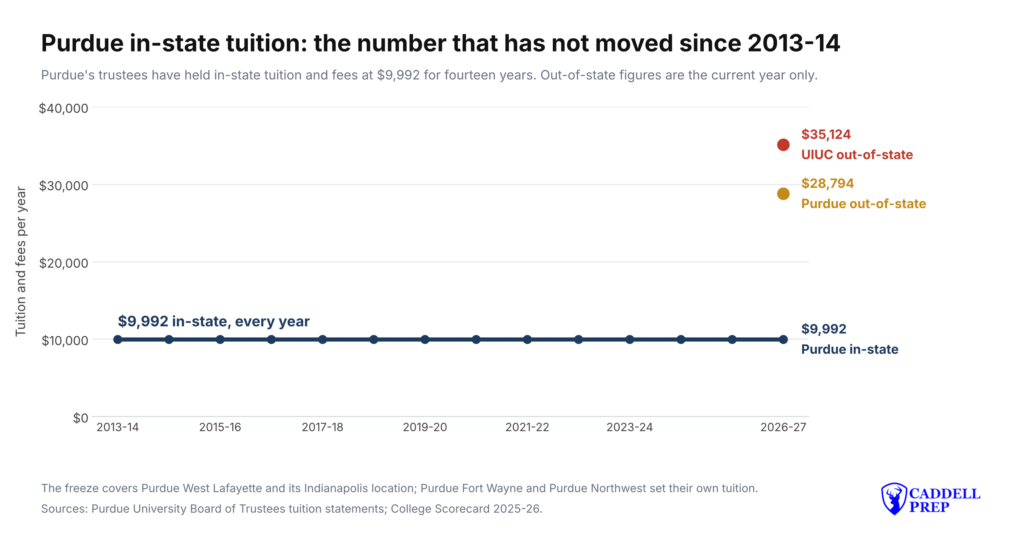
The image above shows the number that has not moved.
The major is decided later. Every student admitted to engineering at West Lafayette enters First-Year Engineering, a common first year of mathematics, science and engineering courses, and becomes eligible to transition to a degree program once he completes its requirements. Purdue’s transition-to-major page says that competitive admission to a degree program is based on GPA, the engineering admissions index and other factors, and it lists four programs as currently capacity-limited: aeronautics and astronautics, biomedical engineering, multidisciplinary engineering and mechanical engineering. Where demand for a major exceeds its space, the school accepts or declines students on their Purdue record, and the page names no SAT figure anywhere in the process.
Take two students admitted to First-Year Engineering, one with a 1400 and one with a 1500. In the spring of their first year both apply to mechanical engineering, a capacity-limited major, with the GPA they earned at Purdue and the engineering admissions index built from it. The SAT is not on the form. The 1500 got its owner into First-Year Engineering with more room to spare, and that is the last thing it did.
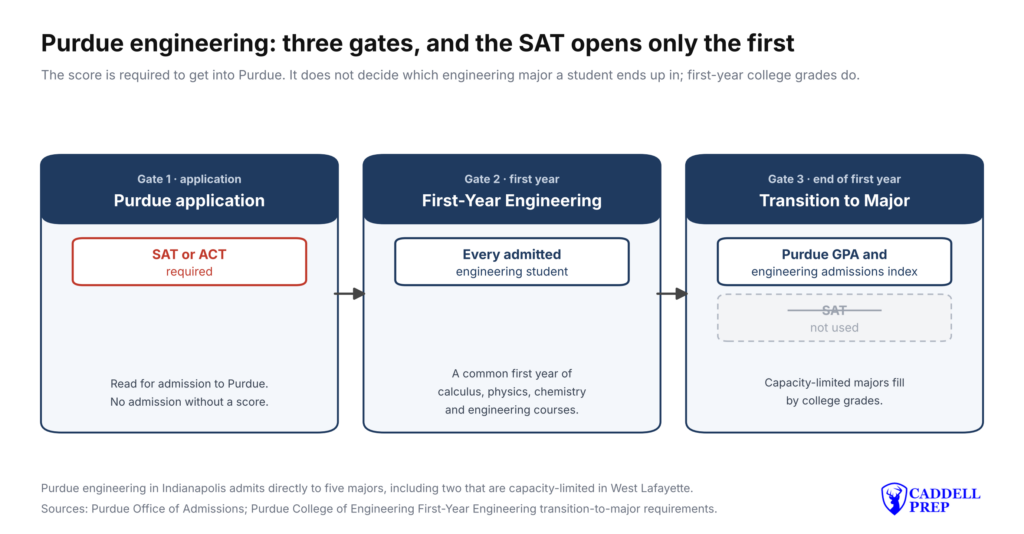
The image above shows the score opening the first door and not the second.
Indianapolis changes one of those three rules. Purdue University in Indianapolis, the former IUPUI engineering programs that Purdue took over in July 2024, admits on West Lafayette’s standards through West Lafayette’s application, and its engineering students are admitted directly to their major rather than to First-Year Engineering. Five majors are offered there: biomedical, computer, electrical, mechanical and motorsports engineering. Two of those, biomedical and mechanical, are the capacity-limited majors in West Lafayette. A student who wants Purdue mechanical engineering and is admitted at Indianapolis has it from the first day, and a student admitted at West Lafayette competes for it a year later.
Families comparing the two locations frequently ask whether the Indianapolis degree is the same one.
Is Purdue Engineering in Indianapolis the Same Degree?
Purdue engineering in Indianapolis is a Purdue degree, admitted on the same standards as West Lafayette and through the same application, in five majors. Purdue describes the Indianapolis location as an extension of West Lafayette and its students as part of the West Lafayette flagship, and the trustees’ tuition freeze covers both locations as one main campus.
Purdue Northwest and Purdue Fort Wayne are different. Each is a separate university within the Purdue system, with its own admission, its own ranges in the table above and its own accredited engineering degrees, and a student applies to each on its own terms. Their Math ceilings sit 150 to 190 points below West Lafayette’s.
Three locations and three sets of rules for one name. The degrees at all of them are accredited ones, and that is the next section.
Which Indiana Universities Have ABET-Accredited Engineering Schools?
Eleven Indiana universities hold ABET-accredited engineering bachelor’s degrees, three of them in the Purdue system, and all eleven are in the table above.
In West Lafayette, Purdue’s College of Engineering holds accredited degrees across every standard discipline and several, nuclear and agricultural engineering among them, that are rare elsewhere, with the same college’s degrees in Indianapolis in five majors. Purdue Fort Wayne and Purdue Northwest hold civil, computer, electrical and mechanical engineering each, Fort Wayne in the state’s second city and Northwest among the steel mills and refineries of the Calumet region on the Illinois line. Cummins in Columbus, Rolls-Royce and Lilly in Indianapolis, and the automotive plants across the north of the state are the largest engineering employers.
Notre Dame’s College of Engineering holds seven accredited degrees in South Bend, and Rose-Hulman in Terre Haute holds accredited degrees across the engineering disciplines and no other kind. Among the smaller private universities, Trine in Angola holds six accredited engineering degrees, Indiana Tech in Fort Wayne five, Valparaiso and Evansville four each, and Taylor in Upland and Indiana Wesleyan in Marion hold accredited engineering programs. Valparaiso, Taylor and Indiana Wesleyan are church-affiliated, and Notre Dame is Catholic.
Accreditation matters for a reason that is easy to miss at seventeen. Licensure as a professional engineer normally requires a degree from an ABET-accredited engineering program. Indiana University Bloomington and Indiana University Indianapolis are not on the page because the engineering programs in Indianapolis became Purdue’s in 2024 and Bloomington’s intelligent systems engineering degree is listed only once its accreditation is confirmed. Ball State, Butler, DePauw and Indiana State report score ranges and are not on the page because none awards an accredited engineering degree, and Marian’s new engineering program is not yet accredited.
Nothing on this page ranks the eleven. The table’s order is a stated, verifiable number, and the choice among accredited programs comes down to cost, discipline and where a student’s score places him.
What If Your Scores Are Below the Range You Want?
An Indiana engineering applicant to Purdue cannot skip the score, so the question at the flagship is how high, and the answer stops at the door of First-Year Engineering.
The Purdue range for admitted students is 1380 to 1520 on the total, and a student below it is a reach applicant to a school that reads every file with a score in it. A student above it is in First-Year Engineering, and from that point his major depends on his Purdue grades, not his SAT, and a capacity-limited major like mechanical engineering is earned in the first year. A New York applicant has Purdue’s $28,794 out-of-state tuition, which the score does not change and which no other large flagship in this series has matched.
The first step is finding out where the score actually is, section by section. A free diagnostic SAT gives a total that can be set against Purdue’s range and a Math score that can be set against the rest of the table.
The Math section rewards the same handful of topics on every test date, and a student who knows which of them he is missing can close a gap of 50 to 100 points in weeks rather than months. The method is on our page on improving your SAT score.
How to Read These Score Ranges
Every range on this page covers the middle 50% of admitted students who submitted the SAT. The lower number is the 25th percentile and the upper number is the 75th, so a quarter of admitted students scored at or above it.
At a university that requires a score from every applicant, the published range describes everyone admitted, not only those who chose to submit. Purdue’s range is complete in that sense, and the private universities’ ranges carry the usual caveat.
Because most colleges are now test-optional, the ranges they publish describe only the students who chose to submit at all. Students with strong scores submit and students with weak ones don’t, so a published range sits higher than the range for everyone who was actually admitted. More on what SAT score you need for college and on test-optional colleges.
Should You Take the ACT Instead?
Indiana administers the SAT to every public high school junior as its state assessment, so nearly every Indiana applicant has an SAT score before he decides whether to take anything else.
Purdue accepts either test and requires one of them. Eight of the eleven universities on this page report both tests, and a student who scores higher on the ACT should submit it.
Engineering Programs in Nearby States
Indiana borders Michigan, Ohio, Kentucky and Illinois, and Indiana students apply across those lines in numbers even with eleven accredited programs at home.
See engineering colleges in Illinois, engineering colleges in Michigan, and engineering colleges in Ohio.
Engineering Colleges in Other States
We publish the same breakdown for engineering programs in every state.
See engineering colleges by state for the full list.

Glyn Caddell
Glyn Caddell holds a BS in Mechanical Engineering from NJIT and has been tutoring New York City students since 2008. He founded Caddell Prep in 2012 and is the author of Digital SAT Math Secrets: Lessons & Tricks to Quickly Improve to a Perfect 800 on the Math Test, which contains over 900 practice problems and is used in Caddell Prep’s SAT math classes. He is founding president of the Staten Island Technical High School alumni association and teaches every lesson on this site personally.
Finally, an SAT course that students actually understand
Every question has a video explanation. Not most — every one.
The on-demand Digital SAT course covers all 17 math topics and 15 reading and writing topics, with 5 full-length practice tests and a 100-point score increase guarantee. Keep access for the rest of high school. No subscription.
Want to Know What 5 Topics Will Improve Your SAT Score the Most?
Sample Feedback from our Diagnostic Test: