
Home » College SAT Score Ranges, Costs, and Programs by Major and State » Engineering Colleges by State: SAT Scores, ACT Scores, Costs, and ABET Programs » Engineering Colleges in Ohio: ACT Scores, SAT Scores, Costs, and Programs
By Glyn Caddell, BSME · Author of Digital SAT Math Secrets · Tutoring since 2008 — Updated October 25, 2026
Eighteen Ohio universities offer ABET-accredited engineering degrees, and this page lists what they cost and the test scores of the students they admit.
One of them charges a student from any state $360 a year more than an Ohio resident, the smallest out-of-state premium at an accredited engineering school in this series that is not zero, and it publishes the surcharge to the dollar, a figure worked out below the table.
The table is sorted by ACT because most Ohio districts give it as the state test, and fifteen of the eighteen universities report it.
Table of Contents
- Ohio Engineering Colleges by ACT and SAT Score
- How Much More Does an Out-of-State Student Pay for Engineering at Youngstown State?
- Which Ohio Universities Have ABET-Accredited Engineering Schools?
- What If Your Score Is Below the Range You Want?
Ohio Engineering Colleges by ACT and SAT Score
The eighteen universities below are the ones in Ohio that hold an ABET-accredited bachelor’s degree in an engineering discipline. The fifteen that report scores are sorted by the midpoint of the ACT composite range, so the order can be checked from the table itself, and the three that do not are listed last in alphabetical order.
| College | ACT composite | SAT Reading & Writing | SAT Math | Cost of attendance | Undergraduates | Admit rate |
|---|---|---|---|---|---|---|
| Case Western Reserve University | 32 to 34 | 700 to 760 | 730 to 780 | $85,851 | 6,437 | 37% |
| Ohio State University | 28 to 32 | 640 to 720 | 670 to 760 | $30,305 | 45,638 | 61% |
| University of Dayton | 25 to 31 | 600 to 690 | 600 to 690 | $65,881 | 7,682 | 65% |
| Miami University | 25 to 30 | 610 to 690 | 610 to 700 | $38,757 | 16,656 | 75% |
| Ohio Northern University | 24 to 29 | 585 to 690 | 590 to 710 | $53,580 | 2,489 | 74% |
| University of Cincinnati | 24 to 29 | 570 to 670 | 590 to 700 | $32,171 | 29,882 | 85% |
| University of Toledo | 23 to 29 | 550 to 650 | 550 to 650 | $26,512 | 9,770 | 92% |
| Cedarville University | 22 to 29 | 580 to 690 | 550 to 670 | $49,320 | 4,024 | 65% |
| Ohio University | 22 to 28 | 550 to 650 | 540 to 640 | $30,586 | 19,633 | 85% |
| Otterbein University | 22 to 28 | Does not report SAT data | Does not report SAT data | $48,321 | 2,157 | 85% |
| Youngstown State University | 19 to 25 | 510 to 620 | 500 to 610 | $21,708 | 7,961 | 84% |
| Kent State University | 18 to 25 | 510 to 630 | 500 to 610 | $30,567 | 19,320 | 86% |
| University of Mount Union | 18 to 25 | 460 to 620 | 450 to 620 | $49,276 | 1,995 | 78% |
| University of Akron | 17 to 25 | 460 to 600 | 440 to 590 | $26,284 | 9,052 | 60% |
| Marietta College | 17 to 24 | 510 to 600 | 530 to 600 | $53,709 | 952 | 79% |
| Central State University | Does not report ACT data | Does not report SAT data | Does not report SAT data | $21,929 | 2,620 | 99% |
| Cleveland State University | Does not report ACT data | Does not report SAT data | Does not report SAT data | $27,159 | 8,969 | 91% |
| Wright State University | Does not report ACT data | Does not report SAT data | Does not report SAT data | $24,373 | 6,762 | 96% |
Each range covers the middle 50% of admitted students who submitted that test. A quarter scored below the lower number, and the top quarter scored at or above the upper one. Being under the lower number does not rule a student out, and being just above it is not as safe as it looks.
Ohio Northern and Cincinnati share an ACT range and are ordered by the SAT Math midpoint. Ohio University and Otterbein share an ACT range and the school that reports an SAT range is listed first. Kent State and Mount Union share an ACT range and are ordered by the SAT Math midpoint. Only universities with an ABET-accredited engineering bachelor’s degree are listed. Bowling Green’s and Shawnee State’s engineering technology degrees are accredited under a separate ABET commission and do not qualify them for the list. Central State, Cleveland State and Wright State report no SAT or ACT range to the Scorecard and are listed last.
Three things about that table are worth pausing on.
Youngstown State’s tuition and fees are $11,113 for an Ohio resident and $11,473 for a student from anywhere else, $360 apart, and the university publishes the surcharge that makes the difference. The next section is about it.
Ohio State, at 45,638 undergraduates, is the largest university on any page in this series, 4,700 students larger than Michigan State and 7,900 larger than Rutgers. It admits 61% on an ACT range of 28 to 32 and a Math range whose floor, 670, is above the ceiling at seven of the fourteen other reporting schools.
Central State charges a student from outside Ohio $10,058, the lowest out-of-state figure on the page and $2,000 above its resident price, and it is the only historically Black university on the page.
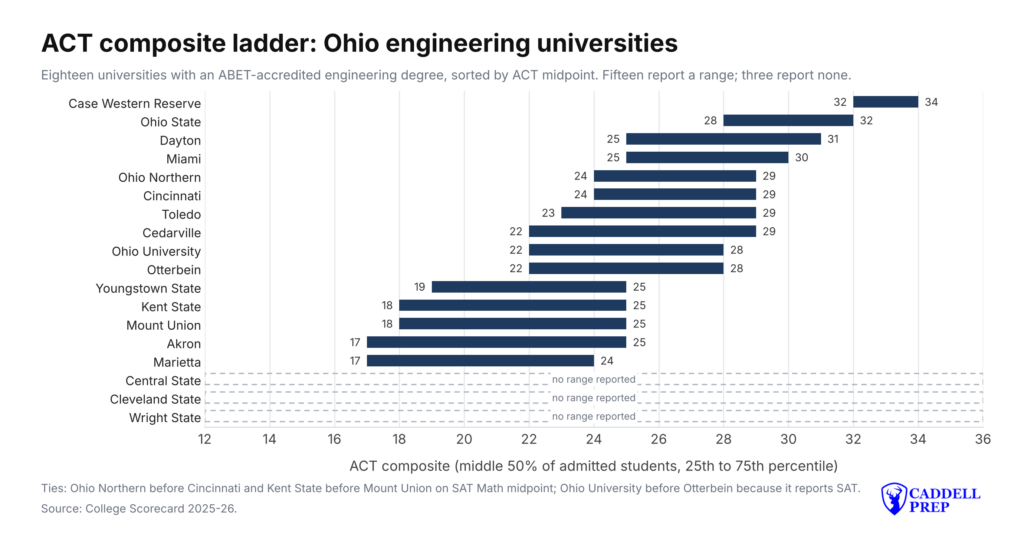
A student can see where his ACT score sits on this list in the image above.
Want to Know What 5 Topics Will Improve Your SAT Score the Most?
Sample Feedback from our Diagnostic Test:

Case Western Reserve University
Case Western Reserve University’s Case School of Engineering in Cleveland holds ABET accreditation in disciplines including aerospace, biomedical, chemical, civil, computer, electrical, materials, mechanical, polymer and systems and control engineering, and Case Western has the highest range on the page on every test.
ACT composite 32 to 34. Reading & Writing 700 to 760, Math 730 to 780. The top quarter of admitted students scored at or above 34 on the ACT and 780 on Math. Cost of attendance $85,851, with tuition and fees at $66,608 for all students. 6,437 undergraduates, 37% admitted.
Case Western is the most selective school on the page, the most expensive, and the holder of the only accredited polymer engineering degree in this series. Its ACT floor of 32 equals Ohio State’s ceiling.
Ohio State University
Ohio State University’s College of Engineering in Columbus holds ABET accreditation in disciplines including aerospace, biomedical, chemical, civil, computer, electrical, environmental, food and agricultural, industrial and systems, materials, mechanical and welding engineering, and Ohio State admits engineering students as pre-majors who apply to a specific major after their first-year courses.
ACT composite 28 to 32. Reading & Writing 640 to 720, Math 670 to 760. The top quarter of admitted students scored at or above 32 on the ACT and 760 on Math. Cost of attendance $30,305, with tuition and fees at $13,244 in state and $40,022 out of state. 45,638 undergraduates, 61% admitted.
Ohio State is the largest university in this series, holds the only accredited welding engineering degree in the country, and charges a non-resident $40,022, the second-highest public figure on the page by $1,199. Its pre-major rule is described in the next section.
University of Dayton
The University of Dayton’s School of Engineering holds ABET accreditation in chemical, civil, computer, electrical and mechanical engineering, and Dayton has the highest ACT ceiling among the private schools on the page other than Case Western.
ACT composite 25 to 31. Reading & Writing 600 to 690, Math 600 to 690. The top quarter of admitted students scored at or above 31 on the ACT and 690 on Math. Cost of attendance $65,881, with tuition and fees at $49,140 for all students. 7,682 undergraduates, 65% admitted.
Dayton is a Marianist Catholic university whose two SAT section ranges are identical, and its ACT range is two points wider than Miami’s at the ceiling on the same floor. Wright-Patterson Air Force Base, the Air Force’s research headquarters, is ten minutes from campus.
Miami University
Miami University’s College of Engineering and Computing in Oxford holds ABET accreditation in chemical, computer, electrical, manufacturing and mechanical engineering, and Miami charges the highest out-of-state tuition on the page.
ACT composite 25 to 30. Reading & Writing 610 to 690, Math 610 to 700. The top quarter of admitted students scored at or above 30 on the ACT and 700 on Math. Cost of attendance $38,757, with tuition and fees at $18,161 in state and $41,221 out of state. 16,656 undergraduates, 75% admitted.
Miami charges a resident $18,161 and a non-resident $41,221, the highest figures among the publics on the page in both columns, and its Math floor of 610 is the highest among the publics after Ohio State’s.
Ohio Northern University
Ohio Northern University’s T.J. Smull College of Engineering in Ada holds ABET accreditation in civil, computer, electrical and mechanical engineering, and Ohio Northern shares its ACT range with Cincinnati.
ACT composite 24 to 29. Reading & Writing 585 to 690, Math 590 to 710. The top quarter of admitted students scored at or above 29 on the ACT and 710 on Math. Cost of attendance $53,580, with tuition and fees at $39,800 for all students. 2,489 undergraduates, 74% admitted.
Ohio Northern is listed ahead of Cincinnati on its SAT Math midpoint, 650 to 645, and its Math ceiling of 710 is the highest on the page among the schools below Ohio State. It is a Methodist-affiliated university in a village of 5,000.
University of Cincinnati
The University of Cincinnati’s College of Engineering and Applied Science holds ABET accreditation in disciplines including aerospace, architectural, biomedical, chemical, civil, computer, electrical, environmental and mechanical engineering, and Cincinnati requires cooperative education of every engineering student, in the program that invented it in 1906.
ACT composite 24 to 29. Reading & Writing 570 to 670, Math 590 to 700. The top quarter of admitted students scored at or above 29 on the ACT and 700 on Math. Cost of attendance $32,171, with tuition and fees at $13,976 in state and $29,310 out of state. 29,882 undergraduates, 85% admitted.
Cincinnati is the second-largest school on the page and the home of mandatory co-op, described in the next section. Its Math ceiling of 700 matches Miami’s on a floor 20 points lower.
University of Toledo
The University of Toledo’s College of Engineering holds ABET accreditation in bioengineering, chemical, civil, computer science and engineering, electrical, environmental and mechanical engineering, and Toledo requires co-op of its engineering students as well.
ACT composite 23 to 29. Reading & Writing 550 to 650, Math 550 to 650. The top quarter of admitted students scored at or above 29 on the ACT and 650 on Math. Cost of attendance $26,512, with tuition and fees at $12,744 in state and $22,104 out of state. 9,770 undergraduates, 92% admitted.
Toledo is the least selective reporting school on the page, and its two SAT section ranges are identical. Its out-of-state tuition is $7,206 below Cincinnati’s.
Cedarville University
Cedarville University’s School of Engineering and Computer Science holds ABET accreditation in civil, computer, electrical and mechanical engineering, and Cedarville has the widest ACT range on the page, seven points.
ACT composite 22 to 29. Reading & Writing 580 to 690, Math 550 to 670. The top quarter of admitted students scored at or above 29 on the ACT and 670 on Math. Cost of attendance $49,320, with tuition and fees at $37,150 for all students. 4,024 undergraduates, 65% admitted.
Cedarville is a Baptist university whose Reading & Writing range sits 30 points above its Math range at the floor and 20 at the ceiling, and whose admit rate matches Dayton’s.
Ohio University
Ohio University’s Russ College of Engineering and Technology in Athens holds ABET accreditation in chemical, civil, computer, electrical, industrial and systems, and mechanical engineering, and Ohio University is the oldest university in the state.
ACT composite 22 to 28. Reading & Writing 550 to 650, Math 540 to 640. The top quarter of admitted students scored at or above 28 on the ACT and 640 on Math. Cost of attendance $30,586, with tuition and fees at $14,158 in state and $24,838 out of state. 19,633 undergraduates, 85% admitted.
Ohio University shares its ACT range with Otterbein and is listed first because it reports an SAT range. Its in-state tuition is the third-highest among the publics after Miami’s and Cincinnati’s.
Otterbein University
Otterbein University in Westerville holds ABET accreditation for its Bachelor of Science in Systems Engineering, and Otterbein is on this page for that one degree.
ACT composite 22 to 28. Otterbein reports no SAT range. The top quarter of admitted students scored at or above 28 on the ACT. Cost of attendance $48,321, with tuition and fees at $35,548 for all students. 2,157 undergraduates, 85% admitted.
Otterbein is a United Methodist-affiliated university in a Columbus suburb, and its systems engineering degree is the only accredited one on the page outside Case Western’s.
Youngstown State University
Youngstown State University’s Rayen School of Engineering holds ABET accreditation in chemical, civil, electrical, industrial and systems, and mechanical engineering, and Youngstown State charges a student from outside Ohio $360 a year more than a resident.
ACT composite 19 to 25. Reading & Writing 510 to 620, Math 500 to 610. The top quarter of admitted students scored at or above 25 on the ACT and 610 on Math. Cost of attendance $21,708, with tuition and fees at $11,113 in state and $11,473 out of state. 7,961 undergraduates, 84% admitted.
Youngstown State has the lowest cost of attendance on the page and the smallest difference between its resident and non-resident prices of any accredited engineering school in this series that charges one. Its Math range, 500 to 610, is shared with Kent State.
Kent State University
Kent State University’s College of Aeronautics and Engineering holds ABET accreditation in aerospace engineering and mechatronics engineering, and Kent State is on this page for two degrees accredited within the last few years.
ACT composite 18 to 25. Reading & Writing 510 to 630, Math 500 to 610. The top quarter of admitted students scored at or above 25 on the ACT and 610 on Math. Cost of attendance $30,567, with tuition and fees at $13,232 in state and $23,082 out of state. 19,320 undergraduates, 86% admitted.
Kent State is the fourth-largest school on the page and the holder of the only accredited mechatronics engineering degree in Ohio. It is listed ahead of Mount Union on its SAT Math midpoint, 555 to 535.
University of Mount Union
The University of Mount Union’s School of Engineering in Alliance holds ABET accreditation in civil, computer, electrical and mechanical engineering, and Mount Union has the widest Math range on the page, 170 points.
ACT composite 18 to 25. Reading & Writing 460 to 620, Math 450 to 620. The top quarter of admitted students scored at or above 25 on the ACT and 620 on Math. Cost of attendance $49,276, with tuition and fees at $36,600 for all students. 1,995 undergraduates, 78% admitted.
Mount Union is a United Methodist-affiliated university whose Math range runs from 450 to 620, the widest on the page, and whose ACT range matches Kent State’s.
University of Akron
zThe University of Akron’s College of Engineering and Polymer Science holds ABET accreditation in disciplines including aerospace systems, biomedical, chemical, civil, computer, corrosion, electrical and mechanical engineering, and Akron holds the only accredited corrosion engineering degree in the country.
ACT composite 17 to 25. Reading & Writing 460 to 600, Math 440 to 590. The top quarter of admitted students scored at or above 25 on the ACT and 590 on Math. Cost of attendance $26,284, with tuition and fees at $13,135 in state and $20,815 out of state. 9,052 undergraduates, 60% admitted.
Akron admits 60% of applicants, the second-lowest rate on the page after Case Western’s, on the lowest Math range among the reporting publics. Goodyear’s headquarters are a mile from campus, and the corrosion engineering degree is unique in the country.
Marietta College
Marietta College’s engineering programs hold ABET accreditation in petroleum engineering, and Marietta is the smallest school on the page.
ACT composite 17 to 24. Reading & Writing 510 to 600, Math 530 to 600. The top quarter of admitted students scored at or above 24 on the ACT and 600 on Math. Cost of attendance $53,709, with tuition and fees at $39,652 for all students. 952 undergraduates, 79% admitted.
Marietta has 952 undergraduates and the lowest ACT ceiling on the page, and its petroleum engineering degree is the only accredited one in Ohio. It sits on the Ohio River across from West Virginia.
Central State University
Central State University’s engineering programs in Wilberforce hold ABET accreditation in manufacturing engineering, and Central State reports no admitted score range.
Cost of attendance $21,929, with tuition and fees at $8,058 in state and $10,058 out of state. 2,620 undergraduates, 99% admitted.
Central State is Ohio’s public historically Black university and its 1890 land-grant institution, the least selective school on the page, and the cheapest for a resident and for a non-resident. It reports no SAT or ACT range to the Scorecard.
Cleveland State University
Cleveland State University’s Washkewicz College of Engineering holds ABET accreditation in chemical, civil, computer, electrical and mechanical engineering, and Cleveland State reports no admitted score range.
Cost of attendance $27,159, with tuition and fees at $12,988 in state and $18,510 out of state. 8,969 undergraduates, 91% admitted.
Cleveland State is the second public engineering school in Cleveland, four miles from Case Western, and its out-of-state tuition is the third-lowest on the page. It reports no SAT or ACT range to the Scorecard.
Wright State University
Wright State University’s College of Engineering and Computer Science in Dayton holds ABET accreditation in biomedical, electrical, industrial and systems, materials science, and mechanical engineering, and Wright State reports no admitted score range.
Cost of attendance $24,373, with tuition and fees at $11,522 in state and $21,222 out of state. 6,762 undergraduates, 96% admitted.
Wright State is the second engineering school in Dayton, named for the brothers who built the first airplane there, and it reports no SAT or ACT range to the Scorecard.
Fifteen ranges and three blanks say who got in. One of the eighteen has published, to the dollar, what it charges a student for coming from somewhere else, and the next section is about it.
How Much More Does an Out-of-State Student Pay for Engineering at Youngstown State?
An out-of-state student pays $180 a semester more than an Ohio resident at Youngstown State at the full-time rate, $360 a year, under the university’s Affordable Tuition Advantage surcharge, and the Scorecard’s two tuition figures for Youngstown State, $11,113 and $11,473, are exactly $360 apart.
The university publishes the schedule. For 2026-27, the non-resident surcharge for an undergraduate is $15 per credit hour for a part-time student taking one to eleven credits, $180 per semester for a full-time student within the bulk rate of twelve to eighteen credits, and $15 per credit hour above eighteen. The schedule names no states and no conditions. A student from New York, Pennsylvania or California pays the same $180 a semester over the resident rate, and the resident rate is the one every Ohioan pays.
| University | Resident | Non-resident | Difference |
|---|---|---|---|
| Youngstown State University | $11,113 | $11,473 | $360 |
| Central State University | $8,058 | $10,058 | $2,000 |
| Cleveland State University | $12,988 | $18,510 | $5,522 |
| University of Akron | $13,135 | $20,815 | $7,680 |
| University of Toledo | $12,744 | $22,104 | $9,360 |
| Wright State University | $11,522 | $21,222 | $9,700 |
| Kent State University | $13,232 | $23,082 | $9,850 |
| Ohio University | $14,158 | $24,838 | $10,680 |
| University of Cincinnati | $13,976 | $29,310 | $15,334 |
| Miami University | $18,161 | $41,221 | $23,060 |
| Ohio State University | $13,244 | $40,022 | $26,778 |
Set the first row against the series. Before this page, the smallest out-of-state premium at an accredited engineering school that charged one was McNeese State’s $1,500, on our page on engineering colleges in Louisiana, with Southern Miss’s $2,000 and Central Connecticut’s $3,500 behind it. A handful of schools charge every student the same tuition and have no premium at all: Central Michigan, Eastern Michigan, Lake Superior State, St. Cloud State and Southeast Missouri State. Youngstown State’s $360 is less than a quarter of McNeese’s, and its non-resident figure of $11,473 is the fifth-lowest at a public engineering school in the series after Western Carolina’s, Southeast Missouri’s, McNeese’s and Central State’s. It is also below the resident price at every other Ohio public on the page except Central State.
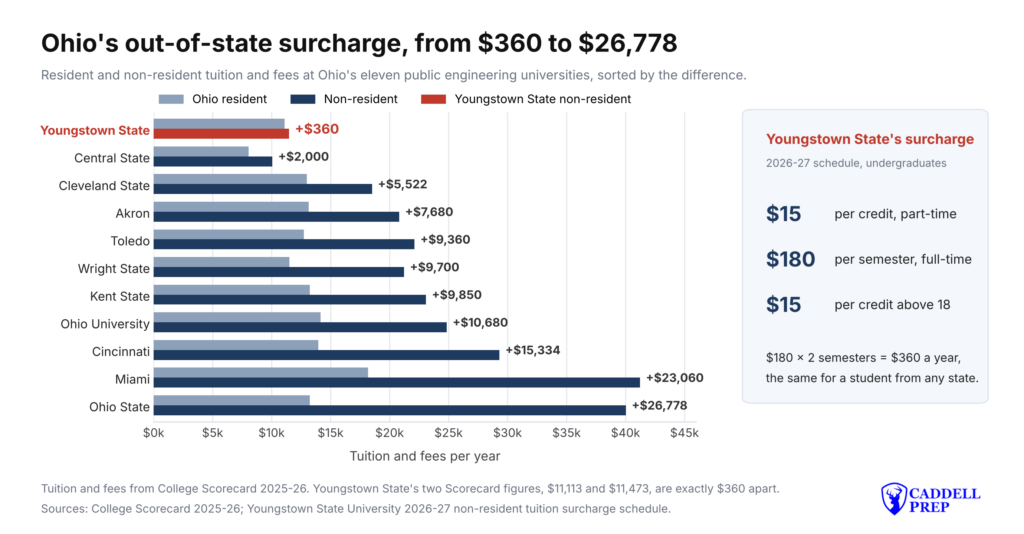
The image above shows the whole out-of-state penalty, written down.
Take a New York student with a 24 on the ACT. At Ohio State he is four points below the floor of 28 and would pay $40,022. At Cincinnati he is at the floor of 24 to 29 and pays $29,310. At Toledo he is in the lower half of 23 to 29 and pays $22,104. At Youngstown State he is in the top quarter of 19 to 25 and pays $11,473, $360 more than the student from Youngstown sitting next to him. The spread from his cheapest accredited Ohio option to his most expensive is $28,549 a year, and the school where his score sits highest is the one at the bottom of that spread.
Cincinnati’s number is the oldest on the page. A Cincinnati civil engineering professor named Herman Schneider founded cooperative education there in 1906 with 27 engineering students and 13 companies, and the university’s College of Engineering and Applied Science still lists every one of its programs as mandatory co-op, under a university rule that mandatory programs require two to five full-time co-op terms of at least 35 hours a week for fifteen to eighteen weeks each before graduation. In 2024-25, students across the university in paid co-op positions earned $94,192,050 in aggregate by the university’s self-reported figures, an average of $11,220 per student per semester across 8,395 placements with 1,757 employers. The figure is university-wide and not engineering-only, and it is self-reported, but it is the number a family should set beside the $29,310 a New York student pays Cincinnati, because the engineering student earns it as part of the degree and not instead of it. Toledo requires co-op of its engineering students as well. Kettering and Grand Valley require it on our page on engineering colleges in Michigan, and Northeastern builds its degree around it on our page on engineering colleges in Massachusetts, and Cincinnati is where all of them got the idea.
Ohio State’s number is a gate rather than a price. The College of Engineering admits first-year students as engineering pre-majors and requires them to apply to a specific major after their first-year courses, on criteria the college publishes by program [VERIFY on engineering.osu.edu: the application-to-major GPA and course requirements, and which majors are competitive]. That is the shape of the gate on our page on engineering colleges in Maryland, a year in and on grades, and a student who is admitted to Ohio State engineering should read the major’s criteria before he reads the university’s range.
The honest version is that Youngstown State’s $360 is the surcharge at the bulk rate, and a student taking more than eighteen credits in a semester pays $15 a credit more, with fees and housing at the university’s regular charges. The Scorecard’s two figures happen to sit exactly $360 apart, so the Scorecard’s year carried the same surcharge. The page states the arithmetic and does not claim the Scorecard is current. Youngstown State admits 84% of applicants on an ACT range of 19 to 25 and a Math range of 500 to 610, among the lower ranges on the page, in a city whose steel mills closed in 1977 and whose university is now its largest employer. A student reading the price should read the row beside it. And Cincinnati’s co-op earnings are what students reported, averaged across every college, not a promise to an engineering first-year.
Families reading Cincinnati’s page frequently ask whether co-op is a choice.
Is Co-op Required for Engineering at the University of Cincinnati?
Co-op is required for engineering at the University of Cincinnati. The university lists every program in its College of Engineering and Applied Science as mandatory co-op, and its rule for mandatory programs is two to five full-time co-op terms of at least 35 hours a week for fifteen to eighteen weeks each, completed before graduation.
The program is the original one, founded in 1906, and its students earned an average of $11,220 a semester in 2024-25 by the university’s self-reported figures. A New York student paying $29,310 a year in tuition should set that number beside it, and should know that the degree normally takes five years because the co-op terms are in it.
The two universities’ numbers are their own. The degrees are what the next section lists.
Which Ohio Universities Have ABET-Accredited Engineering Schools?
Eighteen Ohio universities hold ABET-accredited engineering bachelor’s degrees, eleven public and seven private, and all eighteen are in the table above.
In Cleveland, Case Western’s Case School of Engineering and Cleveland State’s Washkewicz College are four miles apart, with NASA’s Glenn Research Center at the airport. In Columbus, Ohio State’s College of Engineering is the largest in the state, with Honda in Marysville and Intel’s fabs in Licking County the largest new engineering employers in central Ohio, and Otterbein is in Westerville. In Cincinnati, the University of Cincinnati’s College of Engineering and Applied Science sits in the city of GE Aerospace’s Evendale plant and Procter & Gamble. In Dayton, the University of Dayton and Wright State flank Wright-Patterson Air Force Base, and Central State is in Wilberforce twenty minutes east. Miami is in Oxford, Ohio Northern in Ada, Toledo on the Maumee, Ohio University in Athens, Kent State in Kent, Mount Union in Alliance, Cedarville in Cedarville, Youngstown State in Youngstown, Marietta on the Ohio River, and Akron a mile from Goodyear.
Accreditation matters for a reason that is easy to miss at seventeen. Licensure as a professional engineer normally requires a degree from an ABET-accredited engineering program, and that is why Bowling Green’s and Shawnee State’s engineering technology degrees do not put those universities on the list. Denison, Kenyon, Oberlin, Wooster, John Carroll, Xavier, Walsh, Baldwin Wallace, Capital, Ashland, Tiffin, Findlay, Heidelberg, Wilberforce and Franklin award no engineering degree, and Ohio State’s and Ohio University’s regional campuses award their main campuses’ degrees.
Nothing on this page ranks the eighteen. The table’s order is a stated, verifiable number where one exists, and the choice among accredited programs comes down to cost, discipline and where a student’s score places him.
What If Your Scores Are Below the Range You Want?
In Ohio eighteen schools cover ranges from a 17 floor to a 34 ceiling, eleven of them are public, and a New York student’s price among the publics runs from $10,058 to $41,221, with one school that charges him $360 over the resident rate. The score decides Columbus or not, and below Columbus the question is price and co-op.
The gap from a 24 to Ohio State’s floor of 28 is four points of ACT composite, two or three questions a section, and the student who closes it is choosing between $40,022 and a list of ten other publics whose ranges he is already inside. The student who does not is choosing among those ten on price, and the price runs from $10,058 to $29,310, with Cincinnati’s co-op earnings on one side of that range and Youngstown State’s $360 on the other.
The first step is finding out where the score actually is, section by section. A free diagnostic SAT gives a score that can be set against the SAT columns in the table and converted to the ACT scale for the rest of it.
The Math section rewards the same handful of topics on every test date, and a student who knows which of them he is missing can close a gap of 50 to 100 points in weeks rather than months. The method is on our page on improving your SAT Math score, and the same topics carry the ACT Math section.
How to Read These Score Ranges
Every range on this page covers the middle 50% of admitted students who submitted that test. The lower number is the 25th percentile and the upper number is the 75th, so a quarter of admitted students scored at or above it.
A surcharge is a published number and a range is a published description, and a school can have the smallest surcharge and one of the lower ranges on the same page, as Youngstown State does. The two numbers answer different questions, and a student should ask both.
Because most colleges are now test-optional, the ranges that are published describe only the students who chose to submit at all. Students with strong scores submit and students with weak ones don’t, so a published range sits higher than the range for everyone who was actually admitted. More on what SAT score you need for college and on test-optional colleges.
Should You Take the SAT Instead?
Ohio is an ACT state by a narrow margin. Each Ohio district chooses the ACT or the SAT as its state-funded junior-year test and most choose the ACT, and forty-one Ohio institutions report an ACT range against thirty-eight for the SAT.
That is why the table on this page carries an ACT composite column and is sorted by it. All eighteen universities accept either test, and a student from outside Ohio who holds an SAT should read the SAT columns and submit the test he scores higher on.
Engineering Programs in Nearby States
Ohio borders Michigan, Indiana, Kentucky, West Virginia and Pennsylvania, and Ohio students apply across those lines in numbers even with eighteen accredited programs at home.
See engineering colleges in Michigan, engineering colleges in Indiana, and engineering colleges in Kentucky.
Engineering Colleges in Other States
We publish the same breakdown for engineering programs in every state.
See engineering colleges by state for the full list.

Glyn Caddell
Glyn Caddell holds a BS in Mechanical Engineering from NJIT and has been tutoring New York City students since 2008. He founded Caddell Prep in 2012 and is the author of Digital SAT Math Secrets: Lessons & Tricks to Quickly Improve to a Perfect 800 on the Math Test, which contains over 900 practice problems and is used in Caddell Prep’s SAT math classes. He is founding president of the Staten Island Technical High School alumni association and teaches every lesson on this site personally.
Finally, an SAT course that students actually understand
Every question has a video explanation. Not most — every one.
The on-demand Digital SAT course covers all 17 math topics and 15 reading and writing topics, with 5 full-length practice tests and a 100-point score increase guarantee. Keep access for the rest of high school. No subscription.
Want to Know What 5 Topics Will Improve Your SAT Score the Most?
Sample Feedback from our Diagnostic Test: