
Home » College SAT Score Ranges, Costs, and Programs by Major and State » Engineering Colleges by State: SAT Scores, ACT Scores, Costs, and ABET Programs » Engineering Colleges in Kentucky: SAT Scores, Costs, and Programs
By Glyn Caddell, BSME · Author of Digital SAT Math Secrets · Tutoring since 2008 — Updated October 23, 2026
Four Kentucky universities offer ABET-accredited engineering degrees, and this page lists what they cost and the SAT scores of the students they admit.
The University of Louisville’s engineering school admits first-year students on two published tiers in which a higher GPA buys a lower score, and it admits without any score at a 3.0, a rule covered below the table.
Scores are given by section, and the table is sorted by Math because that is the section engineering programs use.
Table of Contents
- Kentucky Engineering Colleges by SAT Math Score
- What SAT Score Do You Need for Louisville’s Speed School of Engineering?
- Which Kentucky Universities Have ABET-Accredited Engineering Schools?
- What If Your Score Is Below the Tier You Want?
Kentucky Engineering Colleges by SAT Math Score
The four universities below are the ones in Kentucky that hold an ABET-accredited bachelor’s degree in an engineering discipline. They are sorted by the midpoint of the SAT Math range, so the order can be checked from the table itself.
| College | SAT Reading & Writing | SAT Math | Cost of attendance | Undergraduates | Admit rate |
|---|---|---|---|---|---|
| University of Kentucky | 540 to 650 | 530 to 640 | $34,391 | 24,763 | 93% |
| University of Louisville | 530 to 640 | 510 to 630 | $32,941 | 14,727 | 79% |
| Murray State University | 480 to 600 | 460 to 570 | $23,485 | 6,688 | 86% |
| Western Kentucky University | 420 to 530 | 420 to 520 | $24,188 | 12,155 | 94% |
Each range covers the middle 50% of admitted students who submitted the SAT. A quarter scored below the lower number, and the top quarter scored at or above the upper one. Being under the lower number does not rule a student out, and being just above it is not as safe as it looks.
Only universities with an ABET-accredited engineering bachelor’s degree are listed. Northern Kentucky’s and Eastern Kentucky’s technology degrees are accredited under a separate ABET commission and do not qualify them for the list.
Three things about that table are worth pausing on.
UK’s out-of-state tuition, $34,140, is more than Louisville’s entire cost of attendance, $32,941. A New York student pays more in tuition alone at the flagship than a Kentucky student pays for tuition, housing, food and books at the state’s second engineering school.
Western Kentucky’s Math range, 420 to 520, is the lowest on any public engineering university in this series so far, and its ceiling sits 10 points under Louisville’s floor. The top quarter of WKU’s admitted class scored where the bottom quarter of UofL’s did.
Louisville’s engineering school publishes two SAT Math lines, 570 and 590, and both sit inside the university’s own range of 510 to 630. The 570 is the middle of the range and the 590 is two thirds of the way up it, which means a typical Louisville admit can be a typical Louisville admit and still be short of the engineering school. The next section explains how.
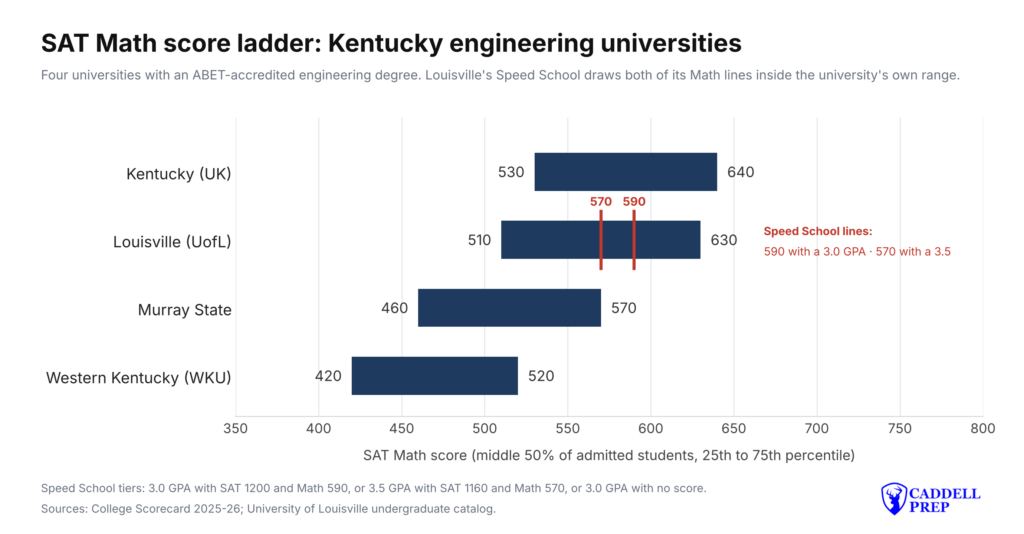
A student can see where his Math score sits on this list, and how much of Louisville’s range sits below each engineering line, in the image above.
Want to Know What 5 Topics Will Improve Your SAT Score the Most?
Sample Feedback from our Diagnostic Test:

University of Kentucky
The University of Kentucky’s Stanley and Karen Pigman College of Engineering in Lexington holds ABET accreditation in disciplines including biosystems, chemical, civil, computer, electrical, materials, mechanical and mining engineering, and UK has the highest Math range on the page.
Reading & Writing 540 to 650, Math 530 to 640. The top quarter of admitted students scored at or above 640 on Math. Cost of attendance $34,391, with tuition and fees at $13,502 in state and $34,140 out of state. 24,763 undergraduates, 93% admitted.
UK is the largest school on the page, the most expensive, and the only one whose out-of-state tuition exceeds $30,000. Its Math ceiling of 640 is 10 points above Louisville’s and 120 above Western Kentucky’s.
University of Louisville
The University of Louisville’s J.B. Speed School of Engineering holds ABET accreditation in disciplines including bioengineering, chemical, civil, computer, electrical, industrial and mechanical engineering, and the Speed School admits first-year students on a 3.0 GPA with an SAT of 1200 and a Math of 590, or a 3.5 GPA with an SAT of 1160 and a Math of 570, or a 3.0 GPA with no score at all.
Reading & Writing 530 to 640, Math 510 to 630. The top quarter of admitted students scored at or above 630 on Math. Cost of attendance $32,941, with tuition and fees at $13,136 in state and $29,482 out of state. 14,727 undergraduates, 79% admitted.
Louisville is the most selective school on the page by admit rate and the only one under 80%. Its Math range sits 20 points below UK’s at the floor and 10 below at the ceiling, and its engineering school’s two lines fall at the middle and the upper third of it.
Murray State University
Murray State University’s Institute of Engineering in Murray holds ABET accreditation for its engineering physics degree, which carries electrical, mechanical and aerospace tracks, and Murray State has the lowest cost of attendance on the page.
Reading & Writing 480 to 600, Math 460 to 570. The top quarter of admitted students scored at or above 570 on Math. Cost of attendance $23,485, with tuition and fees at $9,900 in state and $19,836 out of state. 6,688 undergraduates, 86% admitted.
Murray State is the smallest school on the page and the cheapest on every measure, with the only in-state tuition under $10,000 and the only out-of-state tuition under $20,000. Its Math ceiling of 570 is the Speed School’s lower line.
Western Kentucky University
Western Kentucky University’s Ogden College of Science and Engineering in Bowling Green holds ABET accreditation in civil, electrical and mechanical engineering, and WKU has the lowest Math range on the page.
Reading & Writing 420 to 530, Math 420 to 520. The top quarter of admitted students scored at or above 520 on Math. Cost of attendance $24,188, with tuition and fees at $11,652 in state and $27,000 out of state. 12,155 undergraduates, 94% admitted.
WKU is the least selective school on the page by admit rate and its two section ranges are nearly identical. Its Math ceiling of 520 sits 10 points under Louisville’s floor and 50 under Murray State’s ceiling.
The four ranges describe who got in. Louisville’s engineering school has also written down what it asks of them, and that is the next section.
What SAT Score Do You Need for Louisville's Speed School of Engineering?
The Speed School of Engineering admits a first-year student with a 3.0 GPA and an SAT total of 1200 with a Math of 590, or with a 3.5 GPA and an SAT total of 1160 with a Math of 570, or without any test score on a 3.0 GPA, a comprehensive transcript evaluation and a resume review. The ACT equivalents are a composite and Math of 25 for the first tier and a composite and Math of 24 for the second.
The University of Louisville’s undergraduate catalog states the rule in two tiers, and the table below is the catalog’s rule set beside the university’s admitted range.
| Route | GPA | SAT total | SAT Math | ACT composite and Math |
|---|---|---|---|---|
| Tier 1 | 3.0 | 1200 | 590 | 25 |
| Tier 2 | 3.5 | 1160 | 570 | 24 |
| No score | 3.0 | none | none | none |
| UofL admitted range (middle 50%) | approximately 1040 to 1270 | 510 to 630 | 19 to 27 |
Read the two tiers against each other and the catalog has priced the test. A student who raises his GPA from a 3.0 to a 3.5 lowers the Math he needs by 20 points and the total by 40. Half a GPA point is worth 20 SAT Math points, and the floor is a 3.0 either way. Every Speed School program also requires precalculus or calculus in high school, and the engineering programs require chemistry, so the GPA that buys the discount has to be earned in part in those courses.
Now set the lines against the range. Louisville’s admitted Math range is 510 to 630. The 570 line is the midpoint of it, and the 590 line is approximately two thirds of the way up. The 1200 total is approximately 70% of the way up the admitted total range. So a student squarely inside Louisville’s middle 50% is as likely as not to be below the Speed School’s first tier on Math, and the catalog has already told him what the alternatives are: a 3.5 and 20 fewer points, or a 3.0 and no score.
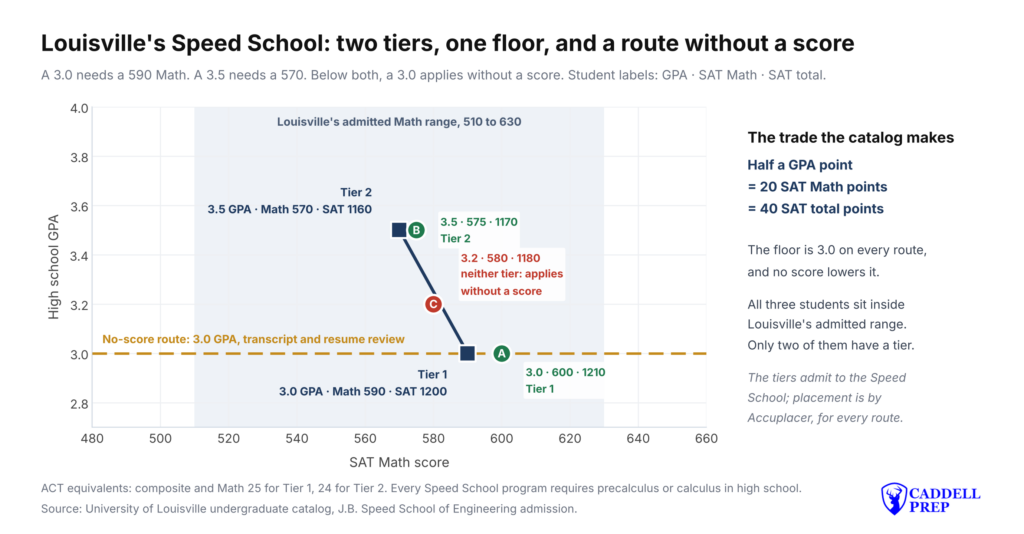
The image above shows the trade in one picture: half a GPA point for twenty Math points, and a floor at 3.0 that no score lowers.
Take three students, all inside Louisville’s admitted range. The first has a 3.0 GPA, a 600 Math and a 1210 total, and he is in the first tier on every number. The second has a 3.5, a 575 and an 1170, and she is in the second tier, admitted on a Math score 25 points below the first student’s because her GPA is half a point higher. The third has a 3.2, a 580 and an 1180. He is short of the first tier on all three numbers and short of the second tier on GPA, so neither tier admits him on his scores, and he applies without them on his 3.2 and his transcript. All three are typical Louisville admits by the table. Only two of them have a tier.
The honest version is shorter than the rule. The tiers are admission to the Speed School. They are not placement. The catalog places most first-year students into ENGR 100 or ENGR 101 by an Accuplacer exam, so a student admitted in the first tier on a 590 and a student admitted with no score at all take the same placement test and can land in the same first course. A student who meets the university’s standard but not the Speed School’s is admitted to the College of Arts and Sciences in a pre-engineering curriculum, and the catalog says his transfer into the Speed School is considered after he completes it, not promised.
[VERIFY: UK’s Pigman College of Engineering publishes its own first-year criteria, revised in 2019 per the University Senate record. Insert here: the GPA and ACT or SAT Math line if there is one, the path for a student who does not meet it, and whether UK admits engineering on the university standard. If UK has a Math line, set it beside Louisville’s 570 and 590 against UK’s range of 530 to 640.]
Iowa’s flagship priced the test against GPA at the university’s door, where a point of ACT composite was worth a tenth of a GPA point. Louisville prices it at the engineering school’s door, and the price is 20 Math points for half a GPA point. The two are the only published exchange rates in this series.
Families reading the catalog frequently ask whether the third route is real.
Can You Get Into the Speed School Without a Test Score?
A student can get into the Speed School without a test score, on a 3.0 GPA, a comprehensive transcript evaluation and a resume review, and the precalculus or calculus and chemistry requirements apply to him exactly as they apply to a student with a 1400.
What the score buys is a tier instead of a review. A student in either tier is admitted on the numbers. A student on the third route is admitted on a reading of his transcript, which means the courses on it and the grades in them carry the decision. A student under a 3.0 has none of the three routes and is admitted to Arts and Sciences in pre-engineering if he meets the university’s standard.
Louisville’s rule is its own. The degrees are what the next section lists.
Which Kentucky Universities Have ABET-Accredited Engineering Schools?
Four Kentucky universities hold ABET-accredited engineering bachelor’s degrees, all four public, and all four are in the table above.
In Lexington, UK’s Pigman College of Engineering holds the state’s mining engineering program and its materials engineering program, and the Toyota plant in Georgetown is 15 miles north. In Louisville, the Speed School of Engineering sits in the same city as Ford’s two assembly plants and GE Appliances’ headquarters, and it is the only engineering school on the page with a published first-year test line. In Bowling Green, WKU’s Ogden College holds civil, electrical and mechanical engineering within a few miles of the Corvette plant. In Murray, Murray State’s Institute of Engineering holds its engineering physics degree with electrical, mechanical and aerospace tracks.
Accreditation matters for a reason that is easy to miss at seventeen. Licensure as a professional engineer normally requires a degree from an ABET-accredited engineering program, and that is why Northern Kentucky’s mechatronics engineering technology degree and Eastern Kentucky’s technology programs do not put those universities on the list. Centre College offers a 3-2 arrangement that finishes the engineering degree elsewhere, and Berea, Transylvania, Morehead State and Kentucky State award no engineering degree.
Nothing on this page ranks the four. The table’s order is a stated, verifiable number, and the choice among accredited programs comes down to cost, discipline and where a student’s score places him.
What If Your Scores Are Below the Range You Want?
In Kentucky the question has a price tag on it. A student who knows his Math score knows which Speed School tier he is 10 or 20 points from, and the catalog has already told him that those 20 points are worth half a GPA point. For a junior, raising a Math score 20 points is a faster job than raising a GPA half a point, because the GPA is mostly already earned and the score is not.
A student under a 3.0 has a different problem, and the score does not solve it. No Speed School route opens below a 3.0, so his work is in the transcript, and the pre-engineering year in Arts and Sciences is the route the catalog describes for him. A New York applicant has the ranges and the out-of-state tuition, $34,140 at UK and $29,482 at Louisville, and the first of those is more than Louisville’s whole cost of attendance.
The first step is finding out where the score actually is, section by section. A free diagnostic SAT gives a Math score that can be set against the table and against the 570 and the 590.
The Math section rewards the same handful of topics on every test date, and a student who knows which of them he is missing can close a gap of 50 to 100 points in weeks rather than months. The method is on our page on improving your SAT Math score, and 20 points is the small end of it.
How to Read These Score Ranges
Every range on this page covers the middle 50% of admitted students who submitted the SAT. The lower number is the 25th percentile and the upper number is the 75th, so a quarter of admitted students scored at or above it.
A published admission line is a different kind of number from a range. An engineering school’s line can sit inside the university’s range, as both of Louisville’s do, and a student can then be a typical admit to the university and below the engineering school’s line at the same time. The range says who got into the university. The line says what the engineering school asks of them.
Because most colleges are now test-optional, the ranges that are published describe only the students who chose to submit at all. Students with strong scores submit and students with weak ones don’t, so a published range sits higher than the range for everyone who was actually admitted. More on what SAT score you need for college and on test-optional colleges.
Should You Take the ACT Instead?
Every Kentucky public high school student takes the ACT as a junior, so most Kentucky applicants already hold an ACT score, and the Speed School writes both tests into its tiers: a 25 composite and Math for the first tier and a 24 for the second.
All four universities on this page report both tests and accept either. A student should take whichever he scores higher on, and a Kentucky student who already holds a 25 on the ACT has his first tier without sitting for the SAT at all.
Engineering Programs in Nearby States
Kentucky borders seven states, and Kentucky students apply across the Ohio River in numbers even with four accredited programs at home.
See engineering colleges in Indiana, engineering colleges in Ohio, and engineering colleges in Tennessee.
Engineering Colleges in Other States
We publish the same breakdown for engineering programs in every state.
See engineering colleges by state for the full list.

Glyn Caddell
Glyn Caddell holds a BS in Mechanical Engineering from NJIT and has been tutoring New York City students since 2008. He founded Caddell Prep in 2012 and is the author of Digital SAT Math Secrets: Lessons & Tricks to Quickly Improve to a Perfect 800 on the Math Test, which contains over 900 practice problems and is used in Caddell Prep’s SAT math classes. He is founding president of the Staten Island Technical High School alumni association and teaches every lesson on this site personally.
Finally, an SAT course that students actually understand
Every question has a video explanation. Not most — every one.
The on-demand Digital SAT course covers all 17 math topics and 15 reading and writing topics, with 5 full-length practice tests and a 100-point score increase guarantee. Keep access for the rest of high school. No subscription.
Want to Know What 5 Topics Will Improve Your SAT Score the Most?
Sample Feedback from our Diagnostic Test: