
Home » College SAT Score Ranges, Costs, and Programs by Major and State » Engineering Colleges by State: SAT Scores, ACT Scores, Costs, and ABET Programs » Engineering Colleges in Maryland: SAT Scores, Costs, and Programs
By Glyn Caddell, BSME · Author of Digital SAT Math Secrets · Tutoring since 2008 — Updated October 23, 2026
Nine Maryland schools offer ABET-accredited engineering degrees, and this page lists what they cost and the SAT scores of the students they admit.
The University of Maryland admits engineering students without a test score and then requires them to pass Calculus II, physics and chemistry at a set grade to keep the major, a rule with two tracks and one attempt that is covered below the table.
Scores are given by section and the table is sorted by Math, with the three schools that report no range listed last.
Table of Contents
- Maryland Engineering Colleges by SAT Math Score
- What Grades Do You Need to Stay in Engineering at the University of Maryland?
- Which Maryland Schools Have ABET-Accredited Engineering Programs?
- What If Your Score Is Below the Range You Want?
Maryland Engineering Colleges by SAT Math Score
The nine schools below are the ones in Maryland that hold an ABET-accredited bachelor’s degree in an engineering discipline. The six that report scores are sorted by the midpoint of the SAT Math range, so the order can be checked from the table itself, and the three that do not are listed last in alphabetical order.
| College | SAT Reading & Writing | SAT Math | Cost of attendance | Undergraduates | Admit rate |
|---|---|---|---|---|---|
| Johns Hopkins University | 740 to 770 | 780 to 800 | $85,947 | 5,693 | 6% |
| University of Maryland, College Park | 690 to 750 | 710 to 780 | $29,299 | 30,760 | 45% |
| University of Maryland, Baltimore County | 630 to 700 | 610 to 720 | $28,576 | 10,701 | 72% |
| United States Naval Academy | 610 to 700 | 600 to 710 | No tuition | 4,474 | 9% |
| Loyola University Maryland | 620 to 690 | 580 to 680 | $74,055 | 3,869 | 75% |
| Morgan State University | 400 to 520 | 440 to 550 | $25,413 | 9,019 | 82% |
| Capitol Technology University | Does not report SAT data | Does not report SAT data | $42,471 | 315 | 74% |
| Frostburg State University | Does not report SAT data | Does not report SAT data | $27,056 | 2,909 | 89% |
| University of Maryland Eastern Shore | Does not report SAT data | Does not report SAT data | $25,941 | 2,391 | 96% |
Each range covers the middle 50% of admitted students who submitted the SAT. A quarter scored below the lower number, and the top quarter scored at or above the upper one. Being under the lower number does not rule a student out, and being just above it is not as safe as it looks.
Only schools with an ABET-accredited engineering bachelor’s degree are listed. The Naval Academy charges no tuition and requires five years of active-duty service after graduation. Capitol Technology, Frostburg State and UMES report no SAT or ACT range to the Scorecard and are listed last.
Three things about that table are worth pausing on.
Johns Hopkins reports a Math range of 780 to 800, so at least a quarter of its admitted class scored a perfect 800 on the section, and its 25th percentile sits at the 75th percentile of the University of Maryland, the next school down.
The University of Maryland’s Math floor of 710 is the highest 25th percentile of any public university in this series so far, above Georgia Tech’s 690, and the university does not require the test that produced it. UMD is test-optional through 2027, and the number its engineering school enforces instead is the subject of the next section.
UMD’s out-of-state tuition, $41,186, is approximately three and a half times its in-state figure of $11,809. A Maryland family pays $11,809 for the highest public Math floor in the series, and a New York family pays $41,186 for the same seat.
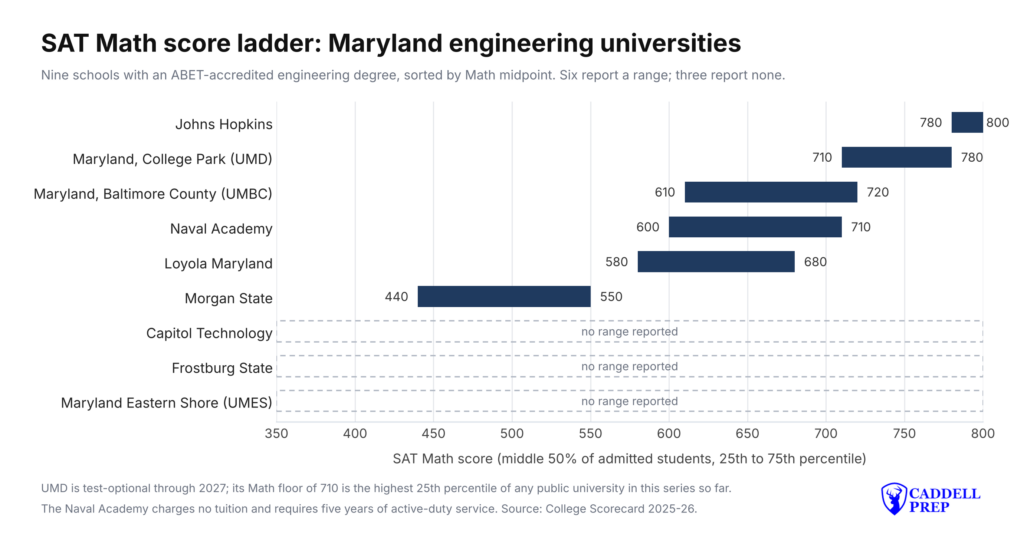
A student can see where his Math score sits on this list in the image above.
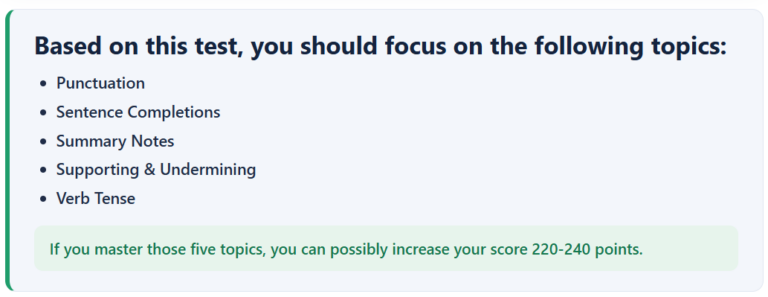
Want to Know What 5 Topics Will Improve Your SAT Score the Most?
Sample Feedback from our Diagnostic Test:
Johns Hopkins University
Johns Hopkins University’s Whiting School of Engineering in Baltimore holds ABET accreditation in disciplines including biomedical, chemical, civil, computer, electrical, environmental, materials and mechanical engineering, and Hopkins has the highest Math range on the page.
Reading & Writing 740 to 770, Math 780 to 800. The top quarter of admitted students scored 800 on Math. Cost of attendance $85,947, with tuition and fees at $65,230 for all students. 5,693 undergraduates, 6% admitted.
Hopkins is the most selective school on the page, the most expensive, and the only one whose Math floor is above every other school’s ceiling.
University of Maryland, College Park
The University of Maryland’s A. James Clark School of Engineering in College Park holds ABET accreditation in disciplines including aerospace, bioengineering, chemical, civil, computer, electrical, fire protection, materials and mechanical engineering, and the Clark School is a Limited Enrollment Program whose students must pass Calculus II, physics and chemistry at a set grade to keep the major.
Reading & Writing 690 to 750, Math 710 to 780. The top quarter of admitted students scored at or above 780 on Math. Cost of attendance $29,299, with tuition and fees at $11,809 in state and $41,186 out of state. 30,760 undergraduates, 45% admitted.
UMD is the largest school on the page by a factor of three, holds the highest public Math floor in this series, and is the only school on the page with a published gate after admission. Its out-of-state tuition is the highest public figure on the page.
University of Maryland, Baltimore County
The University of Maryland, Baltimore County’s College of Engineering and Information Technology holds ABET accreditation in chemical, computer and mechanical engineering, and UMBC has the second-highest public Math range on the page.
Reading & Writing 630 to 700, Math 610 to 720. The top quarter of admitted students scored at or above 720 on Math. Cost of attendance $28,576, with tuition and fees at $13,256 in state and $31,275 out of state. 10,701 undergraduates, 72% admitted.
UMBC’s Math ceiling of 720 is 10 points above the Naval Academy’s and 40 above Loyola’s, on a range 110 points wide. Its in-state tuition is $1,447 above the flagship’s.
United States Naval Academy
The United States Naval Academy in Annapolis holds ABET accreditation in disciplines including aerospace, chemical, computer, electrical, general, mechanical, naval architecture, nuclear, ocean and systems engineering, and the Academy charges no tuition.
Reading & Writing 610 to 700, Math 600 to 710. The top quarter of admitted students scored at or above 710 on Math. No tuition, room or board is charged, and midshipmen are paid a stipend. 4,474 undergraduates, 9% admitted.
The Naval Academy is the second most selective school on the page, requires a nomination from a member of Congress or another authorized source to apply, and requires five years of active-duty service as a commissioned officer after graduation. Midshipmen choose a major in the second semester, and the Academy holds more accredited engineering disciplines than any school on the page other than UMD.
Loyola University Maryland
Loyola University Maryland’s Department of Engineering in Baltimore holds ABET accreditation for its Bachelor of Science in Engineering, offered with computer, electrical, materials and mechanical concentrations, and Loyola has the lowest Math floor among the private schools on the page.
Reading & Writing 620 to 690, Math 580 to 680. The top quarter of admitted students scored at or above 680 on Math. Cost of attendance $74,055, with tuition and fees at $57,150 for all students. 3,869 undergraduates, 75% admitted.
Loyola is a Jesuit university, the second most expensive school on the page, and the only one that awards a single general engineering degree rather than separate degrees by discipline. Its Math floor of 580 is 130 points below UMD’s, and its Reading & Writing range sits 40 points above its Math range at the floor.
Morgan State University
Morgan State University’s Clarence M. Mitchell, Jr. School of Engineering in Baltimore holds ABET accreditation in civil, electrical, industrial and transportation engineering, and Morgan State has the lowest range on the page and the lowest tuition.
Reading & Writing 400 to 520, Math 440 to 550. The top quarter of admitted students scored at or above 550 on Math. Cost of attendance $25,413, with tuition and fees at $8,229 in state and $19,124 out of state. 9,019 undergraduates, 82% admitted.
Morgan State is the only historically Black university among the reporting schools, the cheapest school on the page for a resident and for a non-resident, and the holder of the state’s only transportation engineering degree. Its Math ceiling of 550 is 30 points below Loyola’s floor.
Capitol Technology University
Capitol Technology University in Laurel holds ABET accreditation in astronautical and space engineering, computer engineering and electrical engineering, and Capitol reports no admitted score range.
Cost of attendance $42,471, with tuition and fees at $27,592 for all students. 315 undergraduates, 74% admitted.
Capitol is the smallest school on the page by a factor of seven and the only one with an accredited astronautical engineering degree. It reports no SAT or ACT range to the Scorecard, so a student cannot compare himself to its admitted class.
Frostburg State University
Frostburg State University’s Department of Physics and Engineering holds ABET accreditation for its Bachelor of Science in Engineering, with electrical and materials concentrations, and for a collaborative mechanical engineering program, and Frostburg reports no admitted score range.
Cost of attendance $27,056, with tuition and fees at $10,220 in state and $25,814 out of state. 2,909 undergraduates, 89% admitted.
Frostburg is the westernmost school on the page and the second-cheapest public for a resident. Its engineering degree’s accreditation runs through 2032 and the mechanical program’s through 2030, and it reports no SAT or ACT range to the Scorecard.
University of Maryland Eastern Shore
The University of Maryland Eastern Shore’s Department of Engineering and Aviation Sciences in Princess Anne awards a Bachelor of Science in Engineering, and UMES reports no admitted score range.
Cost of attendance $25,941, with tuition and fees at $9,076 in state and $20,122 out of state. 2,391 undergraduates, 96% admitted.
UMES is the least selective school on the page, the second-cheapest for a non-resident, and a historically Black land-grant university. It reports no SAT or ACT range to the Scorecard.
Six ranges and three blanks say who got in. At the flagship, getting in is not the gate, and the next section is about where the gate is.
What Grades Do You Need to Stay in Engineering at the University of Maryland?
A student admitted directly to the Clark School of Engineering keeps the major by earning a C- or better in MATH 141, PHYS 161 and CHEM 135 and holding a 2.0 cumulative GPA at a review at 45 credits, and a student applying to the Clark School from inside the university needs a B- or better in MATH 141 and PHYS 161, a C- in CHEM 135 and a 3.0 cumulative GPA, with one application.
The University of Maryland runs engineering as a Limited Enrollment Program, and its LEP office publishes the rules for students entering in fall 2027 and later. The table below is those rules on their two tracks.
| Track | MATH 141 (Calculus II) | PHYS 161 | CHEM 135 | Cumulative GPA | Decision point | If the student falls short |
|---|---|---|---|---|---|---|
| Admitted directly to engineering as a first-year | C- | C- | C- | 2.0 | Review at 45 credits | Dismissed from the major, may not reapply |
| Admitted to UMD, applying to engineering from inside | B- | B- | C- | 3.0 | One application | Denied, may appeal to the associate dean |
The one-attempt rules sit under both tracks. Only one gateway course may be repeated to earn the required grade, and it may be repeated only once. A W counts as an attempt. Taking a second course from a list that satisfies the same requirement counts as a repeat. A student may apply to a Limited Enrollment Program once. After admission, any student whose cumulative GPA falls below 2.0 is dismissed from the major.
The fall 2027 rules add a layer the earlier rules did not have. Aerospace, computer, electrical and mechanical engineering are designated high-demand majors, and an internal applicant who meets every gateway requirement but is not admitted to one of them is placed in general engineering instead. The gate into the Clark School is the grades. The gate into the four most popular majors inside it is a competition among students who have already cleared the grades.
Now set the gate against the range. UMD’s admitted Math range is 710 to 780, the highest public floor in this series, and UMD is test-optional through 2027. So a student can be admitted to the Clark School with no test score at all, and the number the school enforces is a letter grade in Calculus II at the end of his first year. On this page the Math score does less work at UMD than at any other school, and the Calculus II grade does more. Kansas puts its engineering gate at the door, on a 540, on our page on engineering colleges in Kansas. Kentucky’s Louisville puts it at the door on a 590, on our page on engineering colleges in Kentucky. Maryland puts it a year in, on a grade.
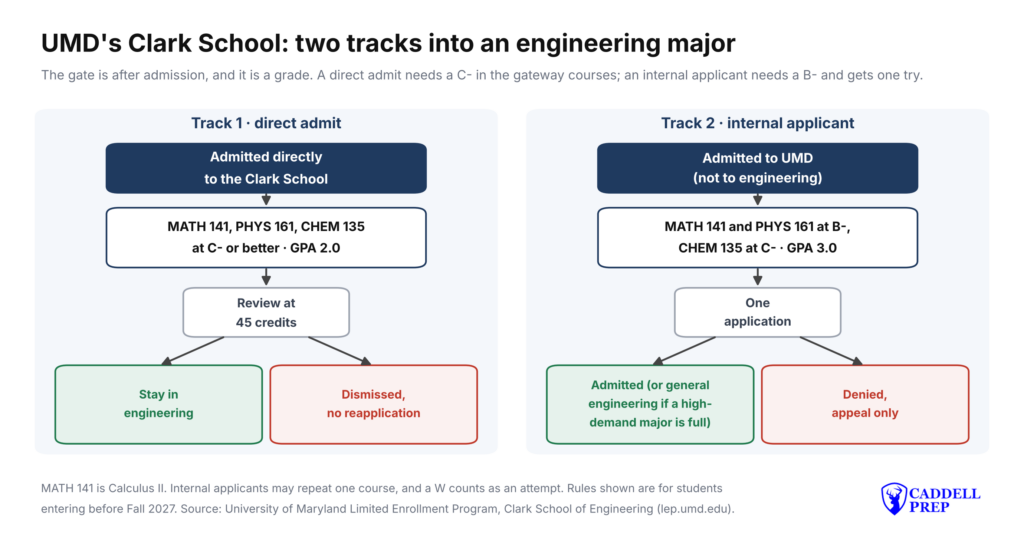
The image above shows the two tracks, and that the gate is at 45 credits, not at the door.
Take two UMD students at the end of their first year, both with a C+ in MATH 141, a B in PHYS 161, a B- in CHEM 135 and a 3.1 GPA. The first was admitted directly to the Clark School. His C+ is above the C- line on every course, his 3.1 is above 2.0, and he clears the 45-credit review and stays. The second was admitted to UMD’s Letters and Sciences and is applying to the Clark School from inside. His C+ in MATH 141 is below the B- line, so his application is denied, and he may apply to a Limited Enrollment Program once in his time at Maryland. Same courses, same grades, same campus. The difference between staying and being shut out is which door he came through at seventeen, and the door was decided by an application that did not require a test score.
The rest of the state runs the gate at the door or not at all. UMBC admits first-year students to its engineering majors and publishes its own continuation rules for them, which are the university’s to state and not this page’s to summarize [VERIFY: UMBC gateway or GPA requirements for chemical, computer and mechanical engineering. If none are published, change this sentence to say so.]. Hopkins admits to the Whiting School by application. Loyola and Morgan State admit to the major. The Naval Academy admits to the Academy, and midshipmen choose a major in the second semester. None of the eight publishes a 45-credit review, and none publishes a one-application rule.
The honest version is that a C- is a low line, and most students admitted directly to the Clark School clear it. UMD publishes no dismissal rate, and this page does not estimate one. The LEP rules are also written for every Limited Enrollment Program at the university, not for engineering alone, and the gateway courses named above are engineering’s. The page’s point is where the line sits, not how high. A student who arrives in College Park with a 780 and a student who arrives with no score at all stand at the same review on the same day, and the review reads the transcript.
Families reading the LEP rules frequently ask whether the test score matters at all at UMD.
Can You Get Into UMD Engineering Without a Test Score?
A student can get into UMD engineering without a test score. The university is test-optional through 2027, the Clark School admits on the application, and the numbers it enforces after admission are the gateway grades and not the test.
A student who does submit a score inside UMD’s range of 710 to 780 is submitting the highest public Math floor in this series, and he should know that the floor describes his classmates and not the school’s requirement. A student without one is judged on a transcript that will also have to carry Calculus II a year later, and a transcript that cannot carry precalculus now is the earlier warning.
The flagship’s rule is its own. The degrees are what the next section lists.
Which Maryland Schools Have ABET-Accredited Engineering Programs?
Nine Maryland schools hold ABET-accredited engineering bachelor’s degrees, five public, three private and one federal, and all nine are in the table above.
In Baltimore, Hopkins’ Whiting School of Engineering holds eight disciplines, with the Applied Physics Laboratory in Laurel the largest engineering employer tied to any school on the page. UMBC holds three, Loyola holds one general engineering degree with four concentrations, and Morgan State’s Mitchell School of Engineering holds four, including the state’s only transportation engineering degree. In College Park, UMD’s Clark School holds nine, with NASA Goddard and the National Institute of Standards and Technology within ten miles. In Annapolis, the Naval Academy holds ten. In Laurel, Capitol Technology holds three, including astronautical and space engineering. In Frostburg, Frostburg State holds a general engineering degree with electrical and materials concentrations and a mechanical engineering program. In Princess Anne, UMES holds a general engineering degree.
Accreditation matters for a reason that is easy to miss at seventeen. Licensure as a professional engineer normally requires a degree from an ABET-accredited engineering program, and that is why Capitol Technology’s and Morgan State’s engineering technology degrees are not the programs that place those schools on the list. Towson, Salisbury, Bowie State, Coppin State, St. Mary’s, Washington College, Goucher, Mount St. Mary’s, Stevenson, Hood and McDaniel award no engineering degree, and several of them route students to one through a three-two arrangement that finishes at another university.
Nothing on this page ranks the nine. The table’s order is a stated, verifiable number where one exists, and the choice among accredited programs comes down to cost, discipline and where a student’s score, and then his grades, place him.
What If Your Scores Are Below the Range You Want?
In Maryland the score is one gate among several, and at the flagship it is optional while the grade is not. The Maryland question for a UMD applicant is whether he can earn a B- in Calculus II in his first year, because that is the line the Clark School enforces, and a student who is not sure of the answer has his answer about which track he wants to be on.
The algebra, functions and trigonometry that raise an SAT Math score are the same material Calculus II assumes a student already has, so the summer spent on them before senior year pays twice: once on the test, if he submits it, and again in MATH 141, which he cannot skip. A New York applicant has the ranges and the out-of-state tuition, $41,186 at UMD, $31,275 at UMBC and $19,124 at Morgan State, and the Naval Academy’s zero with its five years attached.
The first step is finding out where the score actually is, section by section. A free diagnostic SAT gives a Math score that can be set against the table and, at UMD, against the question of whether the student is ready for the course the gate is built on.
The Math section rewards the same handful of topics on every test date, and a student who knows which of them he is missing can close a gap of 50 to 100 points in weeks rather than months. The method is on our page on improving your SAT Math score, and the topics are the ones calculus assumes.
How to Read These Score Ranges
Every range on this page covers the middle 50% of admitted students who submitted the SAT. The lower number is the 25th percentile and the upper number is the 75th, so a quarter of admitted students scored at or above it.
A range describes the students a school admitted. A gateway rule describes the students it kept. A school can have a high range and a low gateway at the same time, as UMD does with a 710 floor and a C- line, and the two numbers answer different questions.
Because most colleges are now test-optional, the ranges that are published describe only the students who chose to submit at all. Students with strong scores submit and students with weak ones don’t, so a published range sits higher than the range for everyone who was actually admitted. More on what SAT score you need for college and on test-optional colleges.
Should You Take the ACT Instead?
Maryland is an SAT state. Seventeen Maryland institutions report an SAT range and fourteen report an ACT range, and most Maryland students take the SAT.
All nine schools on this page accept either test, and a student should take whichever he scores higher on. At UMD the Clark School’s gate reads neither one.
Engineering Programs in Nearby States
Maryland borders Delaware, Pennsylvania, Virginia and West Virginia, and Maryland students apply across those lines in numbers even with nine accredited programs at home.
See engineering colleges in Delaware, engineering colleges in Pennsylvania, and engineering colleges in Virginia.
Engineering Colleges in Other States
We publish the same breakdown for engineering programs in every state.
See engineering colleges by state for the full list.

Glyn Caddell
Glyn Caddell holds a BS in Mechanical Engineering from NJIT and has been tutoring New York City students since 2008. He founded Caddell Prep in 2012 and is the author of Digital SAT Math Secrets: Lessons & Tricks to Quickly Improve to a Perfect 800 on the Math Test, which contains over 900 practice problems and is used in Caddell Prep’s SAT math classes. He is founding president of the Staten Island Technical High School alumni association and teaches every lesson on this site personally.
Finally, an SAT course that students actually understand
Every question has a video explanation. Not most — every one.
The on-demand Digital SAT course covers all 17 math topics and 15 reading and writing topics, with 5 full-length practice tests and a 100-point score increase guarantee. Keep access for the rest of high school. No subscription.
Want to Know What 5 Topics Will Improve Your SAT Score the Most?
Sample Feedback from our Diagnostic Test: