
Home » College SAT Score Ranges, Costs, and Programs by Major and State » Engineering Colleges by State: SAT Scores, ACT Scores, Costs, and ABET Programs » Engineering Colleges in Kansas: SAT Scores, Costs, and Programs
By Glyn Caddell, BSME · Author of Digital SAT Math Secrets · Tutoring since 2008 — Updated October 23, 2026
Four Kansas universities offer ABET-accredited engineering degrees, and this page lists what they cost and the SAT scores of the students they admit.
KU’s School of Engineering admits a first-year student directly on a 3.0 GPA and an SAT Math of 540, the lowest published engineering math line in this series, and K-State’s College of Engineering does not read a test score at all. Both rules are covered below the table.
Scores are given by section, and the table is sorted by Math because that is the section engineering programs use.
Table of Contents
- Kansas Engineering Colleges by SAT Math Score
- What SAT Score Do You Need for Engineering at KU or K-State?
- Which Kansas Universities Have ABET-Accredited Engineering Schools?
- What If Your Score Is Below the Range You Want?
Kansas Engineering Colleges by SAT Math Score
The four universities below are the ones in Kansas that hold an ABET-accredited bachelor’s degree in an engineering discipline. They are sorted by the midpoint of the SAT Math range, so the order can be checked from the table itself.
| College | SAT Reading & Writing | SAT Math | Cost of attendance | Undergraduates | Admit rate |
|---|---|---|---|---|---|
| Benedictine College | 570 to 690 | 570 to 690 | $52,206 | 2,272 | 98% |
| University of Kansas | 540 to 650 | 530 to 650 | $26,751 | 21,217 | 93% |
| Kansas State University | 550 to 640 | 510 to 620 | $27,402 | 15,142 | 82% |
| Wichita State University | 470 to 610 | 435 to 630 | $21,780 | 10,780 | 94% |
Each range covers the middle 50% of admitted students who submitted the SAT. A quarter scored below the lower number, and the top quarter scored at or above the upper one. Being under the lower number does not rule a student out, and being just above it is not as safe as it looks.
Only universities with an ABET-accredited engineering bachelor’s degree are listed. Pittsburg State’s and Washburn’s technology degrees are accredited under a separate ABET commission and do not qualify them for the list.
Three things about that table are worth pausing on.
Benedictine College admits 98% of applicants with the highest Math range in the state, 570 to 690, and its two section ranges are identical. A Catholic college of 2,272 students in Atchison outscores the flagship at both ends of the Math range while turning away one applicant in fifty.
Wichita State’s Math range is the widest on the page, 435 to 630, a spread of 195 points against 120 at KU. Its engineering college draws from a class whose Math scores run from well below every other floor on the page to above K-State’s ceiling.
KU’s range sits above K-State’s at both ends, 530 to 650 against 510 to 620, and KU admits 93% to K-State’s 82%. The flagship with the higher range admits the larger share, and the next section explains how.
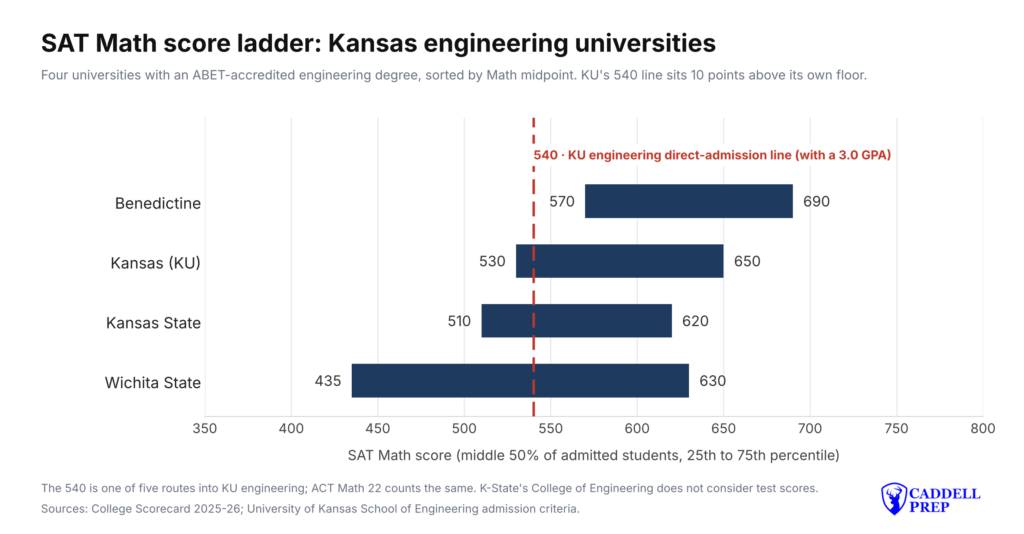
A student can see where his Math score sits on this list, and how little of KU’s range sits below the engineering school’s line, in the image above.
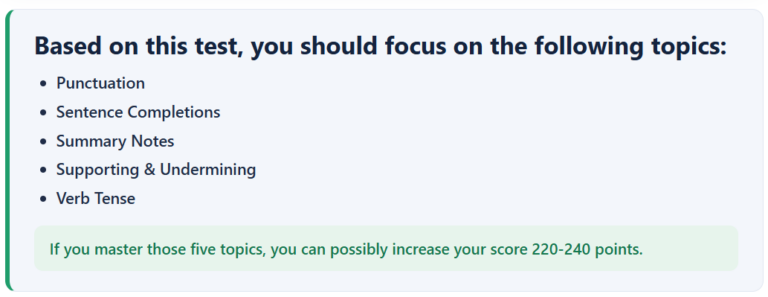
Want to Know What 5 Topics Will Improve Your SAT Score the Most?
Sample Feedback from our Diagnostic Test:
Benedictine College
Benedictine College’s School of Engineering in Atchison holds ABET accreditation in chemical, civil, electrical and mechanical engineering, and Benedictine has the highest Math range on the page.
Reading & Writing 570 to 690, Math 570 to 690. The top quarter of admitted students scored at or above 690 on both sections. Cost of attendance $52,206, with tuition and fees at $36,350 for all students. 2,272 undergraduates, 98% admitted.
Benedictine is a Catholic college, the smallest school on the page, the most expensive, and the least selective by admit rate, with a Math floor 40 points above the flagship’s.
University of Kansas
The University of Kansas’s School of Engineering in Lawrence holds ABET accreditation in aerospace, architectural, chemical, civil, computer, electrical, mechanical and petroleum engineering and engineering physics, and KU publishes the criteria on which its engineering school admits a first-year student directly.
Reading & Writing 540 to 650, Math 530 to 650. The top quarter scored at or above 650 on both sections. Cost of attendance $26,751, with tuition and fees at $12,102 in-state and $30,432 out-of-state. 21,217 undergraduates, 93% admitted.
KU is the largest university in the state, and its engineering school’s published math line, an SAT Math of 540, sits 10 points above the bottom of its own admitted range. The next section is about that line.
Kansas State University
Kansas State University’s Carl R. Ice College of Engineering in Manhattan holds ABET accreditation in architectural, biological, chemical, civil, computer, electrical, industrial and mechanical engineering, and K-State’s engineering college does not consider test scores in its admission decisions.
Reading & Writing 550 to 640, Math 510 to 620. The top quarter scored at or above 640 and 620. Cost of attendance $27,402, with tuition and fees at $11,221 in-state and $28,568 out-of-state. 15,142 undergraduates, 82% admitted.
K-State is the most selective public university on the page by admit rate, and its engineering college says there is no cap on the number of students it admits to any program.
Wichita State University
Wichita State University’s College of Engineering holds ABET accreditation in aerospace, biomedical, computer, electrical, industrial and mechanical engineering, and Wichita State is the cheapest university on the page by cost of attendance and in-state tuition.
Reading & Writing 470 to 610, Math 435 to 630. The top quarter scored at or above 610 and 630. Cost of attendance $21,780, with tuition and fees at $9,684 in-state and $19,869 out-of-state. 10,780 undergraduates, 94% admitted.
Wichita State sits among the aircraft plants that make Wichita the center of American general aviation manufacturing, and its out-of-state tuition of $19,869 is the lowest on the page by more than $8,000.
Four rows, and the two publics at the center of the page read the score in two different ways, one of which is not at all.
What SAT Score Do You Need for Engineering at KU or K-State?
KU’s School of Engineering admits a first-year student directly with a 3.0 high school GPA and an SAT Math of 540 or an ACT Math of 22, or with any of four other proofs of math readiness, and K-State’s College of Engineering does not consider test scores in its admission decisions at all.
KU’s major-specific admission page gives the engineering school’s criteria. A first-year applicant must be admissible to the university by assured admission or individual review, must have a 3.0 or higher high school GPA, and must show math preparedness by any one of five routes. The first is a mathematics ACT score of 22 or higher or a math SAT score of 540 or higher. The second is a B or better in college algebra or a more advanced course. The third is a C or better in a high school calculus course. The fourth is qualifying AP or IB credit. The fifth is a qualifying score for MATH 104 on KU’s ALEKS placement exam. MATH 104 is KU’s precalculus course. The line certifies that a student is ready for precalculus, not for calculus.
| Route into KU engineering, with a 3.0 GPA | What it shows |
|---|---|
| ACT Math 22 or SAT Math 540 | Precalculus readiness by test |
| B or better in college algebra or higher | Precalculus readiness by course |
| C or better in a high school calculus course | Calculus taken |
| Qualifying AP or IB credit | Calculus credit |
| Qualifying ALEKS score for MATH 104 | Precalculus readiness by placement exam |
From KU’s major-specific admission requirements. Any one route satisfies the math requirement.
Set the line against KU’s class. The admitted SAT Math range is 530 to 650, so 540 is 10 points above the 25th percentile. Three quarters of the students KU admits clear the engineering school’s math line on their score alone, and the quarter who do not have four other ways through. The university’s own door is looser still: KU assures admission to a first-year student with a 3.25 GPA, or a 2.0 GPA with an ACT of 21 or an SAT of 1060, and 1060 is below the floor of every range on this page.
K-State’s engineering college takes a different route to a similar place. Its admissions page says that admission decisions do not include standardized test scores and that there is no cap on the number of students admitted to any degree program. The second largest engineering school in the state does not open the score.
The spread across this series is the thing to see. Three state flagships answer the same question, the SAT Math score the engineering school wants before a student starts, and the answers run from 540 at Kansas to 660 at Arkansas to 730 at Hawaii, each measured against a different admitted class. At Kansas the line sits near the bottom of the range. At Arkansas it sits 60 points above the top, as our page on engineering colleges in Arkansas sets out. At Hawaii it sits 90 above, as our page on engineering colleges in Hawaii sets out.
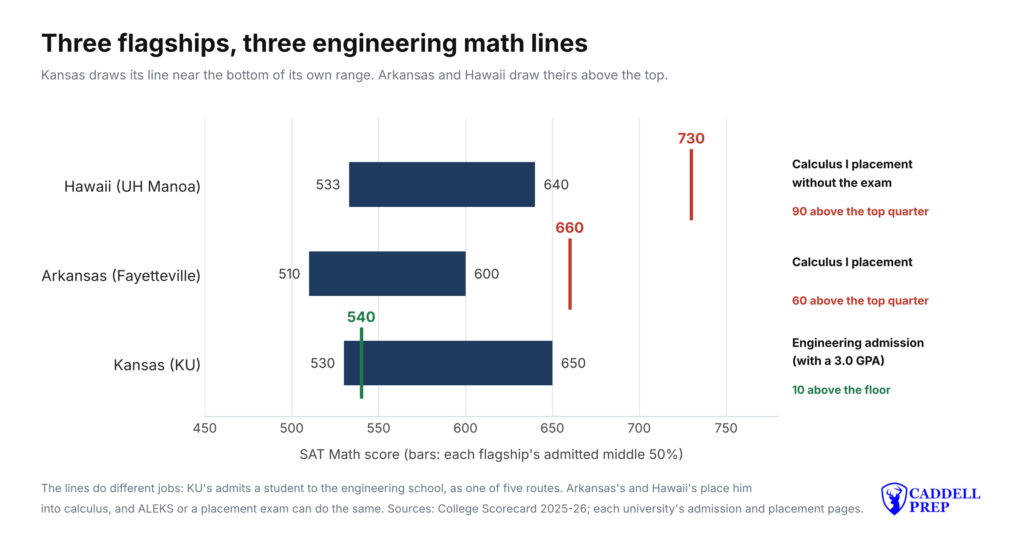
The image above shows the same question and three answers.
Take a student with a 3.1 GPA and a 560 SAT Math. At KU he is admitted to the university on individual review, below the 3.25 assured line, and admitted directly to the School of Engineering on the 3.1 and the 560. At Arkansas’s flagship the same 560 would place him below precalculus. At Hawaii’s it would place him below the top quarter of the class and nowhere near calculus. The student did not change. The number the engineering school wrote down did.
A low gate is not a short degree. KU’s 540 puts a student in precalculus, and his first engineering calculus course waits a semester unless the ALEKS exam or AP credit places him higher, and KU’s own list makes the ALEKS route explicit. K-State’s rule is about admission, not placement, and K-State places its students into mathematics by ALEKS as well. In both cases the score is a door and not a diagnosis, and a student admitted on the lowest route should expect to spend his first semester earning the calculus his classmates arrived with.
Families reading KU’s list frequently ask whether the 540 is enough to start in calculus.
Does a 540 Put You in Calculus at KU?
A 540 does not put a student in calculus at KU. It satisfies the engineering school’s math requirement for direct admission, and the course it certifies readiness for is MATH 104, precalculus.
Placement into Calculus I at KU is by the ALEKS exam or by AP or IB credit, so a student admitted to engineering on a 540 and a 3.0 can be in the School of Engineering and in precalculus in the same semester. Both are true at once, and the second one adds a term to the math sequence.
The two public universities’ rules are theirs. The degrees are what the next section lists.
Which Kansas Universities Have ABET-Accredited Engineering Schools?
Four Kansas universities hold ABET-accredited engineering bachelor’s degrees, three public and one private, and all four are in the table above.
In Lawrence, KU’s School of Engineering holds nine accredited degrees including the state’s petroleum and architectural engineering programs, and Garmin, Black & Veatch and Burns & McDonnell in the Kansas City suburbs are the largest engineering employers within an hour. In Manhattan, K-State’s Carl R. Ice College holds eight, including biological and architectural engineering. In Wichita, Wichita State’s College of Engineering holds six, with aerospace engineering first among them, beside the Spirit AeroSystems, Textron Aviation and Bombardier plants. In Atchison, Benedictine College’s School of Engineering holds four.
Accreditation matters for a reason that is easy to miss at seventeen. Licensure as a professional engineer normally requires a degree from an ABET-accredited engineering program, and that is why Pittsburg State’s engineering technology degrees and Washburn’s technology programs do not put those universities on the list. Fort Hays State, Emporia State and the state’s other private colleges report ranges and award no engineering degree.
Nothing on this page ranks the four. The table’s order is a stated, verifiable number, and the choice among accredited programs comes down to cost, discipline and where a student’s score places him.
What If Your Scores Are Below the Range You Want?
In Kansas the score is never the gate. It is one of five doors into KU engineering, no door at all at K-State, and the second door into KU itself for a student below a 3.25 GPA, so the Kansas question is not admission but placement.
The gap most KU engineering students face is the one between precalculus readiness at 540 and calculus readiness on the ALEKS exam, and the same algebra, functions and trigonometry close it on either side. A student at 540 who spends the summer on those topics arrives at a different ALEKS score and a different first semester. A New York applicant has the ranges and the out-of-state tuition, $30,432 at KU and $28,568 at K-State, and both are below the flagships of the states to the east.
The first step is finding out where the score actually is, section by section. A free diagnostic SAT gives a Math score that can be set against the table and against the 540.
The Math section rewards the same handful of topics on every test date, and a student who knows which of them he is missing can close a gap of 50 to 100 points in weeks rather than months. The method is on our page on improving your SAT Math score, and the topics are the ones ALEKS asks about.
Being below a school’s published range doesn’t disqualify anyone. A quarter of the students admitted to every school on this list scored below its lower number.
It does mean the score isn’t helping the application, and at a selective school that matters more than at a less selective one. The number worth aiming for is the upper end of a school’s range, the one the top quarter cleared, rather than the middle. The reasoning behind that is on what SAT score you need for college.
Reading the sections separately is the useful part. If your Math sits inside a school’s range and your Reading & Writing doesn’t, you know which section your hours should go to, and that’s a more specific answer than a total score gives you.
The gap is measurable and so is the work to close it. A 70 to 130 point improvement takes approximately 40 hours of effective studying, based on the students we’ve worked with since 2008, and a 130 to 250 point improvement takes approximately 80.
How to improve your SAT score covers the method, including how to work out which topics are actually costing you points. If you don’t have a recent score to compare against this list, a free diagnostic SAT gives you one, broken down by section and by topic.
How to Read These Score Ranges
Every range on this page covers the middle 50% of admitted students who submitted the SAT. The lower number is the 25th percentile and the upper number is the 75th, so a quarter of admitted students scored at or above it.
A published admission line is a different kind of number from a range. It can sit near the bottom of a range, as KU’s 540 does, or above the top, as Hawaii’s 730 does, and in both cases it is the number the engineering school wants. The range says who got in. The line says what the school asks of them.
Because most colleges are now test-optional, the ranges that are published describe only the students who chose to submit at all. Students with strong scores submit and students with weak ones don’t, so a published range sits higher than the range for everyone who was actually admitted. More on what SAT score you need for college and on test-optional colleges.
Should You Take the ACT Instead?
Most Kansas students take the ACT, and KU writes both tests into its rules: an ACT of 21 or an SAT of 1060 for assured admission with a 2.0, and an ACT Math of 22 or an SAT Math of 540 for the engineering school.
All four universities on this page report both tests and accept either. A student should take whichever he scores higher on, and should know that at K-State’s engineering college neither one is read.
Engineering Programs in Nearby States
Kansas borders Nebraska, Missouri, Oklahoma and Colorado, and Kansas students apply across those lines in numbers even with four accredited programs at home.
See engineering colleges in Missouri, engineering colleges in Nebraska, and engineering colleges in Oklahoma.
Engineering Colleges in Other States
We publish the same breakdown for engineering programs in every state.
See engineering colleges by state for the full list.

Glyn Caddell
Glyn Caddell holds a BS in Mechanical Engineering from NJIT and has been tutoring New York City students since 2008. He founded Caddell Prep in 2012 and is the author of Digital SAT Math Secrets: Lessons & Tricks to Quickly Improve to a Perfect 800 on the Math Test, which contains over 900 practice problems and is used in Caddell Prep’s SAT math classes. He is founding president of the Staten Island Technical High School alumni association and teaches every lesson on this site personally.
Finally, an SAT course that students actually understand
Every question has a video explanation. Not most — every one.
The on-demand Digital SAT course covers all 17 math topics and 15 reading and writing topics, with 5 full-length practice tests and a 100-point score increase guarantee. Keep access for the rest of high school. No subscription.
Want to Know What 5 Topics Will Improve Your SAT Score the Most?
Sample Feedback from our Diagnostic Test: