
Home » College SAT Score Ranges, Costs, and Programs by Major and State » Engineering Colleges by State: SAT Scores, ACT Scores, Costs, and ABET Programs » Engineering Colleges in Oklahoma: ACT Scores, SAT Scores, Costs, and Programs
By Glyn Caddell, BSME · Author of Digital SAT Math Secrets · Tutoring since 2008 — Updated October 25, 2026
Six Oklahoma universities offer ABET-accredited engineering degrees, and this page lists what they cost and the test scores of the students they admit.
One of them admits a class whose ACT range runs from 25 to 34, a nine-point spread that no other university in the country carries to a 34 ceiling, and the reason is a scholarship decided by the PSAT.
The table is sorted by ACT because most Oklahoma districts give it as the state test and all six universities report it.
Table of Contents
- Oklahoma Engineering Colleges by ACT and SAT Score
- Why Does the University of Tulsa Admit Engineering Students From a 25 to a 34?
- Which Oklahoma Universities Have ABET-Accredited Engineering Schools?
- What If Your Score Is Below the Range You Want?
Oklahoma Engineering Colleges by ACT and SAT Score
The six universities below are the ones in Oklahoma that hold an ABET-accredited bachelor’s degree in an engineering discipline. They are sorted by the midpoint of the ACT composite range, so the order can be checked from the table itself, and there are no ties. Central Oklahoma reports an ACT range and no SAT range.
| College | ACT composite | SAT Reading & Writing | SAT Math | Cost of attendance | Undergraduates | Admit rate |
|---|---|---|---|---|---|---|
| University of Tulsa | 25 to 34 | 610 to 760 | 613 to 770 | $64,459 | 2,813 | 62% |
| University of Oklahoma | 23 to 29 | 580 to 670 | 560 to 660 | $28,872 | 22,734 | 77% |
| Oral Roberts University | 22 to 28 | 580 to 660 | 540 to 650 | $50,004 | 3,487 | 99% |
| Oklahoma State University | 20 to 27 | 530 to 630 | 510 to 620 | $28,290 | 21,773 | 75% |
| Oklahoma Christian University | 19 to 26 | 500 to 640 | 510 to 630 | $39,106 | 1,885 | 97% |
| University of Central Oklahoma | 18 to 24 | Does not report SAT data | Does not report SAT data | $26,392 | 10,170 | 78% |
Each range covers the middle 50% of admitted students who submitted that test. A quarter scored below the lower number, and the top quarter scored at or above the upper one. Being under the lower number does not rule a student out, and being just above it is not as safe as it looks.
Only universities with an ABET-accredited engineering bachelor’s degree are listed. Oklahoma Baptist’s engineering program states on its own page that it is not yet ABET accredited and that the university plans to apply in fall 2027. Southwestern Oklahoma State’s engineering technology degree is accredited under a separate ABET commission and does not qualify it for the list. Tulsa’s SAT Math floor of 613 is printed as the Scorecard reports it. Central Oklahoma reports no SAT range to the Scorecard.
Three things about that table are worth pausing on.
Tulsa’s ACT range, 25 to 34, is nine points wide, tied for the widest on any engineering page in this series with New Mexico Tech, Southern Miss and Eastern Michigan, and the only one of the four whose ceiling is a 34. The next section is about it.
Oklahoma and Oklahoma State are $1,623 apart for a student from outside the state, $27,377 against $25,754, and $437 apart for an Oklahoman, with Oklahoma three points higher at both ends of the ACT range and larger by 961 undergraduates.
Oral Roberts admits 99% of applicants on an ACT range of 22 to 28 that sits above Oklahoma State’s at both ends, and Oklahoma Christian admits 97%. Central Oklahoma, the one public that reports no SAT range, charges a non-resident $19,704, the lowest out-of-state figure on the page.
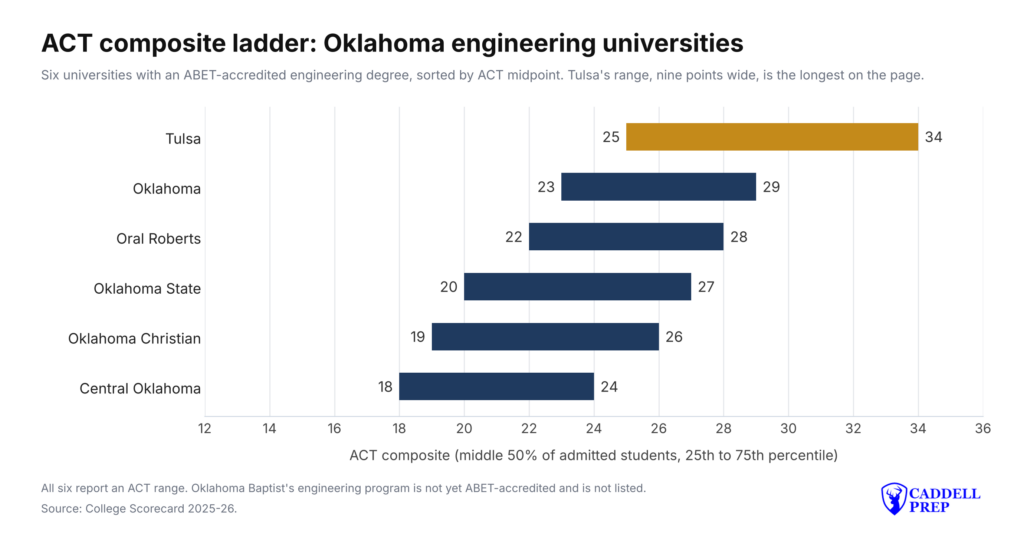
A student can see where his ACT score sits on this list in the image above.
Want to Know What 5 Topics Will Improve Your SAT Score the Most?
Sample Feedback from our Diagnostic Test:

University of Tulsa
The University of Tulsa’s College of Engineering and Computer Science holds ABET accreditation in chemical, electrical, engineering physics, mechanical and petroleum engineering, and Tulsa admits a class whose ACT range is wider than any other on the page.
ACT composite 25 to 34. Reading & Writing 610 to 760, Math 613 to 770. The top quarter of admitted students scored at or above 34 on the ACT and 770 on Math. Cost of attendance $64,459, with tuition and fees at $50,061 for all students. 2,813 undergraduates, 62% admitted.
Tulsa is the most selective school on the page and the most expensive, and its ACT ceiling of 34 is five points above the next ceiling on the page, Oklahoma’s 29. Its floor of 25 is two points above Oklahoma’s floor. Both facts are explained in the next section.
University of Oklahoma
The University of Oklahoma’s Gallogly College of Engineering in Norman holds ABET accreditation in disciplines including aerospace, architectural, biomedical, chemical, civil, computer, electrical, engineering physics, environmental, industrial and systems, mechanical and petroleum engineering, and Oklahoma is the largest school on the page.
ACT composite 23 to 29. Reading & Writing 580 to 670, Math 560 to 660. The top quarter of admitted students scored at or above 29 on the ACT and 660 on Math. Cost of attendance $28,872, with tuition and fees at $9,797 in state and $27,377 out of state. 22,734 undergraduates, 77% admitted.
Oklahoma has the lowest in-state tuition of the three publics and the highest out-of-state tuition, and its Math floor of 560 is the highest on the page after Tulsa’s. Its engineering college lets a first-year student choose “Engineering: Exploratory” as a major, described in the next section.
Oral Roberts University
Oral Roberts University in Tulsa holds ABET accreditation for its Bachelor of Science in Engineering [VERIFY degree name and concentrations on abet.org], and Oral Roberts admits 99% of applicants, the highest rate on the page.
ACT composite 22 to 28. Reading & Writing 580 to 660, Math 540 to 650. The top quarter of admitted students scored at or above 28 on the ACT and 650 on Math. Cost of attendance $50,004, with tuition and fees at $35,470 for all students. 3,487 undergraduates, 99% admitted.
Oral Roberts is a charismatic Christian university four miles from the University of Tulsa, and its Reading & Writing floor of 580 matches Oklahoma’s. Its cost of attendance is $14,455 below Tulsa’s.
Oklahoma State University
Oklahoma State University’s College of Engineering, Architecture and Technology in Stillwater holds ABET accreditation in disciplines including aerospace, architectural, biosystems, chemical, civil, computer, electrical, industrial and mechanical engineering, and Oklahoma State is the second-largest school on the page.
ACT composite 20 to 27. Reading & Writing 530 to 630, Math 510 to 620. The top quarter of admitted students scored at or above 27 on the ACT and 620 on Math. Cost of attendance $28,290, with tuition and fees at $10,234 in state and $25,754 out of state. 21,773 undergraduates, 75% admitted.
Oklahoma State is the one public on the page whose cost of attendance is below Oklahoma’s, by $582, and its ACT range sits three points below Oklahoma’s at both ends. Its engineering college has admitted students in two stages, described in the next section.
Oklahoma Christian University
Oklahoma Christian University in Edmond holds ABET accreditation in computer, electrical and mechanical engineering [VERIFY on abet.org], and Oklahoma Christian is the smallest school on the page.
ACT composite 19 to 26. Reading & Writing 500 to 640, Math 510 to 630. The top quarter of admitted students scored at or above 26 on the ACT and 630 on Math. Cost of attendance $39,106, with tuition and fees at $27,180 for all students. 1,885 undergraduates, 97% admitted.
Oklahoma Christian charges every student $27,180, $197 less than an out-of-state student pays the University of Oklahoma, and its Math ceiling of 630 is ten points above Oklahoma State’s. It is affiliated with the Churches of Christ.
University of Central Oklahoma
The University of Central Oklahoma’s College of Mathematics and Science in Edmond holds ABET accreditation in biomedical, electrical and mechanical engineering [VERIFY on abet.org. The row stands or falls on this], and Central Oklahoma is the one school on the page that reports no SAT range.
ACT composite 18 to 24. Central Oklahoma reports no SAT range. The top quarter of admitted students scored at or above 24 on the ACT. Cost of attendance $26,392, with tuition and fees at $8,818 in state and $19,704 out of state. 10,170 undergraduates, 78% admitted.
Central Oklahoma has the lowest cost of attendance on the page, the lowest in-state tuition and the lowest out-of-state tuition, and the lowest ACT range. It is in the same Oklahoma City suburb as Oklahoma Christian.
Six ranges say who got in. One of them is nine points wide and ends at a 34, and the next section is about why.
Why Does the University of Tulsa Admit Engineering Students From a 25 to a 34?
The University of Tulsa admits engineering students from a 25 to a 34 because the top of its class is recruited with a scholarship decided by the PSAT and the rest of it is admitted test-optional at a 62% admit rate, and the two groups sit in the same classroom at very different prices.
The range is unusual in a specific way. In the 2025-26 Scorecard, among four-year institutions with 500 or more undergraduates, no university other than Tulsa reaches an ACT ceiling of 34 from a floor below 27. NJIT and Purdue reach a 34 from a 27. Cooper Union and North Carolina reach it from a 28. Case Western, on our page on engineering colleges in Ohio, reaches it from a 32. Tulsa reaches it from a 25, a floor at the level of Dayton’s and Miami’s on the same Ohio page.
The scholarship is the National Merit Semifinalist Package, and Tulsa publishes its terms for students entering in fall 2027. The package is “full tuition for four years,” excluding summers, with a fifth year available by petition, plus “basic housing,” with upgrades at the student’s expense. It requires a minimum weighted GPA of 4.0, at least 12 credit hours a semester, and “positive progress toward a degree.” It cannot be combined with other Tulsa funding. By November 1 the student must have completed the admission application, made an official campus visit, sat an in-person Semifinalist interview and submitted two letters of recommendation, and he must designate Tulsa as his first-choice school with National Merit and submit an Intent to Enroll by May 1. Semifinalist status comes from the PSAT taken in the junior year. At this year’s tuition of $50,061, four years of tuition is $200,244 before housing.
| University | ACT floor | ACT ceiling | Width | Tuition for an out-of-state student |
|---|---|---|---|---|
| University of Tulsa | 25 | 34 | 9 | $50,061 |
| University of Oklahoma | 23 | 29 | 6 | $27,377 |
| Oral Roberts University | 22 | 28 | 6 | $35,470 |
| Oklahoma State University | 20 | 27 | 7 | $25,754 |
| Oklahoma Christian University | 19 | 26 | 7 | $27,180 |
| University of Central Oklahoma | 18 | 24 | 6 | $19,704 |
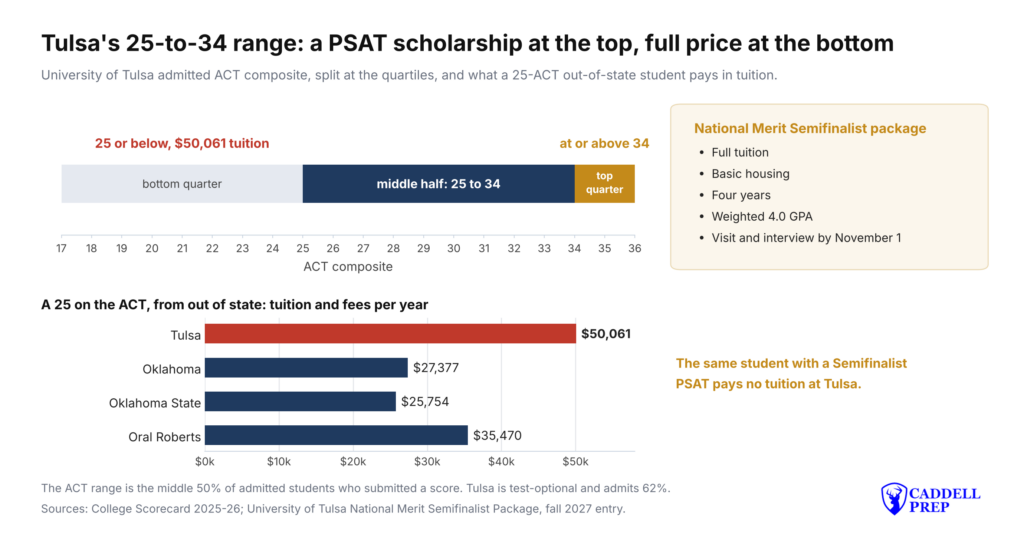
The image above shows the two quarters of the same class and what each pays.
Take a New York student with a 25 on the ACT. At Tulsa he is at the floor of 25 to 34 and pays $50,061 in tuition. At Oklahoma he is in the lower half of 23 to 29 and pays $27,377. At Oral Roberts he is at the middle of 22 to 28 and pays $35,470. At Oklahoma State he is in the upper half of 20 to 27 and pays $25,754. Now give the same student a Semifinalist PSAT from the fall of his junior year. Tulsa’s tuition goes to zero and his housing is covered, and Oklahoma’s price does not move. The ACT placed him on the table. The PSAT set his price at the one school where the price is largest.
Oklahoma State’s number is a gate rather than a scholarship. [VERIFY against the 2026-27 CEAT catalog and Student Services pages. The 2019-20 catalog is the most recent one this page could read, and it says a freshman enters a College of Engineering, Architecture and Technology pre-professional program with “an ACT Composite score of 24 or higher, or a total SAT score of 1090 or higher,” or “an ACT MATH score of 24 or higher, or a SAT Math score of 560 or higher,” or a 3.5 GPA in the fifteen core high school courses, and otherwise enters Pre-CEAT, which requires passing the prerequisites to Calculus I with a 2.5 OSU GPA before moving up. It then says a student enters professional school after “a minimum of 60 credit hours” with “a grade of C or better in technical courses,” on GPA thresholds that differ by school: 3.0 for Mechanical and Aerospace, 2.70 technical and 2.50 overall for Chemical, 2.70 and 2.60 for Electrical, 2.50 for Industrial. The 2026-27 industrial engineering degree sheet shows only a 2.00 technical GPA and refers to a university regulation, so the gate may have changed. If it has, cut this paragraph to one sentence saying Oklahoma State admits first-year students to its engineering majors directly.] That is the shape of the gate on our page on engineering colleges in Maryland, a number at the door and a grade at the second door, and a student with a 23 should read Oklahoma State’s current rule before he reads its range.
Oklahoma’s number is a path rather than a gate. The Gallogly College of Engineering lets an applicant choose “Engineering: Exploratory” as a major, runs a program it calls Engineering Catalyst for “highly motivated, first-year students who are beginning their engineering degree in a math class before Calculus 1,” tells admitted students they “may be required to assess using the ALEKS placement test” to set the first fall math course, and runs a four-week Engineering Summer Bridge with an OU math course. Its First Year Engineering Scholarship requires an application by December 15, an engineering major on the application and a FAFSA on file. The college publishes no score threshold for any of it. A student below calculus is told the name of the path, not turned away at the door.
The honest version is that Tulsa’s range describes everyone it admitted who submitted a score, across every college, not the engineering college alone, and Tulsa is test-optional, so the 25 floor describes the students who chose to submit. The Semifinalist package is for Semifinalists only. The cutoff is set state by state and year by year by the National Merit Scholarship Corporation, and this page does not state a cutoff. The package requires a weighted 4.0, an interview and a campus visit by November 1, and it cannot stack with other Tulsa aid, so a Semifinalist who would also have won Tulsa’s merit scholarships gives those up. And the nationwide claim about the 25-to-34 range is scoped to one year’s Scorecard, four-year institutions, and 500 or more undergraduates. A student reading the range should read both quarters of it.
Families reading Tulsa’s range frequently ask whether the PSAT matters once the ACT is in hand.
Does the PSAT Decide What Engineering Costs at the University of Tulsa?
The PSAT decides what engineering costs at the University of Tulsa for a National Merit Semifinalist, and for no one else. A Semifinalist with a weighted 4.0 who meets the November 1 requirements and names Tulsa his first choice pays no tuition for four years and has basic housing covered. Every other admitted student pays $50,061 in tuition, and the ACT or SAT he submitted, or did not, has no published effect on the price.
The PSAT is taken in October of the junior year, a year before most students take the ACT seriously, and the Semifinalist cutoff in New York normally sits near the top of the scale. A student who wants the Tulsa package has to be preparing for it in the fall of junior year, not the spring.
The range is Tulsa’s. The degrees are what the next section lists.
Which Oklahoma Universities Have ABET-Accredited Engineering Schools?
Six Oklahoma universities hold ABET-accredited engineering bachelor’s degrees, three public and three private, and all six are in the table above.
In Tulsa, the University of Tulsa’s College of Engineering and Computer Science and Oral Roberts are four miles apart. In Norman, the University of Oklahoma’s Gallogly College of Engineering is the largest engineering school in the state. In Stillwater, Oklahoma State’s College of Engineering, Architecture and Technology is the second. In Edmond, Oklahoma Christian and Central Oklahoma are in the same suburb north of Oklahoma City. Oklahoma has two accredited petroleum engineering degrees, at Oklahoma’s Mewbourne School of Petroleum and Geological Engineering and at Tulsa’s McDougall School of Petroleum Engineering [VERIFY school names], a count matched in this series only by states with oil under them. The next-lowest floor beneath a 34 ceiling in the country is NJIT’s 27, on our page on engineering colleges in New Jersey.
Accreditation matters for a reason that is easy to miss at seventeen. Licensure as a professional engineer normally requires a degree from an ABET-accredited engineering program, and that is why Southwestern Oklahoma State’s engineering technology degree does not put the university on the list. Oklahoma Baptist’s engineering page says “Our engineering program is not yet ABET accredited” and that the university plans to apply in fall 2027. Until it does, a student who enrolls there is enrolling ahead of the accreditation. Cameron, Northeastern State, Rogers State, East Central, Southeastern, Northwestern, Panhandle, Langston, Oklahoma City University, Southern Nazarene and Oklahoma Wesleyan award no engineering degree.
Nothing on this page ranks the six. The table’s order is a stated, verifiable number, and the choice among accredited programs comes down to cost, discipline and where a student’s score places him.
What If Your Scores Are Below the Range You Want?
Being below a school’s published range doesn’t disqualify anyone. A quarter of the students admitted to every school on this list scored below its lower number.
It does mean the score isn’t helping the application, and at a selective school that matters more than at a less selective one. The number worth aiming for is the upper end of a school’s range, the one the top quarter cleared, rather than the middle. The reasoning behind that is on what SAT score you need for college.
Reading the sections separately is the useful part. If your Math sits inside a school’s range and your Reading & Writing doesn’t, you know which section your hours should go to, and that’s a more specific answer than a total score gives you.
The gap is measurable and so is the work to close it. A 70 to 130 point improvement takes approximately 40 hours of effective studying, based on the students we’ve worked with since 2008, and a 130 to 250 point improvement takes approximately 80.
How to improve your SAT score covers the method, including how to work out which topics are actually costing you points. If you don’t have a recent score to compare against this list, a free diagnostic SAT gives you one, broken down by section and by topic.
How to Read These Score Ranges
Every range on this page covers the middle 50% of admitted students who submitted that test. The lower number is the 25th percentile and the upper number is the 75th, so a quarter of admitted students scored at or above it.
A range is a description and a scholarship is a number. Tulsa’s range describes a class that includes students on a full-tuition package and students paying $50,061, and the range alone does not say which quarter a given applicant will join. A student should read the range and the scholarship terms separately.
Because most colleges are now test-optional, the ranges that are published describe only the students who chose to submit at all. Students with strong scores submit and students with weak ones don’t, so a published range sits higher than the range for everyone who was actually admitted. More on what SAT score you need for college and on test-optional colleges.
Should You Take the SAT Instead?
Oklahoma is an ACT state. Each Oklahoma district chooses the ACT or the SAT as its state-funded junior-year test and most choose the ACT [VERIFY with the Oklahoma State Department of Education], and fifteen Oklahoma institutions report an ACT range against eleven for the SAT.
That is why the table on this page carries an ACT composite column and is sorted by it. All six universities accept either test, and a student from outside Oklahoma who holds an SAT should read the SAT columns and submit the test he scores higher on.
Engineering Programs in Nearby States
Oklahoma borders Texas, Kansas, Missouri, Arkansas, Colorado and New Mexico, and Oklahoma students apply across all six lines.
See engineering colleges in Kansas, engineering colleges in Missouri, and engineering colleges in New Mexico.
Engineering Colleges in Other States
We publish the same breakdown for engineering programs in every state.
See engineering colleges by state for the full list.

Glyn Caddell
Glyn Caddell holds a BS in Mechanical Engineering from NJIT and has been tutoring New York City students since 2008. He founded Caddell Prep in 2012 and is the author of Digital SAT Math Secrets: Lessons & Tricks to Quickly Improve to a Perfect 800 on the Math Test, which contains over 900 practice problems and is used in Caddell Prep’s SAT math classes. He is founding president of the Staten Island Technical High School alumni association and teaches every lesson on this site personally.
Finally, an SAT course that students actually understand
Every question has a video explanation. Not most — every one.
The on-demand Digital SAT course covers all 17 math topics and 15 reading and writing topics, with 5 full-length practice tests and a 100-point score increase guarantee. Keep access for the rest of high school. No subscription.
Want to Know What 5 Topics Will Improve Your SAT Score the Most?
Sample Feedback from our Diagnostic Test: