
Home » College SAT Score Ranges, Costs, and Programs by Major and State » Engineering Colleges by State: SAT Scores, ACT Scores, Costs, and ABET Programs » Engineering Colleges in Nebraska: ACT Scores, SAT Scores, Costs, and Programs
By Glyn Caddell, BSME · Author of Digital SAT Math Secrets · Tutoring since 2008 — Updated October 24, 2026
One Nebraska university, the University of Nebraska-Lincoln, holds ABET-accredited engineering degrees, and its College of Engineering runs on two campuses in Lincoln and one in Omaha. This page lists what it costs and the test scores of the students it admits.
The College admits a first-year student on any one of five criteria, and four of the five sit at or below the middle of the admitted class, a rule worked out below. Because the state has one engineering school, the second half of the page is the engineering schools across its borders, where most Nebraska applicants also apply.
The scores are given on the ACT first, because Nebraska tests every public-school junior on it, and on the SAT beside it.
Table of Contents
- What Does Nebraska’s Engineering College Admit and Cost?
- What Do You Need to Get Into Engineering at Nebraska?
- Why Does Nebraska Have Only One Engineering School?
- What If You Miss All Five?
What Does Nebraska's Engineering College Admit and Cost?
The University of Nebraska-Lincoln’s College of Engineering admits students with a middle-50% ACT composite of 22 to 28 and ACT Math of 20 to 27, at a cost of attendance of $26,697 for a Nebraska resident.
The top quarter of admitted students scored at or above 28 on the ACT and 27 on ACT Math. The SAT ranges are 560 to 670 on Reading & Writing and 538 to 660 on Math. Tuition and fees are $10,434 in state and $28,584 out of state, so an out-of-state student’s cost of attendance comes to approximately $44,800 once the higher tuition is substituted. UNL has 19,178 undergraduates and admits 87% of applicants.
The College has three campuses: Lincoln City, Lincoln East and the Scott Campus in Omaha, at the Peter Kiewit Institute, where it keeps a second dean’s office. Its accredited degrees include agricultural, architectural, biological systems, chemical, civil, computer, construction, electrical, mechanical and software engineering. Architectural engineering is offered only in Omaha.
| University of Nebraska-Lincoln | |
|---|---|
| ACT composite, middle 50% | 22 to 28 |
| ACT Math, middle 50% | 20 to 27 |
| SAT Reading & Writing, middle 50% | 560 to 670 |
| SAT Math, middle 50% | 538 to 660 |
| Cost of attendance, in-state | $26,697 |
| Tuition and fees, in-state / out-of-state | $10,434 / $28,584 |
| Undergraduates | 19,178 |
| Admit rate | 87% |
| Campuses | Lincoln City, Lincoln East, Scott Campus (Omaha) |
Each range covers the middle 50% of admitted students who submitted that test. A quarter scored below the lower number, and the top quarter scored at or above the upper one. Figures are university-wide, from the 2025-26 College Scorecard.
Three things about those figures are worth pausing on.
The College of Engineering’s five admission criteria, given in the next section, include an ACT composite of 24, an ACT Math of 24 and an SAT Math of 580. Against the ranges above, the composite 24 sits a third of the way up, the Math 24 a little past the middle, and the 580 a third of the way up. The doors are inside the range, and most of them are in its lower half.
Out-of-state tuition is 2.7 times in-state. A New York student pays $18,150 a year more than a Nebraska student for the same seat, in Lincoln or in Omaha.
The Scott Campus is a University of Nebraska-Lincoln campus in the University of Nebraska at Omaha’s city. A student there is a UNL student paying UNL tuition, $10,434 or $28,584, and not UNO’s $8,718 or $23,206, and the only engineering degrees awarded in Omaha are Lincoln’s.
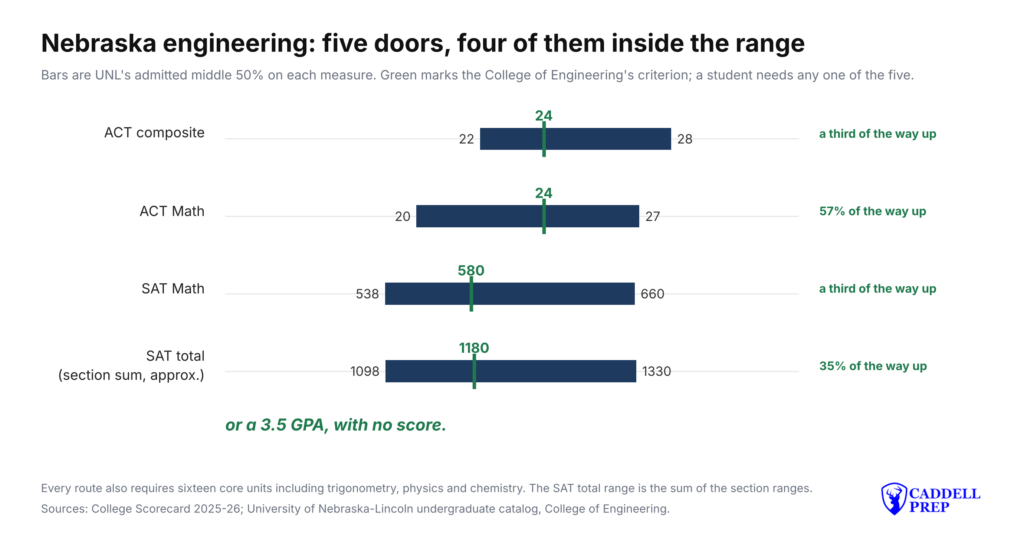
The image above shows four doors, each inside the range, and a fifth with no score on it.
Want to Know What 5 Topics Will Improve Your SAT Score the Most?
Sample Feedback from our Diagnostic Test:

What Do You Need to Get Into Engineering at Nebraska?
A first-year student is admitted to the University of Nebraska-Lincoln’s College of Engineering on any one of a 3.5 cumulative GPA, an ACT composite of 24, an SAT of 1180, an ACT Math of 24 or an SAT Math of 580, together with sixteen core high school units that must include trigonometry, physics and chemistry.
The catalog lists the five and the units. The units are four of mathematics, two of algebra, one of geometry and one of precalculus and trigonometry, four of English, three of natural science including one of physics and one of chemistry, two of a single world language, and three of social studies. Chemistry is waived for construction management, computer science, computer engineering, data science and software engineering. A student with an ACT composite of 28 or an equivalent SAT is admitted even if he is missing one of trigonometry, chemistry or physics. The table below sets each of the five scored criteria against the range UNL reports for the same test.
| Criterion | UNL’s admitted range | Where the criterion sits |
|---|---|---|
| ACT composite 24 | 22 to 28 | approximately a third of the way up |
| ACT Math 24 | 20 to 27 | approximately 57% of the way up |
| SAT total 1180 | approximately 1098 to 1330 | approximately 35% of the way up |
| SAT Math 580 | 538 to 660 | approximately a third of the way up |
| GPA 3.5 | no range | a door with no score on it |
A student needs one. Kansas’s flagship had five routes too, on our page on engineering colleges in Kansas, but they were five ways to satisfy one mathematics requirement. Nebraska’s five are five different measures, and three of them are not a Math score. A student whose composite is stronger than his Math takes the composite door. A student whose Math is stronger takes the Math door. A student with a 3.5 takes no score door at all. The only student who misses all five is below 24 on both ACT figures, below 1180 and 580 on both SAT figures, and below 3.5, and that student is below the middle of UNL’s admitted class on every measure the university publishes.
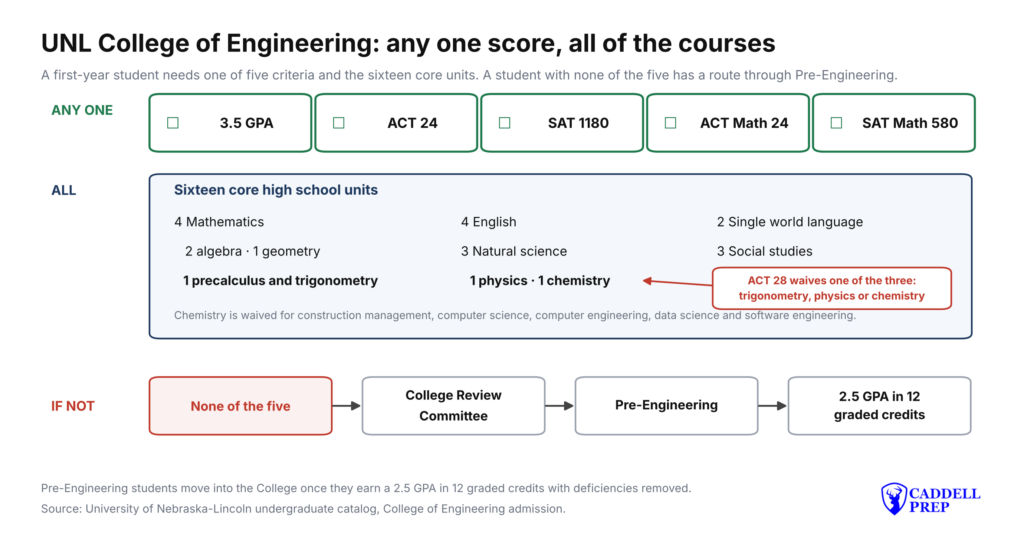
The image above shows any one of the scores and all of the courses, and the route for a student with neither.
The route for that student is also in the catalog. A domestic first-year student admitted to the university but not to the College goes to the College Review Committee, which “considers factors beyond test scores.” A student not admitted there is placed in Pre-Engineering with the Explore Center, may enroll in engineering courses whose prerequisites he meets as space permits, and is admitted to the College when he has a 2.5 cumulative GPA in at least 12 graded credit hours and has removed every entrance deficiency. Missing units can be made up by independent study, summer courses or in the first two semesters.
Take three students. The first has a 22 composite, a 21 on ACT Math and a 3.5 GPA. He is at the floor of the admitted range on the composite and at the floor on Math, and he is admitted on the GPA. The second has a 26 composite, a 23 on Math and a 3.2. He misses the Math door by a point and the GPA door by three tenths and is admitted on the composite. The third has a 23 composite, a 24 on Math and a 3.0. He misses the composite by a point and the GPA by half a point and is admitted on the Math. All three are admitted to the same College on the same day, and none of them cleared more than one door.
Now take a fourth, with a 25 composite, a 24 on Math, a 3.6 GPA and no physics on his transcript. He clears three of the five score doors and is still short, because the 28 that waives a missing science is three points above him. He takes physics in a summer course or in his first semester, and he is admitted with a deficiency to remove. Olin required calculus and physics of every applicant on our page on engineering colleges in Massachusetts, at a college that admits one in four. Nebraska requires physics, chemistry and trigonometry at a public university that admits 87%, and the course list is the gate the scores cannot open.
The Omaha campus is the same College under the same rules. The Scott Campus at the Peter Kiewit Institute is a UNL campus with a second dean’s office, architectural engineering is taught only there, and computer engineering is taught there with its own accreditation listing. A student who wants to study engineering in Omaha applies to UNL, is admitted on the same five criteria, and pays UNL’s tuition. The University of Nebraska at Omaha, in the same city, awards no engineering degree of its own.
The honest version is that the five doors admit to the College and not to calculus. UNL requires almost all new students to take its Math Placement Exam before their first advising meeting, and a student registers for a math course only on a qualifying exam score or a passing grade in the prerequisite course. The catalog’s five criteria say nothing about which math course a student starts in, and the Math Placement Exam decides it for a student admitted on a 3.5 with a 21 just as it does for a student admitted on a 28. The percentile placements in the table above are arithmetic on the reported ranges and are approximate, and the SAT total range is a sum of the two section ranges, not a figure UNL reports.
Families reading the five criteria frequently ask about the one with no score on it.
Can You Get Into Nebraska Engineering With a 3.5 GPA and No Test Score?
A student can get into Nebraska engineering with a 3.5 cumulative GPA and no test score. The 3.5 is one of the five criteria and stands alone, provided the sixteen core units, including trigonometry, physics and chemistry, are on the transcript.
What the score would have done for him afterward is nothing at UNL, because the university places nearly every new student into his first math course by its own placement exam rather than by the ACT or SAT. The student who does need a score is the one with a 3.4, because his door is a 24 or an 1180 or a 580, and a 3.4 with a 21 and an 1100 is the student who goes to College Review.
So a Nebraska engineering applicant has one in-state college on three campuses, and the next section is about why there is only one.
Why Does Nebraska Have Only One Engineering School?
The University of Nebraska-Lincoln is the only institution in Nebraska that holds an ABET-accredited engineering bachelor’s degree, and it holds them on three campuses.
The University of Nebraska at Omaha admits 87% of applicants on an ACT range of 19 to 26 and charges $8,718 in state, and the engineering taught on its grounds belongs to Lincoln. The College of Engineering’s Scott Campus sits at the Peter Kiewit Institute on UNO’s campus, and the degrees awarded there, including the state’s only architectural engineering degree, are UNL’s. Creighton University in Omaha admits 80% on an ACT range of 26 to 31, the highest in the state, and awards no engineering degree. The University of Nebraska at Kearney, Chadron State, Wayne State and Peru State award none. Nebraska Wesleyan, Doane, Hastings, Midland, Concordia, Union Adventist and York award none, and several route students to an engineering degree through a three-two arrangement that finishes at another university. Kiewit, Union Pacific and Valmont in Omaha and the Kawasaki plant in Lincoln are the largest engineering employers in the state, and they hire from one in-state college.
Accreditation is the criterion for a reason that is easy to miss at seventeen. Licensure as a professional engineer normally requires a degree from an ABET-accredited engineering program, and a page about engineering colleges that listed programs without one would be listing a different thing.
So a Nebraska engineering applicant has one in-state option in two cities, and most of them apply across the border too.
What If You Miss All Five?
In Nebraska a student who misses all five of the College’s doors is below the middle of its admitted class on every measure, and the shortest door for most students is the ACT Math 24 or the composite 24, each a point or two from where the middle of the class already sits.
The gap from a 22 or 23 to a 24 on ACT Math is two or three questions, and the material those questions test is the trigonometry and algebra the College already requires on the transcript. A student who has the courses and not the score is closer than he looks, and a student who has the score and not the courses has a summer class to take. A New York student has the ranges on both tests and out-of-state tuition of $28,584, 2.7 times what a Nebraska student pays, at either campus.
The first step is finding out where the score actually is, section by section. A free diagnostic SAT gives a Math score that can be set against the 580 and converted to the 24.
The Math section rewards the same handful of topics on every test date, and a student who knows which of them he is missing can close a gap of 50 to 100 points in weeks rather than months. The method is on our page on improving your SAT Math score, and the topics are the ones UNL’s placement exam asks about.
How to Read These Score Ranges
Every range on this page covers the middle 50% of admitted students who submitted that test. The lower number is the 25th percentile and the upper number is the 75th, so a quarter of admitted students scored at or above it.
A criterion that sits a third of the way up a range is one that approximately two thirds of admitted students met on that measure alone. Nebraska’s engineering college publishes three such criteria and lets a student pick the one he clears.
Because most colleges are now test-optional, the ranges that are published describe only the students who chose to submit at all. Students with strong scores submit and students with weak ones don’t, so a published range sits higher than the range for everyone who was actually admitted. More on what SAT score you need for college and on test-optional colleges.
Should You Take the SAT Instead?
Nebraska is an ACT state. Every public-school junior takes the ACT, nine Nebraska institutions report an ACT range against six for the SAT, and UNL writes its engineering criteria on both scales, 24 and 1180 for the composite and 24 and 580 for Math.
That is why this page gives the ACT first. UNL accepts either test, and a student from outside Nebraska who holds an SAT should read the SAT figures and the 1180 and 580.
Engineering Programs in Nearby States
Nebraska borders Iowa, Kansas, Colorado, Wyoming, South Dakota and Missouri, and Nebraska students cross into Iowa State and the Kansas universities in numbers, because one accredited program at home is the shortest list a state can have.
See engineering colleges in Iowa, engineering colleges in Kansas, and engineering colleges in Colorado.
Engineering Colleges in Other States
We publish the same breakdown for engineering programs in every state.
See engineering colleges by state for the full list.

Glyn Caddell
Glyn Caddell holds a BS in Mechanical Engineering from NJIT and has been tutoring New York City students since 2008. He founded Caddell Prep in 2012 and is the author of Digital SAT Math Secrets: Lessons & Tricks to Quickly Improve to a Perfect 800 on the Math Test, which contains over 900 practice problems and is used in Caddell Prep’s SAT math classes. He is founding president of the Staten Island Technical High School alumni association and teaches every lesson on this site personally.
Finally, an SAT course that students actually understand
Every question has a video explanation. Not most — every one.
The on-demand Digital SAT course covers all 17 math topics and 15 reading and writing topics, with 5 full-length practice tests and a 100-point score increase guarantee. Keep access for the rest of high school. No subscription.
Want to Know What 5 Topics Will Improve Your SAT Score the Most?
Sample Feedback from our Diagnostic Test: