
Home » College SAT Score Ranges, Costs, and Programs by Major and State » Engineering Colleges by State: SAT Scores, ACT Scores, Costs, and ABET Programs » Engineering Colleges in Arkansas: SAT Scores, Costs, and Programs
By Glyn Caddell, BSME · Author of Digital SAT Math Secrets · Tutoring since 2008 — Updated October 22, 2026
Seven Arkansas universities offer ABET-accredited engineering degrees, and this page lists what they cost and the SAT scores of the students they admit.
The University of Arkansas places engineering students into Calculus I at an SAT Math of 660, and the top quarter of the students it admits scored 600. What that gap means for a first semester is covered below the table.
Scores are given by section, and the table is sorted by Math because that is the section engineering programs use.
Table of Contents
- Arkansas Engineering Colleges by SAT Math Score
- What SAT Math Score Puts You in Calculus at the University of Arkansas?
- What Does the SAT Do for Arkansas’s State Scholarships?
- Which Arkansas Universities Have ABET-Accredited Engineering Schools?
- What If Your Math Score Is Below the Calculus Line?
Arkansas Engineering Colleges by SAT Math Score
The seven universities below are the ones in Arkansas that hold an ABET-accredited bachelor’s degree in an engineering discipline. They are sorted by the midpoint of the SAT Math range, so the order can be checked from the table itself.
| College | SAT Reading & Writing | SAT Math | Cost of attendance | Undergraduates | Admit rate |
|---|---|---|---|---|---|
| John Brown University | 550 to 690 | 520 to 650 | $44,710 | 1,471 | 76% |
| Harding University | 530 to 660 | 520 to 630 | $39,534 | 3,382 | 71% |
| University of Arkansas | 520 to 620 | 510 to 600 | $27,767 | 28,677 | 74% |
| Arkansas State University | 490 to 570 | 480 to 620 | $25,082 | 9,110 | 82% |
| University of Arkansas at Little Rock | 490 to 630 | 470 to 580 | $22,519 | 4,949 | 59% |
| Arkansas Tech University | 450 to 550 | 430 to 550 | $22,808 | 5,388 | 96% |
| Southern Arkansas University | 450 to 565 | 425 to 540 | $24,951 | 2,708 | 75% |
Each range covers the middle 50% of admitted students who submitted the SAT. A quarter scored below the lower number, and the top quarter scored at or above the upper one. Being under the lower number does not rule a student out, and being just above it is not as safe as it looks.
Only universities with an ABET-accredited engineering bachelor’s degree are listed. Engineering technology degrees, which are accredited under a separate ABET commission, do not qualify a university for the list.
Three things about that table are worth pausing on, and all three are about the Math column.
The two highest Math ranges in the state are at private universities with fewer than 3,500 undergraduates, and both cost more than $39,000 a year. John Brown’s top quarter scored at or above 650, the highest Math figure on the page, and Harding’s at or above 630.
The flagship is third. The University of Arkansas’s top quarter scored at or above 600 on Math, and the university places students into Calculus I at 660. The next section is about that gap.
Arkansas State’s Math range has a higher ceiling than the University of Arkansas’s, 620 against 600, with a lower floor. The two public universities overlap for most of their range, and the larger one does not have the higher top.
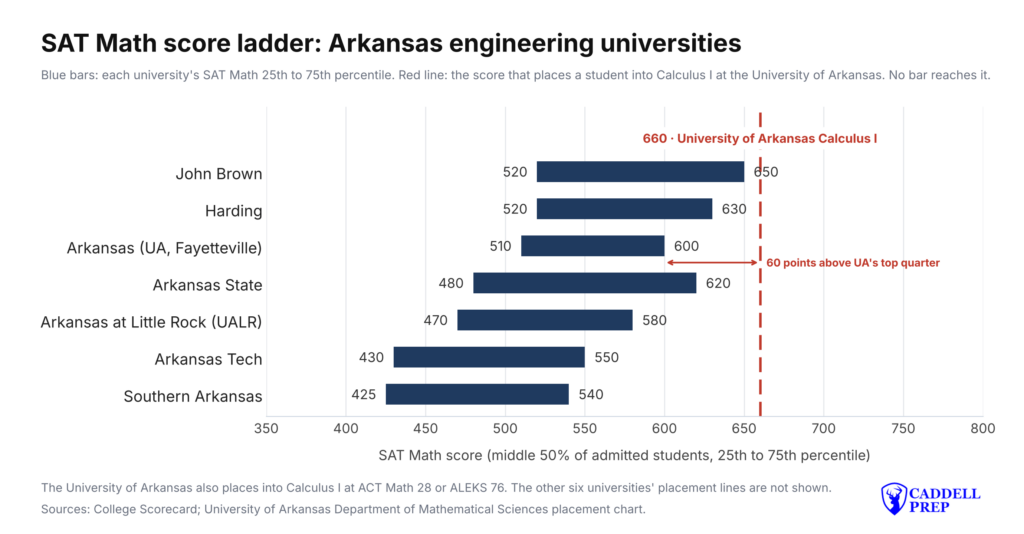
A student can see where his Math score sits on this list, and how far it sits from the flagship’s calculus line, in the image above.
Want to Know What 5 Topics Will Improve Your SAT Score the Most?
Sample Feedback from our Diagnostic Test:

John Brown University
John Brown University’s engineering program in Siloam Springs awards a single ABET-accredited Bachelor of Science in Engineering with concentrations, and John Brown has the highest Math range on this page.
Reading & Writing 550 to 690, Math 520 to 650. The top quarter of admitted students scored at or above 690 and 650. Cost of attendance $44,710, with tuition and fees at $31,756 for all students. 1,471 undergraduates, 76% admitted.
John Brown is the smallest university on the page and the most expensive, and it is an interdenominational Christian university.
Harding University
Harding University’s engineering programs in Searcy hold ABET accreditation in biomedical, computer, electrical and mechanical engineering, and Harding is the second private university at the top of the list.
Reading & Writing 530 to 660, Math 520 to 630. The top quarter scored at or above 660 and 630. Cost of attendance $39,534, with tuition and fees at $26,262 for all students. 3,382 undergraduates, 71% admitted.
Harding is affiliated with the Churches of Christ and admits a smaller share of applicants than any public university on the page except Little Rock.
University of Arkansas
The University of Arkansas’s College of Engineering in Fayetteville is the state’s flagship engineering school and the largest by a distance, and any freshman admitted to the university is eligible to enroll in it.
Reading & Writing 520 to 620, Math 510 to 600. The top quarter scored at or above 620 and 600. Cost of attendance $27,767, with tuition and fees at $10,104 in-state and $29,966 out-of-state. 28,677 undergraduates, 74% admitted.
The University of Arkansas has eight ABET-accredited engineering degrees, more than any other university in the state. Its calculus placement line is the subject of the next section.
Arkansas State University
Arkansas State University’s College of Engineering and Computer Science in Jonesboro holds ABET accreditation in civil, electrical and mechanical engineering, and Arkansas State has the lowest in-state tuition on the page.
Reading & Writing 490 to 570, Math 480 to 620. The top quarter scored at or above 570 and 620. Cost of attendance $25,082, with tuition and fees at $8,090 in-state and $14,522 out-of-state. 9,110 undergraduates, 82% admitted.
Arkansas State’s Math 75th percentile of 620 is above the flagship’s 600, and its out-of-state tuition is less than half the flagship’s.
University of Arkansas at Little Rock
The University of Arkansas at Little Rock’s School of Engineering and Engineering Technology holds ABET engineering accreditation in systems engineering, mechanical systems engineering, civil and construction engineering, and architectural and construction engineering, and Little Rock is the most selective university on the page by admit rate.
Reading & Writing 490 to 630, Math 470 to 580. The top quarter scored at or above 630 and 580. Cost of attendance $22,519, with tuition and fees at $9,748 in-state and $22,158 out-of-state. 4,949 undergraduates, 59% admitted.
Little Rock is the cheapest university on the page by cost of attendance. Its electronics and mechanical engineering technology degrees are accredited under ABET’s technology commission and are not counted among its engineering programs here.
Arkansas Tech University
Arkansas Tech University’s Department of Engineering and Computing Sciences in Russellville holds ABET accreditation in electrical and mechanical engineering, and Arkansas Tech admits a larger share of applicants than any other university on the page.
Reading & Writing 450 to 550, Math 430 to 550. The top quarter scored at or above 550 on both sections. Cost of attendance $22,808, with tuition and fees at $8,674 in-state and $14,668 out-of-state. 5,388 undergraduates, 96% admitted.
Arkansas Tech is within $300 of Little Rock on cost of attendance and admits 96% of applicants against Little Rock’s 59%.
Southern Arkansas University
Southern Arkansas University’s engineering programs in Magnolia hold ABET accreditation for a Bachelor of Science in Engineering, accredited since 2018, and a Bachelor of Science in Mechanical Engineering, accredited retroactively to October 2023.
Reading & Writing 450 to 565, Math 425 to 540. The top quarter scored at or above 565 and 540. Cost of attendance $24,951, with tuition and fees at $9,960 in-state and $15,690 out-of-state. 2,708 undergraduates, 75% admitted.
Southern Arkansas has the lowest Math range on the page and the newest engineering accreditation.
Seven ranges, and the one that matters most to the most students belongs to the flagship, because the flagship has published the number it measures that range against.
What SAT Math Score Puts You in Calculus at the University of Arkansas?
The University of Arkansas places a first-year student into MATH 2554 Calculus I at an SAT Math of 660, an ACT Math of 28, or an ALEKS placement score of 76, and the students it admits score 510 to 600 on SAT Math.
The line is 60 points above the top quarter. A student at the 75th percentile of admitted students, 600, is below it. So are more than three quarters of the students the university admits, because the 75th percentile is the point three quarters of them sit at or under. The same is true on the ACT: the calculus line is a 28 on ACT Math, and the admitted range is 18 to 26.
Precalculus is above the top quarter too. MATH 1284C needs an SAT Math of 620, an ACT Math of 26, or an ALEKS score of 60. A student at 600 is placed below precalculus as well, into college algebra, unless the assessment moves him.
That matters for an engineering student in a way it does not for most majors. Any freshman admitted to the University of Arkansas is eligible to enroll in the College of Engineering, so there is no second gate. The engineering curriculum begins at Calculus I, and the university’s catalog says that students who require preparatory courses take courses that do not count toward the degree. A student placed into college algebra in the fall is two courses from the first course on his degree plan.
Take a student with a 600 SAT Math. He is in the top quarter of admitted students at the University of Arkansas and 60 points below the course his degree starts with. The same student at 660 is in Calculus I in the fall. Sixty points on one section is the difference, and nothing on the admission letter says so.
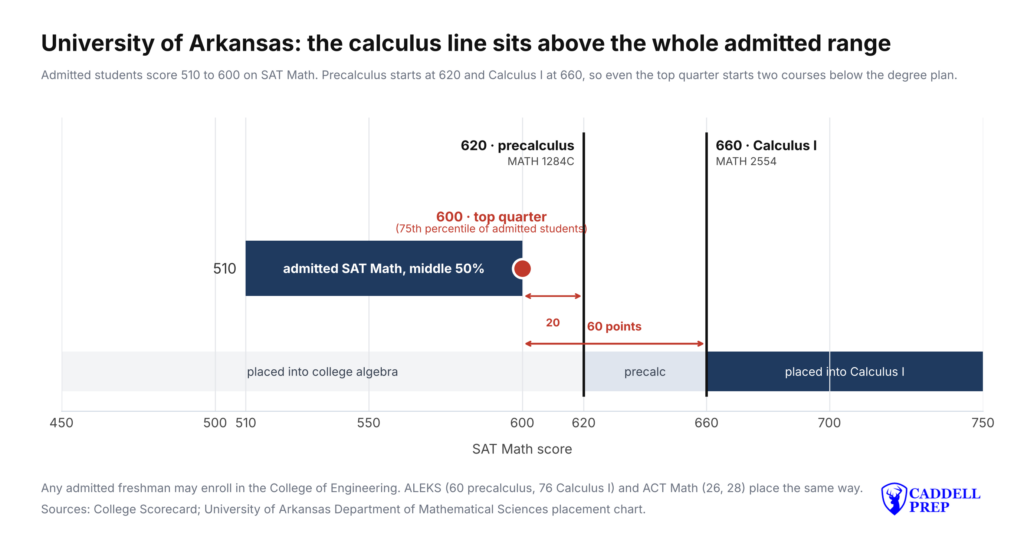
The image above shows a score that is above the top quarter, and still below the line.
There is a second door, and the page should be as plain about it as about the first. The ALEKS placement assessment, taken after admission, places into Calculus I at 76 and into precalculus at 60, and a student who did well in a high school precalculus course can pass it. The 660 is a placement line, not an admission line. It decides a first math course and nothing else, and the assessment can override it in either direction.
Arkansas State accepts the ACT, the SAT, Accuplacer or ALEKS for placement into its calculus course, and publishes its cutscores separately. The other universities on the page publish their own placement rules, and a student should read the rule at the campus he is choosing rather than assume the flagship’s line applies.
Students reading the 660 for the first time frequently ask whether it is a requirement to get in.
Is 660 an Admission Requirement for Engineering at the University of Arkansas?
A 660 is not an admission requirement for engineering at the University of Arkansas. Any freshman admitted to the university may enroll in the College of Engineering, and the 660 decides only which math course he starts in.
A student below it starts in precalculus or college algebra and takes courses that do not count toward the degree, unless the ALEKS assessment places him higher. A student who knows in the spring that his Math score is 600 has one summer to decide which door to use, and the way to find 60 points on one section is on our page on how to improve your SAT Math score.
The placement line belongs to the university. The state has its own uses for the score, and they are different.
What Does the SAT Do for Arkansas's State Scholarships?
The Arkansas Academic Challenge Scholarship requires a standardized test score on record from every traditional applicant, even one whose GPA already qualifies him, and the Governor’s Distinguished Scholarship requires a 1410 SAT or a 32 ACT.
The Academic Challenge Scholarship is the lottery-funded award that most Arkansas students use. At a four-year university it pays $2,000 in the first year, $4,000 in the second, $4,000 in the third and $5,000 in the fourth, $15,000 across a degree, to Arkansas residents of at least twelve months. A traditional student qualifies in one of three ways. The first is a Diploma of Merit. The second is a high school GPA of 3.00 or higher together with a standardized test score on record, with no specific score required. The third is a GPA below 3.00 together with an ACT of 19 or an SAT of 990. The application deadline is July 1.
A 3.00 student still has to have sat the test. His score does not matter, the record does. And a 2.9 student needs a 990, a number that is below every range on this page. For most readers of this page the Academic Challenge requirement is the easiest line they will clear, and it is still one they must clear by sitting the test.
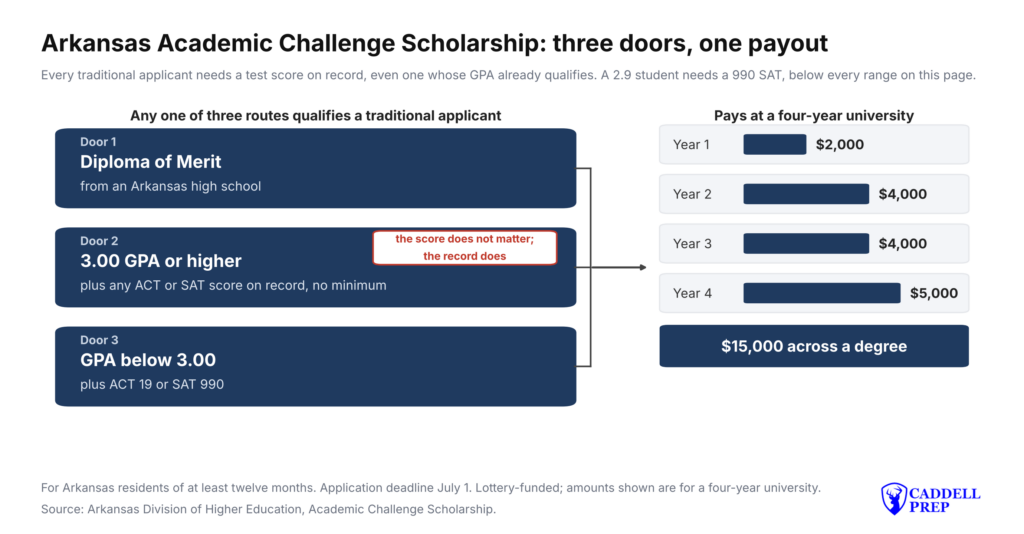
The image above shows the rule most students miss: a score on record, even when the score does not matter.
The Governor’s Distinguished Scholarship is the other state award, and it is out of reach of the middle 50% at every university on this page. It pays up to $10,000 a year for four years, $40,000 in all, to a high school senior with a 3.5 cumulative GPA and a 32 on the ACT or a 1410 on the SAT, with scores earned by the end of February and an application deadline of March 1. The state’s page says the 32 may be a composite or a superscore, and in the same list says the 1410 must come from a single SAT. The SAT wording uses the name of a section that was retired in 2016, so a student relying on it should confirm with the Division of Higher Education whether a superscored SAT counts. A 1410 is above every 75th percentile on this page by at least 60 points, and the one university whose top quarter comes within reach of it is John Brown.
The state’s rules are about money. The next section is about the degrees the money pays for.
Which Arkansas Universities Have ABET-Accredited Engineering Schools?
Seven Arkansas universities hold ABET-accredited engineering bachelor’s degrees, and all seven are in the table above.
The University of Arkansas’s College of Engineering in Fayetteville holds eight accredited degrees: biological, biomedical, chemical, civil, computer, electrical, industrial and mechanical engineering. Northwest Arkansas is where the state’s largest employers run their engineering and logistics operations, and Fayetteville and Siloam Springs both sit inside it. Arkansas State’s College of Engineering and Computer Science in Jonesboro holds civil, electrical and mechanical engineering, with the steel mills of Mississippi County to its east. Little Rock’s School of Engineering and Engineering Technology holds four engineering degrees in the capital, where the state’s utilities and agencies are based. Arkansas Tech in Russellville holds electrical and mechanical engineering, Harding in Searcy holds biomedical, computer, electrical and mechanical, John Brown in Siloam Springs holds a single engineering degree with concentrations, and Southern Arkansas in Magnolia holds general and mechanical engineering.
Accreditation matters for a reason that is easy to miss at seventeen. Licensure as a professional engineer normally requires a degree from an ABET-accredited engineering program, and that is why the engineering technology degrees at Little Rock, and the universities with no accredited engineering degree at all, are not on the list. The University of Central Arkansas, Hendrix, Ouachita Baptist and the University of Arkansas at Pine Bluff are all four-year institutions in the state, and none holds an ABET engineering degree.
Nothing on this page ranks the seven. The table’s order is a stated, verifiable number, and the choice among accredited programs comes down to cost, discipline and where a student’s Math score places him.
What If Your Math Score Is Below the Calculus Line?
An Arkansas engineering applicant to the flagship is almost certainly below the calculus line, because the line sits above the whole admitted SAT Math range, so the question is not whether to close the gap but which door to use.
There are two. The first is the SAT Math section, before the test date: 60 points from a 600, or more from lower, so that the score alone places into Calculus I. The second is the ALEKS assessment, after admission, where a 76 does the same thing. A student can prepare for both at once, because ALEKS tests the same algebra, functions and trigonometry that the SAT Math section does, and the topics a student is missing on one are the topics he is missing on the other.
The first step on either path is finding out where the score actually is, section by section. A free diagnostic SAT gives a Math score that can be set against the 660 and the 620 directly.
The Math section rewards the same handful of topics on every test date, and a student who knows which of them he is missing can close a 60-point gap in weeks rather than months. The method is on our page on improving your SAT Math score.
How to Read These Score Ranges
Every range on this page covers the middle 50% of admitted students who submitted the SAT. The lower number is the 25th percentile and the upper number is the 75th, so a quarter of admitted students scored at or above it.
A placement line can sit above a university’s whole admitted range, as the University of Arkansas’s does here, and that says nothing about admission and everything about the first semester. The range describes who got in. The line describes where they started.
Because most colleges are now test-optional, the ranges that are published describe only the students who chose to submit at all. Students with strong scores submit and students with weak ones don’t, so a published range sits higher than the range for everyone who was actually admitted. More on what SAT score you need for college and on test-optional colleges.
Should You Take the ACT Instead?
Arkansas is an ACT state in practice. The Academic Challenge threshold is written as an ACT 19 first and an SAT 990 second, the flagship’s calculus line is an ACT Math of 28 beside the SAT Math of 660, and every university on this page reports both tests.
Both tests are accepted everywhere on the list, and a student should take whichever he scores higher on. For the Governor’s Distinguished Scholarship, where the state’s page allows an ACT superscore and reads as if it does not allow an SAT one, a student close to the line on both tests should retake the ACT until the wording is confirmed.
Engineering Programs in Nearby States
Arkansas borders Missouri, Tennessee, Mississippi, Louisiana, Oklahoma and Texas, and Arkansas students apply across those lines in numbers even with seven accredited programs at home.
See engineering colleges in Tennessee, engineering colleges in Oklahoma, and engineering colleges in Texas.
Engineering Colleges in Other States
We publish the same breakdown for engineering programs in every state.
See engineering colleges by state for the full list.

Glyn Caddell
Glyn Caddell holds a BS in Mechanical Engineering from NJIT and has been tutoring New York City students since 2008. He founded Caddell Prep in 2012 and is the author of Digital SAT Math Secrets: Lessons & Tricks to Quickly Improve to a Perfect 800 on the Math Test, which contains over 900 practice problems and is used in Caddell Prep’s SAT math classes. He is founding president of the Staten Island Technical High School alumni association and teaches every lesson on this site personally.
Finally, an SAT course that students actually understand
Every question has a video explanation. Not most — every one.
The on-demand Digital SAT course covers all 17 math topics and 15 reading and writing topics, with 5 full-length practice tests and a 100-point score increase guarantee. Keep access for the rest of high school. No subscription.
Want to Know What 5 Topics Will Improve Your SAT Score the Most?
Sample Feedback from our Diagnostic Test: