
Home » College SAT Score Ranges, Costs, and Programs by Major and State » Engineering Colleges by State: SAT Scores, ACT Scores, Costs, and ABET Programs » Engineering Colleges in Texas: SAT Scores, Costs, and Programs
By Glyn Caddell, BSME · Author of Digital SAT Math Secrets · Tutoring since 2008 — Updated October 26, 2026
Thirty-three Texas universities offer ABET-accredited engineering degrees, and this page lists what they cost and the test scores of the students they admit.
At the largest of them, the largest university in this series, admission to engineering is admission to general engineering, and the student who wants his first-choice major automatically needs a 3.75 by the end of the semester he applies, with three chances before his fourth semester ends.
SAT scores are given by section rather than as a total, because a student at 720 Reading & Writing and 620 Math is in a different position from a student at 620 and 720.
Table of Contents
- Texas Engineering Colleges by SAT Score
- What GPA Does a Texas A&M Student Need to Get Into an Engineering Major?
- Which Texas Universities Have ABET-Accredited Engineering Schools?
- What If Your Score Is Below the Range You Want?
Texas Engineering Colleges by SAT Score
The thirty-three universities below are the ones in Texas that hold an ABET-accredited bachelor’s degree in an engineering discipline. The thirty-two that report SAT ranges are sorted by the midpoint of the Math range, so the order can be checked from the table itself, and the ties are stated beneath it. Midwestern State reports no range and is listed last.
| College | SAT Reading & Writing | SAT Math | Cost of attendance | Undergraduates | Admit rate |
|---|---|---|---|---|---|
| Rice University | 740 to 770 | 770 to 800 | $79,788 | 4,776 | 8% |
| Southern Methodist University | 670 to 740 | 670 to 750 | $85,606 | 7,277 | 63% |
| Trinity University | 680 to 750 | 660 to 750 | $68,224 | 2,505 | 26% |
| University of Texas at Austin | 630 to 740 | 620 to 770 | $31,247 | 42,855 | 27% |
| University of Texas at Dallas | 580 to 690 | 580 to 720 | $29,807 | 21,751 | 65% |
| Baylor University | 610 to 700 | 590 to 700 | $74,226 | 14,785 | 51% |
| Texas A&M University | 580 to 690 | 570 to 710 | $32,696 | 59,615 | 57% |
| University of Houston | 590 to 670 | 570 to 670 | $26,185 | 38,380 | 74% |
| Texas Christian University | 580 to 680 | 560 to 670 | $76,604 | 11,026 | 44% |
| Texas Tech University | 550 to 640 | 540 to 640 | $27,443 | 32,394 | 73% |
| LeTourneau University | 500 to 660 | 490 to 670 | $51,124 | 1,468 | 38% |
| Abilene Christian University | 540 to 650 | 530 to 620 | $59,256 | 3,195 | 66% |
| University of Texas at Arlington | 510 to 620 | 500 to 620 | $25,261 | 32,294 | 80% |
| University of Texas at San Antonio | 510 to 620 | 490 to 600 | $22,352 | 30,580 | 87% |
| University of Texas at Tyler | 510 to 610 | 500 to 590 | $24,505 | 7,440 | 94% |
| University of North Texas | 500 to 630 | 480 to 600 | $26,243 | 34,341 | 72% |
| St. Mary’s University | 465 to 665 | 435 to 645 | $47,999 | 1,951 | 98% |
| Houston Christian University | 500 to 600 | 490 to 590 | $50,082 | 2,886 | 84% |
| Texas State University | 500 to 610 | 480 to 590 | $28,073 | 36,177 | 89% |
| Texas A&M University-Corpus Christi | 500 to 610 | 470 to 583 | $25,210 | 8,034 | 89% |
| Tarleton State University | 500 to 590 | 480 to 570 | $24,100 | 12,673 | 90% |
| University of Houston-Clear Lake | 490 to 580 | 480 to 570 | $24,622 | 6,078 | 91% |
| West Texas A&M University | 480 to 590 | 470 to 580 | $23,482 | 6,917 | 99% |
| Texas A&M University-Kingsville | 510 to 550 | 480 to 560 | $24,060 | 4,748 | 91% |
| Lamar University | 480 to 580 | 450 to 560 | $22,254 | 8,150 | 86% |
| Angelo State University | 470 to 590 | 440 to 560 | $23,441 | 5,643 | 83% |
| University of Texas Permian Basin | 470 to 570 | 440 to 560 | $23,886 | 3,911 | 95% |
| Texas A&M International University | 470 to 560 | 420 to 530 | $15,558 | 6,667 | 44% |
| University of Texas Rio Grande Valley | 460 to 560 | 420 to 530 | $16,830 | 28,666 | 94% |
| University of Texas at El Paso | 450 to 550 | 410 to 530 | $19,836 | 21,005 | 100% |
| Prairie View A&M University | 450 to 550 | 410 to 530 | $26,362 | 8,877 | 79% |
| Texas Southern University | 420 to 520 | 380 to 480 | $27,052 | 6,844 | 97% |
| Midwestern State University | Does not report SAT data | Does not report SAT data | $22,652 | 4,087 | 94% |
Each range covers the middle 50% of admitted students who submitted that test. A quarter scored below the lower number, and the top quarter scored at or above the upper one. Being under the lower number does not rule a student out, and being just above it is not as safe as it looks.
Ties on the Math midpoint are ordered by the Reading & Writing midpoint, then by the ACT 25th percentile. San Antonio is before Tyler. North Texas, St. Mary’s and Houston Christian are in that order. Tarleton, Houston-Clear Lake and West Texas A&M are in that order. Angelo State is before Permian Basin, International before Rio Grande Valley, and El Paso before Prairie View. Only universities with an ABET-accredited engineering bachelor’s degree are listed. Texas A&M-Galveston awards Texas A&M degrees and is counted under Texas A&M. Engineering technology degrees at Sam Houston State, Houston-Downtown, Texas A&M-San Antonio and others are accredited under a separate ABET commission and do not qualify those universities for the list. Midwestern State reports no SAT or ACT range to the Scorecard and is listed last. El Paso’s admit rate rounds to 100%.
Three things about that table are worth pausing on.
Texas A&M, at 59,615 undergraduates, is the largest university on any page in this series, and it admits every engineering freshman to general engineering and places him in a major after a second, third or fourth semester, automatically at a 3.75. The next section is about it.
Rice reports Math 770 to 800 and admits 8%, the fifth 770 Math floor in the series, and Texas reports a 770 Math ceiling on a 620 floor, a 150-point range at a university that admits 27% and requires a test score. Texas charges a non-resident $44,908, the highest public figure on the page.
West Texas A&M charges a non-resident $10,996 and Midwestern State $12,530, the two lowest public figures on the page and, for West Texas A&M, the fifth-lowest in this series. Twelve of the twenty-four publics charge a non-resident less than $22,000.
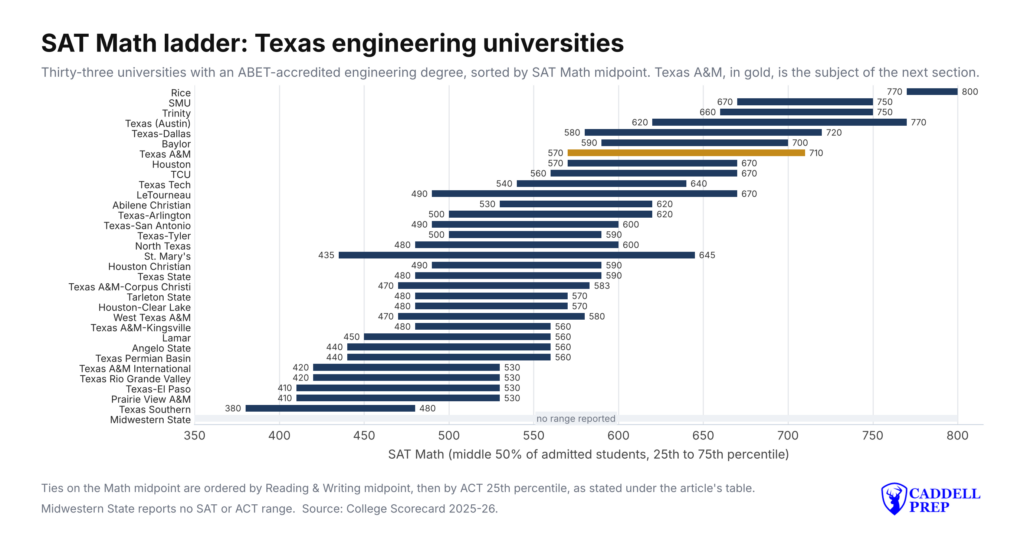
A student can see where his Math score sits on this list in the image above.
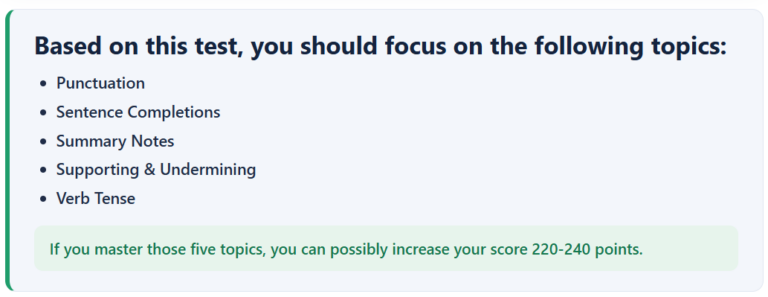
Want to Know What 5 Topics Will Improve Your SAT Score the Most?
Sample Feedback from our Diagnostic Test:
Rice University
Rice University’s George R. Brown School of Engineering in Houston holds ABET accreditation in bioengineering, chemical, civil, computer, electrical, environmental, materials science and mechanical engineering [VERIFY list on abet.org], and Rice is the most selective school on the page.
Reading & Writing 740 to 770, Math 770 to 800. The top quarter of admitted students scored 800 on Math. Cost of attendance $79,788, with tuition and fees at $64,144 for all students. 4,776 undergraduates, 8% admitted.
Rice admits one applicant in twelve and reports a Math floor of 770, the fifth in this series after Penn, Carnegie Mellon, Brown and Vanderbilt. Its Math floor is 20 points above SMU’s ceiling.
Southern Methodist University
Southern Methodist University’s Lyle School of Engineering in Dallas holds ABET accreditation in civil, computer, electrical, environmental and mechanical engineering [VERIFY on abet.org], and SMU has the highest cost of attendance on the page.
Reading & Writing 670 to 740, Math 670 to 750. The top quarter of admitted students scored at or above 750 on Math. Cost of attendance $85,606, with tuition and fees at $67,040 for all students. 7,277 undergraduates, 63% admitted.
SMU admits 63% on a Math range whose floor, 670, is above the ceiling at twenty-two of the thirty-two reporting schools, and its cost of attendance is $5,818 above Rice’s. It is the one school in the top three that admits more than half its applicants.
Trinity University
Trinity University’s engineering science program in San Antonio holds ABET accreditation for its Bachelor of Science in Engineering Science [VERIFY on abet.org], and Trinity is the second liberal arts college in this series with a Math floor above 650.
Reading & Writing 680 to 750, Math 660 to 750. The top quarter of admitted students scored at or above 750 on Math. Cost of attendance $68,224, with tuition and fees at $53,676 for all students. 2,505 undergraduates, 26% admitted.
Trinity’s Reading & Writing floor of 680 is the highest on the page after Rice’s, and it admits 26%, one point below Texas. Its tuition is $13,364 below SMU’s.
University of Texas at Austin
The University of Texas at Austin’s Cockrell School of Engineering holds ABET accreditation in disciplines including aerospace, architectural, biomedical, chemical, civil, computer, electrical, environmental, mechanical and petroleum engineering [VERIFY list on abet.org], and Texas admits to a major at the door, under a rule described in the next section.
Reading & Writing 630 to 740, Math 620 to 770. The top quarter of admitted students scored at or above 770 on Math. Cost of attendance $31,247, with tuition and fees at $11,688 in state and $44,908 out of state. 42,855 undergraduates, 27% admitted.
Texas is the most selective public on the page, the second-largest school on it, and the most expensive public for a non-resident by $4,764 over Texas-Dallas. Its Math ceiling of 770 is the highest among the publics on this page by 50 points.
University of Texas at Dallas
The University of Texas at Dallas’s Erik Jonsson School of Engineering and Computer Science in Richardson holds ABET accreditation in biomedical, computer, electrical, mechanical and software engineering [VERIFY on abet.org], and Texas-Dallas charges the highest in-state tuition on the page.
Reading & Writing 580 to 690, Math 580 to 720. The top quarter of admitted students scored at or above 720 on Math. Cost of attendance $29,807, with tuition and fees at $14,644 in state and $40,144 out of state. 21,751 undergraduates, 65% admitted.
Texas-Dallas charges a resident $14,644, $1,490 more than Texas A&M and $2,956 more than Texas, and its Math ceiling of 720 is the third-highest among the publics. It admits 65%, more than twice Texas’s rate, on a Math floor 40 points lower.
Baylor University
Baylor University’s School of Engineering and Computer Science in Waco holds ABET accreditation in electrical and computer, and mechanical engineering, and in engineering [VERIFY degree names on abet.org], and Baylor is the largest private on the page.
Reading & Writing 610 to 700, Math 590 to 700. The top quarter of admitted students scored at or above 700 on Math. Cost of attendance $74,226, with tuition and fees at $58,100 for all students. 14,785 undergraduates, 51% admitted.
Baylor is a Baptist university whose Reading & Writing floor, 610, is the highest among the schools below Texas, and whose cost of attendance is $2,378 below TCU’s on a Math range 30 points higher at both ends.
Texas A&M University
Texas A&M University’s College of Engineering in College Station holds ABET accreditation in disciplines including aerospace, biological and agricultural, biomedical, chemical, civil, computer, electrical, environmental, industrial, materials science, mechanical, nuclear, ocean and petroleum engineering [VERIFY list on abet.org], and Texas A&M admits its engineering freshmen to general engineering rather than to a major.
Reading & Writing 580 to 690, Math 570 to 710. The top quarter of admitted students scored at or above 710 on Math. Cost of attendance $32,696, with tuition and fees at $13,154 in state and $40,124 out of state. 59,615 undergraduates, 57% admitted.
Texas A&M is the largest university on any page in this series by 16,000 students, and its Galveston campus awards its degrees, including ocean engineering. Its Entry to a Major rule is the next section.
University of Houston
The University of Houston’s Cullen College of Engineering holds ABET accreditation in biomedical, chemical, civil, computer, electrical, environmental, industrial, mechanical and petroleum engineering [VERIFY on abet.org], and Houston is the third-largest school on the page.
Reading & Writing 590 to 670, Math 570 to 670. The top quarter of admitted students scored at or above 670 on Math. Cost of attendance $26,185, with tuition and fees at $9,717 in state and $22,547 out of state. 38,380 undergraduates, 74% admitted.
Houston shares its Math floor of 570 with Texas A&M on a ceiling 40 points lower, and charges a non-resident $17,577 less. Its in-state tuition of $9,717 is below every other public on the page with a Math ceiling above 640.
Texas Christian University
Texas Christian University’s College of Science and Engineering in Fort Worth holds ABET accreditation in electrical and mechanical engineering [VERIFY on abet.org], and TCU has the second-highest cost of attendance on the page.
Reading & Writing 580 to 680, Math 560 to 670. The top quarter of admitted students scored at or above 670 on Math. Cost of attendance $76,604, with tuition and fees at $61,740 for all students. 11,026 undergraduates, 44% admitted.
TCU charges every student $61,740 and admits 44% on a Math range that matches Houston’s at the ceiling and sits 10 points below it at the floor. The two schools are 260 miles and $39,193 in tuition apart.
Texas Tech University
Texas Tech University’s Edward E. Whitacre Jr. College of Engineering in Lubbock holds ABET accreditation in disciplines including chemical, civil, computer, construction, electrical, environmental, industrial, mechanical and petroleum engineering [VERIFY on abet.org], and Texas Tech is the sixth-largest school on the page.
Reading & Writing 550 to 640, Math 540 to 640. The top quarter of admitted students scored at or above 640 on Math. Cost of attendance $27,443, with tuition and fees at $11,852 in state and $24,451 out of state. 32,394 undergraduates, 73% admitted.
Texas Tech’s two section ranges are 10 points apart at the floor and identical at the ceiling, and its non-resident tuition of $24,451 is $15,673 below Texas A&M’s for a Math range 30 points lower at the floor and 70 at the ceiling.
LeTourneau University
LeTourneau University’s School of Engineering and Engineering Technology in Longview holds ABET accreditation in biomedical, civil, computer, electrical, mechanical and engineering [VERIFY degree names on abet.org], and LeTourneau is the smallest school on the page.
Reading & Writing 500 to 660, Math 490 to 670. The top quarter of admitted students scored at or above 670 on Math. Cost of attendance $51,124, with tuition and fees at $37,160 for all students. 1,468 undergraduates, 38% admitted.
LeTourneau is a Christian university founded by an earthmoving-equipment manufacturer, admits 38%, and reports a Math range 180 points wide whose ceiling matches Houston’s and TCU’s. Its engineering technology degrees do not count toward its row.
Abilene Christian University
Abilene Christian University’s engineering program holds ABET accreditation for its Bachelor of Science in Engineering [VERIFY on abet.org, and remove the row if not EAC-accredited], and Abilene Christian is one of two Churches of Christ universities on the page.
Reading & Writing 540 to 650, Math 530 to 620. The top quarter of admitted students scored at or above 620 on Math. Cost of attendance $59,256, with tuition and fees at $44,200 for all students. 3,195 undergraduates, 66% admitted.
Abilene Christian’s Reading & Writing range sits 10 points above its Math range at the floor and 30 above it at the ceiling, and its tuition is $7,040 above LeTourneau’s. Its engineering program is in a city of 125,000 in West Texas
University of Texas at Arlington
The University of Texas at Arlington’s College of Engineering holds ABET accreditation in aerospace, biomedical, civil, computer, electrical, industrial, mechanical and software engineering [VERIFY on abet.org], and Arlington is within 2,000 undergraduates of Texas Tech.
Reading & Writing 510 to 620, Math 500 to 620. The top quarter of admitted students scored at or above 620 on Math. Cost of attendance $25,261, with tuition and fees at $11,950 in state and $29,582 out of state. 32,294 undergraduates, 80% admitted.
Arlington charges a non-resident $29,582, $5,131 more than Texas Tech, on a Math range 40 points lower at the floor and 20 lower at the ceiling. It is the one public outside Austin, College Station and Richardson that charges a non-resident more than $26,000.
University of Texas at San Antonio
The University of Texas at San Antonio’s Klesse College of Engineering and Integrated Design holds ABET accreditation in biomedical, chemical, civil, computer, electrical and mechanical engineering [VERIFY on abet.org], and San Antonio is listed ahead of Tyler on the Reading & Writing midpoint.
Reading & Writing 510 to 620, Math 490 to 600. The top quarter of admitted students scored at or above 600 on Math. Cost of attendance $22,352, with tuition and fees at $9,011 in state and $22,051 out of state. 30,580 undergraduates, 87% admitted.
San Antonio has 30,580 undergraduates and charges a resident $9,011, the lowest in-state figure among the eight publics with more than 20,000 undergraduates. Its Reading & Writing range is identical to Arlington’s.
University of Texas at Tyler
The University of Texas at Tyler’s College of Engineering holds ABET accreditation in civil, computer, electrical and mechanical engineering [VERIFY on abet.org], and Tyler shares its Math midpoint with San Antonio.
Reading & Writing 510 to 610, Math 500 to 590. The top quarter of admitted students scored at or above 590 on Math. Cost of attendance $24,505, with tuition and fees at $9,736 in state and $25,494 out of state. 7,440 undergraduates, 94% admitted.
Tyler admits 94% and charges a non-resident $25,494, $3,443 more than San Antonio for a Math range 10 points higher at the floor and 10 lower at the ceiling. It is in East Texas, ninety miles from Dallas.
University of North Texas
The University of North Texas’s College of Engineering in Denton holds ABET accreditation in biomedical, computer, electrical, materials science and mechanical engineering [VERIFY on abet.org], and North Texas is listed first of three schools tied on the Math midpoint.
Reading & Writing 500 to 630, Math 480 to 600. The top quarter of admitted students scored at or above 600 on Math. Cost of attendance $26,243, with tuition and fees at $11,309 in state and $21,149 out of state. 34,341 undergraduates, 72% admitted.
North Texas has 34,341 undergraduates, the fifth-largest enrollment on the page, and charges a non-resident $21,149, less than any public on the page with more than 30,000 students. It is listed ahead of St. Mary’s on its ACT 25th percentile, the two being tied on both SAT midpoints.
St. Mary's University
St. Mary’s University’s School of Science, Engineering and Technology in San Antonio holds ABET accreditation in electrical, industrial and software engineering [VERIFY on abet.org], and St. Mary’s reports the widest Math range on the page, 210 points.
Reading & Writing 465 to 665, Math 435 to 645. The top quarter of admitted students scored at or above 645 on Math. Cost of attendance $47,999, with tuition and fees at $37,434 for all students. 1,951 undergraduates, 98% admitted.
St. Mary’s is a Marianist Catholic university that admits 98% and reports two section ranges each 210 points wide, printed as the Scorecard reports them. Its Math ceiling of 645 is above every public on the page except Texas, Texas A&M, Texas-Dallas and Houston.
Houston Christian University
Houston Christian University’s College of Science and Engineering holds ABET accreditation for its engineering program [VERIFY on abet.org, and remove the row if not EAC-accredited], and Houston Christian is the third of the three schools tied on the Math midpoint.
Reading & Writing 500 to 600, Math 490 to 590. The top quarter of admitted students scored at or above 590 on Math. Cost of attendance $50,082, with tuition and fees at $39,430 for all students. 2,886 undergraduates, 84% admitted.
Houston Christian, the former Houston Baptist University, charges $39,430 and reports a Math range identical to Tyler’s and San Antonio’s at the floor. Its engineering program is among the newest on the page.
Texas State University
Texas State University’s Ingram School of Engineering in San Marcos holds ABET accreditation in civil, electrical, industrial and manufacturing engineering [VERIFY on abet.org], and Texas State is the fourth-largest school on the page.
Reading & Writing 500 to 610, Math 480 to 590. The top quarter of admitted students scored at or above 590 on Math. Cost of attendance $28,073, with tuition and fees at $11,450 in state and $22,930 out of state. 36,177 undergraduates, 89% admitted.
Texas State has 36,177 undergraduates, more than Texas Tech, Arlington or North Texas, and admits 89% on a Math range 20 points below North Texas’s at the floor and 10 below it at the ceiling. It is halfway between Austin and San Antonio.
Texas A&M University-Corpus Christi
Texas A&M University-Corpus Christi’s College of Engineering and Computer Science holds ABET accreditation in mechanical engineering [VERIFY on abet.org, and remove the row if not EAC-accredited], and Corpus Christi reports a Math ceiling of 583.
Reading & Writing 500 to 610, Math 470 to 583. The top quarter of admitted students scored at or above 583 on Math. Cost of attendance $25,210, with tuition and fees at $9,748 in state and $20,794 out of state. 8,034 undergraduates, 89% admitted.
Corpus Christi’s Reading & Writing range matches Texas State’s exactly, and its Math ceiling of 583 is printed as reported. It charges a non-resident $20,794, $2,136 less than Texas State.
Tarleton State University
Tarleton State University’s Mayfield College of Engineering in Stephenville holds ABET accreditation in civil, electrical and mechanical engineering [VERIFY on abet.org, and remove the row if not EAC-accredited], and Tarleton is listed first of three schools tied on the Math midpoint.
Reading & Writing 500 to 590, Math 480 to 570. The top quarter of admitted students scored at or above 570 on Math. Cost of attendance $24,100, with tuition and fees at $8,302 in state and $18,142 out of state. 12,673 undergraduates, 90% admitted.
Tarleton charges a non-resident $18,142, the third-lowest public figure on the page, and a resident $8,302, the third-lowest in-state figure. It is listed ahead of Houston-Clear Lake and West Texas A&M on its Reading & Writing midpoint.
University of Houston-Clear Lake
The University of Houston-Clear Lake’s College of Science and Engineering holds ABET accreditation in mechanical engineering [VERIFY on abet.org], and Clear Lake charges the lowest in-state tuition on the page.
Reading & Writing 490 to 580, Math 480 to 570. The top quarter of admitted students scored at or above 570 on Math. Cost of attendance $24,622, with tuition and fees at $7,770 in state and $21,114 out of state. 6,078 undergraduates, 91% admitted.
Clear Lake charges a resident $7,770, the lowest figure on the page, and is next to NASA’s Johnson Space Center. It is listed ahead of West Texas A&M on its ACT 25th percentile, the two being tied on both SAT midpoints.
West Texas A&M University
West Texas A&M University’s College of Engineering in Canyon holds ABET accreditation in civil, electrical, environmental and mechanical engineering [VERIFY on abet.org], and West Texas A&M charges a non-resident less than any other school on the page.
Reading & Writing 480 to 590, Math 470 to 580. The top quarter of admitted students scored at or above 580 on Math. Cost of attendance $23,482, with tuition and fees at $9,101 in state and $10,996 out of state. 6,917 undergraduates, 99% admitted.
West Texas A&M charges a student from any state $10,996, $1,895 above its resident figure, the fifth-lowest non-resident price at a public engineering school in this series. It is in the Panhandle, fifteen miles from Amarillo, and admits 99%.
Texas A&M University-Kingsville
Texas A&M University-Kingsville’s Frank H. Dotterweich College of Engineering holds ABET accreditation in chemical, civil, electrical, environmental, mechanical and natural gas engineering [VERIFY on abet.org], and Kingsville reports a Reading & Writing range 40 points wide.
Reading & Writing 510 to 550, Math 480 to 560. The top quarter of admitted students scored at or above 560 on Math. Cost of attendance $24,060, with tuition and fees at $9,892 in state and $25,746 out of state. 4,748 undergraduates, 91% admitted.
Kingsville reports no ACT range and a Reading & Writing range of 510 to 550, the narrowest on the page, printed as reported. Its natural gas engineering degree is the only one of its name in this series [VERIFY].
Lamar University
Lamar University’s College of Engineering in Beaumont holds ABET accreditation in chemical, civil, electrical, industrial and mechanical engineering [VERIFY on abet.org], and Lamar is the engineering school of the Gulf Coast refinery corridor.
Reading & Writing 480 to 580, Math 450 to 560. The top quarter of admitted students scored at or above 560 on Math. Cost of attendance $22,254, with tuition and fees at $8,905 in state and $18,745 out of state. 8,150 undergraduates, 86% admitted.
Lamar charges a non-resident $18,745, the fourth-lowest public figure on the page, and sits ninety miles east of Houston among the refineries its chemical engineering program serves. Its Math floor of 450 is 20 below Kingsville’s.
Angelo State University
Angelo State University’s engineering department in San Angelo holds ABET accreditation in civil and mechanical engineering [VERIFY on abet.org, and remove the row if not EAC-accredited], and Angelo State is listed ahead of Permian Basin on the Reading & Writing midpoint.
Reading & Writing 470 to 590, Math 440 to 560. The top quarter of admitted students scored at or above 560 on Math. Cost of attendance $23,441, with tuition and fees at $8,460 in state and $18,300 out of state. 5,643 undergraduates, 83% admitted.
Angelo State is a Texas Tech System university that charges a non-resident $18,300, $445 less than Lamar, and its engineering programs are among the newest on the page.
University of Texas Permian Basin
The University of Texas Permian Basin’s College of Engineering in Odessa holds ABET accreditation in chemical, electrical, mechanical and petroleum engineering [VERIFY on abet.org], and Permian Basin shares its Math range with Angelo State.
Reading & Writing 470 to 570, Math 440 to 560. The top quarter of admitted students scored at or above 560 on Math. Cost of attendance $23,886, with tuition and fees at $9,236 in state and $21,504 out of state. 3,911 undergraduates, 95% admitted.
Permian Basin reports the same Math range as Angelo State, 440 to 560, and a Reading & Writing ceiling 20 points lower, and its petroleum engineering degree sits in the oil field it is named for. It admits 95%.
Texas A&M International University
Texas A&M International University in Laredo holds ABET accreditation in systems engineering [VERIFY on abet.org, and remove the row if not EAC-accredited], and International has the lowest cost of attendance on the page.
Reading & Writing 470 to 560, Math 420 to 530. The top quarter of admitted students scored at or above 530 on Math. Cost of attendance $15,558, with tuition and fees at $7,894 in state and $19,454 out of state. 6,667 undergraduates, 44% admitted.
International’s cost of attendance of $15,558 is the lowest on the page by $1,272, and its admit rate of 44% is the lowest among the publics after Texas’s, printed as the Scorecard reports it. It is on the Mexican border, and it is listed ahead of Rio Grande Valley on its Reading & Writing midpoint.
University of Texas Rio Grande Valley
The University of Texas Rio Grande Valley’s College of Engineering and Computer Science holds ABET accreditation in civil, computer, electrical, manufacturing and mechanical engineering [VERIFY on abet.org], and Rio Grande Valley is the largest school on the page with a Math ceiling below 560.
Reading & Writing 460 to 560, Math 420 to 530. The top quarter of admitted students scored at or above 530 on Math. Cost of attendance $16,830, with tuition and fees at $9,987 in state and $19,827 out of state. 28,666 undergraduates, 94% admitted.
Rio Grande Valley has 28,666 undergraduates across Edinburg and Brownsville and a cost of attendance of $16,830, the second-lowest on the page. Its Math range matches International’s.
University of Texas at El Paso
The University of Texas at El Paso’s College of Engineering holds ABET accreditation in civil, computer, electrical, industrial, mechanical and metallurgical and materials engineering [VERIFY on abet.org], and El Paso’s admit rate rounds to 100%.
Reading & Writing 450 to 550, Math 410 to 530. The top quarter of admitted students scored at or above 530 on Math. Cost of attendance $19,836, with tuition and fees at $9,744 in state and $25,502 out of state. 21,005 undergraduates, 100% admitted.
El Paso admits every applicant the Scorecard records, has 21,005 undergraduates, and charges a non-resident $25,502, more than Texas Tech. It is listed ahead of Prairie View on its ACT 25th percentile, the two being tied on both SAT midpoints.
Prairie View A&M University
Prairie View A&M University’s Roy G. Perry College of Engineering holds ABET accreditation in chemical, civil, computer, electrical and mechanical engineering [VERIFY on abet.org], and Prairie View is the state’s land-grant historically Black university.
Reading & Writing 450 to 550, Math 410 to 530. The top quarter of admitted students scored at or above 530 on Math. Cost of attendance $26,362, with tuition and fees at $11,299 in state and $26,874 out of state. 8,877 undergraduates, 79% admitted.
Prairie View charges a non-resident $26,874, the highest figure on the page among publics outside Austin, College Station, Richardson and Arlington, on a Math range identical to El Paso’s. It is forty miles northwest of Houston.
Texas Southern University
Texas Southern University’s College of Science, Engineering and Technology in Houston holds ABET accreditation in civil and electrical engineering [VERIFY on abet.org, and remove the row if not EAC-accredited], and Texas Southern has the lowest Math range on the page.
Reading & Writing 420 to 520, Math 380 to 480. The top quarter of admitted students scored at or above 480 on Math. Cost of attendance $27,052, with tuition and fees at $9,173 in state and $21,473 out of state. 6,844 undergraduates, 97% admitted.
Texas Southern is a historically Black university three miles from the University of Houston, and its Math ceiling of 480 is 50 points below the next ceiling on the page. It admits 97%.
Midwestern State University
Midwestern State University’s McCoy College of Science, Mathematics and Engineering in Wichita Falls holds ABET accreditation in mechanical engineering [VERIFY on abet.org], and Midwestern State reports no admitted score range.
Cost of attendance $22,652, with tuition and fees at $10,580 in state and $12,530 out of state. 4,087 undergraduates, 94% admitted.
Midwestern State charges a non-resident $12,530, $1,950 above its resident figure and the second-lowest non-resident price on the page, and it reports no SAT or ACT range to the Scorecard. It joined the Texas Tech System in 2021.
Thirty-two ranges and one blank say who got in. At the largest school on the page, getting in is the first of two gates, and the next section is about the second.
What GPA Does a Texas A&M Student Need to Get Into an Engineering Major?
A Texas A&M general engineering student needs a 3.75 cumulative GPA at the end of the semester he applies, or National Merit Scholar status, to be placed automatically in his first-choice major, after completing the required engineering, science and math courses with a C or higher.
The courses come first. The College of Engineering’s Entry to a Major page for the Class of 2030 says a student is “required to complete at least the following courses at Texas A&M with a minimum grade of C or higher.” The engineering courses are ENGR 102 and ENGR 216 or PHYS 216. The science courses are two from CHEM 107 and 117 or CHEM 119, PHYS 206, PHYS 207, or CHEM 120 and above. The math courses are two from MATH 151, 152, 251 or 253, 308, or MATH 304 or CSCE 222. The rule applies to general engineering students at College Station, Galveston and McAllen.
Then the placement. A student with “a 3.75 cumulative GPA or higher at the conclusion of the semester the application is submitted,” or who is a National Merit Scholar, semifinalist or finalist, is placed automatically in his first-choice major. Everyone else is placed by “a priority method that places students in their highest preferred major possible based on their academic performance,” the content of his application and the capacity of the program. “Students have three opportunities to enter a major,” starting in the second semester and ending no later than the fourth. A student who completes a semester with less than full-time status forfeits his automatic entry eligibility. The 3.75 has been the automatic line since at least the Class of 2026.
Set that beside the other gates on these pages. Each figure is as stated on the page linked, and the table is a list of sources, not a ranking.
| University | Automatic or minimum line into the major | When | Source |
|---|---|---|---|
| Texas A&M | 3.75 for automatic first-choice placement, otherwise priority and capacity | Second to fourth semester, three attempts | Texas A&M ETAM page, Class of 2030 |
| Penn State | 2.60 for most majors, 3.20 for aerospace, computer and mechanical at University Park | Between 29 and 55 credits | Our page on engineering colleges in Pennsylvania |
| Maryland | 2.0 at the 45-credit review for direct admits, 3.0 for internal applicants | 45 credits | Our page on engineering colleges in Maryland |
| Clemson | 2.00 for eight majors, 2.50 biomedical, 2.60 mechanical and civil | After the six core courses | Our page on engineering colleges in South Carolina |
| NC State | 2.0 in the CODA courses, with seat capacity | After the six CODA courses | Our page on engineering colleges in North Carolina |
Texas A&M’s 3.75 is the highest automatic line on these pages, and it is an automatic line, not a minimum. Below it a student is not refused a major. He is placed in his “highest preferred major possible” by performance and capacity, which may be his second choice or his fourth. Texas A&M has 59,615 undergraduates, the largest university on any page in this series, and its engineering college is the largest in the country by enrollment [VERIFY the college’s own figure]. A gate at that scale is a sorting machine, and the page says so.
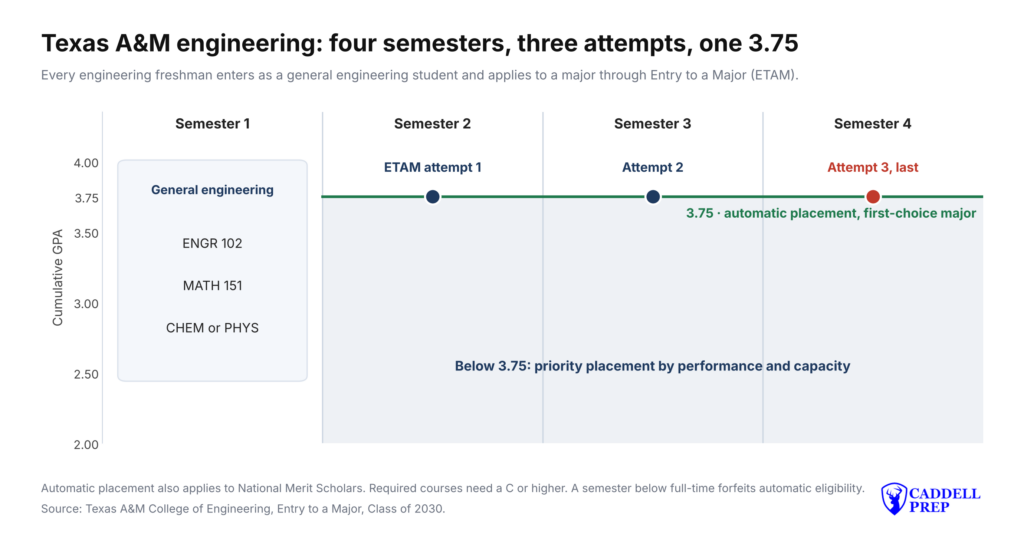
The image above lays out the three ETAM attempts and the 3.75 line across them.
Take a New York student with a 680 on SAT Math. At Texas A&M he is in the upper half of 570 to 710, pays $40,124, and enters general engineering with a 3.75 between him and automatic placement. At Texas he is in the lower half of 620 to 770, pays $44,908, and is admitted to a major or not at the door. At Texas-Dallas he is in the upper half of 580 to 720 and pays $40,144. At Houston he is 10 points above the ceiling of 570 to 670 and pays $22,547. At Texas Tech he is 40 above the ceiling of 540 to 640 and pays $24,451. At West Texas A&M he is 100 above the ceiling of 470 to 580 and pays $10,996. The spread from West Texas A&M to Austin is $33,912 a year, and the two schools at the top of it are the two with a rule after admission.
Texas’s number is at the door. The university’s general information catalog says the university “is required to use automatic admission to fill at least 75 percent of the spaces available to Texas residents” in each freshman class, that the class rank required is announced each September for the next cycle, and that automatic admission “does not guarantee admission to an applicant’s requested major.” It says that “All undergraduate applicants are considered on a competitive basis through holistic review for admission to the majors they request,” and that “An official test score report for the SAT Reasoning Test or the ACT Assessment is required.” For an engineering applicant that means the Cockrell School decides the major before the student arrives, by holistic review, for Texans and non-Texans alike. A New York student is outside the automatic pool and inside the holistic one, at a university that admits 27% and reports a Math ceiling of 770. Texas decides the major at the door. Texas A&M decides it three semesters later.
West Texas A&M’s number is a price. West Texas A&M charges a non-resident $10,996 and Midwestern State $12,530, the two lowest non-resident figures among Texas’s twenty-four public engineering schools, and West Texas A&M’s is the fifth-lowest at a public engineering school in this series, after Western Carolina’s $8,630, Southeast Missouri’s $9,903, McNeese’s $9,989 and Central State’s $10,058. Both are Scorecard figures, and this page does not state the mechanism behind them [VERIFY each university’s non-resident tuition page]. Texas’s non-resident spread runs from $10,996 in Canyon to $44,908 in Austin, a factor of four inside one state system’s borders.
The honest version is that the 3.75 is for automatic placement and not for entry, and Texas A&M does not publish on the ETAM page what share of general engineering students reach their first-choice major by priority placement, so this page does not know it. The required courses run through calculus and differential equations in three semesters, and a student who arrives below calculus will not reach the gate by the fourth semester on the posted list. Texas’s automatic admission rank changes yearly and this page does not state one. The two low non-resident figures are Scorecard figures without a quoted policy behind them. And seven rows in the table are bracketed for accreditation checks, because thirty-three schools is more than this page could verify in one sitting.
Families who have seen the admission letter frequently ask what the word on it means.
Does Texas A&M Admit Engineering Students Directly to a Major?
Texas A&M does not admit first-year engineering students directly to a major. Students at College Station, Galveston and McAllen enter as general engineering students and enter a major through the Entry to a Major process, automatically at a 3.75 or as a National Merit Scholar, otherwise by priority placement and program capacity.
A student has three opportunities, between his second and fourth semesters, and must stay full-time to keep automatic eligibility. The admission letter says engineering. The major comes later.
The gate is Texas A&M’s. The degrees are what the next section lists.
Which Texas Universities Have ABET-Accredited Engineering Schools?
Thirty-three Texas universities hold ABET-accredited engineering bachelor’s degrees, twenty-four public and nine private, and all thirty-three are in the table above.
In Houston, Rice’s George R. Brown School, Houston’s Cullen College, Houston-Clear Lake, Houston Christian, Prairie View and Texas Southern are within forty miles of one another, with Lamar ninety miles east in Beaumont. In Dallas and Fort Worth, SMU’s Lyle School, TCU, Texas-Dallas’s Jonsson School, Texas-Arlington and North Texas in Denton, with Abilene Christian 150 miles west. In Austin and San Antonio, Texas’s Cockrell School, Texas State in San Marcos, Texas-San Antonio’s Klesse College, Trinity and St. Mary’s. In College Station and Waco, Texas A&M and Baylor, with Tarleton in Stephenville. In West Texas, Texas Tech’s Whitacre College in Lubbock, West Texas A&M in Canyon, Angelo State in San Angelo, Midwestern State in Wichita Falls and Permian Basin in Odessa. On the border and the coast, Rio Grande Valley, El Paso, International in Laredo, Kingsville and Corpus Christi. In East Texas, Texas-Tyler and LeTourneau in Longview.
Accreditation matters for a reason that is easy to miss at seventeen. Licensure as a professional engineer normally requires a degree from an ABET-accredited engineering program, and that is why the engineering technology degrees at Sam Houston State, Houston-Downtown, Texas A&M-San Antonio, Stephen F. Austin and East Texas A&M do not put those universities on the list, and why Texas A&M-Texarkana’s new electrical engineering degree is not yet here [VERIFY]. The University of Dallas, Dallas Baptist, St. Thomas, Incarnate Word, Austin College, Southwestern, Hardin-Simmons, McMurry, Lubbock Christian, Wayland Baptist, Mary Hardin-Baylor, Texas Wesleyan, Texas Lutheran, Schreiner, Concordia, Nelson, Our Lady of the Lake, Huston-Tillotson, East Texas Baptist, Texas Woman’s, North Texas at Dallas, Sul Ross and the other Texas A&M campuses award no engineering degree.
Nothing on this page ranks the thirty-three. The table’s order is a stated, verifiable number where one exists, and the choice among accredited programs comes down to cost, discipline and where a student’s score places him.
What If Your Scores Are Below the Range You Want?
In Texas thirty-three schools cover Math ranges from a 380 floor to an 800 ceiling, twenty-four of them are public, and a New York student’s price among the twenty-four runs from $10,996 to $44,908. The score decides Austin or Rice or neither. At College Station the score gets a student into general engineering, and a 3.75 gets him out of it.
The gap from a 680 to the upper half at Texas is 15 points of SAT Math, one question, and the student who closes it is in the upper half at every public on the page. The gap from a 680 to Rice’s floor is 90 points and a different page.
The first step is finding out where the score actually is, section by section. A free diagnostic SAT gives a score that can be set against the Math column in the table.
The Math section rewards the same handful of topics on every test date, and a student who knows which of them he is missing can close a gap of 50 to 100 points in weeks rather than months. The method is on our page on improving your SAT Math score, and the topics it covers are the ones MATH 151 assumes.
How to Read These Score Ranges
Every range on this page covers the middle 50% of admitted students who submitted that test. The lower number is the 25th percentile and the upper number is the 75th, so a quarter of admitted students scored at or above it. At Rice the upper Math number is 800, so the top quarter scored exactly 800.
The range is the gate at the door and the 3.75 is the gate after it. Texas A&M’s 570 to 710 describes who got into general engineering, and its 3.75 describes who was placed automatically in the major he asked for. A student should read both and prepare for both.
Because most colleges are now test-optional, the ranges that are published describe only the students who chose to submit at all. Students with strong scores submit and students with weak ones don’t, so a published range sits higher than the range for everyone who was actually admitted. Texas is the exception on this page: it requires a score from every freshman applicant, so its range describes its whole admitted class. More on what SAT score you need for college and on test-optional colleges.
Should You Take the ACT Instead?
Texas lets each district give the SAT or the ACT as its state test [VERIFY with the Texas Education Agency], and thirty-two of the thirty-three universities on this page report an SAT range while thirty report an ACT range.
That is why the table carries SAT columns and is sorted by Math. All thirty-three universities accept either test, Texas requires one of them, and a student who holds an ACT should convert it and read the same columns.
Engineering Programs in Nearby States
Texas borders New Mexico, Oklahoma, Arkansas and Louisiana, and the border is long enough that a student in El Paso is closer to Las Cruces than to any Texas engineering school but his own.
See engineering colleges in New Mexico, engineering colleges in Oklahoma, engineering colleges in Arkansas, and engineering colleges in Louisiana.
Engineering Colleges in Other States
We publish the same breakdown for engineering programs in every state.
See engineering colleges by state for the full list.

Glyn Caddell
Glyn Caddell holds a BS in Mechanical Engineering from NJIT and has been tutoring New York City students since 2008. He founded Caddell Prep in 2012 and is the author of Digital SAT Math Secrets: Lessons & Tricks to Quickly Improve to a Perfect 800 on the Math Test, which contains over 900 practice problems and is used in Caddell Prep’s SAT math classes. He is founding president of the Staten Island Technical High School alumni association and teaches every lesson on this site personally.
Finally, an SAT course that students actually understand
Every question has a video explanation. Not most — every one.
The on-demand Digital SAT course covers all 17 math topics and 15 reading and writing topics, with 5 full-length practice tests and a 100-point score increase guarantee. Keep access for the rest of high school. No subscription.
Want to Know What 5 Topics Will Improve Your SAT Score the Most?
Sample Feedback from our Diagnostic Test: