
Home » College SAT Score Ranges, Costs, and Programs by Major and State » Engineering Colleges by State: SAT Scores, ACT Scores, Costs, and ABET Programs » Engineering Colleges in South Carolina: SAT Scores, Costs, and Programs
By Glyn Caddell, BSME · Author of Digital SAT Math Secrets · Tutoring since 2008 — Updated October 25, 2026
Eight South Carolina universities offer ABET-accredited engineering degrees, and this page lists what they cost and the test scores of the students they admit.
At the one most New York students are looking at, admission to engineering is admission to General Engineering, and the GPA that gets a student from there into mechanical engineering is a published 2.60, the lowest such gate in this series.
SAT scores are given by section rather than as a total, because a student at 700 Reading & Writing and 600 Math is in a different position from a student at 600 and 700.
Table of Contents
- South Carolina Engineering Colleges by SAT Score
- What GPA Does a Clemson Student Need to Get Into an Engineering Major?
- Which South Carolina Universities Have ABET-Accredited Engineering Schools?
- What If Your Score Is Below the Range You Want?
South Carolina Engineering Colleges by SAT Score
The eight universities below are the ones in South Carolina that hold an ABET-accredited bachelor’s degree in an engineering discipline. The five that report SAT ranges are sorted by the midpoint of the Math range, so the order can be checked from the table itself, and the three that do not are listed last in alphabetical order.
| College | SAT Reading & Writing | SAT Math | Cost of attendance | Undergraduates | Admit rate |
|---|---|---|---|---|---|
| Clemson University | 620 to 700 | 620 to 710 | $35,015 | 23,300 | 38% |
| University of South Carolina | 600 to 680 | 580 to 680 | $31,638 | 29,820 | 60% |
| The Citadel | 540 to 640 | 545 to 645 | $33,880 | 2,705 | 23% |
| University of South Carolina Aiken | 510 to 620 | 470 to 600 | $21,540 | 2,962 | 79% |
| Francis Marion University | 450 to 575 | 420 to 540 | $23,850 | 2,628 | 86% |
| Benedict College | Does not report SAT data | Does not report SAT data | $32,000 | 1,536 | 96% |
| Bob Jones University | Does not report SAT data | Does not report SAT data | $36,580 | 2,005 | Not reported |
| South Carolina State University | Does not report SAT data | Does not report SAT data | $30,015 | 2,934 | 83% |
Each range covers the middle 50% of admitted students who submitted that test. A quarter scored below the lower number, and the top quarter scored at or above the upper one. Being under the lower number does not rule a student out, and being just above it is not as safe as it looks.
Only universities with an ABET-accredited engineering bachelor’s degree are listed. South Carolina State’s engineering technology degrees are accredited under a separate ABET commission, and its row rests on its industrial engineering degree. The Citadel’s admit rate is printed as the Scorecard reports it. Bob Jones reports no admit rate to the Scorecard. Benedict, Bob Jones and South Carolina State report no SAT or ACT range and are listed last in alphabetical order.
Three things about that table are worth pausing on.
Clemson admits every engineering freshman to General Engineering, and the gate into each major is published, from a 2.00 for eight majors to a 2.60 for mechanical engineering. The next section is about it.
South Carolina, at 29,820 undergraduates, is larger than Clemson by 6,520 and charges a New Yorker $4,894 less, on a Math range 40 points lower at the floor and 30 lower at the ceiling. The Citadel charges a non-resident $38,508, more than South Carolina and $2,358 less than Clemson, for four years in the Corps of Cadets.
Benedict charges every student $17,440, the lowest price on the page for a New York student, and in September 2026 became, in its words, the first HBCU in South Carolina with an accredited electrical engineering degree. South Carolina State, the public HBCU, holds an accredited industrial engineering degree at $21,750 for a non-resident.
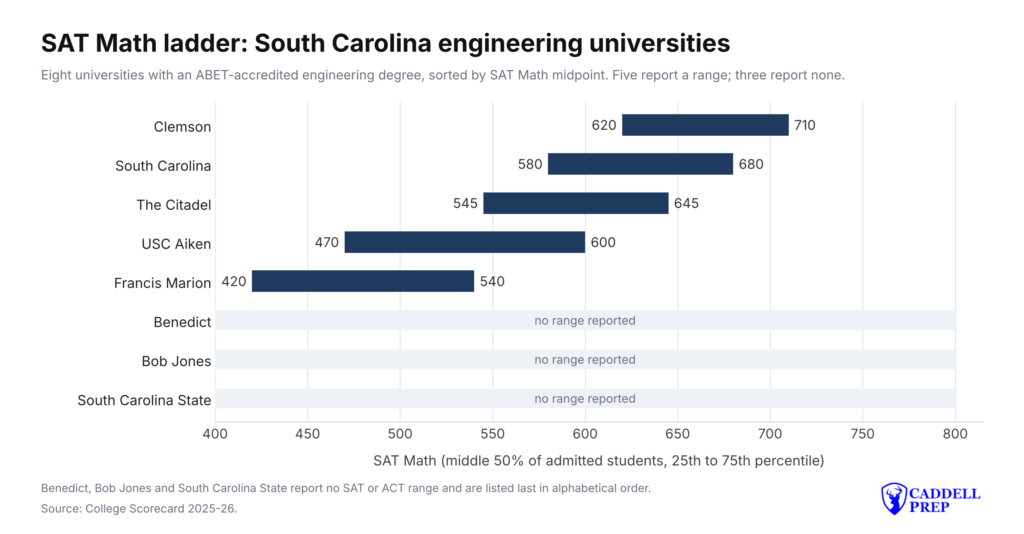
A student can see where his Math score sits on this list in the image above.
Want to Know What 5 Topics Will Improve Your SAT Score the Most?
Sample Feedback from our Diagnostic Test:

Clemson University
Clemson University’s College of Engineering, Computing and Applied Sciences holds ABET accreditation in disciplines including automotive, biomedical, biosystems, chemical, civil, computer, electrical, environmental, industrial, materials science and mechanical engineering [VERIFY list on abet.org], and Clemson admits its engineering students to General Engineering rather than to a major.
Reading & Writing 620 to 700, Math 620 to 710. The top quarter of admitted students scored at or above 710 on Math. Cost of attendance $35,015, with tuition and fees at $15,554 in state and $40,866 out of state. 23,300 undergraduates, 38% admitted.
Clemson has the highest Math range on the page and the highest non-resident tuition, and it admits 38%, the lowest rate on the page after the Scorecard’s figure for The Citadel. The gate from General Engineering into its majors is described in the next section.
University of South Carolina
The University of South Carolina’s Molinaroli College of Engineering and Computing in Columbia holds ABET accreditation in aerospace, biomedical, chemical, civil, computer, electrical and mechanical engineering [VERIFY list on abet.org], and South Carolina is the largest school on the page.
Reading & Writing 600 to 680, Math 580 to 680. The top quarter of admitted students scored at or above 680 on Math. Cost of attendance $31,638, with tuition and fees at $12,688 in state and $35,972 out of state. 29,820 undergraduates, 60% admitted.
South Carolina charges a resident $2,866 less than Clemson does and a non-resident $4,894 less, and its Math ceiling of 680 is 30 points below Clemson’s. Its cost of attendance is the lowest among the three largest publics on the page.
The Citadel
The Citadel’s School of Engineering in Charleston holds ABET accreditation in civil, construction, electrical and mechanical engineering [VERIFY list on abet.org], and The Citadel is a public military college whose day students are members of the Corps of Cadets.
Reading & Writing 540 to 640, Math 545 to 645. The top quarter of admitted students scored at or above 645 on Math. Cost of attendance $33,880, with tuition and fees at $12,570 in state and $38,508 out of state. 2,705 undergraduates, 23% admitted.
The Citadel’s admit rate is printed as the Scorecard reports it, and the figure describes admission to the Corps of Cadets [VERIFY against the university’s Common Data Set, where the published rate in other years has been far higher]. Its civil engineering degree can also be reached by an evening route for transfer students, described in the next section. Its odd-numbered percentiles are printed as reported.
University of South Carolina Aiken
The University of South Carolina Aiken holds ABET accreditation in industrial process engineering, accredited in October 2019 with its first two graduating classes included, and Aiken has the lowest cost of attendance on the page.
Reading & Writing 510 to 620, Math 470 to 600. The top quarter of admitted students scored at or above 600 on Math. Cost of attendance $21,540, with tuition and fees at $10,760 in state and $21,218 out of state. 2,962 undergraduates, 79% admitted.
Aiken graduated its first industrial process engineers in May 2018 and charges a non-resident $21,218, $14,754 less than South Carolina’s Columbia campus charges one. It is across the Savannah River from Augusta, Georgia, near the Savannah River Site.
Francis Marion University
Francis Marion University in Florence holds ABET accreditation in industrial and mechanical engineering, each accredited by the Engineering Accreditation Commission with a last accreditation in 2024, and Francis Marion has the lowest Math range on the page.
Reading & Writing 450 to 575, Math 420 to 540. The top quarter of admitted students scored at or above 540 on Math. Cost of attendance $23,850, with tuition and fees at $11,160 in state and $21,544 out of state. 2,628 undergraduates, 86% admitted.
Francis Marion is the least selective reporting school on the page, and its Math ceiling of 540 sits 5 points below The Citadel’s floor. Its Reading & Writing ceiling of 575 is printed as reported.
Benedict College
Benedict College’s School of Science and Engineering in Columbia holds ABET accreditation in environmental engineering, accredited in 2022, and in electrical engineering, announced on September 3, 2026, and Benedict is the only school on the page that charges a New Yorker less than $20,000.
Benedict reports no SAT or ACT range. Cost of attendance $32,000, with tuition and fees at $17,440 for all students. 1,536 undergraduates, 96% admitted.
Benedict is a historically Black college a mile from the State House, the smallest school on the page, and the least selective by admit rate. Its electrical engineering accreditation made it, in the words of its announcement, “the first HBCU in South Carolina to hold this distinction.”
Bob Jones University
Bob Jones University’s engineering program in Greenville holds ABET accreditation for its bachelor’s degree in engineering, accredited by the Engineering Accreditation Commission in August 2013, and Bob Jones reports neither a score range nor an admit rate.
Bob Jones reports no SAT or ACT range. Cost of attendance $36,580, with tuition and fees at $24,470 for all students. 2,005 undergraduates, admit rate not reported.
Bob Jones is a fundamentalist Christian university whose flat tuition of $24,470 is above every public resident figure on the page and below every public non-resident figure except Aiken’s, Francis Marion’s and South Carolina State’s. The Scorecard carries no admit rate for it.
South Carolina State University
South Carolina State University’s engineering department in Orangeburg holds ABET accreditation in industrial engineering, accredited by the Engineering Accreditation Commission, and South Carolina State is the state’s public historically Black university.
South Carolina State reports no SAT or ACT range. Cost of attendance $30,015, with tuition and fees at $11,060 in state and $21,750 out of state. 2,934 undergraduates, 83% admitted.
South Carolina State has the lowest in-state tuition on the page, $11,060, and charges a non-resident $21,750, within $600 of Aiken and Francis Marion. Its engineering technology degrees are accredited separately and do not count toward its row.
Five ranges and three blanks say who got in. At the school at the top of the table, getting in is the first of two gates, and the next section is about the second.
What GPA Does a Clemson Student Need to Get Into an Engineering Major?
A Clemson student needs a cumulative GPA of 2.00 to enter eight of the university’s engineering majors, a 2.50 to enter biomedical engineering and a 2.60 to enter mechanical or civil engineering, after completing six General Engineering core courses with a C or better.
The courses come first. Clemson’s advising page says a student must “Complete the following General Engineering Core courses with a grade of C or better”. The six are CH 1010 (general chemistry), ENGL 1030 (composition), ENGR 1020 (engineering disciplines and skills), ENGR 1410 (programming and problem-solving, or CHE 1300 and CHE 1350 for chemical engineering students), MATH 1060 (calculus I) and PHYS 1220 (physics with calculus I). Industrial engineering adds MATH 1080, calculus II. A student who earns a C- in any one of them has not cleared the gate, whatever his GPA.
Then the GPA, and the page says the student must “Satisfy the minimum GPA requirement for your intended major.” Automotive, biosystems, chemical, computer, electrical, environmental, industrial, and materials science and engineering require a 2.00. Biomedical engineering requires a 2.50. Mechanical engineering requires a 2.60. Civil engineering requires a 2.60, “dropping to 2.4 effective Fall 2026.” Automotive engineering “requires an application process until Fall 2026.” The student submits the change in Clemson’s iROAR system “as soon as you have received your final grades,” and some majors stop taking requests during set date ranges that the college publishes.
Set that beside the other gates on these pages. Each figure below is as stated on the page linked, and the table is a list of sources, not a ranking.
| University | Gate into the major | Courses | Source |
|---|---|---|---|
| Clemson | 2.00 for eight majors, 2.50 biomedical, 2.60 mechanical and civil (civil 2.4 from fall 2026) | Six core courses at C or better | Clemson advising page |
| Penn State | 2.60 for most majors, 3.20 for aerospace, computer and mechanical engineering at University Park | Five courses at C or better, between 29 and 55 credits | Our page on engineering colleges in Pennsylvania |
| Maryland | 2.0 at the 45-credit review for direct admits, 3.0 for internal applicants | Three gateway courses at C- or B- by route | Our page on engineering colleges in Maryland |
| NC State | 2.0 in the CODA courses, with seat capacity | MA 141 and 241, PY 205 and 206, CH 101 and 102 at C or better | Our page on engineering colleges in North Carolina |
Clemson’s mechanical engineering gate is 2.60. Penn State’s, for the same degree at University Park, is 3.20, and a New York student pays Penn State $924 more than he pays Clemson. Clemson’s civil gate is the only one in the series with a published date on which it falls. None of the four universities publishes how many students fail to clear its gate, and this page does not guess.
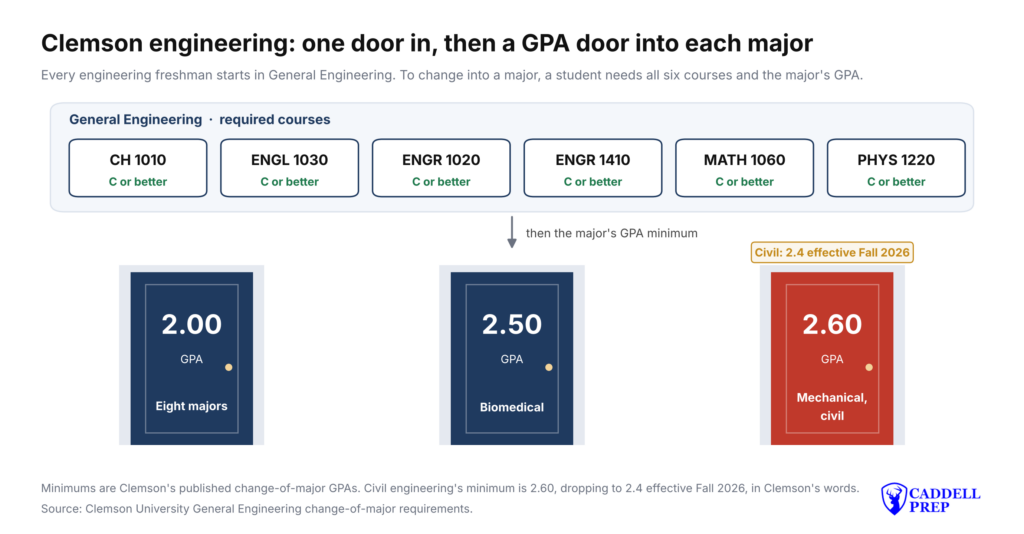
The image above draws Clemson’s six courses and three GPA doors as the student meets them.
Take a New York student with a 640 on SAT Math. At Clemson he is in the lower half of 620 to 710, pays $40,866, and enters General Engineering with a 2.60 between him and mechanical engineering. At South Carolina he is in the upper half of 580 to 680 and pays $35,972. At The Citadel he is just under the ceiling of 545 to 645, pays $38,508, and spends four years in the Corps. At Aiken he is 40 points above the ceiling of 470 to 600 and pays $21,218. At Francis Marion he is 100 points above the ceiling of 420 to 540 and pays $21,544. At Benedict there is no range to read and he pays $17,440. The spread from Benedict to Clemson is $23,426 a year, and the school at the top of it is the one with the published gate after admission.
Benedict’s number is a date. On September 3, 2026, Benedict College announced that its electrical engineering program had earned ABET accreditation, making it, in the words of the announcement, “the first HBCU in South Carolina to hold this distinction.” Its environmental engineering degree was accredited in 2022. South Carolina State, the public HBCU forty miles south in Orangeburg, holds an accredited industrial engineering degree, and its computer science and computer engineering programs are not on this page because they are not engineering degrees or not yet accredited. Two historically Black institutions in one state with accredited engineering degrees is not unique on these pages, but Benedict’s price is: $17,440 for every student, $3,778 less than Aiken charges a non-resident and $23,426 less than Clemson does.
The Citadel’s number is a second route. The Citadel’s civil engineering degree is “accredited by the Engineering Accreditation Commission of ABET,” and a student can reach it in uniform or not. The Corps of Cadets is the four-year route, at $38,508 for a non-resident. The other route runs through The Citadel Graduate College: two years at a South Carolina technical college or another accredited college, then “junior and senior years are taken at The Citadel through evening and online classes,” on “a grade of C or higher” in the designated courses and “a minimum 2.0 GPA,” finishing in two academic years and two summers. The university’s degree-completion page does not state the evening route’s tuition [VERIFY], and this page does not assume the degree-completion student pays the Corps figure.
The honest version is that Clemson’s gate is a published floor and not a selection rate. The 2.00 majors are the ones with room, the 2.50 and 2.60 majors are the ones students most often want, and six courses at a C or better is a real gate even where the GPA line is 2.00. The civil 2.4 takes effect in fall 2026 and automotive’s application process ends the same term, so the page quotes Clemson’s dates and a reader should check the page on the day he reads this. Benedict’s electrical engineering accreditation is weeks old as of this draft and the college’s own release could not be read. The Citadel’s 23% is the Scorecard’s figure and this page prints it without endorsing it. And every gate in the table above is what the university publishes, not what its students experience.
Families reading Clemson’s page frequently ask whether the numbers on it are the numbers their student will face.
Is Clemson's Civil Engineering GPA Requirement Changing?
Clemson’s civil engineering GPA requirement is changing. It is 2.60 now and, in Clemson’s words, is “dropping to 2.4 effective Fall 2026,” and automotive engineering’s application process ends the same term, after which it joins the 2.00 majors.
A student entering General Engineering in fall 2026 or later meets the 2.4 for civil and the 2.00 for automotive, and the same 2.60 for mechanical and 2.50 for biomedical. The six core courses at a C or better do not change.
The gate is Clemson’s. The degrees are what the next section lists.
Which South Carolina Universities Have ABET-Accredited Engineering Schools?
Eight South Carolina universities hold ABET-accredited engineering bachelor’s degrees, six public and two private, and all eight are in the table above.
In the Upstate, Clemson’s College of Engineering, Computing and Applied Sciences is the state’s engineering school and Bob Jones is thirty miles away in Greenville. In Columbia, South Carolina’s Molinaroli College of Engineering and Computing and Benedict’s School of Science and Engineering are a mile apart, and South Carolina State is forty miles south in Orangeburg. In Charleston, The Citadel’s School of Engineering is on the Ashley River. Aiken is across the Savannah River from Augusta, and Francis Marion is in Florence in the Pee Dee. The accreditation dates on the page are the universities’ own: Bob Jones in 2013, Aiken in 2019, Benedict in 2022 and 2026, Francis Marion in 2024.
Accreditation matters for a reason that is easy to miss at seventeen. Licensure as a professional engineer normally requires a degree from an ABET-accredited engineering program, and that is why South Carolina State’s engineering technology degrees do not count toward its row. Coastal Carolina, the College of Charleston, Winthrop, Furman, Wofford, USC Upstate, USC Beaufort, Lander, Presbyterian, Converse, North Greenville, Newberry, Claflin, Allen, Columbia College, Erskine, Southern Wesleyan and Coker award no engineering degree, and Charleston Southern and Anderson award no accredited one [VERIFY both on abet.org].
Nothing on this page ranks the eight. The table’s order is a stated, verifiable number where one exists, and the choice among accredited programs comes down to cost, discipline and where a student’s score places him.
What If Your Score Is Below the Range You Want?
In South Carolina eight schools cover Math ranges from a 420 floor to a 710 ceiling, six of them are public, and a New York student’s price runs from $17,440 to $40,866. The score decides Clemson or not. At Clemson, the score is the first gate and a 2.60 is the second.
The gap from a 640 to the upper half at Clemson is 25 points of SAT Math, two questions, and the student who closes it is in the upper half at every reporting school on the page. The gap from a 640 to Clemson’s top quarter is 70 points, and the student who closes that one is still entering General Engineering like everyone else.
The first step is finding out where the score actually is, section by section. A free diagnostic SAT gives a score that can be set against the Math column in the table.
The Math section rewards the same handful of topics on every test date, and a student who knows which of them he is missing can close a gap of 50 to 100 points in weeks rather than months. The method is on our page on improving your SAT Math score, and the topics it covers are the ones MATH 1060 assumes.
How to Read These Score Ranges
Every range on this page covers the middle 50% of admitted students who submitted that test. The lower number is the 25th percentile and the upper number is the 75th, so a quarter of admitted students scored at or above it.
A range is the gate before admission and a GPA is the gate after it. Clemson’s 620 to 710 describes who got into General Engineering, and its 2.60 describes who got out of it into mechanical engineering. A student should read both and prepare for both.
Because most colleges are now test-optional, the ranges that are published describe only the students who chose to submit at all. Students with strong scores submit and students with weak ones don’t, so a published range sits higher than the range for everyone who was actually admitted. More on what SAT score you need for college and on test-optional colleges.
Should You Take the ACT Instead?
South Carolina lets each district give the SAT or the ACT to its juniors as the state test [VERIFY with the South Carolina Department of Education], and five of the eight universities on this page report an SAT range while five report an ACT range.
The table uses the SAT because the South Carolina pages on this site do and because a student from outside the state normally holds one. All eight universities accept either test, and a student who holds an ACT should convert it and read the same columns.
Engineering Programs in Nearby States
South Carolina borders North Carolina and Georgia, and Clemson sits ten miles from the Georgia line, so South Carolina students compare across both borders as a matter of course.
See engineering colleges in North Carolina and engineering colleges in Georgia.
Engineering Colleges in Other States
We publish the same breakdown for engineering programs in every state.
See engineering colleges by state for the full list.

Glyn Caddell
Glyn Caddell holds a BS in Mechanical Engineering from NJIT and has been tutoring New York City students since 2008. He founded Caddell Prep in 2012 and is the author of Digital SAT Math Secrets: Lessons & Tricks to Quickly Improve to a Perfect 800 on the Math Test, which contains over 900 practice problems and is used in Caddell Prep’s SAT math classes. He is founding president of the Staten Island Technical High School alumni association and teaches every lesson on this site personally.
Finally, an SAT course that students actually understand
Every question has a video explanation. Not most — every one.
The on-demand Digital SAT course covers all 17 math topics and 15 reading and writing topics, with 5 full-length practice tests and a 100-point score increase guarantee. Keep access for the rest of high school. No subscription.
Want to Know What 5 Topics Will Improve Your SAT Score the Most?
Sample Feedback from our Diagnostic Test: