
Home » College SAT Score Ranges, Costs, and Programs by Major and State » Engineering Colleges by State: SAT Scores, ACT Scores, Costs, and ABET Programs » Engineering Colleges in Tennessee: ACT Scores, SAT Scores, Costs, and Programs
By Glyn Caddell, BSME · Author of Digital SAT Math Secrets · Tutoring since 2008 — Updated October 26, 2026
Thirteen Tennessee universities offer ABET-accredited engineering degrees, and this page lists what they cost and the test scores of the students they admit.
One of them publishes an engineering scholarship with one Math score at every tier, 26 on ACT Math or 610 on SAT Math, and the out-of-state award is large enough that a New York student who clears it pays less than a Memphis resident who does not.
The table is sorted by ACT because Tennessee gives it to every junior as the state test, and it carries an ACT Math column because that is the score the finding turns on.
Table of Contents
- Tennessee Engineering Colleges by ACT and SAT Score
- What Math Score Makes an Out-of-State Engineering Student Cheaper Than a Resident at Memphis?
- Which Tennessee Universities Have ABET-Accredited Engineering Schools?
- What If Your Score Is Below the Range You Want?
Tennessee Engineering Colleges by ACT and SAT Score
The thirteen universities below are the ones in Tennessee that hold an ABET-accredited bachelor’s degree in an engineering discipline. They are sorted by the midpoint of the ACT composite range, so the order can be checked from the table itself, and the two ties are stated beneath it. The ACT Math column is there because the scholarship in the next section is written in that score.
| College | ACT composite | ACT Math | SAT Reading & Writing | SAT Math | Cost of attendance | Undergraduates | Admit rate |
|---|---|---|---|---|---|---|---|
| Vanderbilt University | 34 to 35 | 32 to 35 | 730 to 770 | 770 to 800 | $89,590 | 7,208 | 6% |
| University of Tennessee-Knoxville | 25 to 31 | 24 to 29 | 600 to 680 | 600 to 690 | $33,678 | 30,418 | 42% |
| Lipscomb University | 23 to 30 | 22 to 28 | 590 to 700 | 570 to 680 | $55,117 | 2,997 | 68% |
| Union University | 22 to 30 | 18 to 27 | 600 to 710 | 560 to 680 | $58,363 | 1,607 | 60% |
| Milligan University | 22 to 27 | 22 to 26 | 573 to 650 | 560 to 618 | $52,511 | 818 | 72% |
| Tennessee Technological University | 20 to 27 | 18 to 26 | 528 to 650 | 520 to 660 | $25,663 | 8,698 | 76% |
| Middle Tennessee State University | 20 to 26 | 17 to 25 | 520 to 630 | 490 to 600 | $24,289 | 16,301 | 69% |
| University of Tennessee-Chattanooga | 20 to 26 | 17 to 25 | 513 to 620 | 500 to 590 | $25,489 | 10,074 | 81% |
| University of Tennessee-Martin | 19 to 25 | 17 to 24 | 500 to 610 | 470 to 600 | $23,079 | 4,866 | 88% |
| Christian Brothers University | 19 to 24 | 16 to 25 | 460 to 700 | 560 to 680 | $48,038 | 905 | 87% |
| University of Memphis | 18 to 24 | 16 to 23 | 480 to 600 | 435 to 580 | $25,169 | 12,701 | 72% |
| Austin Peay State University | 18 to 24 | 16 to 23 | 445 to 573 | 398 to 553 | $22,233 | 7,560 | 96% |
| Tennessee State University | 16 to 21 | 15 to 19 | 460 to 540 | 420 to 510 | $25,637 | 4,848 | 70% |
Each range covers the middle 50% of admitted students who submitted that test. A quarter scored below the lower number, and the top quarter scored at or above the upper one. Being under the lower number does not rule a student out, and being just above it is not as safe as it looks.
Middle Tennessee and Chattanooga share an ACT range and a SAT Math midpoint and are ordered by the Reading & Writing midpoint. Memphis and Austin Peay share an ACT range and are ordered by the SAT Math midpoint. Only universities with an ABET-accredited engineering bachelor’s degree are listed. East Tennessee State delivers a Tennessee Tech engineering degree and is counted under Tennessee Tech. Engineering technology degrees at Middle Tennessee, Memphis, Austin Peay and Tennessee State are accredited under a separate ABET commission and do not count toward those rows. All thirteen universities report both tests.
Three things about that table are worth pausing on.
Memphis publishes an engineering scholarship whose Math requirement, 26 on ACT Math or 610 on SAT Math, sits above the top quarter of its own admitted class, and whose out-of-state award makes a New Yorker who clears it cheaper to Memphis than a Memphian who does not. The next section is about it.
Five Tennessee publics charge a non-resident less than $19,000: Austin Peay $14,766, Memphis $15,384, Tennessee Tech $15,576, Martin $16,600 and Chattanooga $18,512. Knoxville charges $33,256 and Middle Tennessee $31,574, and Middle Tennessee’s non-resident figure is more than three times its resident figure.
Vanderbilt reports Math 770 to 800 and ACT 34 to 35 and admits 6%, and Christian Brothers, 905 students in Memphis, reports a Reading & Writing range 240 points wide, 460 to 700, beside a Math range of 560 to 680 whose ceiling is 10 points below Knoxville’s.
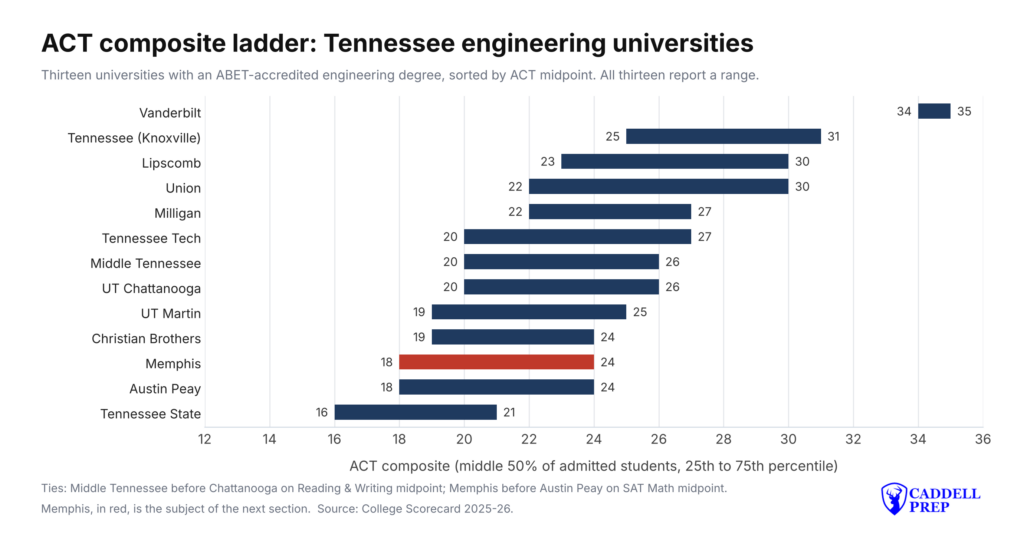
A student can see where his ACT score sits on this list in the image above.
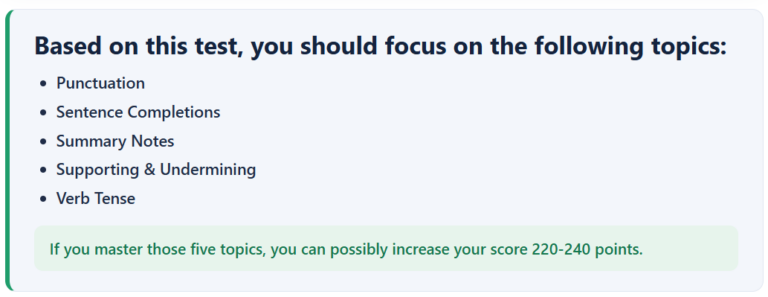
Want to Know What 5 Topics Will Improve Your SAT Score the Most?
Sample Feedback from our Diagnostic Test:
Vanderbilt University
Vanderbilt University’s School of Engineering in Nashville holds ABET accreditation in biomedical, chemical, civil, computer, electrical and mechanical engineering [VERIFY list on abet.org], and Vanderbilt is the most selective school on the page by a wide margin.
ACT composite 34 to 35, ACT Math 32 to 35. Reading & Writing 730 to 770, Math 770 to 800. The top quarter of admitted students scored at or above 35 on the ACT and 800 on Math. Cost of attendance $89,590, with tuition and fees at $67,498 for all students. 7,208 undergraduates, 6% admitted.
Vanderbilt admits one applicant in sixteen, has the highest cost of attendance on the page, and reports an ACT floor of 34 that is three points above the next ceiling on the page, Knoxville’s 31. Its Math floor of 770 is the fourth in this series, after Penn, Carnegie Mellon and Brown.
University of Tennessee-Knoxville
The University of Tennessee-Knoxville’s Tickle College of Engineering holds ABET accreditation in disciplines including aerospace, biomedical, biosystems, chemical, civil, computer, electrical, environmental, industrial, materials science, mechanical and nuclear engineering [VERIFY list on abet.org], and Knoxville is the largest school on the page and the most expensive public for a non-resident.
ACT composite 25 to 31, ACT Math 24 to 29. Reading & Writing 600 to 680, Math 600 to 690. The top quarter of admitted students scored at or above 31 on the ACT and 690 on Math. Cost of attendance $33,678, with tuition and fees at $13,812 in state and $33,256 out of state. 30,418 undergraduates, 42% admitted.
Knoxville is the most selective public on the page, admitting 42%, and it charges a non-resident $33,256, more than twice what the other three UT campuses on the page charge one. Its Math floor of 600 is the highest among the publics by 80 points.
Lipscomb University
Lipscomb University’s Raymond B. Jones College of Engineering in Nashville holds ABET accreditation in civil, electrical and mechanical engineering [VERIFY on abet.org], and Lipscomb has the highest ACT ceiling on the page after Vanderbilt’s, tied with Union’s.
ACT composite 23 to 30, ACT Math 22 to 28. Reading & Writing 590 to 700, Math 570 to 680. The top quarter of admitted students scored at or above 30 on the ACT and 680 on Math. Cost of attendance $55,117, with tuition and fees at $40,572 for all students. 2,997 undergraduates, 68% admitted.
Lipscomb is a Churches of Christ university three miles from Vanderbilt, and its ACT Math range of 22 to 28 is the highest on the page after Vanderbilt’s and Knoxville’s. Its tuition is $547 above Union’s.
Union University
Union University’s engineering department in Jackson holds ABET accreditation for its Bachelor of Science in Engineering [VERIFY degree name and concentrations on abet.org], and Union has the highest Reading & Writing ceiling on the page after Vanderbilt’s.
ACT composite 22 to 30, ACT Math 18 to 27. Reading & Writing 600 to 710, Math 560 to 680. The top quarter of admitted students scored at or above 30 on the ACT and 680 on Math. Cost of attendance $58,363, with tuition and fees at $40,025 for all students. 1,607 undergraduates, 60% admitted.
Union is a Southern Baptist university whose ACT Math range, 18 to 27, is nine points wide, tied for the widest on the page with Christian Brothers’, and whose Reading & Writing floor of 600 matches Knoxville’s. It admits 60%, the lowest rate on the page after Vanderbilt and Knoxville.
Milligan University
Milligan University’s engineering programs in Milligan, near Johnson City, hold ABET accreditation in electrical and mechanical engineering, accredited by the Engineering Accreditation Commission in August 2022 and retroactive to October 2019, and Milligan is the smallest school on the page.
ACT composite 22 to 27, ACT Math 22 to 26. Reading & Writing 573 to 650, Math 560 to 618. The top quarter of admitted students scored at or above 27 on the ACT and 618 on Math. Cost of attendance $52,511, with tuition and fees at $40,450 for all students. 818 undergraduates, 72% admitted.
Milligan graduated its first engineering class in spring 2020, two years before the accreditation that now covers it, and its odd-numbered percentiles are printed as the Scorecard reports them. Its ACT Math floor of 22 is the highest on the page after Vanderbilt’s and Knoxville’s.
Tennessee Technological University
Tennessee Technological University’s College of Engineering in Cookeville holds ABET accreditation in chemical, civil, computer, electrical, mechanical, and general and industrial engineering [VERIFY list on abet.org], and Tennessee Tech charges a non-resident less than any engineering-specialized public university in the country except one.
ACT composite 20 to 27, ACT Math 18 to 26. Reading & Writing 528 to 650, Math 520 to 660. The top quarter of admitted students scored at or above 27 on the ACT and 660 on Math. Cost of attendance $25,663, with tuition and fees at $11,376 in state and $15,576 out of state. 8,698 undergraduates, 76% admitted.
Tennessee Tech’s non-resident figure of $15,576 is $676 above South Dakota Mines’ and below every other engineering-specialized public in the 2025-26 Scorecard, described in the next section. Its Math ceiling of 660 is the highest among the publics after Knoxville’s, and its engineering degree is also delivered at East Tennessee State in Johnson City.
Middle Tennessee State University
Middle Tennessee State University in Murfreesboro holds ABET accreditation in mechatronics engineering, “accredited by the Engineering Accreditation Commission of ABET” in the university’s words, and Middle Tennessee is on this page for that one degree.
ACT composite 20 to 26, ACT Math 17 to 25. Reading & Writing 520 to 630, Math 490 to 600. The top quarter of admitted students scored at or above 26 on the ACT and 600 on Math. Cost of attendance $24,289, with tuition and fees at $10,266 in state and $31,574 out of state. 16,301 undergraduates, 69% admitted.
Middle Tennessee is the second-largest school on the page and the one public whose non-resident price is out of step with the others, $31,574 against a resident figure of $10,266. It is listed ahead of Chattanooga on its Reading & Writing midpoint, the two being tied on ACT and on Math.
University of Tennessee-Chattanooga
The University of Tennessee-Chattanooga’s College of Engineering and Computer Science holds ABET accreditation in chemical, civil, computer, electrical and mechanical engineering [VERIFY on abet.org], and Chattanooga is the second of the four UT campuses on the page by size.
ACT composite 20 to 26, ACT Math 17 to 25. Reading & Writing 513 to 620, Math 500 to 590. The top quarter of admitted students scored at or above 26 on the ACT and 590 on Math. Cost of attendance $25,489, with tuition and fees at $10,448 in state and $18,512 out of state. 10,074 undergraduates, 81% admitted.
Chattanooga charges a non-resident $18,512, $14,744 less than Knoxville, on a Math range 100 points lower at both ends. Its Reading & Writing floor of 513 is printed as reported.
University of Tennessee-Martin
The University of Tennessee-Martin’s engineering department holds ABET accreditation for its Bachelor of Science in Engineering [VERIFY degree name and concentrations on abet.org], and Martin is the smallest of the four UT campuses on the page.
ACT composite 19 to 25, ACT Math 17 to 24. Reading & Writing 500 to 610, Math 470 to 600. The top quarter of admitted students scored at or above 25 on the ACT and 600 on Math. Cost of attendance $23,079, with tuition and fees at $10,560 in state and $16,600 out of state. 4,866 undergraduates, 88% admitted.
Martin is in the northwest corner of the state, an hour from Memphis, and charges a non-resident $16,600, the third-lowest public figure on the page after Austin Peay’s and Memphis’s. It admits 88%.
Christian Brothers University
Christian Brothers University’s School of Engineering in Memphis holds ABET accreditation in chemical, civil, electrical and mechanical engineering [VERIFY on abet.org], and Christian Brothers reports the widest Reading & Writing range on any page in this series, 240 points.
ACT composite 19 to 24, ACT Math 16 to 25. Reading & Writing 460 to 700, Math 560 to 680. The top quarter of admitted students scored at or above 24 on the ACT and 680 on Math. Cost of attendance $48,038, with tuition and fees at $38,420 for all students. 905 undergraduates, 87% admitted.
Christian Brothers is a Lasallian Catholic university with 905 undergraduates, and its Math range of 560 to 680 sits 125 points above Memphis’s at the floor and 100 above it at the ceiling, three miles away. The Reading & Writing range is printed as reported and this page does not explain it.
University of Memphis
The University of Memphis’s Herff College of Engineering holds ABET accreditation in biomedical, civil, computer, electrical and mechanical engineering [VERIFY on abet.org], and Memphis publishes an engineering scholarship whose Math line sits above its own admitted class.
ACT composite 18 to 24, ACT Math 16 to 23. Reading & Writing 480 to 600, Math 435 to 580. The top quarter of admitted students scored at or above 24 on the ACT, 23 on ACT Math and 580 on Math. Cost of attendance $25,169, with tuition and fees at $10,728 in state and $15,384 out of state. 12,701 undergraduates, 72% admitted.
Memphis is the third-largest school on the page and charges a non-resident $15,384, the second-lowest public figure on it. The Herff Merit Scholarship, and what it does to that figure, is the next section.
Austin Peay State University
Austin Peay State University in Clarksville holds ABET accreditation in engineering physics, accredited in August 2022 [VERIFY the release text on apsu.edu], and Austin Peay charges a non-resident less than any other school on the page.
ACT composite 18 to 24, ACT Math 16 to 23. Reading & Writing 445 to 573, Math 398 to 553. The top quarter of admitted students scored at or above 24 on the ACT and 553 on Math. Cost of attendance $22,233, with tuition and fees at $9,006 in state and $14,766 out of state. 7,560 undergraduates, 96% admitted.
Austin Peay admits 96% of applicants, the highest rate on the page, has the lowest cost of attendance and the lowest Math floor, 398, and charges a New Yorker $14,766. It is next to Fort Campbell on the Kentucky line, and its odd-numbered percentiles are printed as reported.
Tennessee State University
Tennessee State University’s College of Engineering in Nashville holds ABET accreditation in architectural, civil, computer, electrical and mechanical engineering [VERIFY on abet.org], and Tennessee State is the state’s public historically Black university.
ACT composite 16 to 21, ACT Math 15 to 19. Reading & Writing 460 to 540, Math 420 to 510. The top quarter of admitted students scored at or above 21 on the ACT and 510 on Math. Cost of attendance $25,637, with tuition and fees at $8,616 in state and $22,416 out of state. 4,848 undergraduates, 70% admitted.
Tennessee State has the lowest in-state tuition on the page, $8,616, and the lowest ACT range, and it charges a non-resident $22,416, more than the four UT campuses other than Knoxville. It is the only HBCU on the page.
Thirteen ranges say who got in. At one of the thirteen a Math score above the whole admitted range changes the price, and the next section is about it.
What Math Score Makes an Out-of-State Engineering Student Cheaper Than a Resident at Memphis?
A 26 on ACT Math or a 610 on SAT Math, with the GPA and composite of any of the three Herff Merit Scholarship tiers, makes an out-of-state engineering student cheaper to the University of Memphis than a resident who does not qualify, in the 2025-26 Scorecard year.
The tiers are published by the Herff College of Engineering. A student qualifies with a 3.5 GPA and either a 26 ACT composite with a 26 ACT Math or a 1230 SAT with a 610 SAT Math. He qualifies with a 3.75 GPA and either a 25 composite with a 26 ACT Math or a 1200 SAT with a 610 Math. He qualifies with a 4.0 GPA and either a 24 composite with a 26 ACT Math or a 1160 SAT with a 610 Math. The award is “$4,000 per year” for a Tennessee resident and “$5,000 per year” for an out-of-state student, each for “a maximum of 4 years.” The GPA and the composite trade off across the tiers. The Math score does not move.
| Tier | GPA | ACT composite | ACT Math | SAT total | SAT Math | Award, in state | Award, out of state |
|---|---|---|---|---|---|---|---|
| 1 | 3.5 | 26 | 26 | 1230 | 610 | $4,000 a year | $5,000 a year |
| 2 | 3.75 | 25 | 26 | 1200 | 610 | $4,000 a year | $5,000 a year |
| 3 | 4.0 | 24 | 26 | 1160 | 610 | $4,000 a year | $5,000 a year |
Set the Math line beside the class. Memphis reports an admitted ACT Math range of 16 to 23 and an SAT Math range of 435 to 580. The scholarship’s 26 is three points above the ACT Math score that the top quarter of admitted students reached, and its 610 is 30 points above the SAT Math figure. A student who qualifies for the Herff scholarship has a Math score above the 75th percentile of the university that is paying him, at every tier, whatever his GPA.
Then the arithmetic. Memphis charged a non-resident $15,384 in tuition and fees in the 2025-26 Scorecard and a resident $10,728. A non-resident with the Herff award pays $15,384 less $5,000, or $10,384, and that is $344 less than the resident figure. On June 3, 2026 the university approved increases for 2026-27 of 4.48% in state, to $11,760, and 4.35% out of state. This page does not compute a 2026-27 non-resident figure from a percentage, and the $344 is the Scorecard year’s number.
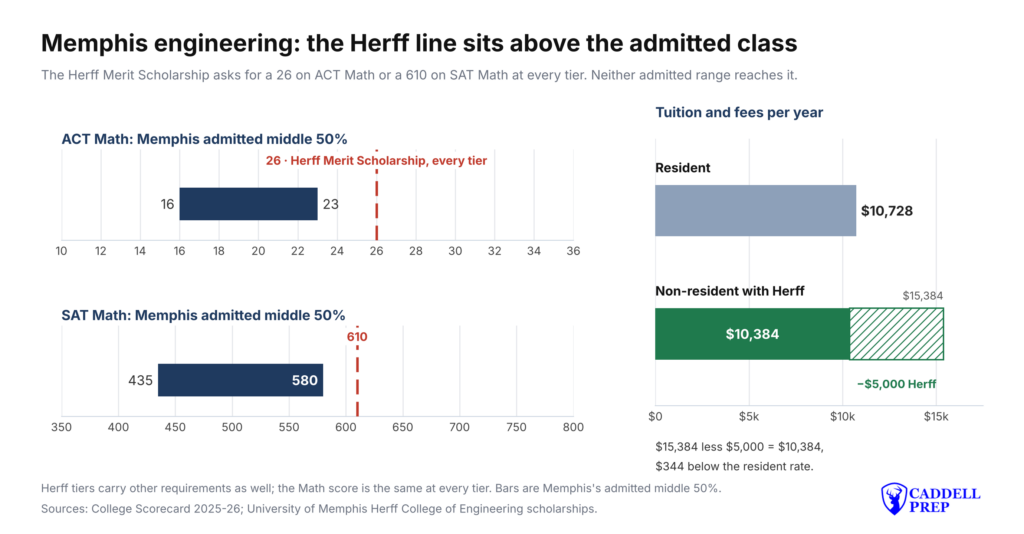
The image above puts the scholarship’s Math line beside the class it sits above and the price it produces.
Take a New York student with a 610 on SAT Math, a 1230 total and a 3.5 GPA. At Memphis he is 30 points above the Math ceiling of 435 to 580, qualifies for the first Herff tier, and pays $10,384 in the Scorecard year, below the resident rate. At Tennessee Tech he is in the upper half of 520 to 660 and pays $15,576. At Austin Peay he is 57 points above the ceiling of 398 to 553 and pays $14,766. At Chattanooga he is 20 above the ceiling of 500 to 590 and pays $18,512. At Knoxville he is 10 above the floor of 600 to 690 and pays $33,256. Now give the same student a 600 on Math. He is one question short of the Herff line and pays Memphis $15,384, $5,000 more than the student in the next seat with a 610.
Tennessee’s second number is the state’s. Five of its eight public engineering universities charge a non-resident less than $19,000: Austin Peay $14,766, Memphis $15,384, Tennessee Tech $15,576, Martin $16,600 and Chattanooga $18,512. Tennessee Tech’s figure is the second-lowest non-resident tuition of any engineering-specialized public university in the country in the 2025-26 Scorecard, $676 above South Dakota Mines’ $14,900, on our page on engineering colleges in South Dakota. The two publics outside that group are Knoxville at $33,256 and Middle Tennessee at $31,574. A New Yorker choosing among Tennessee’s publics is choosing between two prices twenty thousand dollars apart, and the Herff scholarship moves one of them further.
The nearest rule to Herff’s on these pages is Louisville’s, on our page on engineering colleges in Kentucky, where the Speed School sets a GPA and a Math score together, 3.0 with a 590 on SAT Math or 3.5 with a 570, and trades half a GPA point for 20 Math points. Memphis trades GPA for composite and holds Math fixed. A student comparing the two is looking at the same idea written two ways.
Vanderbilt’s number is at the top of the table. Vanderbilt reports Math 770 to 800 and ACT 34 to 35 and admits 6%, and it is the fourth university in this series to report a Math floor of 770, after Penn, Carnegie Mellon and Brown. It is on this page as the top row, and no scholarship on this page reaches it.
The honest version is that the Herff award is “a maximum of 4 years” and the page does not know the renewal condition [VERIFY on the Herff page and quote it]. The $344 is a Scorecard-year figure, and Memphis has raised both rates since, so the 2026-27 gap may be larger or smaller than $344 and the page does not say which. Memphis admits 72% on an ACT range of 18 to 24, so the scholarship is a selection the college makes inside a class the university admits broadly, and a student who clears the Herff line is in a different academic position from most of his classmates. And Memphis is Memphis, with what that means to a New York family, which this page leaves to the family.
Families from SAT states frequently ask whether a scholarship written in ACT points reaches them.
Does the Herff Merit Scholarship Accept the SAT?
The Herff Merit Scholarship accepts the SAT. Every tier gives an SAT equivalent beside the ACT figures: 1230 and 610 for the 3.5 tier, 1200 and 610 for the 3.75 tier, 1160 and 610 for the 4.0 tier.
The Math section line is 610 at every tier, as the ACT Math line is 26 at every tier. A New York student does not need to take the ACT to qualify, and should read the SAT Math column in the table above against the 610.
The scholarship is Memphis’s. The degrees are what the next section lists.
Which Tennessee Universities Have ABET-Accredited Engineering Schools?
Thirteen Tennessee universities hold ABET-accredited engineering bachelor’s degrees, eight public and five private, and all thirteen are in the table above.
In Nashville, Vanderbilt’s School of Engineering, Lipscomb’s Raymond B. Jones College of Engineering and Tennessee State’s College of Engineering are within five miles of one another. In Knoxville, the Tickle College of Engineering is the state’s largest engineering school. In Memphis, the Herff College of Engineering and Christian Brothers’ School of Engineering are three miles apart. Tennessee Tech’s College of Engineering is in Cookeville, halfway between Nashville and Knoxville, and its engineering degree is also delivered at East Tennessee State in Johnson City. Chattanooga, Murfreesboro, Martin, Clarksville, Jackson and Milligan hold the others. The accreditation dates on the page are the universities’ own: Milligan in August 2022, Austin Peay in August 2022.
Accreditation matters for a reason that is easy to miss at seventeen. Licensure as a professional engineer normally requires a degree from an ABET-accredited engineering program, and that is why the engineering technology degrees at Middle Tennessee, Memphis, Austin Peay, East Tennessee State and Tennessee State do not count toward any row. Belmont, Rhodes, Sewanee, Fisk, Lee, Carson-Newman, Freed-Hardeman, Lincoln Memorial, Bethel, Cumberland, King, Maryville, Tennessee Wesleyan, Tennessee Southern and Bryan award no engineering degree, and Southern Adventist and Trevecca award no accredited one [VERIFY both on abet.org].
Nothing on this page ranks the thirteen. The table’s order is a stated, verifiable number, and the choice among accredited programs comes down to cost, discipline and where a student’s score places him.
What If Your Scores Are Below the Range You Want?
In Tennessee thirteen schools cover ACT ranges from a 16 floor to a 35 ceiling, eight of them are public, and a New York student’s price among the eight runs from $14,766 to $33,256. The score decides Knoxville or Vanderbilt or neither. At Memphis one Math score decides $5,000 a year.
The gap from a 600 to the Herff line is 10 points of SAT Math, one question, and the student who closes it pays Memphis $5,000 a year less for four years, $20,000 in all. No other gap on this page is priced that precisely.
The first step is finding out where the score actually is, section by section. A free diagnostic SAT gives a score that can be set against the SAT Math column in the table and against the 610.
The Math section rewards the same handful of topics on every test date, and a student who knows which of them he is missing can close a gap of 50 to 100 points in weeks rather than months. The method is on our page on improving your SAT Math score, and the same topics carry the ACT Math section and the 26.
How to Read These Score Ranges
Every range on this page covers the middle 50% of admitted students who submitted that test. The lower number is the 25th percentile and the upper number is the 75th, so a quarter of admitted students scored at or above it. At Vanderbilt the upper Math number is 800, so the top quarter scored exactly 800.
A scholarship line above the 75th percentile is a number the range cannot show. Memphis’s range says who got in, and the Herff line says who got paid, and the second group is smaller than the top quarter of the first. A student should read the range for admission and the line for price.
Because most colleges are now test-optional, the ranges that are published describe only the students who chose to submit at all. Students with strong scores submit and students with weak ones don’t, so a published range sits higher than the range for everyone who was actually admitted. More on what SAT score you need for college and on test-optional colleges.
Should You Take the SAT Instead?
Tennessee gives the ACT to every public school junior as the state test [VERIFY with the Tennessee Department of Education], and all thirteen universities on this page report an ACT range and an SAT range.
That is why the table carries an ACT composite column and an ACT Math column and is sorted by the composite. All thirteen universities accept either test, the Herff scholarship accepts either, and a student from outside Tennessee who holds an SAT should read the SAT columns and submit the test he scores higher on.
Engineering Programs in Nearby States
Tennessee borders eight states, Kentucky, Virginia, North Carolina, Georgia, Alabama, Mississippi, Arkansas and Missouri, more than any state but Missouri, and Tennessee students leave across all eight lines.
See engineering colleges in Kentucky, engineering colleges in North Carolina, and engineering colleges in Georgia.
Engineering Colleges in Other States
We publish the same breakdown for engineering programs in every state.
See engineering colleges by state for the full list.

Glyn Caddell
Glyn Caddell holds a BS in Mechanical Engineering from NJIT and has been tutoring New York City students since 2008. He founded Caddell Prep in 2012 and is the author of Digital SAT Math Secrets: Lessons & Tricks to Quickly Improve to a Perfect 800 on the Math Test, which contains over 900 practice problems and is used in Caddell Prep’s SAT math classes. He is founding president of the Staten Island Technical High School alumni association and teaches every lesson on this site personally.
Finally, an SAT course that students actually understand
Every question has a video explanation. Not most — every one.
The on-demand Digital SAT course covers all 17 math topics and 15 reading and writing topics, with 5 full-length practice tests and a 100-point score increase guarantee. Keep access for the rest of high school. No subscription.
Want to Know What 5 Topics Will Improve Your SAT Score the Most?
Sample Feedback from our Diagnostic Test: