
Home » College SAT Score Ranges, Costs, and Programs by Major and State » Engineering Colleges by State: SAT Scores, ACT Scores, Costs, and ABET Programs » Engineering Colleges in North Carolina: ACT Scores, SAT Scores, Costs, and Programs
By Glyn Caddell, BSME · Author of Digital SAT Math Secrets · Tutoring since 2008 — Updated October 25, 2026
Ten North Carolina universities offer ABET-accredited engineering degrees, and this page lists what they cost and the test scores of the students they admit.
At one of them state law sets tuition at $500 a semester for a resident and $3,500 for a student from anywhere else, with no eligibility requirement, the lowest price for an accredited engineering degree in this series, worked out below the table.
The table is sorted by ACT because North Carolina tests every public-school junior on it, and nine of the ten universities report it.
Table of Contents
- North Carolina Engineering Colleges by ACT and SAT Score
- How Can an Accredited Engineering Degree Cost $500 a Semester?
- Which North Carolina Universities Have ABET-Accredited Engineering Schools?
- What If Your Score Is Below the Range You Want?
North Carolina Engineering Colleges by ACT and SAT Score
The ten universities below are the ones in North Carolina that hold an ABET-accredited bachelor’s degree in an engineering discipline. The nine that report scores are sorted by the midpoint of the ACT composite range, so the order can be checked from the table itself, and the one that does not is listed last.
| College | ACT composite | SAT Reading & Writing | SAT Math | Cost of attendance | Undergraduates | Admit rate |
|---|---|---|---|---|---|---|
| Duke University | 34 to 35 | 740 to 770 | 760 to 800 | $87,072 | 6,442 | 6% |
| Wake Forest University | 32 to 34 | 700 to 750 | 710 to 770 | $87,499 | 5,485 | 22% |
| University of North Carolina at Chapel Hill | 28 to 34 | 690 to 750 | 700 to 780 | $26,055 | 20,752 | 15% |
| North Carolina State University | 28 to 32 | 650 to 720 | 650 to 750 | $26,425 | 27,371 | 42% |
| Elon University | 23 to 28 | 580 to 650 | 550 to 630 | $62,266 | 6,452 | 66% |
| University of North Carolina at Charlotte | 21 to 28 | 570 to 660 | 570 to 670 | $23,010 | 24,453 | 80% |
| East Carolina University | 21 to 26 | 540 to 630 | 530 to 610 | $23,867 | 19,896 | 89% |
| Western Carolina University | 19 to 25 | 560 to 660 | 520 to 610 | $19,992 | 10,024 | 82% |
| North Carolina A&T State University | 17 to 23 | 510 to 600 | 510 to 590 | $20,427 | 12,182 | 50% |
| Campbell University | Does not report ACT data | Does not report SAT data | Does not report SAT data | $62,187 | 2,680 | 87% |
Each range covers the middle 50% of admitted students who submitted that test. A quarter scored below the lower number, and the top quarter scored at or above the upper one. Being under the lower number does not rule a student out, and being just above it is not as safe as it looks.
Only universities with an ABET-accredited engineering bachelor’s degree are listed. UNC Chapel Hill’s accredited engineering degree is the biomedical engineering degree of its joint department with NC State. Western Carolina’s tuition figures in the entries are the Scorecard’s and the current legislated rate is given below the table. Campbell reports no SAT or ACT range to the Scorecard and is listed last.
Three things about that table are worth pausing on.
Western Carolina’s tuition and fees are $4,630 for a resident and $8,630 for a non-resident in the Scorecard, and the tuition part of each is set by the General Assembly at $500 and $3,500 a semester. No accredited engineering school on any page in this series charges a non-resident less, and none charges a resident within $2,700 of it. The next section is about the statute.
UNC Chapel Hill charges a resident $8,994 and NC State $8,799. The state’s constitution directs that the benefits of its public universities be extended to residents “as far as practicable” free of expense, and the two flagship-tier universities on this page charge their residents less than every flagship in this series other than Florida’s.
North Carolina A&T admits 50% of applicants, the lowest rate among the publics after Chapel Hill and NC State, to the largest historically Black engineering school on any page in this series, 12,182 undergraduates.
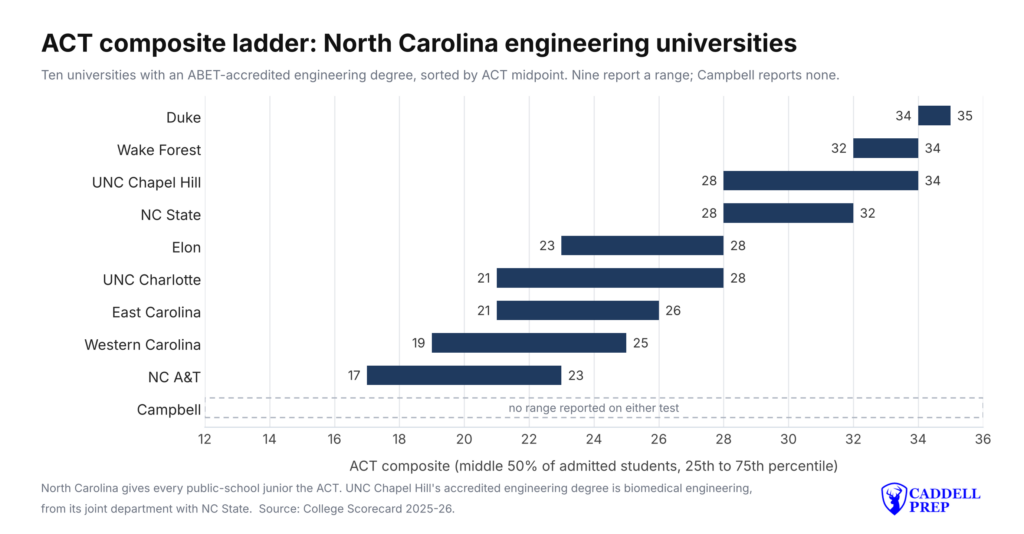
A student can see where his ACT score sits on this list in the image above.
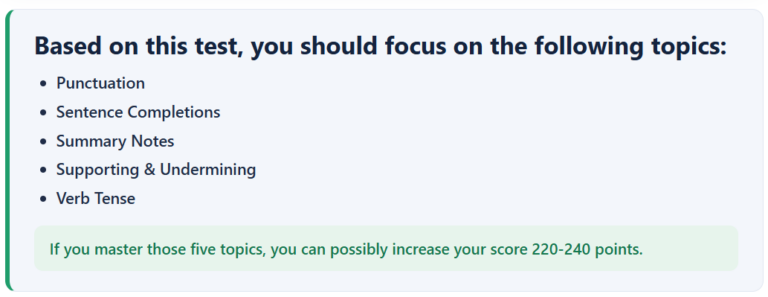
Want to Know What 5 Topics Will Improve Your SAT Score the Most?
Sample Feedback from our Diagnostic Test:
Duke University
Duke University’s Pratt School of Engineering in Durham holds ABET accreditation in biomedical, civil, electrical and computer, environmental and mechanical engineering, and Duke has the highest range on the page on every test.
ACT composite 34 to 35. Reading & Writing 740 to 770, Math 760 to 800. The top quarter of admitted students scored at or above 35 on the ACT and 800 on Math. Cost of attendance $87,072, with tuition and fees at $68,758 for all students. 6,442 undergraduates, 5.7% admitted.
Duke is the most selective school on the page by a factor of two and a half and the only one whose top quarter scored a perfect 800 on Math. Its ACT floor of 34 is above every other school’s ceiling except Wake Forest’s and Chapel Hill’s.
Wake Forest University
Wake Forest University’s Department of Engineering in Winston-Salem holds ABET accreditation for its Bachelor of Science in Engineering, accredited in 2022, and Wake Forest has the highest cost of attendance on the page.
ACT composite 32 to 34. Reading & Writing 700 to 750, Math 710 to 770. The top quarter of admitted students scored at or above 34 on the ACT and 770 on Math. Cost of attendance $87,499, with tuition and fees at $67,642 for all students. 5,485 undergraduates, 22% admitted.
Wake Forest’s engineering program graduated its first class in 2021 and was accredited the following year, among the newest accredited engineering degrees on any page in this series. Its cost of attendance is $427 above Duke’s.
University of North Carolina at Chapel Hill
The University of North Carolina at Chapel Hill awards an ABET-accredited Bachelor of Science in Biomedical Engineering through the joint department it runs with NC State, and Chapel Hill is the most selective public university on the page.
ACT composite 28 to 34. Reading & Writing 690 to 750, Math 700 to 780. The top quarter of admitted students scored at or above 34 on the ACT and 780 on Math. Cost of attendance $26,055, with tuition and fees at $8,994 in state and $41,203 out of state. 20,752 undergraduates, 15% admitted.
Chapel Hill admits 15%, holds one accredited engineering degree, and charges a non-resident $41,203, the highest public out-of-state figure on the page by $8,356 and 4.6 times its resident price. Its Math ceiling of 780 is 30 points above NC State’s.
North Carolina State University
North Carolina State University’s College of Engineering in Raleigh holds ABET accreditation in disciplines including aerospace, biological, biomedical, chemical, civil, computer, construction, electrical, environmental, industrial and systems, materials, mechanical, nuclear, paper science and textile engineering, and NC State admits first-year students to the College and then to a major through a review it calls CODA.
ACT composite 28 to 32. Reading & Writing 650 to 720, Math 650 to 750. The top quarter of admitted students scored at or above 32 on the ACT and 750 on Math. Cost of attendance $26,425, with tuition and fees at $8,799 in state and $32,847 out of state. 27,371 undergraduates, 42% admitted.
NC State is the largest school on the page and the state’s engineering school, with more accredited disciplines than any other school in the state. Its in-state tuition is the lowest of the two flagship-tier universities by $195, and its CODA rule is described in the next section.
Elon University
Elon University’s Department of Engineering holds ABET accreditation for its Bachelor of Science in Engineering, and Elon is the only private university on the page other than Duke and Wake Forest that reports a score range.
ACT composite 23 to 28. Reading & Writing 580 to 650, Math 550 to 630. The top quarter of admitted students scored at or above 28 on the ACT and 630 on Math. Cost of attendance $62,266, with tuition and fees at $46,958 for all students. 6,452 undergraduates, 66% admitted.
Elon’s ACT ceiling of 28 matches Charlotte’s on a floor two points higher, and its Math range sits 40 points under Charlotte’s at the ceiling. Its tuition is $5,358 above Campbell’s.
University of North Carolina at Charlotte
The University of North Carolina at Charlotte’s William States Lee College of Engineering holds ABET accreditation in civil, computer, electrical, mechanical and systems engineering, and Charlotte is the second-largest school on the page.
ACT composite 21 to 28. Reading & Writing 570 to 660, Math 570 to 670. The top quarter of admitted students scored at or above 28 on the ACT and 670 on Math. Cost of attendance $23,010, with tuition and fees at $7,239 in state and $22,492 out of state. 24,453 undergraduates, 80% admitted.
Charlotte has the lowest in-state tuition on the page after Western Carolina’s and A&T’s, and its Math ceiling of 670 is the highest among the publics below NC State. Its out-of-state tuition is $10,355 below NC State’s.
East Carolina University
East Carolina University’s College of Engineering and Technology in Greenville holds ABET accreditation for its Bachelor of Science in Engineering, and East Carolina is the least selective school on the page.
ACT composite 21 to 26. Reading & Writing 540 to 630, Math 530 to 610. The top quarter of admitted students scored at or above 26 on the ACT and 610 on Math. Cost of attendance $23,867, with tuition and fees at $7,361 in state and $23,638 out of state. 19,896 undergraduates, 89% admitted.
East Carolina admits 89% of applicants, holds one accredited engineering degree with concentrations, and shares an ACT floor of 21 with Charlotte on a ceiling two points lower.
Western Carolina University
Western Carolina University’s College of Engineering and Technology in Cullowhee holds ABET accreditation for its Bachelor of Science in Engineering, accredited in 2018, and Western Carolina’s tuition is set by state law at $500 a semester for a resident and $3,500 for a non-resident.
ACT composite 19 to 25. Reading & Writing 560 to 660, Math 520 to 610. The top quarter of admitted students scored at or above 25 on the ACT and 610 on Math. Cost of attendance $19,992, with tuition and fees at $4,630 in state and $8,630 out of state in the Scorecard. 10,024 undergraduates, 82% admitted.
Western Carolina is the cheapest school on the page on every measure and the cheapest accredited engineering school for a resident or a non-resident on any page in this series. Its Math range is the second-lowest on the page, and its campus is in the mountains five hours west of Raleigh.
North Carolina A&T State University
North Carolina A&T State University’s College of Engineering in Greensboro holds ABET accreditation in disciplines including architectural, bio, chemical, civil, computer, electrical, industrial and systems, and mechanical engineering, and A&T is the largest historically Black university on any page in this series.
ACT composite 17 to 23. Reading & Writing 510 to 600, Math 510 to 590. The top quarter of admitted students scored at or above 23 on the ACT and 590 on Math. Cost of attendance $20,427, with tuition and fees at $6,813 in state and $20,673 out of state. 12,182 undergraduates, 50% admitted.
A&T admits half its applicants, the third-lowest rate among the publics, holds eight accredited disciplines, and reports the lowest range on the page. Its in-state tuition of $6,813 is the second-lowest on the page after Western Carolina’s legislated figure.
Campbell University
Campbell University’s School of Engineering in Buies Creek holds ABET accreditation for its Bachelor of Science in Engineering, and Campbell reports no admitted score range.
Cost of attendance $62,187, with tuition and fees at $41,600 for all students. 2,680 undergraduates, 87% admitted.
Campbell is a Baptist university, the smallest school on the page, and the cheapest private by tuition, and it reports no SAT or ACT range to the Scorecard.
Nine ranges and one blank say who got in. At one university the price was set in Raleigh, and the next section is about the statute.
How Can an Accredited Engineering Degree Cost $500 a Semester?
An accredited engineering degree costs $500 a semester in tuition at Western Carolina University because the North Carolina General Assembly set it there, under the NC Promise Tuition Plan, which fixes tuition at Western Carolina and three other UNC System campuses at $500 a semester for a resident and $3,500 for a non-resident, with no eligibility requirement, and Western Carolina is the only one of the four with an ABET-accredited engineering degree.
Western Carolina’s own page gives the terms. Tuition is “$500 per fall and spring semesters for in-state students” and “$3,500 for out-of-state students.” “There are no eligibility requirements to take advantage of NC Promise.” The plan does not reduce fees or housing: “Campus-related fees for students and on-campus residency costs did not drop,” and the university lists in-state fees of $1,878 a semester. So a resident’s tuition and fees run approximately $4,756 a year on the current figures, and a non-resident’s approximately $10,756, against the Scorecard’s $4,630 and $8,630, which predate the non-resident rate’s rise from $2,500 to $3,500 a semester. The other three NC Promise campuses, UNC Pembroke, Elizabeth City State and Fayetteville State, award no engineering degree.
| University | Resident tuition and fees | Non-resident tuition and fees | Set by |
|---|---|---|---|
| Western Carolina (Scorecard) | $4,630 | $8,630 | NC Promise, $500 / $2,500 a semester plus fees |
| Western Carolina (current) | approximately $4,756 | approximately $10,756 | NC Promise, $500 / $3,500 a semester plus fees |
| NC A&T | $6,813 | $20,673 | UNC Board of Governors |
| UNC Charlotte | $7,239 | $22,492 | UNC Board of Governors |
| East Carolina | $7,361 | $23,638 | UNC Board of Governors |
| NC State | $8,799 | $32,847 | UNC Board of Governors |
| UNC Chapel Hill | $8,994 | $41,203 | UNC Board of Governors |
Set the two Western Carolina rows against the series. The lowest non-resident tuition at an accredited engineering school on any drafted page was Southeast Missouri State’s $9,903 flat rate, on our page on engineering colleges in Missouri, with McNeese State’s $9,989 behind it on our page on engineering colleges in Louisiana. Western Carolina’s Scorecard figure of $8,630 is below both, and its current figure is within $800 of them with the tuition itself at $7,000. Its resident figure of $4,630 is $2,710 below the next public in-state figure in the series, City College’s $7,340, and $2,183 below A&T’s on this page. Every other price in the grid was set by a university or a system board. This one was set by a legislature, which appropriates the difference to the four campuses each year.
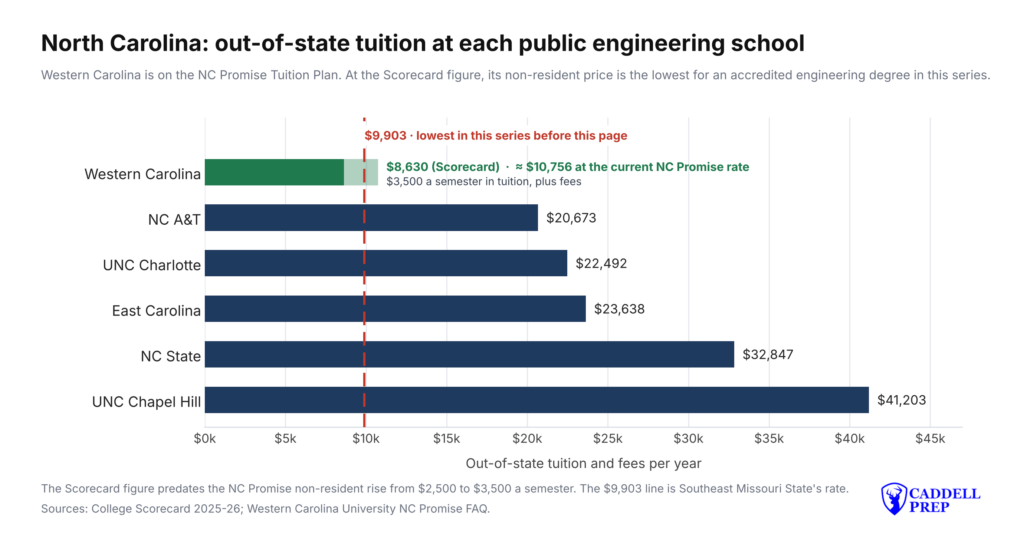
The image above shows what a New York student pays at each one, and the statute behind the shortest bar.
Take a New York student with a 24 on the ACT. At NC State he is four points below the floor of 28 and would pay $32,847. At Charlotte he is in the middle of the range, 21 to 28, and pays $22,492. At East Carolina he is in the upper half of 21 to 26 and pays $23,638. At Western Carolina he is in the top quarter of 19 to 25 and pays $7,000 in tuition plus fees, approximately $10,800 in all. The two universities where his score sits highest are Western Carolina and East Carolina, and the price between them is $12,800 a year. The statute is the reason, and the statute attaches to the seat and not to the student, so his GPA, his income and his score have nothing to do with it.
The flagship-tier universities have their own number, and it is also a North Carolina number. Chapel Hill charges a resident $8,994 and NC State $8,799, and the state constitution’s instruction that public higher education be “as far as practicable” free of expense is the reason both sit below every flagship in this series except Florida’s. NC State is where the state’s engineering is, with fifteen accredited disciplines, and it admits first-year students to the College of Engineering and then to a major through CODA, the Change of Degree Application. A student must earn a C or better in Calculus I, Calculus II, Physics for Engineers I with its lab, and Chemistry with its lab, hold a CODA GPA of at least 2.0 across those six courses and a 2.0 overall, name his top three programs in his first year, and complete the requirements within four semesters. Departments set seat capacity, the College ranks qualified students by CODA GPA and other criteria such as essays, and a qualified student not placed in his first choice is considered for his second and third. A student who cannot enter any engineering program within four semesters is moved to the Transitional College Program and helped toward another major. That is the gate Maryland’s flagship runs on our page on engineering colleges in Maryland, a year in and on grades, and NC State’s version adds a seat count by major.
The honest version is in four parts. NC Promise is current law, funded since 2018 and raised for non-residents since, and a legislature that set a price can change it, so this page dates the figures. The Scorecard’s Western Carolina figures are one rate behind the university’s own, and the page gives both. The degree the price buys is a Bachelor of Science in Engineering accredited in 2018 at a university whose admitted range is the second-lowest on the page, in a mountain town of a few thousand people five hours from the Research Triangle. That is a description, not a judgment, and a student should read it as one. And the price is tuition: fees and housing are the university’s regular charges, and a resident’s bill with housing runs approximately $8,200 to $8,700 a semester by Western Carolina’s own sample.
Families from outside North Carolina reading Western Carolina’s page frequently ask whether the rate is for residents only.
Does NC Promise Apply to a Student From New York?
NC Promise applies to a student from New York, at $3,500 a semester in tuition, with no residency, income, GPA or score requirement, and with campus fees and housing at the university’s regular rates.
The Scorecard’s $8,630 out-of-state figure for Western Carolina is from the year before the non-resident rate rose from $2,500 to $3,500 a semester, so a New York student entering now should plan on $7,000 in tuition and approximately $3,750 in fees, approximately $10,800 before housing. That is still less than half of what the next public engineering school on the page charges him.
The statute’s price is the state’s. The degrees are what the next section lists.
Which North Carolina Universities Have ABET-Accredited Engineering Schools?
Ten North Carolina universities hold ABET-accredited engineering bachelor’s degrees, six public and four private, and all ten are in the table above.
In the Research Triangle, Duke’s Pratt School is in Durham, NC State’s College of Engineering is in Raleigh with fifteen disciplines, and Chapel Hill’s biomedical engineering degree is awarded through the joint department the two public universities run together. In Winston-Salem, Wake Forest holds a general engineering degree. In Elon, Elon University holds one. In Charlotte, UNC Charlotte’s Lee College holds five, with Duke Energy and the city’s banks the largest engineering employers in the state’s largest city. In Greenville, East Carolina holds a general engineering degree. In Cullowhee, Western Carolina holds one. In Greensboro, A&T holds eight. In Buies Creek, Campbell holds one.
Accreditation matters for a reason that is easy to miss at seventeen. Licensure as a professional engineer normally requires a degree from an ABET-accredited engineering program, and that is why the engineering technology degrees at Western Carolina, A&T and East Carolina are not the programs that place those universities on the list. UNC Asheville’s mechatronics students earn NC State’s degree, and High Point’s new engineering programs had not been accredited when this page was written. Davidson, Appalachian State, UNC Wilmington, UNC Greensboro, UNC Pembroke, North Carolina Central, Queens, Gardner-Webb, Fayetteville State, Elizabeth City State and Winston-Salem State award no engineering degree.
Nothing on this page ranks the ten. The table’s order is a stated, verifiable number where one exists, and the choice among accredited programs comes down to cost, discipline and where a student’s score places him.
What If Your Scores Are Below the Range You Want?
In North Carolina the state has two engineering schools that admit 15% and 42% and four publics that admit 80% or more, so the score decides between Raleigh and Chapel Hill and the rest, and the rest includes the cheapest accredited engineering degree in this series.
The gap from a 24 to NC State’s floor of 28 is four points of ACT composite, two or three questions a section, and the student who closes it is choosing between $32,847 and approximately $10,800 a year with a far longer list of disciplines on one side. The student who does not is choosing among four publics whose ranges he is already inside, and the price among them runs from approximately $10,800 to $23,638. A New York student has nine ranges and out-of-state tuition from $7,000 at Western Carolina to $41,203 at Chapel Hill.
The first step is finding out where the score actually is, section by section. A free diagnostic SAT gives a score that can be set against the SAT columns in the table and converted to the ACT scale for the rest of it.
The Math section rewards the same handful of topics on every test date, and a student who knows which of them he is missing can close a gap of 50 to 100 points in weeks rather than months. The method is on our page on improving your SAT Math score, and the same topics carry the ACT Math section.
How to Read These Score Ranges
Every range on this page covers the middle 50% of admitted students who submitted that test. The lower number is the 25th percentile and the upper number is the 75th, so a quarter of admitted students scored at or above it.
A legislated price is not a scholarship. It attaches to the seat and not to the student, so no range on this page has anything to do with it, and a student at the bottom of Western Carolina’s range pays the same $500 as a student at the top.
Because most colleges are now test-optional, the ranges that are published describe only the students who chose to submit at all. Students with strong scores submit and students with weak ones don’t, so a published range sits higher than the range for everyone who was actually admitted. More on what SAT score you need for college and on test-optional colleges.
Should You Take the SAT Instead?
North Carolina is an ACT state by a narrow margin. Every public-school junior takes the ACT, and thirty-five North Carolina institutions report an ACT range against thirty-four for the SAT.
That is why the table on this page carries an ACT composite column and is sorted by it. All ten universities accept either test, and a student from outside North Carolina who holds an SAT should read the SAT columns and submit the test he scores higher on.
Engineering Programs in Nearby States
North Carolina borders Virginia, South Carolina, Tennessee and Georgia, and North Carolina students apply across those lines in numbers even with ten accredited programs at home.
See engineering colleges in Virginia, engineering colleges in South Carolina, and engineering colleges in Georgia.
Engineering Colleges in Other States
We publish the same breakdown for engineering programs in every state.
See engineering colleges by state for the full list.

Glyn Caddell
Glyn Caddell holds a BS in Mechanical Engineering from NJIT and has been tutoring New York City students since 2008. He founded Caddell Prep in 2012 and is the author of Digital SAT Math Secrets: Lessons & Tricks to Quickly Improve to a Perfect 800 on the Math Test, which contains over 900 practice problems and is used in Caddell Prep’s SAT math classes. He is founding president of the Staten Island Technical High School alumni association and teaches every lesson on this site personally.
Finally, an SAT course that students actually understand
Every question has a video explanation. Not most — every one.
The on-demand Digital SAT course covers all 17 math topics and 15 reading and writing topics, with 5 full-length practice tests and a 100-point score increase guarantee. Keep access for the rest of high school. No subscription.
Want to Know What 5 Topics Will Improve Your SAT Score the Most?
Sample Feedback from our Diagnostic Test: