
Home » College SAT Score Ranges, Costs, and Programs by Major and State » Engineering Colleges by State: SAT Scores, ACT Scores, Costs, and ABET Programs » Engineering Colleges in Illinois: SAT Scores, Costs, and Programs
By Glyn Caddell, BSME · Author of Digital SAT Math Secrets · Tutoring since 2008 — Updated October 23, 2026
Eleven Illinois universities offer ABET-accredited engineering degrees, and this page lists what they cost and the SAT scores of the students they admit.
UIUC publishes a separate admitted range for its engineering college. It sits approximately 150 points above the figure the ranking sites show, and the gap is covered below the table.
Scores are given by section, and the table is sorted by Math because that is the section engineering programs use.
Table of Contents
- Illinois Engineering Colleges by SAT Math Score
- What SAT Score Does UIUC’s Engineering College Admit?
- Which Illinois Universities Have ABET-Accredited Engineering Schools?
- What If Your Score Is Below the Engineering Range You Want?
Illinois Engineering Colleges by SAT Math Score
The eleven universities below are the ones in Illinois that hold an ABET-accredited bachelor’s degree in an engineering discipline. They are sorted by the midpoint of the SAT Math range, with the three that report no range at the bottom.
| College | SAT Reading & Writing | SAT Math | Cost of attendance | Undergraduates | Admit rate |
|---|---|---|---|---|---|
| Northwestern University | 740 to 770 | 770 to 800 | $91,250 | 9,201 | 8% |
| University of Illinois Urbana-Champaign | 650 to 740 | 660 to 780 | $33,642 | 36,258 | 42% |
| Illinois Institute of Technology | 590 to 720 | 590 to 720 | $68,164 | 2,833 | 55% |
| Loyola University Chicago | 600 to 690 | 570 to 670 | $67,408 | 11,737 | 82% |
| University of Illinois Chicago | 570 to 670 | 560 to 680 | $27,521 | 22,170 | 77% |
| Olivet Nazarene University | 490 to 620 | 460 to 600 | $51,981 | 2,603 | 56% |
| Southern Illinois University Edwardsville | 490 to 600 | 460 to 590 | $28,919 | 8,750 | 98% |
| Southern Illinois University Carbondale | 470 to 590 | 430 to 570 | $28,329 | 8,494 | 87% |
| Bradley University | Does not report SAT data | Does not report SAT data | $54,730 | 3,574 | 77% |
| Northern Illinois University | Does not report SAT data | Does not report SAT data | $28,851 | 11,301 | 70% |
| Western Illinois University | Does not report SAT data | Does not report SAT data | $28,254 | 4,410 | 71% |
Each range covers the middle 50% of admitted students who submitted the SAT. A quarter scored below the lower number, and the top quarter scored at or above the upper one. Being under the lower number does not rule a student out, and being just above it is not as safe as it looks.
Loyola and UIC share a Math midpoint, and Loyola is listed first on the Reading & Writing midpoint. Only universities with an ABET-accredited engineering bachelor’s degree are listed. Southern Illinois Edwardsville, Southern Illinois Carbondale, Northern Illinois and Western Illinois report the same tuition for in-state and out-of-state students. Illinois State University opened a College of Engineering in 2025 whose programs are not yet accredited and is not listed.
Three things about that table are worth pausing on.
Northwestern’s Math range of 770 to 800 is the highest on any page in this series, tied with Stanford’s and Harvey Mudd’s, and its cost of attendance of $91,250 is the highest in the series outright.
Four Illinois public universities report the same tuition and fees for a student from Illinois and a student from anywhere else: $12,922 at Edwardsville, $13,334 at Carbondale, $13,248 at Northern Illinois and $15,264 at Western Illinois. For a reader from outside the state, those four are the cheapest accredited engineering degrees in this series by a distance.
UIC’s Math ceiling of 680 sits above Loyola’s 670, with a floor 10 points below it, at approximately $40,000 less in cost of attendance. The two Chicago schools admit students who score the same and charge them very differently.
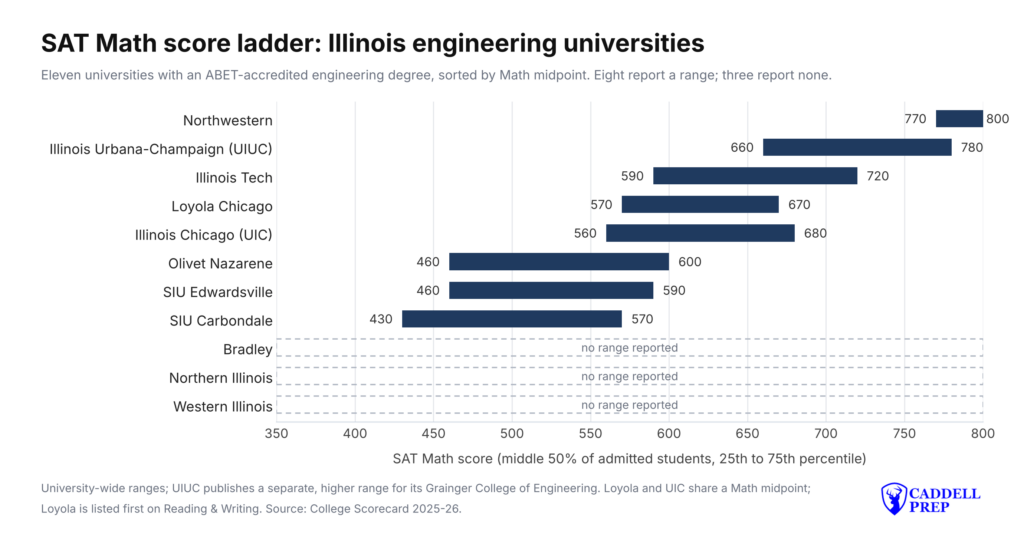
A student can see where his Math score sits on this list in the image above.
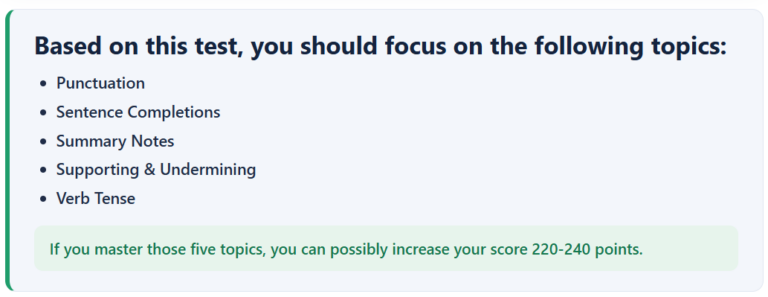
Want to Know What 5 Topics Will Improve Your SAT Score the Most?
Sample Feedback from our Diagnostic Test:
Northwestern University
Northwestern University’s McCormick School of Engineering in Evanston holds ABET accreditation across its engineering degrees, and Northwestern is test-optional for the current application cycle.
Reading & Writing 740 to 770, Math 770 to 800. The top quarter of admitted students scored at or above 770 and a perfect 800. Cost of attendance $91,250, with tuition and fees at $68,322 for all students. 9,201 undergraduates, 8% admitted.
Northwestern is the most selective and the most expensive school on the page, and its Math floor of 770 is above the ceiling at every other Illinois school but UIUC.
University of Illinois Urbana-Champaign
The University of Illinois Urbana-Champaign’s Grainger College of Engineering is the state’s flagship engineering school and one of the largest in the country, and UIUC publishes a separate admitted range for it.
Reading & Writing 650 to 740, Math 660 to 780. The top quarter scored at or above 740 and 780. Cost of attendance $33,642, with tuition and fees at $16,004 in-state and $35,124 out-of-state. 36,258 undergraduates, 42% admitted.
Those figures describe enrolled students across the whole university. For students admitted to Grainger, UIUC reports a three-year middle-50% SAT of 1460 to 1550 and an ACT of 33 to 35, and the next section sets the two against each other.
Illinois Institute of Technology
The Illinois Institute of Technology’s Armour College of Engineering on Chicago’s South Side holds ABET accreditation across its engineering degrees, and IIT is the one school on the page where both section ranges are identical.
Reading & Writing 590 to 720, Math 590 to 720. The top quarter scored at or above 720 on both sections. Cost of attendance $68,164, with tuition and fees at $52,386 for all students. 2,833 undergraduates, 55% admitted.
IIT’s Math ceiling of 720 is 60 points below UIUC’s and its floor is 70 below, at approximately twice the cost of attendance.
Loyola University Chicago
Loyola University Chicago’s engineering program awards an ABET-accredited Bachelor of Science in Engineering, accredited in 2020, and Loyola is a Jesuit university with the youngest accredited engineering degree on the page.
Reading & Writing 600 to 690, Math 570 to 670. The top quarter scored at or above 690 and 670. Cost of attendance $67,408, with tuition and fees at $53,710 for all students. 11,737 undergraduates, 82% admitted.
Loyola admits more than four applicants in five with a Math range that overlaps UIC’s almost entirely.
University of Illinois Chicago
The University of Illinois Chicago’s College of Engineering holds ABET accreditation in bioengineering, chemical, civil, computer, electrical, industrial and mechanical engineering, and UIC is the cheapest university on the page by cost of attendance.
Reading & Writing 570 to 670, Math 560 to 680. The top quarter scored at or above 670 and 680. Cost of attendance $27,521, with tuition and fees at $14,338 in-state and $29,884 out-of-state. 22,170 undergraduates, 77% admitted.
UIC’s out-of-state tuition of $29,884 is $5,240 below UIUC’s and its Math ceiling is 100 points lower.
Olivet Nazarene University
Olivet Nazarene University’s engineering program in Bourbonnais holds ABET accreditation, and Olivet is affiliated with the Church of the Nazarene.
Reading & Writing 490 to 620, Math 460 to 600. The top quarter scored at or above 620 and 600. Cost of attendance $51,981, with tuition and fees at $38,900 for all students. 2,603 undergraduates, 56% admitted.
Olivet is the smallest school on the page and the most selective of the three below UIC by admit rate.
Southern Illinois University Edwardsville
Southern Illinois University Edwardsville’s School of Engineering holds ABET accreditation in civil, computer, electrical, industrial and mechanical engineering, and Edwardsville has the lowest tuition on the page for a student from any state.
Reading & Writing 490 to 600, Math 460 to 590. The top quarter scored at or above 600 and 590. Cost of attendance $28,919, with tuition and fees at $12,922 for in-state and out-of-state students alike. 8,750 undergraduates, 98% admitted.
Edwardsville admits 98% of applicants and sits across the river from St. Louis.
Southern Illinois University Carbondale
Southern Illinois University Carbondale’s College of Engineering, Computing, Technology, and Mathematics holds ABET accreditation in civil, electrical, mechanical and mining engineering, and Carbondale has the lowest Math range on the page.
Reading & Writing 470 to 590, Math 430 to 570. The top quarter scored at or above 590 and 570. Cost of attendance $28,329, with tuition and fees at $13,334 for in-state and out-of-state students alike. 8,494 undergraduates, 87% admitted.
Carbondale holds the state’s only mining engineering degree.
Bradley University
Bradley University’s Caterpillar College of Engineering and Technology in Peoria holds ABET accreditation in civil, electrical, industrial and mechanical engineering, and Bradley reports no admitted score range.
Cost of attendance $54,730, with tuition and fees at $42,160 for all students. 3,574 undergraduates, 77% admitted.
Bradley’s engineering college carries the name of the Peoria company whose engineers it trains, and it is the one private school on the page without a published range.
Northern Illinois University
Northern Illinois University’s College of Engineering and Engineering Technology in DeKalb holds ABET accreditation in biomedical, electrical, industrial and mechanical engineering, and Northern Illinois reports no admitted score range.
Cost of attendance $28,851, with tuition and fees at $13,248 for in-state and out-of-state students alike. 11,301 undergraduates, 70% admitted.
Northern Illinois is the largest of the three non-reporting schools and the only one in the Chicago region.
Western Illinois University
Western Illinois University’s engineering program, based at its Quad Cities campus in Moline, holds ABET accreditation, and Western Illinois reports no admitted score range.
Cost of attendance $28,254, with tuition and fees at $15,264 for in-state and out-of-state students alike. 4,410 undergraduates, 71% admitted.
Western Illinois is the smallest public university on the page and the only one whose engineering program sits on a branch campus.
Eleven rows, and the one most readers will look at first is the flagship’s, and the number in it is not the engineering college’s.
What SAT Score Does UIUC's Engineering College Admit?
UIUC’s Grainger College of Engineering admitted students with a three-year middle-50% SAT of 1460 to 1550, an ACT of 33 to 35 and an unweighted GPA of 3.83 to 4.0, against an SAT of 1390 to 1520 for the university as a whole, and it admitted approximately 24% of the students who named it as their first choice against 42% for the university.
The figures come from UIUC’s own class profile, which reports the middle 50% of admitted first-year students by college, averaged over three years. Three ranges describe UIUC, and they describe three different groups.
| Range | SAT total, middle 50% | Who it describes |
|---|---|---|
| College Scorecard, 2025-26 | approximately 1310 to 1520 | Enrolled students, whole university, sections summed |
| UIUC university-wide | 1390 to 1520 | Enrolled students who submitted scores, whole university |
| UIUC Grainger College of Engineering | 1460 to 1550 | Admitted first-choice applicants, three-year average |
The Scorecard sum adds the two sections’ 25th percentiles and 75th percentiles, which is not how a total range is built, so it is approximate. UIUC is test-optional, so each range describes students who submitted scores.
The Grainger floor sits approximately 70 points above the university’s own enrolled figure and approximately 150 points above the Scorecard sum, and the Scorecard sum is the figure every ranking site shows for UIUC.
Take a student with a 700 Reading & Writing and a 700 Math, a 1400. He is inside the Scorecard’s range on both sections. He is inside the university’s range. He is 60 points below the floor of the engineering college’s range, and he reads the number the ranking sites show, decides UIUC engineering is a target school, and is wrong.
The SAT does not matter for admission to any public engineering school in California, because the University of California and the California State University do not consider it, and it is required at Caltech and Stanford and read at every other private engineering school in the state.
Both public systems dropped the test in 2020. The University of California’s regents removed it from admissions that year and reaffirmed the decision in 2021, and a legal settlement in May 2021 barred UC from using SAT or ACT scores in admissions or scholarships. A score sent to Berkeley, UCLA, UC San Diego or Cal Poly is not read. UC does not use it for scholarships either.
The private universities are different, and two of them have moved the other way. Caltech restored its requirement on April 11, 2024, for students entering in fall 2025. Stanford requires scores from applicants for fall 2026 onward. Harvey Mudd’s test-optional pilot runs through 2026, and USC, Santa Clara, Loyola Marymount, Pacific, USF, USD and Cal Baptist are test-optional, meaning a submitted score is read and an unsubmitted one is not held against the applicant.
Take a student with a 780 SAT Math. At Harvey Mudd he is in the middle of the admitted range. At USC he is in the top quarter. At UCLA his score is not opened. The same 780, read twice and ignored once.
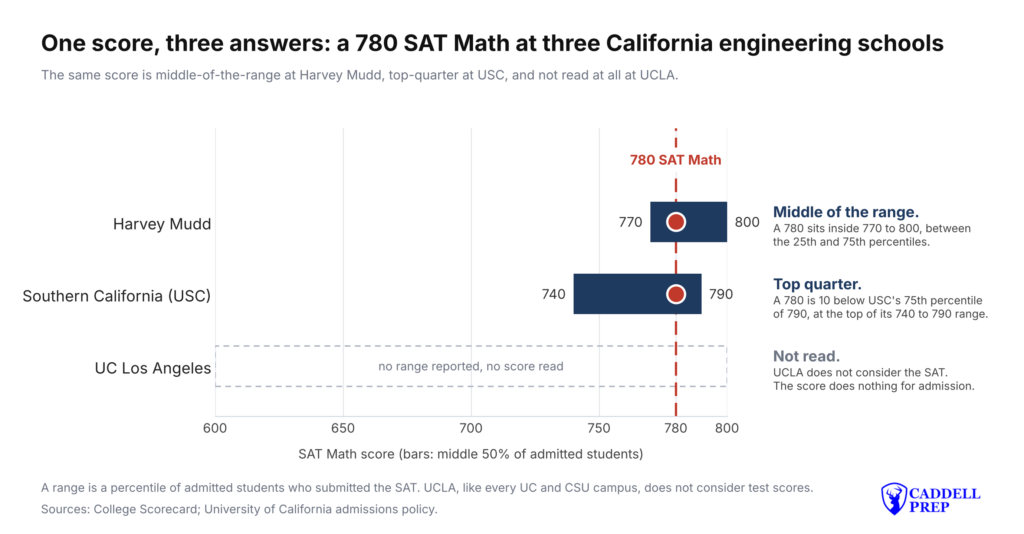
The image above shows the same 780, read twice and ignored once, and that is the whole of the California question for a student choosing where to send a score.
The public systems still use scores for one thing, and it is small. The California State University’s multiple-measures placement puts a student with an SAT Math of 570 or above, or an ACT Math of 23 or above, straight into general-education mathematics without a support course, under the 2026-28 Cal Poly catalog and the systemwide rule it follows. That is a general-education line, not a calculus line. Placement into calculus for an engineering major is by campus exam, the MAPE at Cal Poly San Luis Obispo and the equivalent elsewhere, and UC campuses place by their own tests or by ALEKS. The SAT’s one remaining public use in California is below what an engineering student needs.
So the honest answer is in five parts. Nothing at the public universities for admission. Nothing at UC for scholarships. One small thing at CSU for placement. Required at the two most selective private engineering schools and read at the rest. And read at every university a California student applies to outside the state. The next question is whether the first part will stay true.
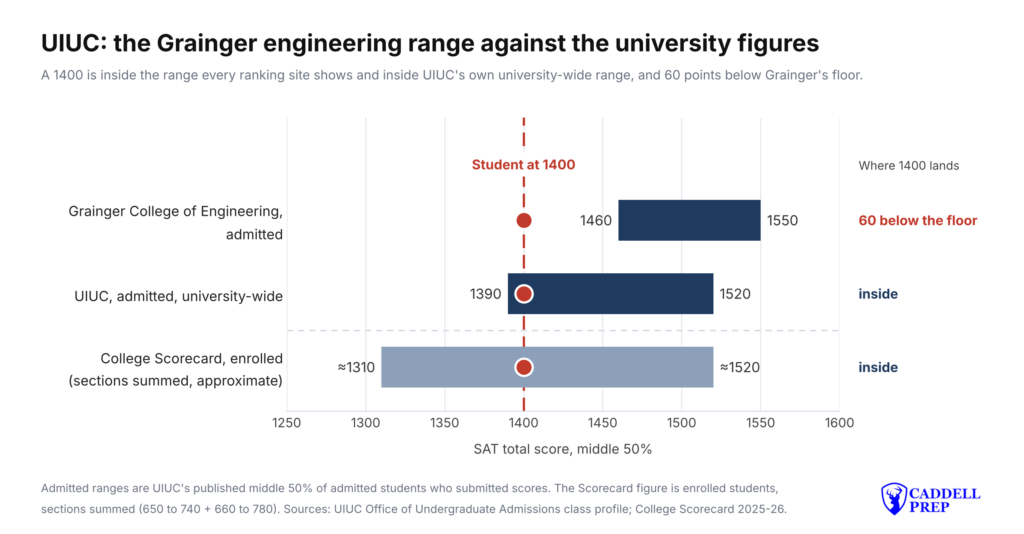
The image above shows the range the ranking sites show, and the one the engineering college publishes.
Illinois is the second state in this series where the flagship publishes an engineering-college range. At CU Boulder the engineering college sat 70 points above the university at both ends, as our page on engineering colleges in Colorado sets out. At UIUC the gap to the Scorecard figure is approximately double that, and Grainger admits by first-choice major, so a student who names engineering and misses it is reviewed for his second choice.
The score decides which range a student is measured against and nothing about his first math course. UIUC places every incoming student into math by its ALEKS placement assessment, and Calculus I for engineering majors needs the assessment’s cutoff rather than any SAT or ACT Math figure. A 1550 and a 1460 take the same assessment on the same terms.
Families comparing the top two schools on the page frequently ask whether the one above UIUC requires the test.
Does Northwestern Require the SAT for Engineering?
Northwestern does not require the SAT or ACT for the current application cycle. Its admissions office states that Northwestern is test-optional and that applicants may submit an SAT or ACT score if they wish, along with optional AP or IB results.
Northwestern’s McCormick School of Engineering admitted students with a Math range of 770 to 800 and admits 8% of applicants, so a submitted score is read against the highest range in Illinois, and an unsubmitted one leaves the file to the transcript. Northwestern’s policy is set each cycle, and a student applying after 2026 should check it.
Whatever the range, the degree at the end is an accredited one at all eleven schools, and that is the next section.
Which Illinois Universities Have ABET-Accredited Engineering Schools?
Eleven Illinois universities hold ABET-accredited engineering bachelor’s degrees, six public and five private, and all eleven are in the table above.
In Chicago and its suburbs, Northwestern’s McCormick School in Evanston and IIT’s Armour College on the South Side hold accredited degrees across the standard disciplines, UIC’s College of Engineering holds seven, Loyola holds one, and Northern Illinois in DeKalb holds four. Argonne and Fermilab, the two national laboratories west of the city, and Chicago’s consulting, manufacturing and transportation firms are the engineering employers around them. In Champaign, UIUC’s Grainger College holds accredited degrees across every standard discipline and several that are rare elsewhere.
Downstate, Bradley’s Caterpillar College in Peoria holds four accredited degrees beside the company that names it, Southern Illinois Edwardsville holds five across the river from St. Louis, Southern Illinois Carbondale holds four including mining, Western Illinois holds an accredited program at its Quad Cities campus beside the John Deere and Rock Island Arsenal engineering operations, and Olivet Nazarene in Bourbonnais holds an accredited program.
Accreditation matters for a reason that is easy to miss at seventeen. Licensure as a professional engineer normally requires a degree from an ABET-accredited engineering program. Illinois State’s College of Engineering, which admitted its first students in 2025, cannot be accredited until it has graduated a class, and the University of Chicago, DePaul, Wheaton, Augustana and North Central report score ranges and are not on the page because none awards an accredited engineering degree.
Nothing on this page ranks the eleven. The table’s order is a stated, verifiable number, and the choice among accredited programs comes down to cost, discipline and where a student’s score places him against the range that applies to him.
What If Your Score Is Below the Engineering Range You Want?
An Illinois engineering applicant to the flagship should measure himself against Grainger’s range, not the university’s, and the gap between the two is the gap most applicants are misjudging.
At UIUC that gap is 60 to 150 points at the floor, depending on which number the applicant has been shown, and either section can supply it. At Northwestern a submitted score is read against 770 to 800 on Math, and the choice to submit is the applicant’s. A New York student has UIUC’s out-of-state tuition of $35,124, which the score does not change, and four public universities that charge him what they charge an Illinois resident.
The first step is finding out where the score actually is, section by section. A free diagnostic SAT gives a total that can be set against Grainger’s range and a Math score that can be set against the rest of the table.
The Math section rewards the same handful of topics on every test date, and a student who knows which of them he is missing can close a gap of 50 to 100 points in weeks rather than months. The method is on our page on improving your SAT score.
How to Read These Score Ranges
Every range in the first table on this page covers the middle 50% of admitted students who submitted the SAT. The lower number is the 25th percentile and the upper number is the 75th, so a quarter of admitted students scored at or above it.
A university-wide range and a college-level range describe different groups of students. The Scorecard figure describes everyone enrolled at the university. A college’s own published figure describes students admitted to that college, and at a university where engineering is the most selective college, the second number is the one that applies. An engineering applicant should look for it wherever a university publishes it.
Because most colleges are now test-optional, the ranges that are published describe only the students who chose to submit at all. Students with strong scores submit and students with weak ones don’t, so a published range sits higher than the range for everyone who was actually admitted. More on what SAT score you need for college and on test-optional colleges.
Should You Take the ACT Instead?
Illinois administers the SAT to every public high school junior as its state assessment, so nearly every Illinois applicant has an SAT score before he decides whether to take anything else.
Eight of the eleven universities on this page report both tests, and all eleven accept either. A student who scores higher on the ACT should submit it, and a student whose state-administered SAT is already inside the range he wants does not need a second test.
Engineering Programs in Nearby States
Illinois borders Wisconsin, Iowa, Missouri, Kentucky and Indiana, and Illinois students apply across those lines in numbers even with eleven accredited programs at home.
See engineering colleges in Iowa, engineering colleges in Michigan, and engineering colleges in Indiana.
Engineering Colleges in Other States
We publish the same breakdown for engineering programs in every state.
See engineering colleges by state for the full list.

Glyn Caddell
Glyn Caddell holds a BS in Mechanical Engineering from NJIT and has been tutoring New York City students since 2008. He founded Caddell Prep in 2012 and is the author of Digital SAT Math Secrets: Lessons & Tricks to Quickly Improve to a Perfect 800 on the Math Test, which contains over 900 practice problems and is used in Caddell Prep’s SAT math classes. He is founding president of the Staten Island Technical High School alumni association and teaches every lesson on this site personally.
Finally, an SAT course that students actually understand
Every question has a video explanation. Not most — every one.
The on-demand Digital SAT course covers all 17 math topics and 15 reading and writing topics, with 5 full-length practice tests and a 100-point score increase guarantee. Keep access for the rest of high school. No subscription.
Want to Know What 5 Topics Will Improve Your SAT Score the Most?
Sample Feedback from our Diagnostic Test: