
Home » College SAT Score Ranges, Costs, and Programs by Major and State » Engineering Colleges by State: SAT Scores, ACT Scores, Costs, and ABET Programs » Engineering Colleges in Colorado: SAT Scores, Costs, and Programs
By Glyn Caddell, BSME · Author of Digital SAT Math Secrets · Tutoring since 2008 — Updated October 22, 2026
Eleven Colorado universities offer ABET-accredited engineering degrees, and this page lists what they cost and the SAT scores of the students they admit.
CU Boulder publishes a separate admitted range for its engineering college. It sits 70 points above the university’s own range and approximately 130 points above the figure the ranking sites show, and the gap is covered below the table.
Scores are given by section, and the table is sorted by Math because that is the section engineering programs use.
Table of Contents
- Colorado Engineering Colleges by SAT Math Score
- What SAT Score Does CU Boulder’s Engineering College Admit?
- Which Colorado Universities Have ABET-Accredited Engineering Schools?
- What If Your Score Is Below the Engineering Range You Want?
Colorado Engineering Colleges by SAT Math Score
The eleven universities below are the ones in Colorado that hold an ABET-accredited bachelor’s degree in an engineering discipline. They are sorted by the midpoint of the SAT Math range, with the two that report no SAT range at the bottom.
| College | SAT Reading & Writing | SAT Math | Cost of attendance | Undergraduates | Admit rate |
|---|---|---|---|---|---|
| Colorado School of Mines | 650 to 730 | 670 to 750 | $40,560 | 6,155 | 61% |
| United States Air Force Academy | 620 to 710 | 610 to 730 | No tuition; service commitment | 4,114 | 14% |
| University of Colorado Boulder | 630 to 710 | 610 to 720 | $37,684 | 31,939 | 78% |
| University of Denver | 640 to 710 | 600 to 700 | $78,476 | 6,025 | 78% |
| Fort Lewis College | 505 to 605 | 505 to 605 | $27,030 | 3,079 | 77% |
| University of Colorado Colorado Springs | 510 to 620 | 500 to 600 | $24,595 | 8,697 | 97% |
| University of Colorado Denver | 490 to 620 | 490 to 600 | $24,902 | 10,519 | 75% |
| Colorado Mesa University | 480 to 590 | 450 to 570 | $24,046 | 8,143 | 82% |
| Metropolitan State University of Denver | 450 to 570 | 430 to 560 | $24,622 | 15,002 | 99% |
| Colorado State University | Does not report SAT data | Does not report SAT data | $31,642 | 25,538 | 89% |
| Colorado State University Pueblo | Does not report SAT data | Does not report SAT data | $23,937 | 3,042 | 95% |
Each range covers the middle 50% of admitted students who submitted the SAT. A quarter scored below the lower number, and the top quarter scored at or above the upper one. Being under the lower number does not rule a student out, and being just above it is not as safe as it looks.
Only universities with an ABET-accredited engineering bachelor’s degree are listed. The Air Force Academy charges no tuition and requires a period of military service after graduation. Colorado Mesa’s engineering degree is awarded by CU Boulder and delivered in Grand Junction. Colorado State University Pueblo reports an ACT range of 19 to 26 and no SAT range.
Three things about that table are worth pausing on.
Colorado State University, the second largest engineering school in the state, reports no score range on either test. A student comparing the two land-grant campuses has a range for one and nothing for the other.
Colorado School of Mines has the highest Math range on the page, 670 to 750, and admits 61% of applicants. Its ACT Math range, 28 to 34, has a ceiling above its own ACT composite ceiling of 33. Every Mines student is an engineering or applied science student, so the applicants select themselves, and a high range at a 61% admit rate is self-selection rather than a narrow gate.
CU Boulder’s range in the table is for the whole university. The engineering college publishes its own, and it is higher. The next section is about that.
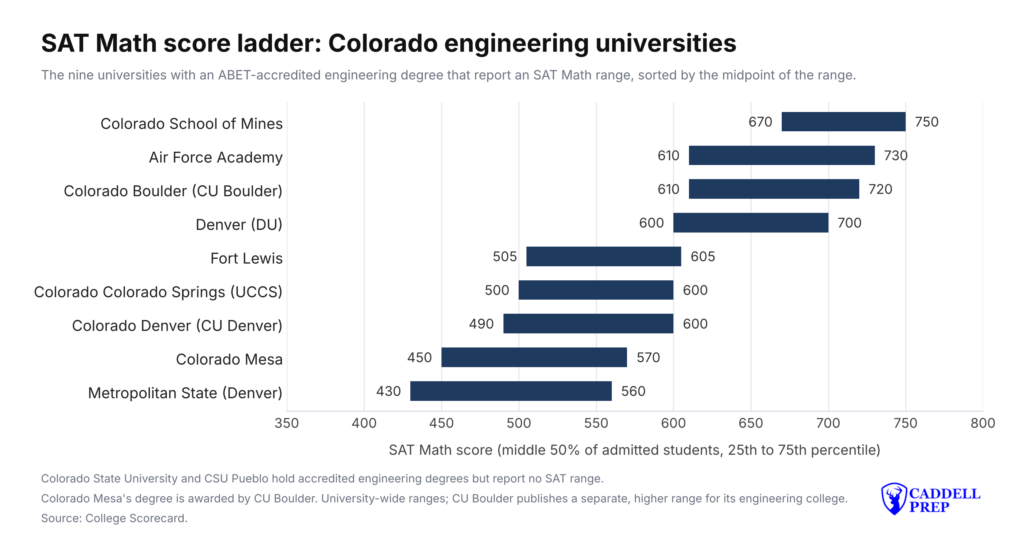
A student can see where his Math score sits on this list in the image above.
The eleven universities below are the ones in Colorado that hold an ABET-accredited bachelor’s degree in an engineering discipline. They are sorted by the midpoint of the SAT Math range, with the two that report no SAT range at the bottom.
| College | SAT Reading & Writing | SAT Math | Cost of attendance | Undergraduates | Admit rate |
|---|---|---|---|---|---|
| Colorado School of Mines | 650 to 730 | 670 to 750 | $40,560 | 6,155 | 61% |
| United States Air Force Academy | 620 to 710 | 610 to 730 | No tuition; service commitment | 4,114 | 14% |
| University of Colorado Boulder | 630 to 710 | 610 to 720 | $37,684 | 31,939 | 78% |
| University of Denver | 640 to 710 | 600 to 700 | $78,476 | 6,025 | 78% |
| Fort Lewis College | 505 to 605 | 505 to 605 | $27,030 | 3,079 | 77% |
| University of Colorado Colorado Springs | 510 to 620 | 500 to 600 | $24,595 | 8,697 | 97% |
| University of Colorado Denver | 490 to 620 | 490 to 600 | $24,902 | 10,519 | 75% |
| Colorado Mesa University | 480 to 590 | 450 to 570 | $24,046 | 8,143 | 82% |
| Metropolitan State University of Denver | 450 to 570 | 430 to 560 | $24,622 | 15,002 | 99% |
| Colorado State University | Does not report SAT data | Does not report SAT data | $31,642 | 25,538 | 89% |
| Colorado State University Pueblo | Does not report SAT data | Does not report SAT data | $23,937 | 3,042 | 95% |
Each range covers the middle 50% of admitted students who submitted the SAT. A quarter scored below the lower number, and the top quarter scored at or above the upper one. Being under the lower number does not rule a student out, and being just above it is not as safe as it looks.
Only universities with an ABET-accredited engineering bachelor’s degree are listed. The Air Force Academy charges no tuition and requires a period of military service after graduation. Colorado Mesa’s engineering degree is awarded by CU Boulder and delivered in Grand Junction. Colorado State University Pueblo reports an ACT range of 19 to 26 and no SAT range.
Three things about that table are worth pausing on.
Colorado State University, the second largest engineering school in the state, reports no score range on either test. A student comparing the two land-grant campuses has a range for one and nothing for the other.
Colorado School of Mines has the highest Math range on the page, 670 to 750, and admits 61% of applicants. Its ACT Math range, 28 to 34, has a ceiling above its own ACT composite ceiling of 33. Every Mines student is an engineering or applied science student, so the applicants select themselves, and a high range at a 61% admit rate is self-selection rather than a narrow gate.
CU Boulder’s range in the table is for the whole university. The engineering college publishes its own, and it is higher. The next section is about that.
A student can see where his Math score sits on this list in the image above.
Lorem ipsum dolor sit amet, consectetur adipiscing elit. Ut elit tellus, luctus nec ullamcorper mattis, pulvinar dapibus leo.
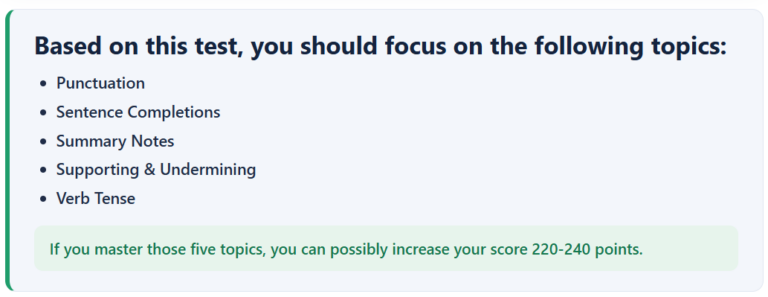
Want to Know What 5 Topics Will Improve Your SAT Score the Most?
Sample Feedback from our Diagnostic Test:
Colorado School of Mines
Colorado School of Mines in Golden is the state’s public university devoted to engineering and applied science, and Mines has the highest Math range on this page.
Reading & Writing 650 to 730, Math 670 to 750. The top quarter of admitted students scored at or above 730 and 750. Cost of attendance $40,560, with tuition and fees at $21,914 in-state and $45,824 out-of-state. 6,155 undergraduates, 61% admitted.
Mines is the most expensive public university on the page and sits beside the National Renewable Energy Laboratory.
United States Air Force Academy
The United States Air Force Academy in Colorado Springs holds ABET accreditation across its engineering majors, and the Academy is the most selective engineering school in the state by admit rate.
Reading & Writing 620 to 710, Math 610 to 730. The top quarter scored at or above 710 and 730. There is no tuition, and a graduate is commissioned as an officer and owes a period of active-duty service. 4,114 undergraduates, 14% admitted.
Admission requires a congressional or other nomination in addition to the academic file, and the Academy’s second highest Math range on the page comes with that extra gate.
University of Colorado Boulder
The University of Colorado Boulder’s College of Engineering & Applied Science holds eleven ABET-accredited engineering degrees, the most in the state, and CU Boulder is the one university on this page that publishes a separate admitted range for its engineering college.
Reading & Writing 630 to 710, Math 610 to 720. The top quarter scored at or above 710 and 720. Cost of attendance $37,684, with tuition and fees at $15,666 in-state and $44,918 out-of-state. 31,939 undergraduates, 78% admitted.
Those figures describe enrolled students across the whole university. For students admitted to the engineering college in 2026, CU Boulder reports a middle-50% SAT total of 1370 to 1500, and the next section sets the two against each other.
University of Denver
The University of Denver’s Ritchie School of Engineering and Computer Science holds ABET accreditation in electrical, mechanical and computer engineering, and the University of Denver is the only private university on this page.
Reading & Writing 640 to 710, Math 600 to 700. The top quarter scored at or above 710 and 700. Cost of attendance $78,476, with tuition and fees at $61,398 for all students. 6,025 undergraduates, 78% admitted.
The University of Denver costs approximately twice what Mines costs and has a Math range 50 points lower at both ends.
Fort Lewis College
Fort Lewis College in Durango awards an ABET-accredited Bachelor of Science in Engineering, and Fort Lewis is the one engineering school on this page in the southwestern corner of the state.
Reading & Writing 505 to 605, Math 505 to 605. The top quarter scored at or above 605 on both sections. Cost of attendance $27,030, with tuition and fees at $9,958 in-state and $21,526 out-of-state. 3,079 undergraduates, 77% admitted.
Fort Lewis is the only school on the page whose two section ranges are identical.
University of Colorado Colorado Springs
The University of Colorado Colorado Springs’ College of Engineering and Applied Science holds ABET accreditation in aerospace, computer, electrical and mechanical engineering, and UCCS sits in the city where the state’s military and aerospace employers are concentrated.
Reading & Writing 510 to 620, Math 500 to 600. The top quarter scored at or above 620 and 600. Cost of attendance $24,595, with tuition and fees at $10,149 in-state and $24,336 out-of-state. 8,697 undergraduates, 97% admitted.
UCCS admits nearly every applicant and has the same Math ceiling as Fort Lewis.
University of Colorado Denver
The University of Colorado Denver’s College of Engineering, Design and Computing holds ABET accreditation in bioengineering, civil, electrical and mechanical engineering, and CU Denver is the engineering school in the state capital.
Reading & Writing 490 to 620, Math 490 to 600. The top quarter scored at or above 620 and 600. Cost of attendance $24,902, with tuition and fees at $10,383 in-state and $29,391 out-of-state. 10,519 undergraduates, 75% admitted.
CU Denver’s ACT range, 23 to 32, is wider than any other on the page and reaches a ceiling only one point below CU Boulder’s.
Colorado Mesa University
Colorado Mesa University in Grand Junction delivers a mechanical engineering degree awarded by CU Boulder through a partnership program, and the degree is ABET-accredited under CU Boulder’s listing.
Reading & Writing 480 to 590, Math 450 to 570. The top quarter scored at or above 590 and 570. Cost of attendance $24,046, with tuition and fees at $9,927 in-state and $25,124 out-of-state. 8,143 undergraduates, 82% admitted.
Colorado Mesa is the only engineering option on the Western Slope with a published score range.
Metropolitan State University of Denver
Metropolitan State University of Denver’s Department of Engineering and Engineering Technology holds ABET engineering accreditation in computer engineering and environmental engineering, and Metro State admits 99% of applicants.
Reading & Writing 450 to 570, Math 430 to 560. The top quarter scored at or above 570 and 560. Cost of attendance $24,622, with tuition and fees at $11,124 in-state and $30,684 out-of-state. 15,002 undergraduates, 99% admitted.
Metro State’s civil and mechanical degrees are engineering technology degrees under a separate ABET commission and are not counted here.
Colorado State University
Colorado State University’s Walter Scott, Jr. College of Engineering in Fort Collins is the state’s land-grant engineering school and the second largest on this page, and Colorado State reports no admitted score range.
Cost of attendance $31,642, with tuition and fees at $13,373 in-state and $34,783 out-of-state. 25,538 undergraduates, 89% admitted.
Colorado State is test-optional and publishes nothing to the Department of Education on either test.
Colorado State University Pueblo
Colorado State University Pueblo holds ABET engineering accreditation in industrial engineering and mechatronics engineering, and CSU Pueblo is the cheapest university on the page by cost of attendance.
ACT composite 19 to 26, with no SAT range reported. Cost of attendance $23,937, with tuition and fees at $9,720 in-state and $17,944 out-of-state. 3,042 undergraduates, 95% admitted.
CSU Pueblo is the smallest school on the page and the only one that reports the ACT without the SAT.
Eleven ranges, and the one most readers will look at first is also the one most likely to mislead them, because it is not the engineering college’s range.
What SAT Score Does CU Boulder's Engineering College Admit?
CU Boulder’s College of Engineering & Applied Science admitted students in 2026 with a middle-50% SAT total of 1370 to 1500, an ACT composite of 31 to 35 and a weighted high school GPA of 3.96 to 4.44, against an SAT of 1300 to 1450 for the university as a whole.
The university publishes the figures by college, and the differences are large. Arts & Sciences admitted a middle 50% of 1270 to 1430. All majors together admitted 1300 to 1450. The Leeds School of Business admitted 1370 to 1450. Engineering admitted 1370 to 1500. The engineering college’s range sits 70 points above the university’s at both ends and 100 points above Arts & Sciences at the floor, and only the business school matches its floor.
| CU Boulder, 2026 admitted students | SAT total, middle 50% | ACT composite, middle 50% | Weighted GPA, middle 50% |
|---|---|---|---|
| College of Engineering & Applied Science | 1370 to 1500 | 31 to 35 | 3.96 to 4.44 |
| Leeds School of Business | 1370 to 1450 | 31 to 34 | 4.00 to 4.38 |
| All majors | 1300 to 1450 | 29 to 34 | 3.70 to 4.26 |
| College of Arts & Sciences | 1270 to 1430 | 29 to 34 | 3.62 to 4.20 |
Source: CU Boulder Office of Admissions, credentials of 2026 admitted first-year students. The ACT composite is computed from Math, English and Reading only. Score ranges reflect students who asked for their scores to be considered.
The figure in the table at the top of this page is a different number. The Scorecard reports Reading & Writing of 630 to 710 and Math of 610 to 720 for students enrolled across the whole university, approximately 1240 to 1430 when the sections are summed. That is the number every ranking site shows for CU Boulder, and it is approximately 130 points below the engineering college’s floor.
Take a student with a 660 Reading & Writing and a 660 Math, a 1320. He is inside the Scorecard’s range on both sections. He is inside the university’s admitted range. He is 50 points below the floor of the engineering college’s admitted range. He would read the published number, decide CU Boulder engineering was a target school, and be wrong.
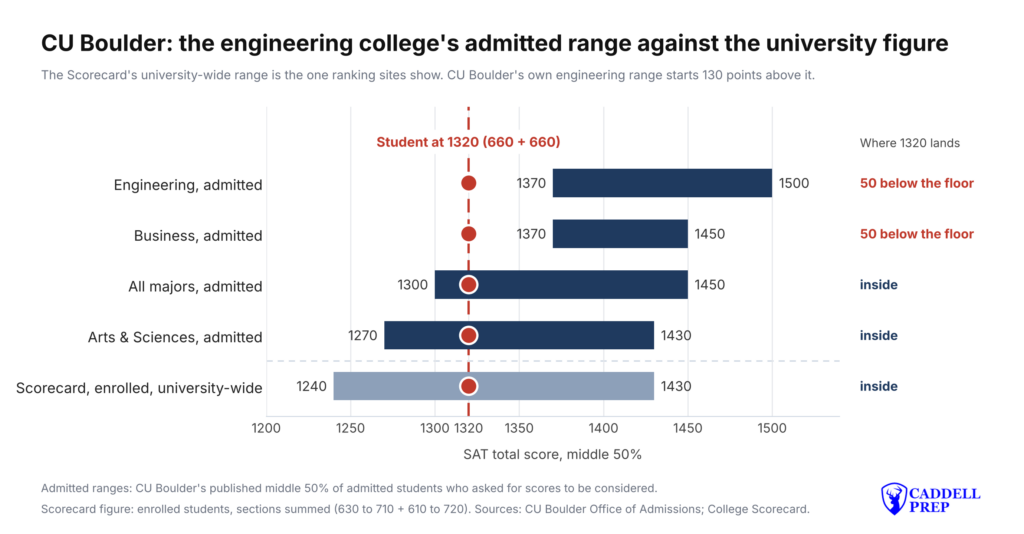
The image above shows the range the ranking sites show, and the one the engineering college publishes.
Two details on CU Boulder’s own page change how a student should read those numbers. The ACT composite CU Boulder reports is computed from Math, English and Reading only, without the Science section, so a student’s composite on his score report can differ from the one the university reads. And CU Boulder is test-optional, so the ranges describe only students who asked for their scores to be considered. Students with strong scores ask and students with weak ones do not, and the range of all admitted engineering students sits lower than 1370 to 1500.
The score decides admission to the college and nothing about the first math course. CU Boulder does not use the SAT, the ACT or ALEKS for calculus placement, and it stopped using ALEKS in 2017. Every first-year engineering student takes CU Boulder’s own Math Readiness Test, due in late May, even with AP or transfer calculus credit, and a placement below Calculus 1 puts him into Precalculus for Engineers in the fall. A 1500 and a 1370 take the same test on the same terms.
Students who have seen both numbers frequently ask why the school with the highest Math range in the state is not the hardest to get into.
Why Is Colorado School of Mines's Math Range the Highest in the State?
Colorado School of Mines has the highest Math range in Colorado because every Mines applicant is applying to study engineering or applied science, and students who are not strong in math do not apply.
Mines reports an SAT Math range of 670 to 750 and an ACT Math range of 28 to 34, with an ACT composite range of 29 to 33. The Math ceiling above the composite ceiling is what a university looks like when every student is an engineer. Mines admits 61% of applicants, so the range is high because of who applies rather than because of how many are turned away. A student at 680 Math is inside the range at Mines and inside the range at CU Boulder’s university figure, and the two numbers mean different things.
Whether a student measures himself against CU Boulder’s college figure or Mines’s, the degree at the end of it is an accredited one, and that is the next section.
Which Colorado Universities Have ABET-Accredited Engineering Schools?
Eleven Colorado universities hold ABET-accredited engineering bachelor’s degrees, and all eleven are in the table above.
Along the Front Range, CU Boulder’s College of Engineering & Applied Science holds eleven accredited degrees, aerospace, architectural, biomedical, chemical, chemical and biological, civil, electrical, electrical and computer, environmental, integrated design and mechanical engineering, and Colorado School of Mines in Golden holds its accredited degrees across the mining, energy, materials and standard engineering disciplines beside the National Renewable Energy Laboratory. Colorado State’s Walter Scott, Jr. College of Engineering in Fort Collins holds the land-grant programs. In Denver, CU Denver holds bioengineering, civil, electrical and mechanical, the University of Denver holds electrical, mechanical and computer, and Metro State holds computer and environmental engineering. Lockheed Martin’s space division in Littleton and Ball Aerospace in Boulder are the largest engineering employers in the corridor.
In Colorado Springs, UCCS holds aerospace, computer, electrical and mechanical engineering, and the Air Force Academy holds accreditation across its engineering majors, with the Space Force and Air Force bases and their contractors around both. On the Western Slope and in the south, Colorado Mesa delivers CU Boulder’s mechanical engineering degree in Grand Junction, Fort Lewis in Durango awards a single accredited engineering degree, and CSU Pueblo holds industrial and mechatronics engineering.
Western Colorado University in Gunnison also delivers a CU Boulder mechanical engineering degree through a partnership, but the program does not appear on CU Boulder’s accreditation listing, and a student should confirm its status with CU Boulder before choosing it on that basis.
Accreditation matters for a reason that is easy to miss at seventeen. Licensure as a professional engineer normally requires a degree from an ABET-accredited engineering program, and that is why Metro State’s civil and mechanical engineering technology degrees, and CSU Pueblo’s civil engineering technology degree, are not counted here.
Nothing on this page ranks the eleven. The table’s order is a stated, verifiable number, and the choice among accredited programs comes down to cost, discipline and where a student’s score places him against the range that applies to him.
What If Your Score Is Below the Engineering Range You Want?
A Colorado engineering applicant should measure himself against the engineering college’s range where a university publishes one, not the university’s, and the gap between the two is the gap most applicants are misjudging.
At CU Boulder that gap is 70 points at the floor. A student at 1320 is a target applicant to the university and a reach applicant to its engineering college, and the 50 points between him and 1370 can come from either section. At Mines and the University of Denver the published range is the whole university, and the whole university is an engineering school or close to one, so the range on this page is the one to use.
The first step is finding out where the score actually is, section by section. A free diagnostic SAT gives a total that can be set against CU Boulder’s college-level range and a Math score that can be set against the rest of the table.
The Math section rewards the same handful of topics on every test date, and a student who knows which of them he is missing can close a gap of 50 to 70 points in weeks rather than months. The method is on our page on improving your SAT score.
How to Read These Score Ranges
Every range in the first table on this page covers the middle 50% of admitted students who submitted the SAT. The lower number is the 25th percentile and the upper number is the 75th, so a quarter of admitted students scored at or above it.
A university-wide range and a college-level range describe different groups of students. The Scorecard figure describes everyone enrolled at the university. A college’s own published figure describes students admitted to that college, and at a university where engineering is the most selective college, the second number is the one that applies. An engineering applicant should look for it wherever a university publishes it.
Because most colleges are now test-optional, the ranges that are published describe only the students who chose to submit at all. Students with strong scores submit and students with weak ones don’t, so a published range sits higher than the range for everyone who was actually admitted. More on what SAT score you need for college and on test-optional colleges.
Should You Take the ACT Instead?
Colorado administers the SAT to every public high school junior as its state assessment, so nearly every Colorado applicant has an SAT score before he decides whether to take anything else.
Nine of the eleven universities on this page report both tests and CSU Pueblo reports the ACT only. CU Boulder reads the ACT without its Science section. A student who scores higher on the ACT should submit it, and a student whose state-administered SAT is already inside the range he wants does not need a second test.
Engineering Programs in Nearby States
Colorado borders Wyoming, Nebraska, Kansas, Oklahoma, New Mexico, Utah and Arizona, and Colorado students apply across those lines in numbers even with eleven accredited programs at home.
See engineering colleges in Wyoming, engineering colleges in Nebraska, and engineering colleges in Utah.
Engineering Colleges in Other States
We publish the same breakdown for engineering programs in every state.
See engineering colleges by state for the full list.

Glyn Caddell
Glyn Caddell holds a BS in Mechanical Engineering from NJIT and has been tutoring New York City students since 2008. He founded Caddell Prep in 2012 and is the author of Digital SAT Math Secrets: Lessons & Tricks to Quickly Improve to a Perfect 800 on the Math Test, which contains over 900 practice problems and is used in Caddell Prep’s SAT math classes. He is founding president of the Staten Island Technical High School alumni association and teaches every lesson on this site personally.
Finally, an SAT course that students actually understand
Every question has a video explanation. Not most — every one.
The on-demand Digital SAT course covers all 17 math topics and 15 reading and writing topics, with 5 full-length practice tests and a 100-point score increase guarantee. Keep access for the rest of high school. No subscription.
Want to Know What 5 Topics Will Improve Your SAT Score the Most?
Sample Feedback from our Diagnostic Test: