
Home » College SAT Score Ranges, Costs, and Programs by Major and State » Engineering Colleges by State: SAT Scores, ACT Scores, Costs, and ABET Programs » Engineering Colleges in Utah: ACT Scores, SAT Scores, Costs, and Programs
By Glyn Caddell, BSME · Author of Digital SAT Math Secrets · Tutoring since 2008 — Updated October 26, 2026
Seven Utah universities offer ABET-accredited engineering degrees, and this page lists what they cost and the test scores of the students they admit.
The one with the highest admitted range on the page publishes two tuition rates, $7,096 a year for a member of its sponsoring church and $14,192 for everyone else, and the higher one is below what any Utah public charges a non-resident.
The table is sorted by ACT because Utah gives it to every junior as the state test and all three reporting universities report it.
Table of Contents
- Utah Engineering Colleges by ACT and SAT Score
- Why Does BYU Charge Two Tuition Rates, and Which One Does a New York Student Pay?
- Which Utah Universities Have ABET-Accredited Engineering Schools?
- What If Your Score Is Below the Range You Want?
Utah Engineering Colleges by ACT and SAT Score
The seven universities below are the ones in Utah that hold an ABET-accredited bachelor’s degree in an engineering discipline. The three that report scores are sorted by the midpoint of the ACT composite range, so the order can be checked from the table itself, and the four that report none are listed last in alphabetical order.
| College | ACT composite | SAT Reading & Writing | SAT Math | Cost of attendance | Undergraduates | Admit rate |
|---|---|---|---|---|---|---|
| Brigham Young University | 28 to 32 | 640 to 730 | 630 to 730 | $22,690 | 32,952 | 68% |
| University of Utah | 22 to 29 | 600 to 690 | 590 to 690 | $25,557 | 27,264 | 86% |
| Utah State University | 20 to 28 | 540 to 650 | 530 to 640 | $21,654 | 20,272 | 92% |
| Southern Utah University | Does not report ACT data | Does not report SAT data | Does not report SAT data | $19,416 | 9,289 | 82% |
| Utah Tech University | Does not report ACT data | Does not report SAT data | Does not report SAT data | $20,763 | 8,552 | Not reported |
| Utah Valley University | Does not report ACT data | Does not report SAT data | Does not report SAT data | $14,765 | 28,453 | Not reported |
| Weber State University | Does not report ACT data | Does not report SAT data | Does not report SAT data | $16,035 | 16,360 | Not reported |
Each range covers the middle 50% of admitted students who submitted that test. A quarter scored below the lower number, and the top quarter scored at or above the upper one. Being under the lower number does not rule a student out, and being just above it is not as safe as it looks.
BYU’s tuition figure in the entries below is the Scorecard’s member rate for 2024-25, and both 2026-27 rates are in the next section. Only universities with an ABET-accredited engineering bachelor’s degree are listed. Southern Utah’s and Weber State’s engineering technology degrees are accredited under a separate ABET commission and do not count toward their rows. Utah Valley, Weber State and Utah Tech are classed by the Scorecard as associate- or certificate-predominant because of the sub-bachelor’s credentials they award, and all three award accredited engineering bachelor’s degrees. Southern Utah, Utah Tech, Utah Valley and Weber State report no SAT or ACT range and are listed last in alphabetical order, and three of them report no admit rate.
Three things about that table are worth pausing on.
BYU reports the highest range on the page and the lowest tuition, and its tuition is two figures, not one: $7,096 a year for a Church member and $14,192 for anyone else in 2026-27, and the second is still below every public non-resident figure in the state. The next section is about it.
Four of the six publics report no score range at all. Utah Valley, Weber State, Southern Utah and Utah Tech are open-admission universities with accredited engineering degrees, and Utah Valley, at 28,453 undergraduates, is larger than the University of Utah.
Utah charges a non-resident $30,860 and Utah State $24,802, and every other public on the page charges one less than $21,200. Utah’s ACT floor of 22 is six points below BYU’s.
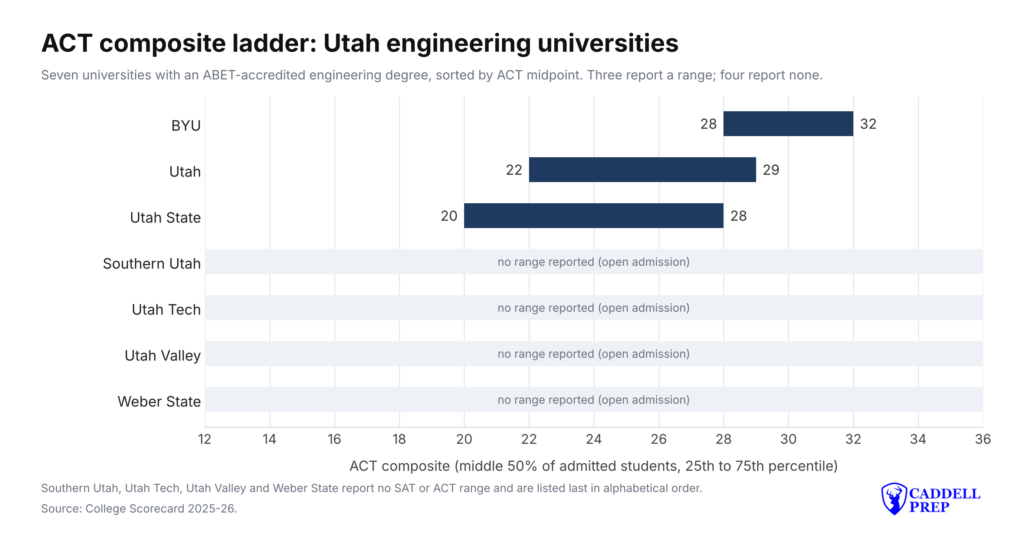
A student can see where his ACT score sits on this list in the image above.
Want to Know What 5 Topics Will Improve Your SAT Score the Most?
Sample Feedback from our Diagnostic Test:

Brigham Young University
Brigham Young University’s Ira A. Fulton College of Engineering in Provo holds ABET accreditation in chemical, civil, computer, electrical, manufacturing and mechanical engineering [VERIFY list on abet.org], and BYU is the largest school on the page and the only private.
ACT composite 28 to 32. Reading & Writing 640 to 730, Math 630 to 730. The top quarter of admitted students scored at or above 32 on the ACT and 730 on Math. Cost of attendance $22,690, with tuition and fees at $6,688 for all students in the Scorecard, the member rate for 2024-25. 32,952 undergraduates, 68% admitted.
BYU is owned by The Church of Jesus Christ of Latter-day Saints, admits 68% on the highest range on the page, and has the lowest cost of attendance of the three reporting schools. Its two tuition rates and its mechanical engineering admission rule are described in the next section.
University of Utah
The University of Utah’s John and Marcia Price College of Engineering in Salt Lake City holds ABET accreditation in biomedical, chemical, civil, computer, electrical, materials science, mechanical and nuclear engineering [VERIFY list on abet.org], and Utah is the state’s flagship and the most expensive school on the page for a non-resident.
ACT composite 22 to 29. Reading & Writing 600 to 690, Math 590 to 690. The top quarter of admitted students scored at or above 29 on the ACT and 690 on Math. Cost of attendance $25,557, with tuition and fees at $9,620 in state and $30,860 out of state. 27,264 undergraduates, 86% admitted.
Utah charges a non-resident $30,860, $6,058 more than Utah State and more than twice what BYU charges a non-member, and its ACT range sits six points below BYU’s at the floor and three below it at the ceiling. It is the third-largest school on the page, behind BYU and Utah Valley.
Utah State University
Utah State University’s College of Engineering in Logan holds ABET accreditation in biological, civil, computer, electrical, environmental and mechanical engineering [VERIFY list on abet.org], and Utah State is the state’s land-grant university.
ACT composite 20 to 28. Reading & Writing 540 to 650, Math 530 to 640. The top quarter of admitted students scored at or above 28 on the ACT and 640 on Math. Cost of attendance $21,654, with tuition and fees at $9,228 in state and $24,802 out of state. 20,272 undergraduates, 92% admitted.
Utah State is the least selective reporting school on the page, admitting 92%, and its Math range sits 60 points below Utah’s at the floor and 50 below it at the ceiling. It is eighty miles north of Salt Lake City in Cache Valley.
Southern Utah University
Southern Utah University’s engineering programs in Cedar City hold ABET accreditation in civil and mechanical engineering, each “accredited by the Engineering Accreditation Commission of ABET” in the university’s words, and Southern Utah is the one open-admission public on the page that reports an admit rate.
Southern Utah reports no SAT or ACT range. Cost of attendance $19,416, with tuition and fees at $6,962 in state and $21,192 out of state. 9,289 undergraduates, 82% admitted.
Southern Utah charges a non-resident $21,192, the highest figure among the four open-admission publics, and its engineering technology degree is accredited separately and does not count toward its row. It is in the southwest of the state, near Zion and Bryce Canyon.
Utah Tech University
Utah Tech University’s engineering department in St. George holds ABET accreditation in mechanical and electrical engineering, which the university announced on October 30, 2025 had “recently earned accreditation,” and Utah Tech is the newest engineering school on the page.
Utah Tech reports no SAT or ACT range. Cost of attendance $20,763, with tuition and fees at $6,306 in state and $18,246 out of state. 8,552 undergraduates, admit rate not reported.
Utah Tech, the former Dixie State University, charges a resident $6,306, the lowest in-state figure on the page, and its accreditation is weeks old as of this draft. The Scorecard classes it as certificate-predominant and carries no admit rate for it.
Utah Valley University
Utah Valley University’s engineering programs in Orem hold ABET accreditation in civil, computer, electrical, mechanical and software engineering, “accredited by the Engineering Accreditation Commission (EAC) of ABET” since 2021 in the university’s words, and Utah Valley is the second-largest school on the page.
Utah Valley reports no SAT or ACT range. Cost of attendance $14,765, with tuition and fees at $6,507 in state and $18,489 out of state. 28,453 undergraduates, admit rate not reported.
Utah Valley introduced its civil, mechanical and electrical engineering programs in 2018, has the lowest cost of attendance on the page, and is larger than the University of Utah by 1,189 students. It is five miles from BYU, and the Scorecard classes it as associate-predominant.
Weber State University
Weber State University’s College of Engineering, Applied Science and Technology in Ogden holds ABET accreditation in electrical and computer engineering, “accredited by the Engineering Accreditation Commission of ABET” in the university’s words, and Weber State charges a non-resident less than any other public on the page.
Weber State reports no SAT or ACT range. Cost of attendance $16,035, with tuition and fees at $6,557 in state and $17,545 out of state. 16,360 undergraduates, admit rate not reported.
Weber State charges a non-resident $17,545, the lowest public figure on the page, and its engineering technology degrees do not count toward its row. The Scorecard classes it as associate-predominant and carries no admit rate for it.
Three ranges and four blanks say who got in. At the school with the highest range, the price depends on a question no other school on these pages asks, and the next section is about it.
Why Does BYU Charge Two Tuition Rates, and Which One Does a New York Student Pay?
BYU charges two tuition rates because, in the university’s words, “Church members are assessed lower tuition fees than those who are not members,” and a New York student pays the member rate if he is a member of The Church of Jesus Christ of Latter-day Saints and the non-member rate if he is not.
The figures are published for 2026-27. A Latter-day Saint undergraduate taking 12 or more credit hours pays $3,548 a semester in fall and winter, and a non-member pays $7,096. Two semesters come to $7,096 for a member and $14,192 for a non-member. The university’s page says it is a non-profit affiliated with the Church, that tithes from Church members pay a significant portion of its operating costs, and it compares the difference to a state university charging non-residents more than residents. A student is counted as a member if he was baptized at any time during the semester or term.
The Scorecard reports one figure, $6,688, and that is the member rate for 2024-25: two semesters of $3,344, from the university’s detailed tuition schedule for fall 2024 and winter 2025. A New York family reading the Scorecard figure and not a member is reading half its price.
Now set the non-member rate against the state. BYU reports an ACT range of 28 to 32 and a Math range of 630 to 730, the highest on the page, and admits 68%. Its non-member rate of $14,192 is below every public non-resident figure in Utah: Weber State $17,545, Utah Tech $18,246, Utah Valley $18,489, Southern Utah $21,192, Utah State $24,802 and Utah $30,860. A New York student who is not a member pays BYU $3,353 less than he pays the cheapest Utah public and $16,668 less than he pays the flagship, for an engineering college whose ACT floor sits six points above the flagship’s. A member pays $7,096, below the resident figure at Utah and Utah State and above it at the four open-admission publics.
| University | Tuition for a New York student | ACT composite |
|---|---|---|
| BYU, Church member (2026-27) | $7,096 | 28 to 32 |
| BYU, non-member (2026-27) | $14,192 | 28 to 32 |
| Weber State University | $17,545 | Does not report |
| Utah Tech University | $18,246 | Does not report |
| Utah Valley University | $18,489 | Does not report |
| Southern Utah University | $21,192 | Does not report |
| Utah State University | $24,802 | 20 to 28 |
| University of Utah | $30,860 | 22 to 29 |
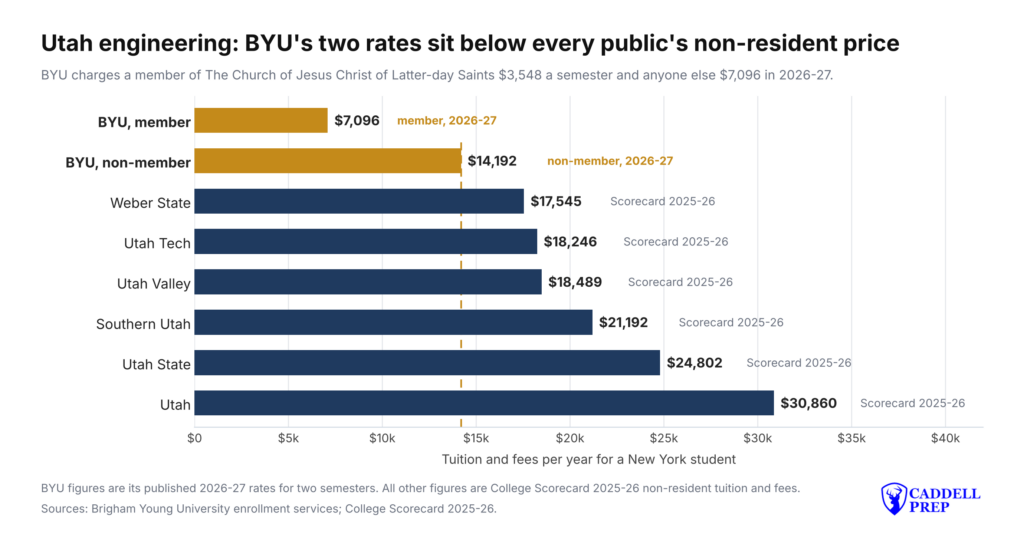
The image above lines up what a New York student pays at each of the seven, with BYU’s two rates at the top.
Take a New York student with a 26 on the ACT who is not a member. At BYU he is two points below the floor of 28 to 32 and, if admitted, pays $14,192. At Utah he is in the upper half of 22 to 29 and pays $30,860. At Utah State he is in the upper half of 20 to 28 and pays $24,802. At Utah Valley there is no range to read and he pays $18,489. At Weber State there is no range and he pays $17,545. Now make the same student a member. BYU’s price falls to $7,096 and nothing else on the list moves. The score places him outside BYU’s range and the price places BYU below every other school on his list, and both are true at once.
BYU’s second number is a gate inside the college. BYU admits to the university and not to the engineering major, and the mechanical engineering department publishes how it fills the major. “Only 260 students are granted acceptance to the professional program each year based on the Application GPA,” and that GPA is built from equally weighted grades in the student’s first BYU physics course, first BYU math course, first BYU mechanics course and ME EN 191. The department posts the cutoff by term, and it has risen from 3.03 for winter 2024 to 3.4 for fall 2026. Applications are taken in three ten-day windows a year, February 1 to 10, July 1 to 10 and October 1 to 10, and “each course may be retaken only ONE time (includes withdraws).” A student must declare a major by 60 earned BYU credit hours. That is the shape of the gate on our page on engineering colleges in Texas, where Texas A&M places engineering students by a 3.75 and capacity, at a university charging a non-member less than half what Texas A&M charges a non-resident.
Utah’s third number is a count. Four of the state’s six public engineering schools are open-admission universities that report no score range and hold accredited engineering degrees. Utah Valley has held EAC accreditation in civil, computer, electrical, mechanical and software engineering since 2021, three years after it introduced three of the five. Weber State holds it in electrical and computer engineering, Southern Utah in civil and mechanical, and Utah Tech in mechanical and electrical, announced on October 30, 2025. All four charge a resident less than $7,000 and a non-resident less than $21,200, and Utah Valley, at 28,453 undergraduates, is larger than the flagship. On our page on engineering colleges in South Dakota the whole state’s public engineering sat under $15,000 for a non-resident. Utah’s open-admission four sit under $21,200, and the private school above them all on score sits under $14,200.
The honest version is that BYU’s price comes with conditions, and the conditions are not in the table. Every BYU student, member or not, agrees to the university’s Honor Code and obtains an ecclesiastical endorsement [VERIFY the wording and the endorsement rule for non-members on byu.edu], and the large majority of students are members. A non-member New York family should read those before the price. The non-member rate is double the member rate by design, and the page gives the university’s own reason without adding one. The Scorecard figure is the 2024-25 member rate and the page gives the 2026-27 rates with their year. The mechanical engineering gate is one department’s rule, and the other engineering departments publish their own [VERIFY civil, electrical and chemical on byu.edu]. The four open-admission publics report no range, and the page does not estimate one.
Families who are not members of the Church frequently ask the question underneath the price.
Does a Non-Member Pay More at BYU?
A non-member pays more at BYU. The 2026-27 rate is $7,096 a semester for a non-member against $3,548 for a Latter-day Saint, double, by the university’s stated policy, and a student is counted as a member if he was baptized at any time during the semester or term.
The non-member rate for two semesters, $14,192, is still below what any Utah public university charges a non-resident, and a New York student who is not a member should read the table in this section with that row and not the Scorecard’s.
The price is BYU’s. The degrees are what the next section lists.
Which Utah Universities Have ABET-Accredited Engineering Schools?
Seven Utah universities hold ABET-accredited engineering bachelor’s degrees, six public and one private, and all seven are in the table above.
Six of the seven are on or near the Wasatch Front. In Provo, BYU’s Ira A. Fulton College of Engineering, with Utah Valley five miles north in Orem. In Salt Lake City, Utah’s Price College of Engineering, with Weber State forty miles north in Ogden and Utah State eighty miles north in Logan. In the south of the state, Southern Utah in Cedar City and Utah Tech in St. George. The accreditation dates on the page are the universities’ own: Utah Valley in 2021, Utah Tech in October 2025.
Accreditation matters for a reason that is easy to miss at seventeen. Licensure as a professional engineer normally requires a degree from an ABET-accredited engineering program, and that is why Southern Utah’s and Weber State’s engineering technology degrees do not count toward their rows. Westminster, Western Governors, Ensign and Neumont award no engineering degree.
Nothing on this page ranks the seven. The table’s order is a stated, verifiable number where one exists, and the choice among accredited programs comes down to cost, discipline and where a student’s score places him.
What If Your Score Is Below the Range You Want?
In Utah seven schools cover ACT ranges from a 20 floor to a 32 ceiling where ranges are reported, six of them are public, and a New York student’s price runs from $14,192 to $30,860. The score decides BYU or not. Below BYU, four schools do not read the score at all.
The gap from a 26 to BYU’s floor of 28 is two points of ACT composite, one or two questions a section, and the student who closes it is inside the range at the school that charges him least. The gap from a 26 to the top quarter at Utah is three points.
The first step is finding out where the score actually is, section by section. A free diagnostic SAT gives a score that can be set against the SAT columns in the table and converted to the ACT scale for the rest of it.
The Math section rewards the same handful of topics on every test date, and a student who knows which of them he is missing can close a gap of 50 to 100 points in weeks rather than months. The method is on our page on improving your SAT Math score, and the same topics carry the ACT Math section.
How to Read These Score Ranges
Every range on this page covers the middle 50% of admitted students who submitted that test. The lower number is the 25th percentile and the upper number is the 75th, so a quarter of admitted students scored at or above it.
A price with a condition on it is still a price, and the range does not show the condition. BYU’s 28 to 32 describes who got in, and its two rates describe what each of them paid, and a student should read the range for admission and the conditions for the price.
Because most colleges are now test-optional, the ranges that are published describe only the students who chose to submit at all. Students with strong scores submit and students with weak ones don’t, so a published range sits higher than the range for everyone who was actually admitted. More on what SAT score you need for college and on test-optional colleges.
Should You Take the SAT Instead?
Utah gives the ACT to every public school junior as the state test [VERIFY with the Utah State Board of Education], and the three universities on this page that report a range report both tests.
That is why the table carries an ACT composite column and is sorted by it. All seven universities accept either test, four do not read one, and a student from outside Utah who holds an SAT should read the SAT columns and submit the test he scores higher on.
Engineering Programs in Nearby States
Utah borders Idaho, Wyoming, Colorado, New Mexico, Arizona and Nevada, and BYU-Idaho, on our Idaho page with 44,397 undergraduates and the same two-rate tuition, draws many of the same families.
See engineering colleges in Idaho, engineering colleges in Colorado, and engineering colleges in Nevada.
Engineering Colleges in Other States
We publish the same breakdown for engineering programs in every state.
See engineering colleges by state for the full list.

Glyn Caddell
Glyn Caddell holds a BS in Mechanical Engineering from NJIT and has been tutoring New York City students since 2008. He founded Caddell Prep in 2012 and is the author of Digital SAT Math Secrets: Lessons & Tricks to Quickly Improve to a Perfect 800 on the Math Test, which contains over 900 practice problems and is used in Caddell Prep’s SAT math classes. He is founding president of the Staten Island Technical High School alumni association and teaches every lesson on this site personally.
Finally, an SAT course that students actually understand
Every question has a video explanation. Not most — every one.
The on-demand Digital SAT course covers all 17 math topics and 15 reading and writing topics, with 5 full-length practice tests and a 100-point score increase guarantee. Keep access for the rest of high school. No subscription.
Want to Know What 5 Topics Will Improve Your SAT Score the Most?
Sample Feedback from our Diagnostic Test: