
Home » College SAT Score Ranges, Costs, and Programs by Major and State » Engineering Colleges by State: SAT Scores, ACT Scores, Costs, and ABET Programs » Engineering Colleges in New York: SAT Scores, Costs, and Programs
By Glyn Caddell, BSME · Author of Digital SAT Math Secrets · Tutoring since 2008 — Updated October 25, 2026
Twenty-eight New York schools offer ABET-accredited engineering degrees, and this page lists what they cost and the SAT scores of the students they admit.
Three of them charge every admitted student nothing, half, or $895 in tuition regardless of where he lives, and one of the three is the smallest college in this series, a set covered below the table.
Scores are given by section and the table is sorted by Math, with the two schools that report no range listed last.
Table of Contents
- New York Engineering Colleges by SAT Math Score
- Which New York Engineering Schools Cover Tuition for Every Student?
- Which New York Schools Have ABET-Accredited Engineering Programs?
- What If Your Score Is Below the Range You Want?
New York Engineering Colleges by SAT Math Score
The twenty-eight schools below are the ones in New York that hold an ABET-accredited bachelor’s degree in an engineering discipline. The twenty-six that report scores are sorted by the midpoint of the SAT Math range, so the order can be checked from the table itself, and the two that do not are listed last in alphabetical order.
| College | SAT Reading & Writing | SAT Math | Cost of attendance | Undergraduates | Admit rate |
|---|---|---|---|---|---|
| Columbia University | 740 to 780 | 770 to 800 | $89,472 | 8,973 | 4% |
| Cornell University | 730 to 770 | 770 to 800 | $88,140 | 15,995 | 9% |
| New York University | 720 to 760 | 760 to 800 | $84,374 | 28,663 | 9% |
| University of Rochester | 680 to 750 | 730 to 790 | $85,962 | 6,331 | 40% |
| Webb Institute | 710 to 750 | 720 to 780 | $81,950 | 106 | 14% |
| Rensselaer Polytechnic Institute | 670 to 740 | 705 to 770 | $82,404 | 5,714 | 63% |
| Stony Brook University | 650 to 730 | 680 to 770 | $30,539 | 18,101 | 49% |
| Binghamton University | 670 to 740 | 670 to 760 | $30,345 | 14,655 | 39% |
| Union College | 660 to 720 | 650 to 760 | $84,561 | 2,046 | 44% |
| The Cooper Union | 653 to 748 | 642 to 753 | $64,190 | 842 | 21% |
| Rochester Institute of Technology | 650 to 720 | 650 to 740 | $74,626 | 13,215 | 67% |
| Syracuse University | 640 to 720 | 630 to 720 | $84,517 | 15,477 | 46% |
| New York Institute of Technology | 590 to 690 | 600 to 730 | $56,976 | 3,440 | 81% |
| United States Military Academy | 600 to 710 | 600 to 720 | No tuition | 4,408 | 12% |
| Hofstra University | 620 to 700 | 610 to 700 | $70,624 | 6,488 | 68% |
| University at Buffalo | 600 to 680 | 610 to 700 | $30,785 | 20,112 | 74% |
| Clarkson University | 590 to 690 | 610 to 700 | $79,022 | 2,196 | 77% |
| Manhattan University | 580 to 680 | 600 to 678 | $64,348 | 2,744 | 79% |
| CUNY City College | 540 to 700 | 530 to 730 | $14,403 | 12,505 | 60% |
| SUNY New Paltz | 600 to 690 | 570 to 650 | $28,428 | 6,086 | 62% |
| SUNY Polytechnic Institute | 505 to 680 | 520 to 690 | $23,741 | 1,849 | 81% |
| SUNY Maritime College | 570 to 640 | 553 to 648 | $29,786 | 1,285 | 72% |
| United States Merchant Marine Academy | 560 to 650 | 550 to 650 | $9,168 | 962 | 34% |
| Alfred University | 555 to 660 | 540 to 650 | $57,445 | 1,423 | 74% |
| SUNY Oswego | 530 to 630 | 540 to 640 | $27,052 | 5,473 | 81% |
| CUNY College of Staten Island | 460 to 620 | 430 to 630 | $14,795 | 9,657 | 92% |
| University at Albany | Does not report SAT data | Does not report SAT data | $28,802 | 12,564 | 69% |
| Vaughn College of Aeronautics and Technology | Does not report SAT data | Does not report SAT data | $47,346 | 1,302 | Not reported |
Each range covers the middle 50% of admitted students who submitted the SAT. A quarter scored below the lower number, and the top quarter scored at or above the upper one. Being under the lower number does not rule a student out, and being just above it is not as safe as it looks.
Columbia and Cornell share a Math range and are ordered by the Reading & Writing midpoint. Hofstra, Buffalo and Clarkson share a Math range and are ordered by the Reading & Writing midpoint, then by the ACT 25th percentile. Only schools with an ABET-accredited engineering bachelor’s degree are listed. New York City College of Technology’s, Buffalo State’s and Farmingdale State’s engineering technology degrees are accredited under a separate ABET commission and do not qualify them for the list. West Point charges no tuition and requires five years of active-duty service after graduation. Webb’s, the Cooper Union’s and the Merchant Marine Academy’s cost figures are sticker figures before the universal scholarships described below the table. The University at Albany and Vaughn College report no SAT or ACT range to the Scorecard and are listed last.
Three things about that table are worth pausing on.
Webb Institute, the Cooper Union and the Merchant Marine Academy charge every admitted student nothing, half, or $895 in tuition, whatever state he lives in. The Scorecard shows Webb at $63,214 and Cooper at $46,820, and neither figure is what any student pays. The next section is about the three.
CUNY City College charges a New York resident $7,340, the lowest in-state tuition at an accredited engineering school on any page in this series, and reports a Math range of 530 to 730, 200 points wide, the widest on any page in this series. The Grove School of Engineering admits a class whose Math scores run from below SUNY Oswego’s floor to above RIT’s ceiling.
Columbia, Cornell and NYU report Math floors of 770, 770 and 760. Only one other page in this series, Massachusetts, has three schools whose bottom quarter of admitted students scored 760 or above. Two of New York’s three are in New York City, and the third is 220 miles away in Ithaca.
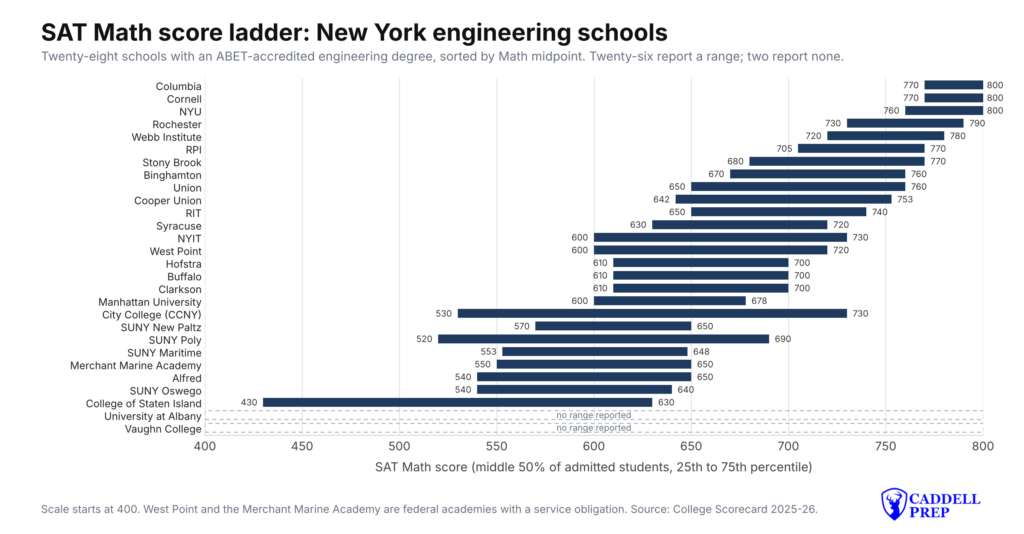
A student can see where his Math score sits on this list in the image above.
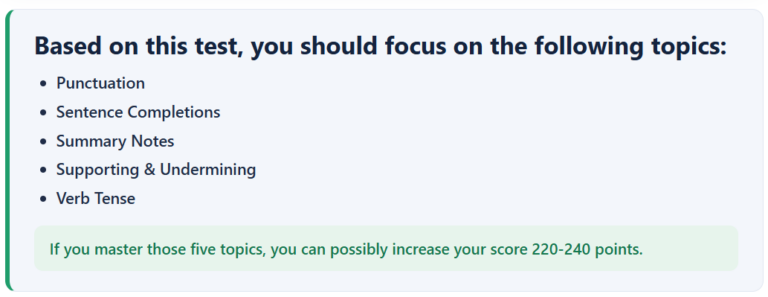
Want to Know What 5 Topics Will Improve Your SAT Score the Most?
Sample Feedback from our Diagnostic Test:
Columbia University
Columbia University’s Fu Foundation School of Engineering and Applied Science holds ABET accreditation in disciplines including biomedical, chemical, civil, earth and environmental, electrical, industrial, materials and mechanical engineering, and Columbia has the highest Math range on the page, shared with Cornell.
Reading & Writing 740 to 780, Math 770 to 800. The top quarter of admitted students scored 800 on Math. Cost of attendance $89,472, with tuition and fees at $71,845 for all students. 8,973 undergraduates, 4.0% admitted.
Columbia is the most selective school on the page, the most expensive by total cost and by tuition, and the sixth school in this series whose Math floor sits at 770 or above.
Cornell University
Cornell University’s College of Engineering in Ithaca holds ABET accreditation in disciplines including biological, chemical, civil, computer, electrical, environmental, materials, mechanical and operations research engineering, and Cornell shares the highest Math range on the page with Columbia.
Reading & Writing 730 to 770, Math 770 to 800. The top quarter of admitted students scored 800 on Math. Cost of attendance $88,140, with tuition and fees at $69,314 for all students. 15,995 undergraduates, 8.8% admitted.
Cornell is the only Ivy League engineering college outside New York City on the page and the second-largest private school on it, and its Reading & Writing floor sits 10 points under Columbia’s on an identical Math range.
New York University
New York University’s Tandon School of Engineering in Brooklyn holds ABET accreditation in disciplines including biomolecular, chemical, civil, computer, electrical and mechanical engineering, and NYU is the largest school on the page.
Reading & Writing 720 to 760, Math 760 to 800. The top quarter of admitted students scored 800 on Math. Cost of attendance $84,374, with tuition and fees at $62,796 for all students. 28,663 undergraduates, 9.2% admitted.
NYU is the largest school on the page by 8,500 students and the cheapest of the three New York schools whose top quarter scored a perfect 800 on Math, by $6,518 against Cornell and $9,049 against Columbia.
University of Rochester
The University of Rochester’s Hajim School of Engineering and Applied Sciences holds ABET accreditation in disciplines including biomedical, chemical, electrical and computer, mechanical and optical engineering, and Rochester holds the only accredited optical engineering degree on any page in this series.
Reading & Writing 680 to 750, Math 730 to 790. The top quarter of admitted students scored at or above 790 on Math. Cost of attendance $85,962, with tuition and fees at $67,080 for all students. 6,331 undergraduates, 40% admitted.
Rochester admits 40% of applicants on a Math range whose floor is 30 points above Stony Brook’s and 50 above Binghamton’s, the two public universities nearest it in the table.
Webb Institute
Webb Institute in Glen Cove awards one degree, a dual Bachelor of Science in Naval Architecture and Marine Engineering, and Webb awards a full-tuition scholarship to every enrolled student who is a United States citizen or permanent resident.
Reading & Writing 710 to 750, Math 720 to 780. The top quarter of admitted students scored at or above 780 on Math. Cost of attendance $81,950, with tuition and fees at $63,214 for all students before the scholarship, which covers all of it. 106 undergraduates, 14% admitted.
Webb is the smallest college on any page in this series, by a factor of three against the next smallest, and the one school in the series where every student pays no tuition without a service obligation. Its Math floor of 720 is above Stony Brook’s, Binghamton’s and Union’s.
Rensselaer Polytechnic Institute
Rensselaer Polytechnic Institute in Troy holds ABET accreditation in disciplines including aeronautical, biomedical, chemical, civil, computer and systems, electrical, environmental, industrial and management, materials, mechanical and nuclear engineering, and RPI is the oldest technological university in the English-speaking world.
Reading & Writing 670 to 740, Math 705 to 770. The top quarter of admitted students scored at or above 770 on Math. Cost of attendance $82,404, with tuition and fees at $64,081 for all students. 5,714 undergraduates, 63% admitted.
RPI admits 63% of applicants on a Math range whose floor, 705, is above every public university’s on the page, and it holds more accredited engineering disciplines than any other school in the state.
Stony Brook University
Stony Brook University’s College of Engineering and Applied Sciences holds ABET accreditation in disciplines including biomedical, chemical and molecular, civil, computer, electrical and mechanical engineering, and Stony Brook has the highest Math range among the public universities on the page.
Reading & Writing 650 to 730, Math 680 to 770. The top quarter of admitted students scored at or above 770 on Math. Cost of attendance $30,539, with tuition and fees at $10,931 in state and $32,741 out of state. 18,101 undergraduates, 49% admitted.
Stony Brook’s Math ceiling of 770 matches RPI’s, at a sixth of RPI’s tuition for a resident. It is the only SUNY university center that admits fewer than half of its applicants other than Binghamton.
Binghamton University
Binghamton University’s Thomas J. Watson College of Engineering and Applied Science holds ABET accreditation in biomedical, computer, electrical, industrial and systems, and mechanical engineering, and Binghamton is the most selective public university on the page.
Reading & Writing 670 to 740, Math 670 to 760. The top quarter of admitted students scored at or above 760 on Math. Cost of attendance $30,345, with tuition and fees at $10,567 in state and $30,447 out of state. 14,655 undergraduates, 39% admitted.
Binghamton admits 39% of applicants, the lowest rate among the publics, and its Reading & Writing range of 670 to 740 is the highest among them. Its in-state tuition is the lowest of the three SUNY university centers by $364.
Union College
Union College in Schenectady holds ABET accreditation in biomedical, computer, electrical and mechanical engineering, and Union is the only liberal arts college on the page with accredited engineering degrees.
Reading & Writing 660 to 720, Math 650 to 760. The top quarter of admitted students scored at or above 760 on Math. Cost of attendance $84,561, with tuition and fees at $69,039 for all students. 2,046 undergraduates, 44% admitted.
Union has taught engineering since 1845, longer than any liberal arts college in the country, and its Math range is 110 points wide, the second-widest among the private schools on the page.
The Cooper Union
The Cooper Union for the Advancement of Science and Art’s Albert Nerken School of Engineering in Manhattan holds ABET accreditation in chemical, civil, electrical and mechanical engineering, and the Cooper Union awards a half-tuition scholarship to every enrolled undergraduate.
Reading & Writing 653 to 748, Math 642 to 753. The top quarter of admitted students scored at or above 753 on Math. Cost of attendance $64,190, with tuition and fees at $46,820 for all students before the scholarship of $22,275 a year that every undergraduate receives. 842 undergraduates, 21% admitted.
The Cooper Union is the third most selective private school on the page after Columbia and Cornell, and the second-smallest, and its Math range of 642 to 753 is the second-widest among the privates, at 111 points, after NYIT’s.
Rochester Institute of Technology
Rochester Institute of Technology’s Kate Gleason College of Engineering holds ABET accreditation in disciplines including biomedical, chemical, computer, electrical, industrial and systems, mechanical and microelectronic engineering, and RIT requires paid cooperative education of every engineering student.
Reading & Writing 650 to 720, Math 650 to 740. The top quarter of admitted students scored at or above 740 on Math. Cost of attendance $74,626, with tuition and fees at $59,274 for all students. 13,215 undergraduates, 67% admitted.
RIT is the third-largest private school on the page and holds the only accredited microelectronic engineering degree in this series. Its Math ceiling of 740 is 10 points above Syracuse’s.
Syracuse University
Syracuse University’s College of Engineering and Computer Science holds ABET accreditation in aerospace, bioengineering, chemical, civil, computer, electrical, environmental and mechanical engineering, and Syracuse has the second-highest cost of attendance on the page.
Reading & Writing 640 to 720, Math 630 to 720. The top quarter of admitted students scored at or above 720 on Math. Cost of attendance $84,517, with tuition and fees at $65,528 for all students. 15,477 undergraduates, 46% admitted.
Syracuse holds one of two accredited aerospace engineering degrees on the page, with Buffalo’s, and its cost of attendance is $143 above NYU’s.
New York Institute of Technology
New York Institute of Technology’s College of Engineering and Computing Sciences, in Old Westbury and Manhattan, holds ABET accreditation in electrical and computer engineering and mechanical engineering, and NYIT has the widest Math range among the private schools on the page.
Reading & Writing 590 to 690, Math 600 to 730. The top quarter of admitted students scored at or above 730 on Math. Cost of attendance $56,976, with tuition and fees at $46,560 for all students. 3,440 undergraduates, 81% admitted.
NYIT admits 81% of applicants on a Math range of 600 to 730, 130 points wide, and its Math ceiling matches CUNY City College’s at a tuition six times higher.
United States Military Academy
The United States Military Academy at West Point holds ABET accreditation in disciplines including chemical, civil, electrical, environmental, mechanical, nuclear and systems engineering, and West Point charges no tuition.
Reading & Writing 600 to 710, Math 600 to 720. The top quarter of admitted students scored at or above 720 on Math. No tuition, room or board is charged, and cadets are paid a stipend. 4,408 undergraduates, 12% admitted.
West Point is the third most selective school on the page, requires a nomination from a member of Congress or another authorized source to apply, and requires five years of active-duty service as a commissioned officer after graduation.
Hofstra University
Hofstra University’s Fred DeMatteis School of Engineering and Applied Science in Hempstead holds ABET accreditation in disciplines including bioengineering, civil, electrical, industrial and mechanical engineering, and Hofstra shares its Math range with Buffalo and Clarkson.
Reading & Writing 620 to 700, Math 610 to 700. The top quarter of admitted students scored at or above 700 on Math. Cost of attendance $70,624, with tuition and fees at $57,660 for all students. 6,488 undergraduates, 68% admitted.
Hofstra is listed first of the three schools at 610 to 700 on its Reading & Writing range, 620 to 700, and it is the only one of the three on Long Island.
University at Buffalo
The University at Buffalo’s School of Engineering and Applied Sciences holds ABET accreditation in disciplines including aerospace, biomedical, chemical, civil, computer, electrical, environmental, industrial and mechanical engineering, and Buffalo is the largest public university on the page.
Reading & Writing 600 to 680, Math 610 to 700. The top quarter of admitted students scored at or above 700 on Math. Cost of attendance $30,785, with tuition and fees at $10,936 in state and $31,536 out of state. 20,112 undergraduates, 74% admitted.
Buffalo is the largest of the SUNY university centers by 2,000 students and the least selective of the three, and it holds nine accredited engineering disciplines, the most of any public university in the state.
Clarkson University
Clarkson University’s Wallace H. Coulter School of Engineering in Potsdam holds ABET accreditation in disciplines including aeronautical, chemical, civil, computer, electrical, environmental, mechanical and software engineering, and Clarkson is the northernmost engineering school on the page.
Reading & Writing 590 to 690, Math 610 to 700. The top quarter of admitted students scored at or above 700 on Math. Cost of attendance $79,022, with tuition and fees at $59,398 for all students. 2,196 undergraduates, 77% admitted.
Clarkson shares its Math range with Hofstra and Buffalo and is listed last of the three on its ACT 25th percentile of 25. Its cost of attendance is the fourth-highest among the privates with a Math floor under 700.
Manhattan University
Manhattan University’s School of Engineering in Riverdale holds ABET accreditation in chemical, civil, computer, electrical and mechanical engineering, and Manhattan is the only Catholic university on the page with accredited engineering degrees.
Reading & Writing 580 to 680, Math 600 to 678. The top quarter of admitted students scored at or above 678 on Math. Cost of attendance $64,348, with tuition and fees at $53,400 for all students. 2,744 undergraduates, 79% admitted.
Manhattan’s Math ceiling of 678 is the only unrounded private figure on the page, and its range is 78 points wide, the narrowest among the schools below Rochester.
CUNY City College
The City College of New York’s Grove School of Engineering in Harlem holds ABET accreditation in biomedical, chemical, civil, computer, earth system science and environmental, electrical and mechanical engineering, and City College charges the lowest in-state tuition at any accredited engineering school in this series.
Reading & Writing 540 to 700, Math 530 to 730. The top quarter of admitted students scored at or above 730 on Math. Cost of attendance $14,403, with tuition and fees at $7,340 in state and $15,290 out of state. 12,505 undergraduates, 60% admitted.
City College’s Math range of 530 to 730 is 200 points wide, the widest on any page in this series, and its out-of-state tuition of $15,290 is below the in-state tuition at eleven public universities on drafted pages. The Grove School is the only public engineering school in New York City.
SUNY New Paltz
SUNY New Paltz’s School of Science and Engineering holds ABET accreditation in computer, electrical and mechanical engineering, and New Paltz is the only SUNY comprehensive college on the page with three accredited engineering degrees.
Reading & Writing 600 to 690, Math 570 to 650. The top quarter of admitted students scored at or above 650 on Math. Cost of attendance $28,428, with tuition and fees at $8,572 in state and $18,822 out of state. 6,086 undergraduates, 62% admitted.
New Paltz’s Reading & Writing range sits 30 points above its Math range at the floor and 40 at the ceiling, the widest such gap among the publics on the page.
SUNY Polytechnic Institute
SUNY Polytechnic Institute in Utica holds ABET accreditation in civil, computer, electrical and mechanical engineering, and SUNY Poly has the widest Math range among the SUNY schools on the page.
Reading & Writing 505 to 680, Math 520 to 690. The top quarter of admitted students scored at or above 690 on Math. Cost of attendance $23,741, with tuition and fees at $8,625 in state and $21,215 out of state. 1,849 undergraduates, 81% admitted.
SUNY Poly’s Math range of 520 to 690 is 170 points wide, and its Reading & Writing floor of 505 is the lowest on the page other than City College’s and the College of Staten Island’s.
SUNY Maritime College
SUNY Maritime College at Fort Schuyler in the Bronx holds ABET accreditation in electrical, mechanical, naval architecture and marine engineering, and SUNY Maritime is the only public school on the page whose engineering students may also sit for a Coast Guard license.
Reading & Writing 570 to 640, Math 553 to 648. The top quarter of admitted students scored at or above 648 on Math. Cost of attendance $29,786, with tuition and fees at $8,589 in state and $19,159 out of state. 1,285 undergraduates, 72% admitted.
SUNY Maritime’s Math range is reported to the point, 553 to 648, and its license-track students spend their summers at sea aboard the training ship. Its in-state tuition is $17 above New Paltz’s.
United States Merchant Marine Academy
The United States Merchant Marine Academy at Kings Point holds ABET accreditation in marine engineering, marine engineering systems, and marine engineering and shipyard management, and the Academy provides tuition, room and board in exchange for a service obligation after graduation.
Reading & Writing 560 to 650, Math 550 to 650. The top quarter of admitted students scored at or above 650 on Math. The Scorecard lists tuition and fees at $895 and a cost of attendance of $9,168, and the Congressional Research Service puts the midshipman’s own attendance expenses at approximately $5,000 a year. 962 undergraduates, 34% admitted.
Kings Point admits approximately 225 students a year through congressional and other nominations and up to 40 more by the Maritime Administrator without nomination, and a graduate owes six years of merchant mariner licensure with eight years in a reserve component served concurrently, or five years of active duty in any uniformed service, or five years in a federal civilian maritime role.
Alfred University
Alfred University’s Inamori School of Engineering holds ABET accreditation in ceramic, glass, materials, mechanical and renewable energy engineering, and Alfred holds the only accredited ceramic and glass engineering degrees in this series.
Reading & Writing 555 to 660, Math 540 to 650. The top quarter of admitted students scored at or above 650 on Math. Cost of attendance $57,445, with tuition and fees at $41,500 for all students. 1,423 undergraduates, 74% admitted.
Alfred’s ceramic engineering program is housed in the New York State College of Ceramics, a statutory college of SUNY inside a private university, and its tuition is the lowest among the private schools on the page other than Vaughn’s.
SUNY Oswego
SUNY Oswego’s engineering programs hold ABET accreditation in electrical and computer engineering and in software engineering, both accredited in 2019, and Oswego has the lowest Math ceiling among the SUNY schools on the page.
Reading & Writing 530 to 630, Math 540 to 640. The top quarter of admitted students scored at or above 640 on Math. Cost of attendance $27,052, with tuition and fees at $8,825 in state and $18,735 out of state. 5,473 undergraduates, 81% admitted.
Oswego is the newest SUNY engineering program on the page, and its Math floor of 540 matches Alfred’s on a ceiling 10 points lower.
CUNY College of Staten Island
The College of Staten Island’s engineering programs hold ABET accreditation in electrical engineering and engineering science, and the College of Staten Island has the lowest Math range on the page.
Reading & Writing 460 to 620, Math 430 to 630. The top quarter of admitted students scored at or above 630 on Math. Cost of attendance $14,795, with tuition and fees at $7,490 in state and $15,440 out of state. 9,657 undergraduates, 92% admitted.
The College of Staten Island is the least selective reporting school on the page and the only accredited engineering school on Staten Island, and its Math range of 430 to 630 is 200 points wide, matching City College’s as the widest in this series.
University at Albany
The University at Albany’s College of Nanotechnology, Science and Engineering holds ABET accreditation in electrical and computer engineering, and Albany reports no admitted score range.
Cost of attendance $28,802, with tuition and fees at $10,866 in state and $31,256 out of state. 12,564 undergraduates, 69% admitted.
Albany is the fourth SUNY university center and the one with the fewest accredited engineering degrees, and it reports no SAT or ACT range to the Scorecard.
Vaughn College of Aeronautics and Technology
Vaughn College of Aeronautics and Technology in Flushing holds ABET accreditation in mechatronic engineering, and Vaughn reports no admitted score range and no admit rate.
Cost of attendance $47,346, with tuition and fees at $29,810 for all students. 1,302 undergraduates, admit rate not reported.
Vaughn sits across the Grand Central Parkway from LaGuardia Airport, holds one accredited engineering degree, and reports no SAT or ACT range to the Scorecard.
Twenty-six ranges and two blanks say who got in. At three schools on the page, getting in settles the tuition for every student, and the next section is about them.
Which New York Engineering Schools Cover Tuition for Every Student?
Webb Institute awards a full-tuition scholarship to every enrolled student who is a United States citizen or permanent resident, the Cooper Union awards a half-tuition scholarship of $22,275 a year to every undergraduate, and the Merchant Marine Academy provides tuition, room and board to every midshipman in exchange for a service obligation after graduation.
The three policies are the schools’ own words. Webb’s admissions page: “A full-tuition scholarship is awarded to every enrolled student who is a US citizen or Permanent Resident.” Applicants “must have completed coursework in Calculus I and Physics,” the SAT or ACT is listed as recommended and not required, and finalists are invited to campus and must document citizenship or permanent residency. The Cooper Union’s financial aid page: “Every enrolled undergraduate student is awarded a half-tuition scholarship valued at $22,275 per school year.” The Congressional Research Service on Kings Point: the Academy “provides its students room, board, and tuition valued at approximately $300,000 over 4 years,” with the student responsible for approximately $5,000 a year in attendance expenses, and a graduate serves six years as a licensed merchant mariner with eight years in a reserve component concurrently, or five years on active duty, or five years in a federal civilian maritime job.
| School | Students | Admit rate | SAT Math, middle 50% | Sticker tuition (Scorecard) | What every student pays |
|---|---|---|---|---|---|
| Webb Institute | 106 | 14% | 720 to 780 | $63,214 | No tuition, for citizens and permanent residents |
| The Cooper Union | 842 | 21% | 642 to 753 | $46,820 | Half, after a $22,275 scholarship |
| Merchant Marine Academy | 962 | 34% | 550 to 650 | $895 | Fees and approximately $5,000 in expenses, plus the service obligation |
No other state in this series has one such school. The Naval Academy on our page on engineering colleges in Maryland and West Point above are federal academies that require a nomination and a commission. Olin, on our page on engineering colleges in Massachusetts, gives every student $10,000 against a $66,398 tuition. New York has three schools that cover all, half, or all but $895 of tuition for every admitted student, and the three together enroll approximately 1,900.
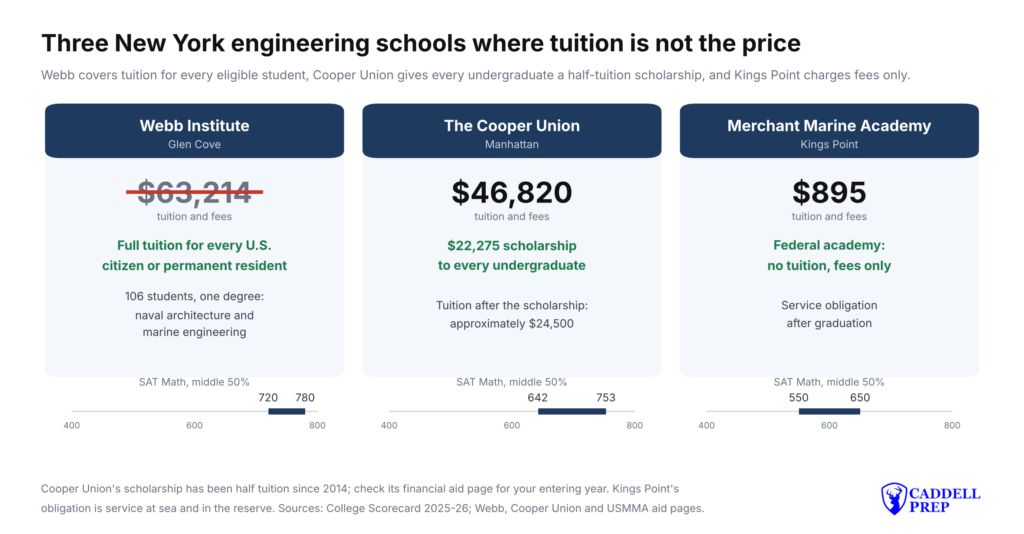
The image above shows nothing, half, and $895, for everyone admitted.
Webb is the clearest case in this series of a school where the score does not set the price and the transcript sets the gate. The scholarship is universal, so a 720 and a 780 pay the same. The test is recommended, so a student can apply without one. Calculus I and physics are required, so a student without them cannot. Olin requires the same two courses at a college of 375. Webb requires them at a college of 106 that awards one degree, in naval architecture and marine engineering, to a class of approximately 25 to 30 a year.
Take a Staten Island student with a 740 on Math and calculus and physics on his transcript. At Webb he is in the middle of the admitted range, one of approximately 25 to 30 admitted a year if he is admitted, and he pays no tuition for a naval architecture degree. At the Cooper Union he is in the upper half of the range and pays $24,545 in tuition after the scholarship. At Stony Brook he is in the upper half and pays $10,931. At Columbia he is 30 points below the floor and pays $71,845. The two private engineering schools on the page that charge him least are the fifth and tenth rows of the table, and neither price has anything to do with his score.
The public side of the page has its own numbers. City College’s Grove School of Engineering charges a resident $7,340, the lowest in-state tuition at an accredited engineering school on any page in this series, and reports the widest Math range in the series, 530 to 730. Stony Brook, Binghamton and Buffalo charge $10,931, $10,567 and $10,936 in state. New York’s Excelsior Scholarship covers SUNY and CUNY tuition for resident families under its income limit who meet its credit and residency terms, and the terms are on our page on pre-med colleges in New York. A New Jersey student reading this page pays the SUNY out-of-state figures, $30,447 to $32,741, and his own state’s four publics charge a New Yorker $25,752 to $37,664, on our page on engineering colleges in New Jersey. The two states’ students cross the Hudson in both directions, and this is the one page in the series where the out-of-state sentence is written for the other side.
The honest version has four parts. Webb’s scholarship is tuition only, and the Scorecard’s cost of attendance less tuition leaves approximately $18,700 a year in room, board and fees. Webb awards one degree, and a student who does not want ships has nothing there. The Cooper Union’s scholarship has been half tuition since 2014 after a century of full tuition, and its policy page is quoted here as it stands. A reader who has seen news of a tuition-free year or a return to full scholarships should check the page’s date against the year he will enroll. Kings Point’s price is the obligation, and six years at sea with eight in the reserve is a career, not a discount.
Families on Long Island reading Webb’s page frequently ask about the test.
Does Webb Require the SAT?
Webb does not require the SAT. Its admissions page lists the SAT or ACT as recommended, and what it requires is Calculus I and Physics on the transcript, United States citizenship or permanent residency for the scholarship, and a finalist visit to Glen Cove.
The range of 720 to 780 describes the students who enrolled and submitted a score, not a cutoff, and the transcript requirement is the gate. A student with a 700 and both courses is a candidate. A student with a 790 and no physics is not.
The three schools’ policies are their own. The degrees are what the next section lists.
Which New York Schools Have ABET-Accredited Engineering Programs?
Twenty-eight New York schools hold ABET-accredited engineering bachelor’s degrees, eleven public, fifteen private and two federal, and all twenty-eight are in the table above.
In New York City, Columbia’s engineering school is in Morningside Heights, NYU’s Tandon School is in downtown Brooklyn, the Cooper Union is on Cooper Square, City College’s Grove School is in Harlem, Manhattan University is in Riverdale, SUNY Maritime is at Fort Schuyler in the Bronx, Vaughn is in Flushing, and the College of Staten Island is in Willowbrook. On Long Island, Stony Brook, Hofstra, NYIT, Webb in Glen Cove and Kings Point hold engineering schools within forty miles of one another. In the Hudson Valley, West Point and SUNY New Paltz. In the Capital Region, RPI in Troy, Union in Schenectady and the University at Albany. In Central and Western New York, Cornell in Ithaca, Syracuse, Binghamton, Rochester and RIT, Alfred, Buffalo, Oswego and SUNY Poly in Utica, with Clarkson in Potsdam near the Canadian border. Brookhaven National Laboratory, IBM in the Hudson Valley, GlobalFoundries in Malta, Micron’s planned fabs in Clay, Con Edison, the MTA and the Port Authority are the largest engineering employers in the state.
Accreditation matters for a reason that is easy to miss at seventeen. Licensure as a professional engineer normally requires a degree from an ABET-accredited engineering program, and that is why the engineering technology degrees at City Tech, Buffalo State and Farmingdale State do not put those colleges on the list. Fordham, Pace, Siena, Adelphi, Hobart and William Smith, Marist, St. John’s, Iona, Wagner, LIU, Molloy, Utica, Canisius, Niagara, Daemen and Mercy award no engineering degree, and CUNY’s Hunter, Baruch, Brooklyn, Queens, John Jay, Lehman, Medgar Evers and York colleges award none.
Nothing on this page ranks the twenty-eight. The table’s order is a stated, verifiable number where one exists, and the choice among accredited programs comes down to cost, discipline and where a student’s score places him.
What If Your Score Is Below the Range You Want?
In New York the spread from the College of Staten Island’s floor of 430 to Columbia’s floor of 770 is the widest on any page in this series, and the gap a student closes decides which band of the table he is choosing in. The three SUNY university centers sit at 610 to 770. The three schools that cover tuition for everyone sit at 550, 642 and 720 at the floor.
A student at 600 is above the floor at eleven schools on the page and inside the range at the three university centers, and his question is placement and price. A student at 680 is inside Stony Brook’s and Binghamton’s ranges and 40 under Webb’s floor, and his question is whether the forty points are worth a summer, because at Webb they are worth $63,214 a year. A student at 740 is choosing among schools that charge him nothing, half, $10,931 and $71,845, and his score has stopped being the question.
The first step is finding out where the score actually is, section by section. A free diagnostic SAT gives a Math score that can be set against the table.
The Math section rewards the same handful of topics on every test date, and a student who knows which of them he is missing can close a gap of 50 to 100 points in weeks rather than months. The method is on our page on improving your SAT Math score, and the forty points between 680 and 720 are inside it.
How to Read These Score Ranges
Every range on this page covers the middle 50% of admitted students who submitted the SAT. The lower number is the 25th percentile and the upper number is the 75th, so a quarter of admitted students scored at or above it.
A sticker cost beside a universal scholarship is not a price. Webb’s $63,214 and the Cooper Union’s $46,820 are what the Scorecard records and not what any student pays, and this page says so wherever the two differ.
Because most colleges are now test-optional, the ranges that are published describe only the students who chose to submit at all. Students with strong scores submit and students with weak ones don’t, so a published range sits higher than the range for everyone who was actually admitted. More on what SAT score you need for college and on test-optional colleges.
Should You Take the ACT Instead?
New York is an SAT state. Eighty-five New York institutions report an SAT range and sixty-six report an ACT range, and New York City’s public high schools administer the SAT during the school day.
All twenty-eight schools on this page accept either test, and a student should take whichever he scores higher on. Webb recommends either and requires neither.
Engineering Programs in Nearby States
New York borders New Jersey, Connecticut, Massachusetts, Vermont and Pennsylvania, and New York students apply across those lines in numbers even with twenty-eight accredited programs at home. New Jersey’s four public engineering schools charge a New Yorker $25,752 to $37,664, and the two smaller ones charge him within $11,000 of a resident.
See engineering colleges in New Jersey, engineering colleges in Connecticut, and engineering colleges in Massachusetts.
Engineering Colleges in Other States
We publish the same breakdown for engineering programs in every state.
See engineering colleges by state for the full list.

Glyn Caddell
Glyn Caddell holds a BS in Mechanical Engineering from NJIT and has been tutoring New York City students since 2008. He founded Caddell Prep in 2012 and is the author of Digital SAT Math Secrets: Lessons & Tricks to Quickly Improve to a Perfect 800 on the Math Test, which contains over 900 practice problems and is used in Caddell Prep’s SAT math classes. He is founding president of the Staten Island Technical High School alumni association and teaches every lesson on this site personally.
Finally, an SAT course that students actually understand
Every question has a video explanation. Not most — every one.
The on-demand Digital SAT course covers all 17 math topics and 15 reading and writing topics, with 5 full-length practice tests and a 100-point score increase guarantee. Keep access for the rest of high school. No subscription.
Want to Know What 5 Topics Will Improve Your SAT Score the Most?
Sample Feedback from our Diagnostic Test: