
Home » College SAT Score Ranges, Costs, and Programs by Major and State » Engineering Colleges by State: SAT Scores, ACT Scores, Costs, and ABET Programs » Engineering Colleges in Connecticut: SAT Scores, Costs, and Programs
By Glyn Caddell, BSME · Author of Digital SAT Math Secrets · Tutoring since 2008 — Updated October 22, 2026
Fourteen Connecticut campuses offer ABET-accredited engineering degrees, and this page lists what they cost and the SAT scores of the students they admit.
UConn admits students directly into its School of Engineering at three campuses whose Math ranges are up to 170 points apart at the floor, for the same degree. Which campus a student applies to decides which range applies to him, and that is covered below the table.
Scores are given by section, and the table is sorted by Math because that is the section engineering programs use.
Table of Contents
- Connecticut Engineering Colleges by SAT Math Score
- What SAT Math Score Gets You Into UConn Engineering?
- Which Connecticut Universities Have ABET-Accredited Engineering Schools?
- What If Your Math Score Is Below the Storrs Range?
Connecticut Engineering Colleges by SAT Math Score
The fourteen campuses below are the ones in Connecticut that hold an ABET-accredited bachelor’s degree in an engineering discipline. They are sorted by the midpoint of the SAT Math range, with the two that report no range at the bottom.
| College | SAT Reading & Writing | SAT Math | Cost of attendance | Undergraduates | Admit rate |
|---|---|---|---|---|---|
| Yale University | 730 to 780 | 740 to 790 | $88,300 | 6,758 | 4% |
| Trinity College | 658 to 740 | 640 to 730 | $87,840 | 2,146 | 29% |
| University of Connecticut (Storrs) | 610 to 710 | 600 to 730 | $39,426 | 19,835 | 52% |
| Fairfield University | 630 to 700 | 630 to 690 | $76,074 | 5,373 | 33% |
| United States Coast Guard Academy | 620 to 700 | 620 to 700 | No tuition; service obligation | 1,108 | 22% |
| Quinnipiac University | 580 to 660 | 570 to 660 | $72,215 | 6,531 | 72% |
| University of Hartford | 570 to 660 | 550 to 650 | $64,729 | 4,146 | 96% |
| University of New Haven | 540 to 645 | 520 to 620 | $66,962 | 4,841 | 60% |
| University of Connecticut (Stamford) | 470 to 630 | 460 to 630 | $30,122 | 2,432 | 83% |
| University of Connecticut (Hartford) | 470 to 610 | 460 to 610 | $26,946 | 1,525 | 88% |
| Central Connecticut State University | 490 to 600 | 470 to 590 | $24,870 | 7,822 | 73% |
| University of Connecticut (Waterbury) | 480 to 600 | 430 to 600 | $22,933 | 733 | 87% |
| Sacred Heart University | Does not report SAT data | Does not report SAT data | $69,289 | 7,087 | 65% |
| University of Bridgeport | Does not report SAT data | Does not report SAT data | $52,957 | 1,534 | 83% |
Each range covers the middle 50% of admitted students who submitted the SAT. A quarter scored below the lower number, and the top quarter scored at or above the upper one. Being under the lower number does not rule a student out, and being just above it is not as safe as it looks.
Fairfield and the Coast Guard Academy share a Math midpoint, and Fairfield is listed first on the Reading & Writing midpoint. The four University of Connecticut rows are one university: Storrs, Stamford and Waterbury admit directly into the School of Engineering, and Hartford admits exploring-engineering students who apply into the School later. The Coast Guard Academy charges no tuition and requires military service after graduation. Only universities with an ABET-accredited engineering bachelor’s degree are listed.
Three things about that table are worth pausing on.
UConn’s four campuses span a Math floor of 430 to 600 for one degree. The gap between the Storrs floor and the Waterbury floor is 170 points, larger than the gap between Storrs and Yale, and the next section is about it.
Trinity’s Math ceiling of 730 matches Storrs’s exactly, at a 29% admit rate against 52%, and at more than twice the cost. The two schools admit students who score the same at the top and are otherwise nothing alike.
The University of Hartford admits 96% of applicants with a Math range above the University of New Haven’s, which admits 60%. Admit rate and score range measure different things, and Hartford is the clearest case on the page.
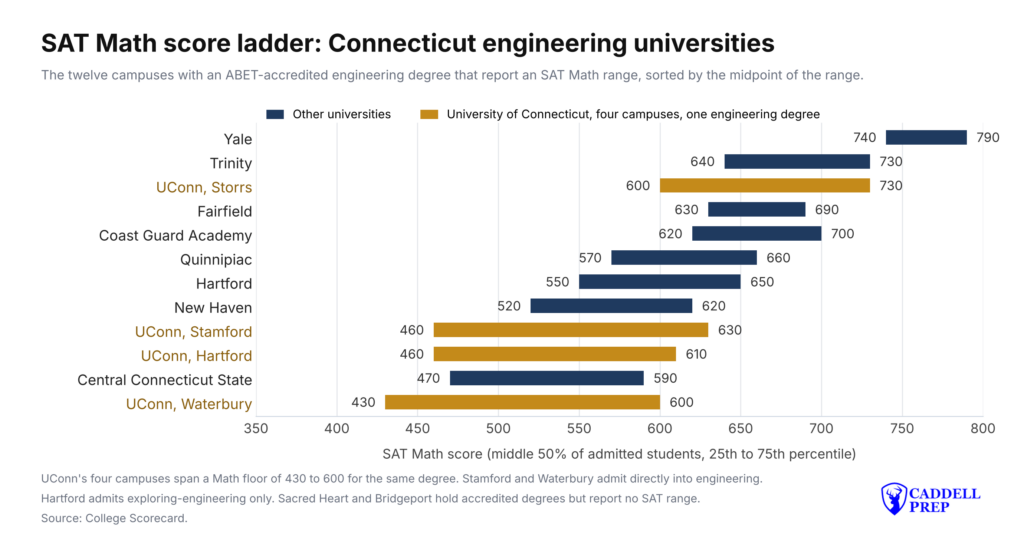
A student can see where his Math score sits on this list in the image above.
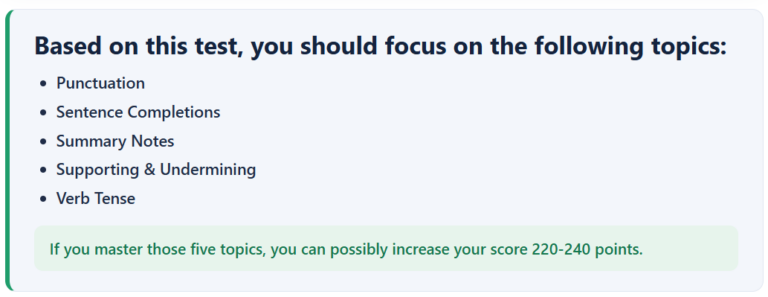
Want to Know What 5 Topics Will Improve Your SAT Score the Most?
Sample Feedback from our Diagnostic Test:
Yale University
Yale University’s School of Engineering & Applied Science in New Haven holds ABET accreditation in chemical, electrical, environmental and mechanical engineering, and Yale requires an SAT or ACT score from every applicant.
Reading & Writing 730 to 780, Math 740 to 790. The top quarter of admitted students scored at or above 780 and 790. Cost of attendance $88,300, with tuition and fees at $67,250 for all students. 6,758 undergraduates, 4% admitted.
Yale is the most selective and the most expensive school on the page, and its testing policy is covered below.
Trinity College
Trinity College in Hartford is a liberal arts college that awards an ABET-accredited Bachelor of Science in Engineering, and Trinity is the second most expensive school on the page.
Reading & Writing 658 to 740, Math 640 to 730. The top quarter scored at or above 740 and 730. Cost of attendance $87,840, with tuition and fees at $70,770 for all students. 2,146 undergraduates, 29% admitted.
Trinity’s tuition is the highest in the state, above Yale’s by $3,520.
University of Connecticut (Storrs)
The University of Connecticut’s School of Engineering at Storrs is the state’s flagship engineering school and the largest on this page, and Storrs is the UConn campus every ranking site reports.
Reading & Writing 610 to 710, Math 600 to 730. The top quarter scored at or above 710 and 730. Cost of attendance $39,426, with tuition and fees at $21,044 in-state and $43,712 out-of-state. 19,835 undergraduates, 52% admitted.
Storrs is the most selective public campus on the page and the only UConn campus that admits fewer than four applicants in five.
Fairfield University
Fairfield University’s School of Engineering and Computing holds ABET accreditation in bioengineering, computer, electrical and mechanical engineering, and Fairfield is a Jesuit university in Fairfield County.
Reading & Writing 630 to 700, Math 630 to 690. The top quarter scored at or above 700 and 690. Cost of attendance $76,074, with tuition and fees at $58,350 for all students. 5,373 undergraduates, 33% admitted.
Fairfield’s Math floor of 630 is the second highest on the page, above Storrs’s, with a ceiling 40 points below it.
United States Coast Guard Academy
The United States Coast Guard Academy in New London holds ABET accreditation in civil, electrical, mechanical, and naval architecture and marine engineering, and the Academy is the one tuition-free engineering school in the state.
Reading & Writing 620 to 700, Math 620 to 700. The top quarter scored at or above 700 on both sections. There is no tuition, and a graduate is commissioned as an officer and owes a period of service. 1,108 undergraduates, 22% admitted.
The Academy sits across the Thames River from Electric Boat’s submarine yard in Groton, and it is the only service academy that admits without a congressional nomination.
Quinnipiac University
Quinnipiac University’s School of Computing and Engineering in Hamden holds ABET accreditation in civil, industrial, mechanical and software engineering, and Quinnipiac admits nearly three applicants in four.
Reading & Writing 580 to 660, Math 570 to 660. The top quarter scored at or above 660 on both sections. Cost of attendance $72,215, with tuition and fees at $55,480 for all students. 6,531 undergraduates, 72% admitted.
Quinnipiac costs $4,000 less than Fairfield with a Math range 60 points lower at the floor.
University of Hartford
The University of Hartford’s College of Engineering, Technology, and Architecture holds ABET accreditation in acoustical, biomedical, civil, computer, electrical and mechanical engineering, and Hartford admits a larger share of applicants than any other school on the page.
Reading & Writing 570 to 660, Math 550 to 650. The top quarter scored at or above 660 and 650. Cost of attendance $64,729, with tuition and fees at $49,075 for all students. 4,146 undergraduates, 96% admitted.
Hartford holds the state’s only accredited acoustical engineering degree.
University of New Haven
The University of New Haven’s Tagliatela College of Engineering in West Haven holds ABET accreditation in chemical, civil, computer, electrical, mechanical and system engineering, and New Haven is the second cheapest private university on the page.
Reading & Writing 540 to 645, Math 520 to 620. The top quarter scored at or above 645 and 620. Cost of attendance $66,962, with tuition and fees at $47,332 for all students. 4,841 undergraduates, 60% admitted.
New Haven admits 60% with a Math range below Hartford’s, which admits 96%.
University of Connecticut (Stamford)
The University of Connecticut’s Stamford campus admits students directly from high school into the School of Engineering, and Stamford is the UConn campus closest to New York City.
Reading & Writing 470 to 630, Math 460 to 630. The top quarter scored at or above 630 on both sections. Cost of attendance $30,122, with tuition and fees at $18,150 in-state and $40,818 out-of-state. 2,432 undergraduates, 83% admitted.
Stamford’s Math ceiling of 630 is 100 points below Storrs’s, and its floor is 140 points below.
University of Connecticut (Hartford)
The University of Connecticut’s Hartford campus admits students into the ACES Exploring Engineering program rather than directly into the School of Engineering, and a Hartford student applies into the School after his first coursework at UConn.
Reading & Writing 470 to 610, Math 460 to 610. The top quarter scored at or above 610 on both sections. Cost of attendance $26,946, with tuition and fees at $18,130 in-state and $40,798 out-of-state. 1,525 undergraduates, 88% admitted.
Hartford is the one UConn campus on this page where the engineering door is not direct.
Central Connecticut State University
Central Connecticut State University’s School of Engineering, Science and Technology in New Britain holds ABET engineering accreditation in civil, computer, manufacturing and mechanical engineering, and Central is the cheapest public university on the page for an out-of-state student.
Reading & Writing 490 to 600, Math 470 to 590. The top quarter scored at or above 600 and 590. Cost of attendance $24,870, with tuition and fees at $13,050 in-state and $16,550 out-of-state. 7,822 undergraduates, 73% admitted.
Central’s out-of-state tuition is $16,550, less than half of any UConn campus’s, and its engineering technology degrees are accredited under a separate ABET commission and are not counted here.
University of Connecticut (Waterbury)
The University of Connecticut’s Waterbury campus admits students directly from high school into the School of Engineering, and Waterbury is the smallest campus on the page and the cheapest by cost of attendance.
Reading & Writing 480 to 600, Math 430 to 600. The top quarter scored at or above 600 on both sections. Cost of attendance $22,933, with tuition and fees at $18,140 in-state and $40,808 out-of-state. 733 undergraduates, 87% admitted.
Waterbury’s Math floor of 430 is the lowest on the page, 170 points below the Storrs floor, for the same degree.
Sacred Heart University
Sacred Heart University’s School of Computing and Engineering in Fairfield holds ABET accreditation in computer and electrical engineering, awarded in 2024 and retroactive to 2021, and Sacred Heart reports no score range.
Cost of attendance $69,289, with tuition and fees at $50,404 for all students. 7,087 undergraduates, 65% admitted.
Sacred Heart is a Catholic university and the largest private university on the page.
University of Bridgeport
The University of Bridgeport’s School of Engineering holds ABET accreditation in computer, electrical and mechanical engineering, and Bridgeport reports no score range.
Cost of attendance $52,957, with tuition and fees at $35,760 for all students. 1,534 undergraduates, 83% admitted.
Bridgeport is the cheapest private university on the page by more than $11,000.
Fourteen rows, and four of them belong to one university. How those four work is the thing a Connecticut engineering applicant, or a New York one, most needs to know.
What SAT Math Score Gets You Into UConn Engineering?
UConn’s School of Engineering admits students directly from high school at Storrs, where the middle 50% of admitted students scored 600 to 730 on SAT Math, and at Stamford and Waterbury, where the middle 50% scored 460 to 630 and 430 to 600, and the degree at the end is the same UConn engineering degree.
UConn’s engineering site describes the arrangement. The Stamford, Waterbury and Avery Point campuses admit students directly from high school into the School of Engineering. The Hartford campus admits only students in the ACES Exploring Engineering program, who become eligible for the School after completing minimum coursework at UConn. A student who starts at a regional campus takes the same first-year sequence and moves to Storrs at a point planned with his advisor, based on his major and on course availability. The move is not automatic and it has no fixed date.
The four campuses report four different admitted classes. Storrs admits 52% of applicants. Stamford admits 83%, Waterbury 87%, Hartford 88%. In-state tuition and fees are $21,044 at Storrs and approximately $18,140 at the three regional campuses, so the regional route is approximately $2,900 a year cheaper for a Connecticut resident. For an out-of-state student, which means most of our readers, every UConn campus costs approximately $40,800 to $43,700 in tuition and fees, and the campus changes the range he is measured against and not the bill.
| UConn campus | SAT Math, middle 50% | Admit rate | In-state tuition and fees | Engineering admission |
|---|---|---|---|---|
| Storrs | 600 to 730 | 52% | $21,044 | Direct |
| Stamford | 460 to 630 | 83% | $18,150 | Direct |
| Waterbury | 430 to 600 | 87% | $18,140 | Direct |
| Hartford | 460 to 610 | 88% | $18,130 | Exploring Engineering, then apply |
Scores and admit rates from the College Scorecard, 2025-26. Admission pathways from UConn’s School of Engineering, current as of [DATE]. Avery Point also admits directly into engineering and is too small to appear in the federal data.
Take a student with a 560 SAT Math. At Storrs he is 40 points below the floor of the admitted range. At Stamford he is inside the middle 50%. At Waterbury he is in the top quarter. Every ranking site shows him the Storrs number and nothing else, and he concludes that UConn engineering is a reach when two of its front doors are open to him.
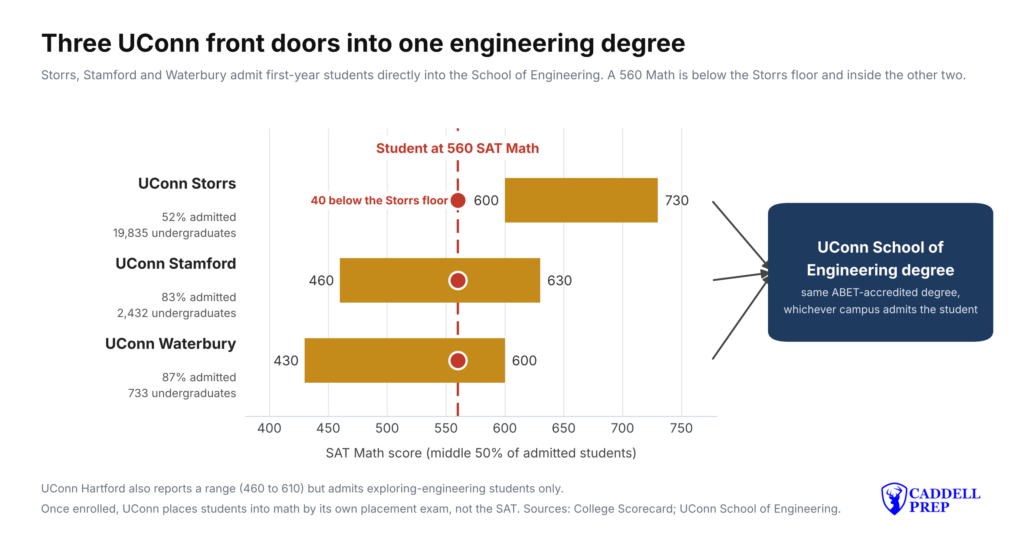
The image above shows three front doors, one degree, and it is the picture the ranking sites do not draw.
The route has costs that the numbers do not show. The regional campuses are commuter campuses with limited housing. The move to Storrs is planned rather than guaranteed on a date, and a student who wants the Storrs campus from his first semester needs the Storrs range. A student choosing Stamford or Waterbury for the admission range should choose it knowing what the first year or two look like.
Once a student is in, the SAT stops mattering, and UConn says so in its own words. Every UConn student who wants to enroll in Precalculus or Calculus takes UConn’s Math Placement Exam, and a score of 22 places into MATH 1131Q Calculus I while a score of 17 places into MATH 1060Q Precalculus. The placement office’s page states that there are no substitutions for the MPE requirement when trying to enroll in Precalculus and Calculus, and that students with high SAT scores still need a qualifying MPE score. A student has three attempts a semester. Math courses numbered 1110Q and below do not count toward graduation, and the engineering catalog says preparatory coursework assigned from placement may not count either.
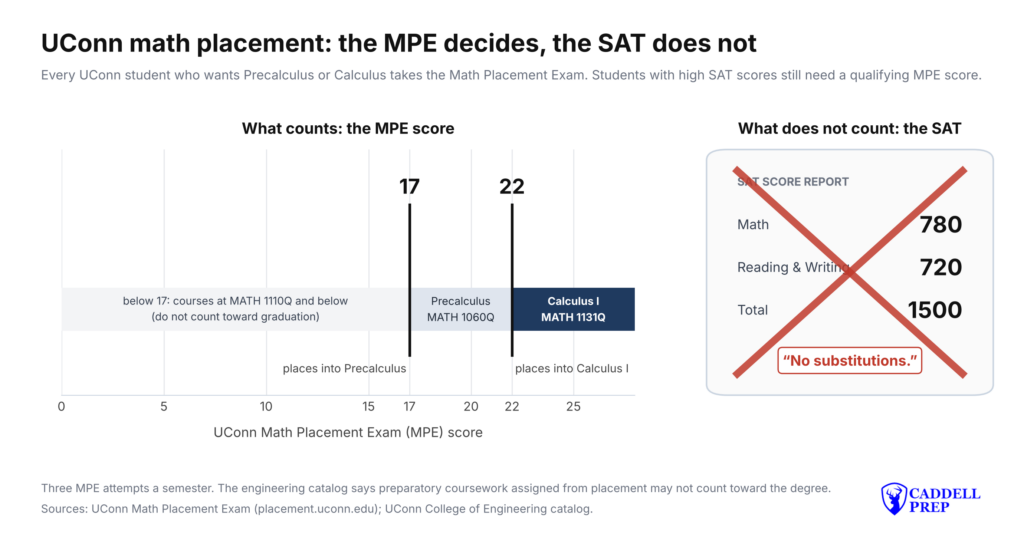
The image above shows the rule in UConn’s words: no substitutions.
So the SAT at UConn is read for admission, decides which campus range a student is measured against, and then does nothing. The next question most families ask is about the school at the other end of the table.
Does Yale Require the SAT for Engineering?
Yale requires an SAT or ACT score from every applicant, including engineering applicants, beginning with the admissions cycle that opened in the fall of 2026. Yale announced the change on May 27, 2026. For the two cycles before it, Yale had been test-flexible and accepted AP or IB results in place of the SAT or ACT, and before 2020 it required the SAT or ACT, so the new rule restores the old one.
Yale’s School of Engineering & Applied Science holds ABET accreditation in chemical, electrical, environmental and mechanical engineering, and Yale admitted 4% of applicants with a Math range of 740 to 790. The state’s most selective engineering school requires a score, and the state’s flagship does not use one for placement. Connecticut’s public high schools administer the SAT to every junior as the state assessment, so a Connecticut applicant has the score either way.
The policies belong to the universities. The degrees are what the next section lists.
Which Connecticut Universities Have ABET-Accredited Engineering Schools?
Eleven Connecticut universities hold ABET-accredited engineering bachelor’s degrees across fourteen campuses, and all fourteen are in the table above.
In the Hartford area, UConn’s School of Engineering at Storrs holds accredited degrees in biomedical, chemical, civil, computer, electrical, environmental, materials science and mechanical engineering, with the same degrees reachable through its Stamford, Waterbury and Hartford campuses. Trinity in Hartford awards a single accredited engineering degree, the University of Hartford in West Hartford holds six, and Central Connecticut State in New Britain holds four. Pratt & Whitney’s jet engine plant in East Hartford is the largest engineering employer in the region.
In New Haven and along the shoreline, Yale holds four accredited degrees, the University of New Haven holds six in West Haven, and Quinnipiac holds four in Hamden. The Coast Guard Academy in New London holds four, including the state’s only naval architecture and marine engineering degree, across the river from Electric Boat’s submarine yard in Groton.
In Fairfield County, Fairfield University holds four accredited degrees, Sacred Heart holds two, and the University of Bridgeport holds three. Sikorsky’s helicopter plant in Stratford is between them.
Accreditation matters for a reason that is easy to miss at seventeen. Licensure as a professional engineer normally requires a degree from an ABET-accredited engineering program, and that is why Central Connecticut’s engineering technology degrees are not counted here. Wesleyan and Connecticut College report Math ranges in the 600s and 700s and are not on the page because neither awards an engineering degree.
Nothing on this page ranks the eleven. The table’s order is a stated, verifiable number, and the choice among accredited programs comes down to cost, discipline and, at UConn, which campus a student applies to.
What If Your Math Score Is Below the Storrs Range?
A Connecticut engineering applicant below the Storrs floor has two routes to the same UConn degree, and the SAT Math section decides only one of them.
The first route is the regional campus now. A 560 is inside the Stamford range and in the top quarter at Waterbury, and both admit directly into the School of Engineering. The cost is the Storrs campus for a year or two. The second route is 40 to 60 points on the Math section before the application, so that the Storrs range applies. The cost is a spring of work. A student can pursue both, and a New York student has a third thing to weigh that neither route changes, out-of-state tuition of approximately $41,000 at every UConn campus.
The first step on the second route is finding out where the score actually is, section by section. A free diagnostic SAT gives a Math score that can be set against the Storrs floor directly.
The Math section rewards the same handful of topics on every test date, and a student who knows which of them he is missing can close a 40 to 60 point gap in weeks rather than months. The method is on our page on improving your SAT Math score
How to Read These Score Ranges
Every range on this page covers the middle 50% of admitted students who submitted the SAT. The lower number is the 25th percentile and the upper number is the 75th, so a quarter of admitted students scored at or above it.
A university with several campuses reports a range for each one, and the range on the ranking sites is normally the main campus’s. UConn is the clearest case in this series, and a student should check which campus a published range describes before measuring himself against it.
Because most colleges are now test-optional, the ranges that are published describe only the students who chose to submit at all. Students with strong scores submit and students with weak ones don’t, so a published range sits higher than the range for everyone who was actually admitted. More on what SAT score you need for college and on test-optional colleges.
Should You Take the ACT Instead?
Connecticut is an SAT state. Seventeen Connecticut universities report SAT sections and eleven report an ACT range, and the state administers the SAT to every public high school junior.
Yale accepts either test, and every university on the page that reads scores accepts both. A student who scores higher on the ACT should submit it, and a student whose state-administered SAT is already inside the range he wants does not need a second test.
Engineering Programs in Nearby States
Connecticut borders New York, Massachusetts and Rhode Island, and Connecticut students apply across those lines in numbers even with eleven accredited programs at home.
See engineering colleges in New York, engineering colleges in Massachusetts, and engineering colleges in Rhode Island.
Engineering Colleges in Other States
We publish the same breakdown for engineering programs in every state.
See engineering colleges by state for the full list.

Glyn Caddell
Glyn Caddell holds a BS in Mechanical Engineering from NJIT and has been tutoring New York City students since 2008. He founded Caddell Prep in 2012 and is the author of Digital SAT Math Secrets: Lessons & Tricks to Quickly Improve to a Perfect 800 on the Math Test, which contains over 900 practice problems and is used in Caddell Prep’s SAT math classes. He is founding president of the Staten Island Technical High School alumni association and teaches every lesson on this site personally.
Finally, an SAT course that students actually understand
Every question has a video explanation. Not most — every one.
The on-demand Digital SAT course covers all 17 math topics and 15 reading and writing topics, with 5 full-length practice tests and a 100-point score increase guarantee. Keep access for the rest of high school. No subscription.
Want to Know What 5 Topics Will Improve Your SAT Score the Most?
Sample Feedback from our Diagnostic Test: