
Home » College SAT Score Ranges, Costs, and Programs by Major and State » Engineering Colleges by State: SAT Scores, ACT Scores, Costs, and ABET Programs » Engineering Colleges in Wisconsin: ACT Scores, SAT Scores, Costs, and Programs
By Glyn Caddell, BSME · Author of Digital SAT Math Secrets · Tutoring since 2008 — Updated October 26, 2026
Seven Wisconsin universities offer ABET-accredited engineering degrees, and this page lists what they cost and the test scores of the students they admit.
The flagship admits engineering students directly and then publishes, for each of fourteen programs, the GPA a student needs after two semesters to be guaranteed a place in it, from a 2.8 to a 3.5, with a second tier for consideration and a capacity clause behind both.
The table is sorted by ACT because Wisconsin gives it to every junior as the state test and six of the seven universities report it.
Table of Contents
- Wisconsin Engineering Colleges by ACT and SAT Score
- What GPA Does a Madison Engineering Student Need to Progress Into His Major?
- Which Wisconsin Universities Have ABET-Accredited Engineering Schools?
- What If Your Score Is Below the Range You Want?
Wisconsin Engineering Colleges by ACT and SAT Score
The seven universities below are the ones in Wisconsin that hold an ABET-accredited bachelor’s degree in an engineering discipline. The six that report scores are sorted by the midpoint of the ACT composite range, so the order can be checked from the table itself, and there are no ties. Milwaukee School of Engineering reports no range and is listed last.
| College | ACT composite | SAT Reading & Writing | SAT Math | Cost of attendance | Undergraduates | Admit rate |
|---|---|---|---|---|---|---|
| University of Wisconsin-Madison | 29 to 33 | 670 to 740 | 710 to 780 | $28,679 | 36,902 | 45% |
| Marquette University | 26 to 31 | 610 to 680 | 590 to 680 | $66,768 | 7,660 | 81% |
| University of Wisconsin-Platteville | 21 to 28 | Does not report SAT data | Does not report SAT data | $21,266 | 5,837 | 89% |
| University of Wisconsin-Stout | 20 to 27 | Does not report SAT data | Does not report SAT data | $22,797 | 5,842 | 88% |
| University of Wisconsin-Milwaukee | 18 to 25 | Does not report SAT data | Does not report SAT data | $22,756 | 16,758 | 91% |
| University of Wisconsin-Green Bay | 18 to 24 | Does not report SAT data | Does not report SAT data | $19,366 | 6,341 | 89% |
| Milwaukee School of Engineering | Does not report ACT data | Does not report SAT data | Does not report SAT data | $62,648 | 2,654 | 59% |
Each range covers the middle 50% of admitted students who submitted that test. A quarter scored below the lower number, and the top quarter scored at or above the upper one. Being under the lower number does not rule a student out, and being just above it is not as safe as it looks.
Only universities with an ABET-accredited engineering bachelor’s degree are listed. Wisconsin-Oshkosh’s engineering technology degrees are accredited under a separate ABET commission and do not qualify it for the list. Platteville, Stout, Milwaukee and Green Bay report an ACT range and no SAT range. Milwaukee School of Engineering reports no SAT or ACT range to the Scorecard and is listed last.
Three things about that table are worth pausing on.
Madison admits engineering students directly and publishes, a year ahead, the GPA each of its fourteen programs requires after two semesters, from a 2.8 core for civil and electrical to a 3.5 for engineering physics. The next section is about those lines.
Madison’s Math range of 710 to 780 is the highest public range on these pages, tied with Virginia’s at the floor, and its ACT floor of 29 is three points above Marquette’s. The four regional UW campuses charge a non-resident between $17,288 and $22,398, against Madison’s $42,103.
Milwaukee School of Engineering, an engineering-specialized university of 2,654 students, reports no score range at all, admits 59% and charges $50,480, $8,377 more than Madison charges a non-resident.
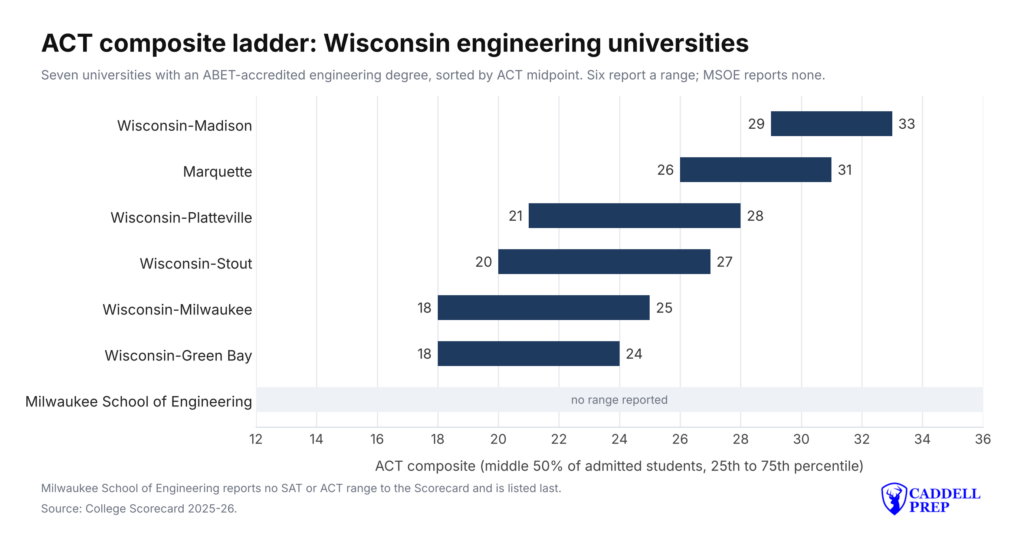
A student can see where his ACT score sits on this list in the image above.
Want to Know What 5 Topics Will Improve Your SAT Score the Most?
Sample Feedback from our Diagnostic Test:

University of Wisconsin-Madison
The University of Wisconsin-Madison’s College of Engineering holds ABET accreditation in disciplines including biomedical, chemical, civil, computer, electrical, engineering mechanics, engineering physics, environmental, geological, industrial, materials science, mechanical and nuclear engineering [VERIFY list on abet.org], and Madison admits engineering students directly to the college and into a degree program two semesters later.
ACT composite 29 to 33. Reading & Writing 670 to 740, Math 710 to 780. The top quarter of admitted students scored at or above 33 on the ACT and 780 on Math. Cost of attendance $28,679, with tuition and fees at $11,603 in state and $42,103 out of state. 36,902 undergraduates, 45% admitted.
Madison is the largest school on the page by a factor of more than two, the most selective, and the holder of a Math floor of 710 that no public on these pages exceeds. Its progression rule is the next section.
Marquette University
Marquette University’s Opus College of Engineering in Milwaukee holds ABET accreditation in biomedical, civil, computer, construction, electrical, environmental and mechanical engineering [VERIFY on abet.org], and Marquette is the larger of Milwaukee’s two private engineering schools.
ACT composite 26 to 31. Reading & Writing 610 to 680, Math 590 to 680. The top quarter of admitted students scored at or above 31 on the ACT and 680 on Math. Cost of attendance $66,768, with tuition and fees at $51,170 for all students. 7,660 undergraduates, 81% admitted.
Marquette is a Jesuit university whose ACT ceiling of 31 is two points below Madison’s and whose Math floor of 590 is 120 points below it, and it charges every student $51,170, $9,067 more than Madison charges a non-resident. It admits 81%.
University of Wisconsin-Platteville
The University of Wisconsin-Platteville’s College of Engineering, Mathematics and Science holds ABET accreditation in civil, electrical, environmental, industrial, mechanical and software engineering [VERIFY on abet.org], and Platteville is the UW System’s second engineering school by age.
ACT composite 21 to 28. Platteville reports no SAT range. The top quarter of admitted students scored at or above 28 on the ACT. Cost of attendance $21,266, with tuition and fees at $8,644 in state and $17,603 out of state. 5,837 undergraduates, 89% admitted.
Platteville charges a non-resident $17,603, $24,500 less than Madison, on an ACT range eight points lower at the floor and five at the ceiling. It is in the southwest corner of the state, twenty miles from Iowa and Illinois.
University of Wisconsin-Stout
The University of Wisconsin-Stout’s engineering programs in Menomonie hold ABET accreditation in computer and electrical, manufacturing, mechanical and plastics engineering [VERIFY on abet.org], and Stout holds the only accredited plastics engineering degree in the state.
ACT composite 20 to 27. Stout reports no SAT range. The top quarter of admitted students scored at or above 27 on the ACT. Cost of attendance $22,797, with tuition and fees at $10,701 in state and $19,265 out of state. 5,842 undergraduates, 88% admitted.
Stout is the UW System’s polytechnic campus, five students larger than Platteville, and it charges a non-resident $19,265, $1,662 more than Platteville for an ACT range one point lower at both ends. It is an hour from the Twin Cities.
University of Wisconsin-Milwaukee
The University of Wisconsin-Milwaukee’s College of Engineering and Applied Science holds ABET accreditation in biomedical, civil, computer, electrical, industrial, materials and mechanical engineering [VERIFY on abet.org], and Milwaukee is the second-largest school on the page.
ACT composite 18 to 25. Milwaukee reports no SAT range. The top quarter of admitted students scored at or above 25 on the ACT. Cost of attendance $22,756, with tuition and fees at $10,398 in state and $22,398 out of state. 16,758 undergraduates, 91% admitted.
Milwaukee admits 91% and charges a non-resident $22,398, the highest figure among the four regional UW campuses, on the second-lowest ACT range on the page. It is one of three accredited engineering schools within three miles of one another in the city.
University of Wisconsin-Green Bay
The University of Wisconsin-Green Bay’s Richard J. Resch School of Engineering holds ABET accreditation in electrical, environmental and mechanical engineering [VERIFY on abet.org, and remove the row if not EAC-accredited], and Green Bay charges a non-resident less than any other school on the page.
ACT composite 18 to 24. Green Bay reports no SAT range. The top quarter of admitted students scored at or above 24 on the ACT. Cost of attendance $19,366, with tuition and fees at $8,700 in state and $17,288 out of state. 6,341 undergraduates, 89% admitted.
Green Bay has the lowest cost of attendance on the page, charges a non-resident $17,288, and reports the lowest ACT range on the page. Its engineering school is among the newest on these pages.
Milwaukee School of Engineering
Milwaukee School of Engineering holds ABET accreditation in disciplines including architectural, biomedical, civil, computer, electrical, industrial, mechanical and software engineering [VERIFY list on abet.org], and MSOE reports no admitted score range.
MSOE reports no SAT or ACT range. Cost of attendance $62,648, with tuition and fees at $50,480 for all students. 2,654 undergraduates, 59% admitted.
MSOE is an engineering-specialized university in downtown Milwaukee, admits 59%, the second-lowest rate on the page, and charges $50,480. It is one of two engineering-specialized universities on these pages with a blank row, with WPI on our Massachusetts page [VERIFY MSOE’s test policy on msoe.edu].
Six ranges and one blank say who got in. At the flagship, getting in is the first gate and fourteen published numbers are the second, and the next section is about them.
What GPA Does a Madison Engineering Student Need to Progress Into His Major?
A Madison engineering student needs the core and overall GPA his program publishes, from a 2.8 core and 2.5 overall for civil, electrical, environmental, geological and industrial engineering to a 3.5 core and 3.0 overall for engineering physics, after his first two semesters, to be guaranteed progression into the degree program.
The rule is in the college’s regulations. First-year students are admitted directly to the College of Engineering and must meet the progression requirements “after their first two semesters of residency at UW-Madison.” Guaranteed progression requires 24 graded credits at Madison, Engr Comm 1 taken there or a graded liberal studies course if it was satisfied by placement, the program’s Introduction to Engineering course, the math sequence through Math 222, and four foundational courses, and then “Core and Overall GPA requirements must be satisfied as defined by CoE departments.”
The departments define them a year ahead, and the college posts the list.
| Program | Core GPA | Overall GPA |
|---|---|---|
| Engineering Physics | 3.5 | 3.0 |
| Biomedical Engineering | 3.3 | 3.0 |
| Chemical Engineering | 3.3 | 3.0 |
| Aerospace Engineering | 3.2 | 3.0 |
| Engineering Mechanics | 3.2 | 3.0 |
| Mechanical Engineering | 3.2 | 3.0 |
| Computer Engineering | 3.2 | 2.5 |
| Materials Science and Engineering | 3.0 | 2.5 |
| Nuclear Engineering | 3.0 | 2.5 |
| Civil Engineering | 2.8 | 2.5 |
| Electrical Engineering | 2.8 | 2.5 |
| Environmental Engineering | 2.8 | 2.5 |
| Geological Engineering | 2.8 | 2.5 |
| Industrial Engineering | 2.8 | 2.5 |
The lines have three things behind them. A student who misses his program’s GPAs but holds a core GPA of at least 2.500 and meets the other requirements “will be considered for progression,” on written statements, course rigor and grade trends. A student who needs more time may receive a one-semester extension, “not beyond their fourth semester.” A D or F in a core course disqualifies guaranteed progression unless the course is repeated at Madison for a C or higher, and only one repeated core course counts. And where a program is at capacity, “progression is limited to available spots,” so the guaranteed tier is guaranteed until the program is full.
Set that beside the other gates on these pages. Texas A&M publishes one line, a 3.75 for automatic placement, on our page on engineering colleges in Texas. Penn State publishes two, a 2.60 and a 3.20, on our page on engineering colleges in Pennsylvania. Clemson publishes three. Madison publishes fourteen pairs, with a consideration tier and a capacity clause, and it is the most finely drawn gate in this series. It sits at the public with the highest Math floor on these pages, 710, tied with Virginia, at a university that admits 45% and charges a non-resident $42,103.
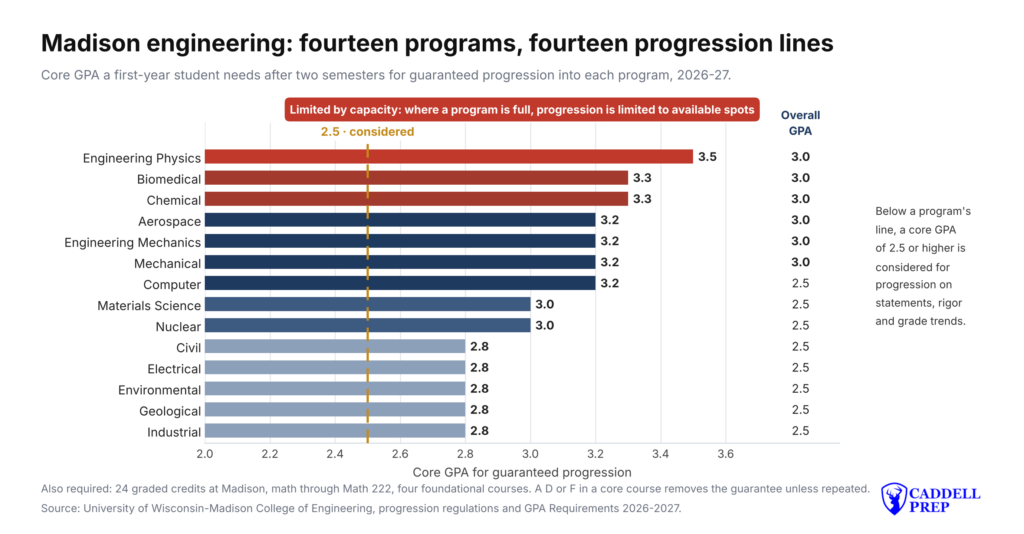
The image above lays out the fourteen lines a Madison engineering student meets after two semesters.
Take a New York student with a 31 on the ACT. At Madison he is at the middle of 29 to 33, pays $42,103, is admitted directly to the College of Engineering, and after two semesters needs a 3.2 core and 3.0 overall for mechanical engineering, a 2.8 and 2.5 for civil or electrical, or a 3.3 and 3.0 for biomedical or chemical. At Marquette he is at the ceiling of 26 to 31 and pays $51,170. At Platteville he is 3 points above the ceiling of 21 to 28 and pays $17,603. At Stout he is 4 above the ceiling of 20 to 27 and pays $19,265. At MSOE there is no range to read and he pays $50,480. The spread from Platteville to Marquette is $33,567 a year, and the school with the published second gate is the one in the middle of it.
Wisconsin’s second number is a blank. Milwaukee School of Engineering, an engineering-specialized university of 2,654 students, reports no SAT or ACT range to the Scorecard, admits 59% and charges every student $50,480. On these pages the engineering-specialized schools nearly all publish a range, from Rose-Hulman’s 670 to 770 to Oregon Tech’s 500 to 620, and MSOE and WPI are the two that do not. A New York student comparing MSOE with Marquette three miles away has a range at one and a blank at the other, and the blank is $690 cheaper.
Wisconsin’s third number is the regional campuses’ price. Platteville, Stout, Milwaukee and Green Bay charge a non-resident $17,603, $19,265, $22,398 and $17,288, and Platteville, the UW System’s second engineering school by age, charges $24,500 less than Madison on an ACT range of 21 to 28 against Madison’s 29 to 33. Minnesota residents pay the resident rate at all five under the two states’ reciprocity agreement [VERIFY on wisconsin.edu]. New York has no such agreement, and a New Yorker pays the figures in the table.
The honest version is that progression is a published floor and not a count. The page does not know how many direct-admit students progress into their first program, and the college’s capacity clause means a 3.2 is not a seat in mechanical engineering if the program is full that year. The fourteen pairs apply to the 2026-27 cycle and the college reposts them each year, so a student entering later should read that year’s list. Madison’s range describes the students who submitted a score. MSOE’s blank is a blank. And Green Bay’s row is bracketed until its accreditation is confirmed.
Families who have read the words direct admit frequently ask what they are direct to.
Is Direct Admission to Madison Engineering Admission to a Major?
Direct admission to Madison engineering is admission to the College of Engineering and not to a major. The degree program comes through progression after two semesters, guaranteed at the program’s published core and overall GPAs, considered at a 2.5 core, extended at most to the fourth semester, and limited by capacity.
A student who is admitted with mechanical engineering on his application is admitted to the college with mechanical engineering as his intended program, and he enters it with a 3.2 core and a 3.0 overall after two semesters if the program has room.
The lines are Madison’s. The degrees are what the next section lists.
Which Wisconsin Universities Have ABET-Accredited Engineering Schools?
Seven Wisconsin universities hold ABET-accredited engineering bachelor’s degrees, five public and two private, and all seven are in the table above.
In Madison, the College of Engineering is the state’s engineering school. In Milwaukee, Wisconsin-Milwaukee’s College of Engineering and Applied Science, Marquette’s Opus College of Engineering and Milwaukee School of Engineering are within three miles of one another. Platteville is in the southwest corner near the Iowa and Illinois lines, Stout in Menomonie an hour from the Twin Cities, and Green Bay on the bay. Wisconsin-Eau Claire has launched materials science and biomedical engineering programs that are not yet on this list [VERIFY their accreditation status].
Accreditation matters for a reason that is easy to miss at seventeen. Licensure as a professional engineer normally requires a degree from an ABET-accredited engineering program, and that is why Wisconsin-Oshkosh’s engineering technology degrees do not put it on the list. Stevens Point, La Crosse, Whitewater, River Falls, Parkside, Superior, Lawrence, Beloit, Carroll, Carthage, Concordia, St. Norbert, Wisconsin Lutheran, Viterbo, Edgewood, Lakeland and Marian award no engineering degree.
Nothing on this page ranks the seven. The table’s order is a stated, verifiable number where one exists, and the choice among accredited programs comes down to cost, discipline and where a student’s score places him.
What If Your Score Is Below the Range You Want?
In Wisconsin seven schools cover ACT ranges from an 18 floor to a 33 ceiling where ranges are reported, five of them are public, and a New York student’s price among the five runs from $17,288 to $42,103. The score decides Madison or not. After Madison, fourteen GPA lines decide the program.
The gap from a 31 to the top quarter at Madison is two points of ACT composite, one or two questions a section, and the student who closes it is in the top quarter at the most selective public engineering school in the Midwest on these pages. The gap after that is a 3.2, and no test closes it.
The first step is finding out where the score actually is, section by section. A free diagnostic SAT gives a score that can be set against the SAT columns in the table and converted to the ACT scale for the rest of it.
The Math section rewards the same handful of topics on every test date, and a student who knows which of them he is missing can close a gap of 50 to 100 points in weeks rather than months. The method is on our page on improving your SAT Math score, and the same topics carry the ACT Math section and the first semester of Math 221.
How to Read These Score Ranges
Every range on this page covers the middle 50% of admitted students who submitted that test. The lower number is the 25th percentile and the upper number is the 75th, so a quarter of admitted students scored at or above it.
A range is one number before admission and progression is fourteen pairs after it. Madison’s 29 to 33 describes who got into the college, and its GPA list describes who got into each program, and a student should read the range for the first gate and the list for the second.
Because most colleges are now test-optional, the ranges that are published describe only the students who chose to submit at all. Students with strong scores submit and students with weak ones don’t, so a published range sits higher than the range for everyone who was actually admitted. More on what SAT score you need for college and on test-optional colleges.
Should You Take the SAT Instead?
Wisconsin gives the ACT to every public school junior as the state test [VERIFY with the Department of Public Instruction], and six of the seven universities on this page report an ACT range while two report an SAT range.
That is why the table carries an ACT composite column and is sorted by it. All seven universities accept either test, and a student from outside Wisconsin who holds an SAT should read the SAT columns where they exist and submit the test he scores higher on.
Engineering Programs in Nearby States
Wisconsin borders Minnesota, Iowa, Illinois and Michigan, and Minnesota students pay the resident rate at Wisconsin’s publics under the two states’ agreement.
See engineering colleges in Minnesota, engineering colleges in Iowa, engineering colleges in Illinois, and engineering colleges in Michigan.
Engineering Colleges in Other States
We publish the same breakdown for engineering programs in every state.
See engineering colleges by state for the full list.

Glyn Caddell
Glyn Caddell holds a BS in Mechanical Engineering from NJIT and has been tutoring New York City students since 2008. He founded Caddell Prep in 2012 and is the author of Digital SAT Math Secrets: Lessons & Tricks to Quickly Improve to a Perfect 800 on the Math Test, which contains over 900 practice problems and is used in Caddell Prep’s SAT math classes. He is founding president of the Staten Island Technical High School alumni association and teaches every lesson on this site personally.
Finally, an SAT course that students actually understand
Every question has a video explanation. Not most — every one.
The on-demand Digital SAT course covers all 17 math topics and 15 reading and writing topics, with 5 full-length practice tests and a 100-point score increase guarantee. Keep access for the rest of high school. No subscription.
Want to Know What 5 Topics Will Improve Your SAT Score the Most?
Sample Feedback from our Diagnostic Test: