
Home » College SAT Score Ranges, Costs, and Programs by Major and State » Engineering Colleges by State: SAT Scores, ACT Scores, Costs, and ABET Programs » Engineering Colleges in Minnesota: ACT Scores, SAT Scores, Costs, and Programs
By Glyn Caddell, BSME · Author of Digital SAT Math Secrets · Tutoring since 2008 — Updated October 24, 2026
Seven Minnesota universities offer ABET-accredited engineering degrees, and this page lists what they cost and the test scores of the students they admit.
The University of Minnesota admits each applicant to one of eight colleges rather than to the university, and its engineering college publishes an admitted range whose floor sits at the top of the university’s enrolled range, a mechanism covered below the table.
The table is sorted by ACT composite because Minnesota is an ACT state and six of the seven universities report it.
Table of Contents
- Minnesota Engineering Colleges by ACT and SAT Score
- What ACT Score Do You Need for Engineering at the University of Minnesota?
- Which Minnesota Universities Have ABET-Accredited Engineering Schools?
- What If Your Score Is Below the Range You Want?
Minnesota Engineering Colleges by ACT and SAT Score
The seven universities below are the ones in Minnesota that hold an ABET-accredited bachelor’s degree in an engineering discipline. The six that report scores are sorted by the midpoint of the ACT composite range, so the order can be checked from the table itself, and the one that does not is listed last.
| College | ACT composite | SAT Reading & Writing | SAT Math | Cost of attendance | Undergraduates | Admit rate |
|---|---|---|---|---|---|---|
| University of Minnesota Twin Cities | 26 to 31 | 640 to 730 | 660 to 770 | $30,061 | 31,855 | 80% |
| University of St. Thomas | 25 to 30 | 640 to 713 | 620 to 710 | $66,116 | 6,245 | 85% |
| University of Minnesota Duluth | 23 to 28 | 590 to 675 | 590 to 675 | $27,680 | 7,336 | 89% |
| Bethel University | 22 to 28 | 610 to 650 | 580 to 650 | $58,569 | 1,871 | 88% |
| Minnesota State University, Mankato | 21 to 25 | Does not report SAT data | Does not report SAT data | $23,995 | 11,703 | 88% |
| St. Cloud State University | 17 to 25 | 510 to 615 | 515 to 645 | $21,116 | 5,088 | 95% |
| Winona State University | Does not report ACT data | Does not report SAT data | Does not report SAT data | $23,683 | 5,144 | 75% |
Each range covers the middle 50% of admitted students who submitted that test. A quarter scored below the lower number, and the top quarter scored at or above the upper one. Being under the lower number does not rule a student out, and being just above it is not as safe as it looks.
Only universities with an ABET-accredited engineering bachelor’s degree are listed. Minnesota State Mankato reports an ACT range and no SAT range. Winona State reports no range on either test and is listed last. The University of Minnesota’s range is for enrolled students across the university, and its engineering college’s admitted range is given below the table.
Three things about that table are worth pausing on.
The University of Minnesota’s in-state tuition, $17,214, is the third-highest resident charge at any public university in this series, within $600 of UMass Amherst’s and behind only Colorado School of Mines. A Minnesota family pays more to send a student to its flagship than a Maryland family pays by $5,405.
St. Cloud State charges every student the same tuition, $10,245, in state or out, the lowest flat rate on any page in this series and the second-lowest out-of-state tuition at a public engineering school after McNeese State’s. A New York student pays less at St. Cloud than a Minnesota student pays at three of the other four publics on the page.
Minnesota Duluth’s out-of-state tuition, $20,130, is $18,232 below the flagship’s, for an engineering college with six accredited disciplines and an ACT range three points lower at both ends.
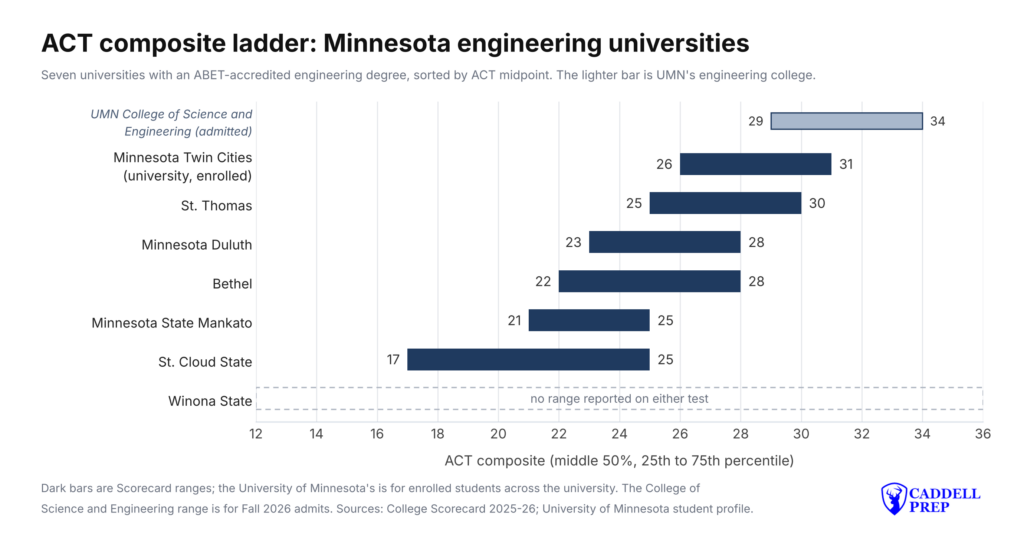
A student can see where his ACT score sits on this list in the image above, and how the engineering college’s bar sits against the university’s.
Want to Know What 5 Topics Will Improve Your SAT Score the Most?
Sample Feedback from our Diagnostic Test:

University of Minnesota Twin Cities
The University of Minnesota’s College of Science and Engineering in Minneapolis holds ABET accreditation in disciplines including aerospace, biomedical, bioproducts and biosystems, chemical, civil, computer, electrical, environmental, geoengineering, industrial and systems, materials and mechanical engineering, and the university admits each applicant to one of eight colleges, with the engineering college publishing an admitted range of 29 to 34 on the ACT.
ACT composite 26 to 31 for enrolled students across the university. Reading & Writing 640 to 730, Math 660 to 770. The top quarter of enrolled students scored at or above 31 on the ACT and 770 on Math. Cost of attendance $30,061, with tuition and fees at $17,214 in state and $38,362 out of state. 31,855 undergraduates, 80% admitted.
Minnesota is the largest school on the page by a factor of three and the only one whose engineering college publishes its own admitted range. Its Math ceiling of 770 is 60 points above St. Thomas’s and 95 above Duluth’s.
University of St. Thomas
The University of St. Thomas’s School of Engineering in St. Paul holds ABET accreditation in civil, computer, electrical and mechanical engineering, and St. Thomas has the highest range among the private universities on the page.
ACT composite 25 to 30. Reading & Writing 640 to 713, Math 620 to 710. The top quarter of admitted students scored at or above 30 on the ACT and 710 on Math. Cost of attendance $66,116, with tuition and fees at $54,398 for all students. 6,245 undergraduates, 85% admitted.
St. Thomas is a Catholic university, the most expensive school on the page, and the only one whose ACT range overlaps the flagship’s by more than it misses it. Its Reading & Writing floor of 640 equals Minnesota’s.
University of Minnesota Duluth
The University of Minnesota Duluth’s Swenson College of Science and Engineering holds ABET accreditation in chemical, civil, computer, electrical, industrial and mechanical engineering, and Duluth has the lowest out-of-state tuition of the two University of Minnesota campuses on the page by $18,232.
ACT composite 23 to 28. Reading & Writing 590 to 675, Math 590 to 675. The top quarter of admitted students scored at or above 28 on the ACT and 675 on Math. Cost of attendance $27,680, with tuition and fees at $14,610 in state and $20,130 out of state. 7,336 undergraduates, 89% admitted.
Duluth’s two SAT section ranges are identical, and its ACT range sits three points under the Twin Cities campus’s at both ends. It is the only engineering college on the page north of the Twin Cities other than Mankato’s Iron Range site.
Bethel University
Bethel University’s engineering department in Arden Hills holds ABET accreditation in electrical engineering, granted in 2023, and Bethel is the smallest school on the page.
ACT composite 22 to 28. Reading & Writing 610 to 650, Math 580 to 650. The top quarter of admitted students scored at or above 28 on the ACT and 650 on Math. Cost of attendance $58,569, with tuition and fees at $44,226 for all students. 1,871 undergraduates, 88% admitted.
Bethel is an evangelical Christian university whose place on this page rests on one accredited degree, and whose Reading & Writing range is the narrowest on the page at 40 points. Its ACT ceiling matches Duluth’s on a floor one point lower.
Minnesota State University, Mankato
Minnesota State University, Mankato’s College of Science, Engineering and Technology holds ABET accreditation in disciplines including civil, computer, electrical, mechanical and integrated engineering, and Mankato runs its integrated engineering degree at two sites where upper-division students work in engineering positions while they finish the degree.
ACT composite 21 to 25. Mankato reports no SAT range. The top quarter of admitted students scored at or above 25 on the ACT. Cost of attendance $23,995, with tuition and fees at $9,572 in state and $18,942 out of state. 11,703 undergraduates, 88% admitted.
Mankato has the lowest in-state tuition on the page and is the second-largest school on it. Its integrated engineering program, Iron Range Engineering in Virginia and the Bell Program in the Twin Cities, is described in the section below.
St. Cloud State University
St. Cloud State University’s Department of Mechanical and Manufacturing Engineering and Department of Electrical and Computer Engineering hold ABET accreditation in electrical, mechanical and computer engineering, and St. Cloud State charges every student the same tuition.
ACT composite 17 to 25. Reading & Writing 510 to 615, Math 515 to 645. The top quarter of admitted students scored at or above 25 on the ACT and 645 on Math. Cost of attendance $21,116, with tuition and fees at $10,245 for all students. 5,088 undergraduates, 95% admitted.
St. Cloud State is the least selective school on the page, the cheapest by total cost, and the cheapest for a student from outside Minnesota by $7,063 over the next public. Its ACT floor of 17 is the lowest on the page by four points.
Winona State University
Winona State University’s School of Engineering holds ABET accreditation for its general engineering degree, granted in 2024, and awards the only bachelor’s degree in composite materials engineering in the country, and Winona State reports no admitted score range.
Cost of attendance $23,683, with tuition and fees at $10,576 in state and $17,308 out of state. 5,144 undergraduates, 75% admitted.
Winona State is the most selective school on the page by admit rate and the second-cheapest for a non-resident. It reports no SAT or ACT range to the Scorecard.
Six ranges and one blank say who got in. At the flagship, the range in the table is not the one an engineering applicant is measured against, and the next section is about the one he is.
What ACT Score Do You Need for Engineering at the University of Minnesota?
The University of Minnesota admits applicants to one of eight colleges, and the middle 50% of applicants admitted to its College of Science and Engineering for Fall 2026 scored 29 to 34 on the ACT with an unweighted GPA of 3.63 to 4.00, against 27 to 33 and 3.51 to 3.96 for applicants admitted to the university as a whole.
The university’s counselor guidebook describes the process. An applicant lists the freshman-admitting colleges he wants in order. He is considered for each in turn, then for any other college that fits his academic interests and preparation, and he is admitted to one of the eight. Admission is competitive by college, in the university’s words, “based on applications received, academic qualifications, and available spaces.” The letter names the college.
The guidebook also publishes the admitted range for each college, and the table below sets three ranges side by side: the Scorecard’s range for students enrolled across the university, the university’s range for admitted applicants, and the engineering college’s range for admitted applicants.
| Population | ACT composite | SAT total | Unweighted GPA | Class rank percentile |
|---|---|---|---|---|
| Enrolled, university-wide (Scorecard) | 26 to 31 | approximately 1300 to 1500 | ||
| Admitted, university-wide (Fall 2026) | 27 to 33 | 1350 to 1490 | 3.51 to 3.96 | 75th to 95th |
| Admitted, College of Science and Engineering (Fall 2026) | 29 to 34 | 1390 to 1510 | 3.63 to 4.00 | 83rd to 98th |
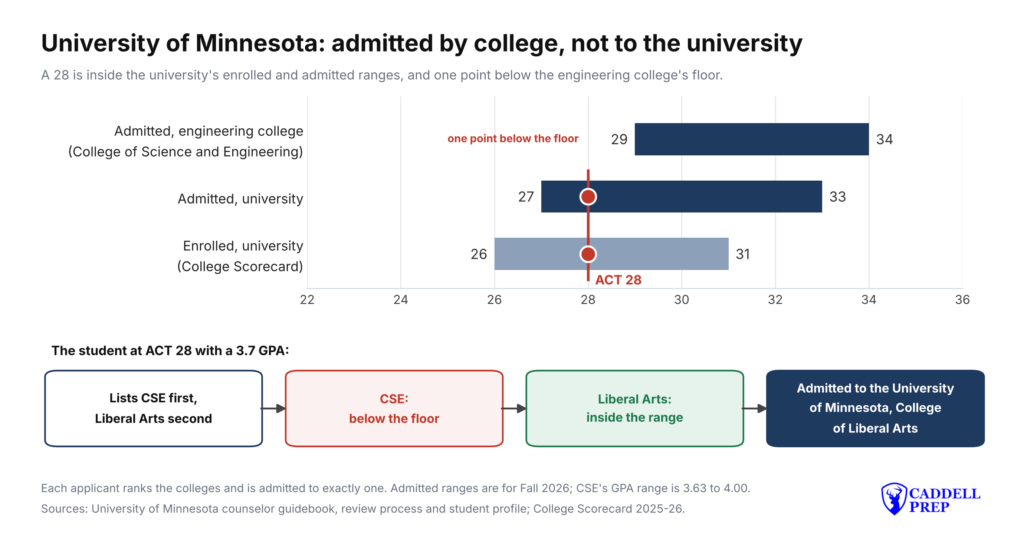
The university’s page says of its ranges that “these are not admission criteria,” and the page here says the same. They are descriptions of who was admitted. But read the three rows together. The engineering college’s floor, 29, is three points above the enrolled floor and two points below the enrolled ceiling. A student at the middle of the university’s enrolled class, a 28 or a 29, is at or below the 25th percentile of the students the engineering college admitted. The college’s ceiling of 34 is a point above the university’s admitted ceiling and three above its enrolled one.
[In-article image 2, 2760 x 1440] Three horizontal bars stacked: “Enrolled, university: 26 to 31,” “Admitted, university: 27 to 33,” “Admitted, engineering college: 29 to 34.” A vertical line at 28 crossing the first two bars and stopping short of the third. Beneath, a small flow in four boxes: “Lists CSE first, Liberal Arts second” → “CSE: below the floor” → “Liberal Arts: inside the range” → “Admitted to the University of Minnesota, College of Liberal Arts.” Alt text: University of Minnesota admitted-student ranges for the university and the College of Science and Engineering File name: umn-cse-admission-by-college
The image above shows a student admitted to the university and routed to another college, and the one point of ACT that separates the two outcomes.
Take a student with a 28 on the ACT and a 3.7 unweighted GPA who lists the College of Science and Engineering first and the College of Liberal Arts second. Against the university’s admitted profile he is inside on every measure. Against the engineering college’s he is one point below the ACT floor and inside on GPA. If the engineering college does not take him, the process considers him for Liberal Arts, where he is inside the range, and he is admitted to the University of Minnesota as a liberal arts student holding a score that would have been the median of the enrolled class. The number did not change. The college did, and the Scorecard’s row for the University of Minnesota, 26 to 31 and 80% admitted, describes a university he was admitted to and an engineering college he was not.
Colorado’s flagship published its engineering college’s range beside the university’s, on our page on engineering colleges in Colorado, and left the mechanism unstated. Minnesota states it: the college is the unit of admission. Maryland’s flagship puts its engineering gate a year after admission, on our page on engineering colleges in Maryland. Minnesota’s is in the letter.
Mankato runs the other arrangement on the page that a reader should know about. Its integrated engineering degree is taught at Iron Range Engineering in Virginia and at the Bell Program in the Twin Cities. Students complete their first two years of pre-engineering coursework at a community college, spend one semester in residence at the Bell Academy in Chisholm, and then spend two years working in engineering internships and co-op positions while taking their upper-division classes in the evenings. The degree is Mankato’s and the program is ABET-accredited. Mankato does not publish a pay figure on its program page and this page does not give one. Minnesota also has tuition reciprocity with Wisconsin, North Dakota, South Dakota and Manitoba, so the out-of-state figures in the table do not apply to students from those places. They apply to a student from New York.
The honest version is that the three rows in the table above are three different populations. The Scorecard’s range is of students who enrolled a year ago. The university’s two ranges are of applicants admitted this cycle, most of whom enrolled somewhere else. The engineering college does not publish its admit rate, and a 28 is not a rejection. It is a score one point below a published 25th percentile, and the student holding it should list a second college he would attend.
Families reading the guidebook frequently ask whether a student can be admitted to the university and turned away from engineering.
The image above shows a student admitted to the university and routed to another college, and the one point of ACT that separates the two outcomes.
Take a student with a 28 on the ACT and a 3.7 unweighted GPA who lists the College of Science and Engineering first and the College of Liberal Arts second. Against the university’s admitted profile he is inside on every measure. Against the engineering college’s he is one point below the ACT floor and inside on GPA. If the engineering college does not take him, the process considers him for Liberal Arts, where he is inside the range, and he is admitted to the University of Minnesota as a liberal arts student holding a score that would have been the median of the enrolled class. The number did not change. The college did, and the Scorecard’s row for the University of Minnesota, 26 to 31 and 80% admitted, describes a university he was admitted to and an engineering college he was not.
Colorado’s flagship published its engineering college’s range beside the university’s, on our page on engineering colleges in Colorado, and left the mechanism unstated. Minnesota states it: the college is the unit of admission. Maryland’s flagship puts its engineering gate a year after admission, on our page on engineering colleges in Maryland. Minnesota’s is in the letter.
Mankato runs the other arrangement on the page that a reader should know about. Its integrated engineering degree is taught at Iron Range Engineering in Virginia and at the Bell Program in the Twin Cities. Students complete their first two years of pre-engineering coursework at a community college, spend one semester in residence at the Bell Academy in Chisholm, and then spend two years working in engineering internships and co-op positions while taking their upper-division classes in the evenings. The degree is Mankato’s and the program is ABET-accredited. Mankato does not publish a pay figure on its program page and this page does not give one. Minnesota also has tuition reciprocity with Wisconsin, North Dakota, South Dakota and Manitoba, so the out-of-state figures in the table do not apply to students from those places. They apply to a student from New York.
The honest version is that the three rows in the table above are three different populations. The Scorecard’s range is of students who enrolled a year ago. The university’s two ranges are of applicants admitted this cycle, most of whom enrolled somewhere else. The engineering college does not publish its admit rate, and a 28 is not a rejection. It is a score one point below a published 25th percentile, and the student holding it should list a second college he would attend.
Families reading the guidebook frequently ask whether a student can be admitted to the university and turned away from engineering.
Can You Get Into the University of Minnesota and Not Into Engineering?
A student can get into the University of Minnesota and not into its engineering college. Each applicant is admitted to one of eight colleges, considered in the order he lists them and then for others that fit his preparation, so a student below the engineering college’s range can be admitted to the university in a different college.
A student admitted elsewhere in the university who still wants engineering applies to transfer into the College of Science and Engineering from inside, on requirements the college sets for internal transfers, and those requirements are not covered on this page. The score he submits as a first-year applicant is read once, by college, and the college that admits him is the one on the letter.
The flagship’s process is its own. The degrees are what the next section lists.
Which Minnesota Universities Have ABET-Accredited Engineering Schools?
Seven Minnesota universities hold ABET-accredited engineering bachelor’s degrees, five public and two private, and all seven are in the table above.
In Minneapolis, the University of Minnesota’s College of Science and Engineering holds twelve disciplines, with 3M, Medtronic and Honeywell headquartered within fifteen miles. In St. Paul, St. Thomas’s School of Engineering holds four. In Duluth, the Swenson College of Science and Engineering holds six. Mankato’s engineering degrees are taught in Mankato, at Iron Range Engineering in Virginia and at the Bell Program in Bloomington. St. Cloud State holds three disciplines on the Mississippi. Winona State holds general engineering and composite materials engineering. Bethel holds electrical engineering in Arden Hills.
Accreditation matters for a reason that is easy to miss at seventeen. Licensure as a professional engineer normally requires a degree from an ABET-accredited engineering program, and that is why Bethel’s mechanical and computer engineering majors, which are not yet accredited, are not the degrees that place it on the list. Carleton, Macalester, St. Olaf and Gustavus Adolphus award no engineering degree and route students to one through three-two arrangements that finish at another university, and Hamline, Augsburg, St. Catherine, Saint Benedict and Saint John’s, Concordia, Bemidji State, Southwest Minnesota State, Metro State and Minnesota State Moorhead award none.
Nothing on this page ranks the seven. The table’s order is a stated, verifiable number where one exists, and the choice among accredited programs comes down to cost, discipline and where a student’s score places him.
What If Your Scores Are Below the Range You Want?
In Minnesota the range that matters at the flagship is the engineering college’s, 29 to 34, and not the university’s, and a student at 27 or 28 is deciding between two things: raising the score before the application goes in, or listing a second college he would attend if the first does not take him.
The gap from 27 to 29 on the ACT is two or three questions a section, and the Math and Science sections, where engineering applicants are expected to be strongest, are the two where a summer of work moves the composite fastest. A New York student has six ranges, no reciprocity, and out-of-state tuition from $10,245 at St. Cloud State to $38,362 at the flagship.
The first step is finding out where the score actually is, section by section. A free diagnostic SAT gives a score that can be set against the SAT columns in the table and converted to the ACT scale for the rest of it.
The Math section rewards the same handful of topics on every test date, and a student who knows which of them he is missing can close a gap of 50 to 100 points in weeks rather than months. The method is on our page on improving your SAT Math score, and the same topics carry the ACT Math section.
How to Read These Score Ranges
Every range on this page covers the middle 50% of admitted students who submitted that test. The lower number is the 25th percentile and the upper number is the 75th, so a quarter of admitted students scored at or above it.
An enrolled range and an admitted range describe different students, and a university that publishes both by college gives a reader three numbers where the Scorecard gives one. The one to read for engineering at Minnesota is the engineering college’s.
Because most colleges are now test-optional, the ranges that are published describe only the students who chose to submit at all. Students with strong scores submit and students with weak ones don’t, so a published range sits higher than the range for everyone who was actually admitted. More on what SAT score you need for college and on test-optional colleges.
Should You Take the SAT Instead?
Minnesota is an ACT state. Twenty-six Minnesota institutions report an ACT range and sixteen report SAT sections, and the University of Minnesota publishes its engineering college’s range on both scales, 29 to 34 on the ACT and 1390 to 1510 on the SAT.
That is why the table on this page carries an ACT composite column and is sorted by it. Every university on the page accepts either test, and a student from outside Minnesota who holds an SAT should read the SAT columns and submit the test he scores higher on.
Engineering Programs in Nearby States
Minnesota borders Wisconsin, Iowa, North Dakota and South Dakota, and its reciprocity agreements with Wisconsin and the Dakotas mean a Minnesota student pays close to resident tuition across three of those lines.
See engineering colleges in Wisconsin, engineering colleges in Iowa, and engineering colleges in North Dakota.
Engineering Colleges in Other States
We publish the same breakdown for engineering programs in every state.
See engineering colleges by state for the full list.

Glyn Caddell
Glyn Caddell holds a BS in Mechanical Engineering from NJIT and has been tutoring New York City students since 2008. He founded Caddell Prep in 2012 and is the author of Digital SAT Math Secrets: Lessons & Tricks to Quickly Improve to a Perfect 800 on the Math Test, which contains over 900 practice problems and is used in Caddell Prep’s SAT math classes. He is founding president of the Staten Island Technical High School alumni association and teaches every lesson on this site personally.
Finally, an SAT course that students actually understand
Every question has a video explanation. Not most — every one.
The on-demand Digital SAT course covers all 17 math topics and 15 reading and writing topics, with 5 full-length practice tests and a 100-point score increase guarantee. Keep access for the rest of high school. No subscription.
Want to Know What 5 Topics Will Improve Your SAT Score the Most?
Sample Feedback from our Diagnostic Test: