
Home » College SAT Score Ranges, Costs, and Programs by Major and State » Engineering Colleges by State: SAT Scores, ACT Scores, Costs, and ABET Programs » Engineering Colleges in Washington: SAT Scores, Costs, and Programs
By Glyn Caddell, BSME · Author of Digital SAT Math Secrets · Tutoring since 2008 — Updated October 26, 2026
Eleven Washington universities offer ABET-accredited engineering degrees, and this page lists what they cost and, where they report it, the test scores of the students they admit.
The largest of them reports no score at all, tells applicants that its reviewers will not see one, and admits engineering students to the college rather than to a major, with the major assigned after a single placement cycle at the end of the first year.
SAT scores are given by section rather than as a total, because a student at 710 Reading & Writing and 580 Math is in a different position from a student at 580 and 710.
Table of Contents
- Washington Engineering Colleges by SAT Score
- What Does a Test Score Do at the University of Washington’s College of Engineering?
- Which Washington Universities Have ABET-Accredited Engineering Schools?
- What If Your Score Is Below the Range You Want?
Washington Engineering Colleges by SAT Score
The eleven universities below are the ones in Washington that hold an ABET-accredited bachelor’s degree in an engineering discipline. The five that report SAT ranges are sorted by the midpoint of the Math range, so the order can be checked from the table itself, and the six that report none are listed last in alphabetical order.
| College | SAT Reading & Writing | SAT Math | Cost of attendance | Undergraduates | Admit rate |
|---|---|---|---|---|---|
| Seattle University | 620 to 710 | 580 to 720 | $72,124 | 4,062 | 77% |
| Gonzaga University | 600 to 700 | 590 to 680 | $73,178 | 5,198 | 82% |
| Western Washington University | 590 to 710 | 560 to 680 | $30,359 | 13,544 | 93% |
| Whitworth University | 550 to 670 | 540 to 660 | $68,516 | 1,858 | 90% |
| Saint Martin’s University | 510 to 610 | 515 to 620 | $62,449 | 1,158 | 90% |
| Central Washington University | Does not report SAT data | Does not report SAT data | $28,816 | 7,833 | 91% |
| Eastern Washington University | Does not report SAT data | Does not report SAT data | $24,478 | 6,222 | 91% |
| Seattle Pacific University | Does not report SAT data | Does not report SAT data | $56,826 | 1,762 | 83% |
| University of Washington | Does not report SAT data | Does not report SAT data | $32,446 | 31,942 | 39% |
| Walla Walla University | Does not report SAT data | Does not report SAT data | $45,903 | 1,252 | Not reported |
| Washington State University | Does not report SAT data | Does not report SAT data | $27,648 | 21,099 | 87% |
Each range covers the middle 50% of admitted students who submitted that test. A quarter scored below the lower number, and the top quarter scored at or above the upper one. Being under the lower number does not rule a student out, and being just above it is not as safe as it looks.
Only universities with an ABET-accredited engineering bachelor’s degree are listed. The University of Washington’s Bothell and Tacoma campuses award University of Washington degrees and are counted under Washington, and their figures are given in its entry. Washington State’s branch campuses are counted under Washington State. Central Washington’s engineering technology degree is accredited under a separate ABET commission and does not count toward its row. Six universities report no SAT or ACT range to the Scorecard and are listed last in alphabetical order, and Walla Walla also reports no admit rate.
Three things about that table are worth pausing on.
Washington, the largest school on the page by more than 10,000 students, reports no score range, and its admissions page says its reviewers do not see test scores. Its engineering college admits to the college and places into a major a year later. The next section is about both.
Only one of the five publics reports a range, Western Washington, and it charges a non-resident $28,707, $14,502 less than Washington. Washington State charges $29,950, also with no range.
Seattle and Gonzaga, the two largest privates that report ranges, charge $56,721 and $55,480 and admit 77% and 82%, and Seattle’s Math ceiling of 720 is the highest on the page.
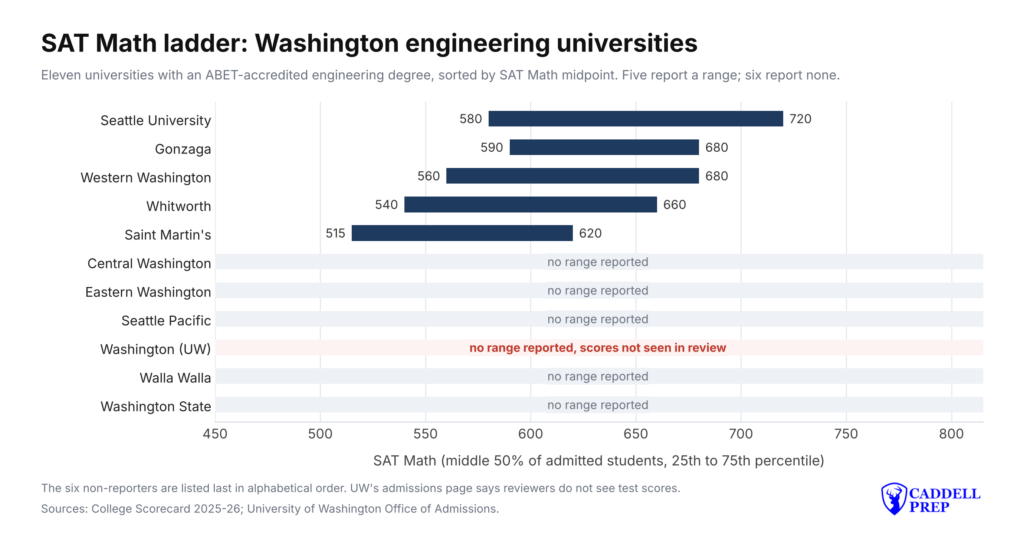
A student can see where his Math score sits on this list in the image above, and where there is nothing to sit against.
Want to Know What 5 Topics Will Improve Your SAT Score the Most?
Sample Feedback from our Diagnostic Test:

Seattle University
Seattle University’s College of Science and Engineering holds ABET accreditation in civil, computer, electrical and mechanical engineering [VERIFY on abet.org], and Seattle has the highest Math ceiling on the page.
Reading & Writing 620 to 710, Math 580 to 720. The top quarter of admitted students scored at or above 720 on Math. Cost of attendance $72,124, with tuition and fees at $56,721 for all students. 4,062 undergraduates, 77% admitted.
Seattle is a Jesuit university on First Hill whose Math range is 140 points wide, the widest on the page, and whose tuition is $1,241 above Gonzaga’s. It admits 77%, the lowest rate on the page after Washington’s.
Gonzaga University
Gonzaga University’s School of Engineering and Applied Science in Spokane holds ABET accreditation in civil, computer, electrical and mechanical engineering [VERIFY on abet.org], and Gonzaga has the highest Math floor on the page.
Reading & Writing 600 to 700, Math 590 to 680. The top quarter of admitted students scored at or above 680 on Math. Cost of attendance $73,178, with tuition and fees at $55,480 for all students. 5,198 undergraduates, 82% admitted.
Gonzaga is a Jesuit university whose Math floor of 590 is 10 points above Seattle’s and whose cost of attendance, $73,178, is the highest on the page. It is the larger of Spokane’s two accredited engineering schools.
Western Washington University
Western Washington University’s College of Science and Engineering in Bellingham holds ABET accreditation in electrical and computer, manufacturing, and polymer materials engineering [VERIFY on abet.org], and Western is the one public on the page that reports a score range.
Reading & Writing 590 to 710, Math 560 to 680. The top quarter of admitted students scored at or above 680 on Math. Cost of attendance $30,359, with tuition and fees at $9,582 in state and $28,707 out of state. 13,544 undergraduates, 93% admitted.
Western admits 93% on a Math range whose ceiling matches Gonzaga’s and whose Reading & Writing ceiling of 710 matches Seattle’s, and it charges a non-resident $28,707, the lowest public figure on the page after Eastern’s and Central’s. It is ninety miles north of Seattle, twenty from the Canadian line.
Whitworth University
Whitworth University’s engineering program in Spokane holds ABET accreditation for its Bachelor of Science in Engineering [VERIFY on abet.org, and remove the row if not EAC-accredited], and Whitworth is the second accredited engineering school in Spokane.
Reading & Writing 550 to 670, Math 540 to 660. The top quarter of admitted students scored at or above 660 on Math. Cost of attendance $68,516, with tuition and fees at $52,880 for all students. 1,858 undergraduates, 90% admitted.
Whitworth is a Presbyterian university five miles from Gonzaga whose Math range sits 50 points below Gonzaga’s at the floor and 20 below it at the ceiling, and whose tuition is $2,600 below Gonzaga’s. Its engineering program is among the newest on the page.
Saint Martin's University
Saint Martin’s University’s Hal and Inge Marcus School of Engineering in Lacey holds ABET accreditation in civil and mechanical engineering [VERIFY on abet.org], and Saint Martin’s is the smallest school on the page that reports a range.
Reading & Writing 510 to 610, Math 515 to 620. The top quarter of admitted students scored at or above 620 on Math. Cost of attendance $62,449, with tuition and fees at $45,510 for all students. 1,158 undergraduates, 90% admitted.
Saint Martin’s is a Benedictine university outside Olympia whose Math floor of 515 is printed as reported, and whose tuition of $45,510 is the lowest among the privates on the page that report a range. It has the lowest Math range among the reporting schools.
Central Washington University
Central Washington University’s engineering program in Ellensburg holds ABET accreditation in electrical engineering [VERIFY on abet.org, and remove the row if the degree is not EAC-accredited. Its mechanical engineering technology degree is ETAC], and Central reports no admitted score range.
Central reports no SAT or ACT range. Cost of attendance $28,816, with tuition and fees at $9,417 in state and $27,526 out of state. 7,833 undergraduates, 91% admitted.
Central charges a non-resident $27,526, the second-lowest public figure on the page, and its engineering technology degree does not count toward its row. It is in the center of the state, on the dry side of the Cascades.
Eastern Washington University
Eastern Washington University’s engineering programs in Cheney hold ABET accreditation in electrical and mechanical engineering [VERIFY on abet.org], and Eastern charges a non-resident less than any other public on the page.
Eastern reports no SAT or ACT range. Cost of attendance $24,478, with tuition and fees at $8,586 in state and $25,959 out of state. 6,222 undergraduates, 91% admitted.
Eastern has the lowest cost of attendance on the page, the lowest in-state tuition and the lowest out-of-state tuition, and it reports no range. It is fifteen miles from Spokane.
Seattle Pacific University
Seattle Pacific University’s engineering programs hold ABET accreditation in electrical and mechanical engineering [VERIFY on abet.org], and Seattle Pacific reports no admitted score range.
Seattle Pacific reports no SAT or ACT range. Cost of attendance $56,826, with tuition and fees at $40,407 for all students. 1,762 undergraduates, 83% admitted.
Seattle Pacific is a Free Methodist university in Queen Anne, three miles from Seattle University, and it charges $40,407, the lowest private tuition on the page after Walla Walla’s. It reports no range.
University of Washington
The University of Washington’s College of Engineering in Seattle holds ABET accreditation in disciplines including aeronautics and astronautics, bioengineering, chemical, civil, computer, electrical, environmental, industrial, materials science and mechanical engineering [VERIFY list on abet.org], and Washington admits engineering students to the college and not to a major, and does not read their test scores.
Washington reports no SAT or ACT range. Cost of attendance $32,446, with tuition and fees at $12,973 in state and $43,209 out of state. 31,942 undergraduates, 39% admitted.
Washington is the largest school on the page, the most selective, and the most expensive public for a non-resident. Its Bothell campus holds accredited degrees in electrical and mechanical engineering and charges a non-resident $43,155 with 5,457 undergraduates and 91% admitted, and its Tacoma campus holds accredited degrees in civil, computer engineering and systems, and mechanical engineering and charges $43,404 with 4,185 undergraduates and 83% admitted [VERIFY both lists]. The two rules at Seattle are the next section.
Walla Walla University
Walla Walla University’s Edward F. Cross School of Engineering in College Place holds ABET accreditation for its Bachelor of Science in Engineering [VERIFY on abet.org], and Walla Walla reports neither a score range nor an admit rate.
Walla Walla reports no SAT or ACT range. Cost of attendance $45,903, with tuition and fees at $34,227 for all students. 1,252 undergraduates, admit rate not reported.
Walla Walla is a Seventh-day Adventist university in the southeast corner of the state, charges $34,227, the lowest private tuition on the page, and is the one school on it for which the Scorecard carries no admit rate.
Washington State University
Washington State University’s Voiland College of Engineering and Architecture in Pullman holds ABET accreditation in disciplines including bioengineering, chemical, civil, computer, electrical, materials science, mechanical and software engineering [VERIFY list on abet.org], and Washington State is the second-largest school on the page and the second public flagship with no range.
Washington State reports no SAT or ACT range. Cost of attendance $27,648, with tuition and fees at $13,391 in state and $29,950 out of state. 21,099 undergraduates, 87% admitted.
Washington State charges a non-resident $29,950, $13,259 less than Washington, and admits 87% against Washington’s 39%, with no range at either. Its Vancouver, Tri-Cities and Everett campuses award its engineering degrees and are counted here.
Five ranges and six blanks say who got in, and the largest blank is a policy. The next section is about it.
What Does a Test Score Do at the University of Washington's College of Engineering?
A test score does nothing in the University of Washington’s holistic review, in the admissions office’s own words, and the College of Engineering admits a student to the college rather than to a major, with the major assigned after a single placement cycle at the end of the first year.
The test rule first. The university’s admissions office says it “permanently removed the SAT/ACT requirement for incoming students,” calls the university “technically test-optional,” and says of its review that “we will not be using test scores at all during the holistic review” and that “the reviewers will not see your test scores, if provided.” It gives one exception, scores well above the middle 50 percent of admitted students that may be considered for a few applicants, with no cutoff defined, and one requirement, that home-schooled applicants and those from schools without letter or numeric grades “are still required to submit SAT or ACT scores” unless they have a year of college coursework. The university reports no range to the Scorecard, and the blank in the table is the policy, not a gap in the data.
Then the college rule. First-year engineering students are admitted Direct to College. An applicant lists “Engineering Undeclared” or an engineering major as a first choice, is admitted in autumn only, and enters as an Engineering Undeclared student, ENGRUD in the college’s shorthand. The college says Direct to College admission “guarantees incoming first-year students access to an engineering major,” and in the next breath that “we cannot guarantee placement into a specific major.” There is “only one placement cycle at the end of a student’s first year.” The college says that “historically, the majority of students have placed in their first-choice major,” and it publishes placement data each summer. A student who was not admitted Direct to College can apply to a major later through what the college calls the “capacity-constrained pathway,” and “we are unable to guarantee admission to the College of Engineering or to a specific engineering major at a later time.”
Put the two rules together for a New York applicant. He sends a score and no reviewer sees it. He is admitted to a college of ten engineering majors and not to one of them. A year later he requests a major in a single cycle and is guaranteed one, probably but not certainly the one he wanted. The two documents that carry him through both steps are his transcript and his application, and the score he spent a year on is in neither. Washington State, the state’s second flagship, also reports no range [VERIFY its test policy] and charges him $29,950 against Washington’s $43,209, so his choice between the two public engineering schools is made with no range to read at either and $13,259 between them.
| University | Non-resident tuition | Admit rate | Admitted Math range |
|---|---|---|---|
| University of Washington, Seattle | $43,209 | 39% | Not reported |
| University of Washington, Tacoma | $43,404 | 83% | Not reported |
| University of Washington, Bothell | $43,155 | 91% | Not reported |
| Washington State University | $29,950 | 87% | Not reported |
| Western Washington University | $28,707 | 93% | 560 to 680 |
| Central Washington University | $27,526 | 91% | Not reported |
| Eastern Washington University | $25,959 | 91% | Not reported |
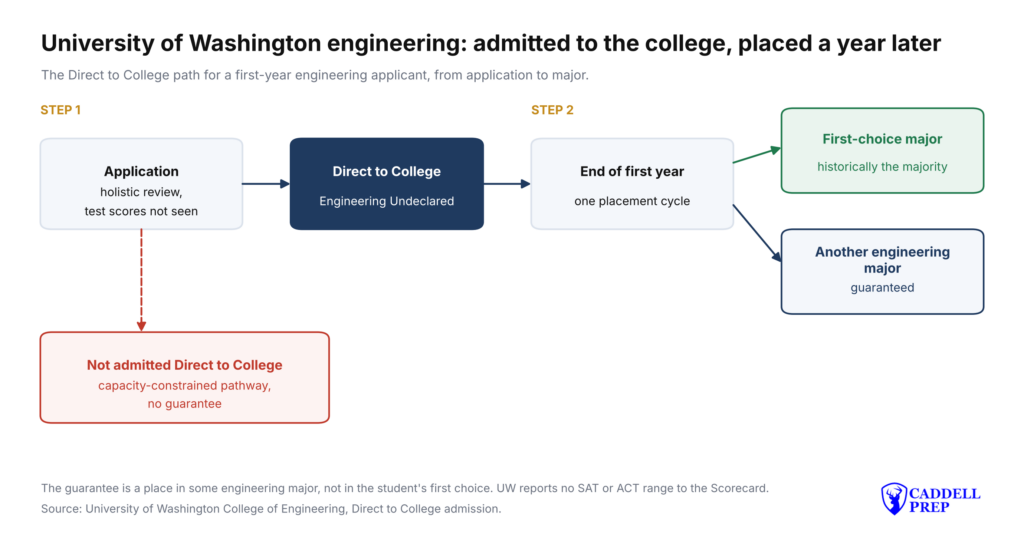
The image above draws the two steps a Washington engineering applicant goes through and where the score is absent from both.
Take a New York student with a 680 on SAT Math. At Washington there is no range to read, the score is not seen in review, and if he is admitted Direct to College he pays $43,209 and is guaranteed an engineering major, though not a guaranteed first choice, after one placement cycle. At Washington State there is no range and he pays $29,950. At Western he is at the ceiling of 560 to 680 and pays $28,707. At Seattle he is in the upper half of 580 to 720 and pays $56,721. At Gonzaga he is at the ceiling of 590 to 680 and pays $55,480. The score places him at the top of the range at the three schools that publish one and does nothing at the two largest.
Washington’s second number is a count. Six of the eleven rows in the table are blank, the most on any page in this series that uses this table [VERIFY against the Alaska and California drafts, which use different wording for their no-data and test-blind rows]. Four of the five publics report nothing, and the one that does, Western, reports the highest public range on the page, 560 to 680, and charges a non-resident $28,707. A New York student who wants a public engineering school in Washington with a published range has one choice, and it is in Bellingham.
Washington’s third number is three campuses. The University of Washington’s Bothell and Tacoma campuses hold their own accredited engineering degrees and charge a non-resident $43,155 and $43,404, within $200 of Seattle’s $43,209, and they admit 91% and 83% of applicants against Seattle’s 39%. The three figures are in the table and this page states them and does not characterize them. The nearest cousin of Washington’s test rule on these pages is California’s, on our page on engineering colleges in California, where the public universities do not look at a score at all. The nearest cousin of Direct to College is Texas A&M’s placement on our page on engineering colleges in Texas, where the major comes after three semesters and a 3.75 makes it automatic. Washington’s comes after one year and nothing makes it automatic.
The honest version is that the exception for very high scores is real and undefined, and a New York student with a 1550 should still send it. The Direct to College guarantee is a guarantee of some engineering major, in the college’s words, and this page does not estimate how many students get their first choice beyond “the majority.” The 39% is the university’s admit rate, and the College of Engineering’s Direct to College rate is not on the pages this page read [VERIFY]. No range means no range, not a low one, and a student should not read a blank as a 500. And the state’s assessment for juniors is neither the SAT nor the ACT [VERIFY with OSPI], so a Washington student arrives at this table without a state-given score to begin with.
Families with a strong score frequently ask whether it is worth sending at all.
Does the University of Washington Look at SAT Scores?
The University of Washington does not look at SAT scores during its holistic review, in its admissions office’s words, and its reviewers do not see them if they are sent. The one exception is a score well above the middle 50 percent of admitted students, considered for a few applicants with no defined cutoff, and the one requirement is for home-schooled applicants and students from schools without letter or numeric grades.
A New York student with a very high score should send it for the exception. A student with an ordinary one is sending it to no one.
The rule is Washington’s. The degrees are what the next section lists.
Which Washington Universities Have ABET-Accredited Engineering Schools?
Eleven Washington universities hold ABET-accredited engineering bachelor’s degrees, five public and six private, and all eleven are in the table above.
In Seattle, the University of Washington’s College of Engineering, Seattle University’s College of Science and Engineering on First Hill and Seattle Pacific in Queen Anne are within four miles of one another, with the university’s Bothell campus fifteen miles north and its Tacoma campus thirty miles south, each with its own accredited degrees. In Pullman, Washington State’s Voiland College is on the Idaho line, with its Vancouver, Tri-Cities and Everett campuses awarding its degrees. In Spokane, Gonzaga’s School of Engineering and Applied Science and Whitworth are five miles apart, with Eastern Washington in Cheney fifteen miles out. Western is in Bellingham, Central in Ellensburg, Saint Martin’s in Lacey outside Olympia, and Walla Walla in College Place in the southeast corner.
Accreditation matters for a reason that is easy to miss at seventeen. Licensure as a professional engineer normally requires a degree from an ABET-accredited engineering program, and that is why Central Washington’s mechanical engineering technology degree does not count toward its row. Pacific Lutheran, Puget Sound, Whitman, Evergreen, Heritage and City University award no engineering degree.
Nothing on this page ranks the eleven. The table’s order is a stated, verifiable number where one exists, and the choice among accredited programs comes down to cost, discipline and where a student’s score places him, where a school reads one.
What If Your Score Is Below the Range You Want?
In Washington eleven schools cover Math ranges from a 515 floor to a 720 ceiling where ranges are reported, five of them are public, and a New York student’s price among the five runs from $25,959 to $43,209. The score decides Seattle University or Gonzaga or Western. At the University of Washington the score decides nothing, and the transcript decides everything.
The gap from a 680 to the top quarter at Seattle is 40 points of SAT Math, three questions, and the student who closes it is in the top quarter at every school on the page that reports one. There is no gap to close at Washington, and there is no range to be inside.
The first step is finding out where the score actually is, section by section. A free diagnostic SAT gives a score that can be set against the Math column in the table, for the schools that have one.
The Math section rewards the same handful of topics on every test date, and a student who knows which of them he is missing can close a gap of 50 to 100 points in weeks rather than months. The method is on our page on improving your SAT Math score, and the topics it covers are the ones a first-year engineering calculus course assumes, and that course is part of what decides placement at Washington.
How to Read These Score Ranges
Every range on this page covers the middle 50% of admitted students who submitted that test. The lower number is the 25th percentile and the upper number is the 75th, so a quarter of admitted students scored at or above it.
A blank is not a low range, and at Washington the blank is the policy. A school that reports nothing has told the Scorecard nothing, and a student should not fill the cell in from what he imagines. Washington has gone further and told applicants that the cell is empty on its side too.
Because most colleges are now test-optional, the ranges that are published describe only the students who chose to submit at all. Students with strong scores submit and students with weak ones don’t, so a published range sits higher than the range for everyone who was actually admitted. More on what SAT score you need for college and on test-optional colleges.
Should You Take the ACT Instead?
Washington’s statewide assessment for juniors is neither the SAT nor the ACT [VERIFY with the Office of Superintendent of Public Instruction], and five of the eleven universities on this page report an SAT range while four report an ACT range.
That is why the table carries SAT columns and is sorted by Math. Every university on this page that reads a score accepts either test, and a student who holds an ACT should convert it and read the same columns.
Engineering Programs in Nearby States
Washington borders Oregon and Idaho, and Montana is across the Idaho panhandle.
See engineering colleges in Oregon, engineering colleges in Idaho, and engineering colleges in Montana.
Engineering Colleges in Other States
We publish the same breakdown for engineering programs in every state.
See engineering colleges by state for the full list.

Glyn Caddell
Glyn Caddell holds a BS in Mechanical Engineering from NJIT and has been tutoring New York City students since 2008. He founded Caddell Prep in 2012 and is the author of Digital SAT Math Secrets: Lessons & Tricks to Quickly Improve to a Perfect 800 on the Math Test, which contains over 900 practice problems and is used in Caddell Prep’s SAT math classes. He is founding president of the Staten Island Technical High School alumni association and teaches every lesson on this site personally.
Finally, an SAT course that students actually understand
Every question has a video explanation. Not most — every one.
The on-demand Digital SAT course covers all 17 math topics and 15 reading and writing topics, with 5 full-length practice tests and a 100-point score increase guarantee. Keep access for the rest of high school. No subscription.
Want to Know What 5 Topics Will Improve Your SAT Score the Most?
Sample Feedback from our Diagnostic Test: