
Home » College SAT Score Ranges, Costs, and Programs by Major and State » Engineering Colleges by State: SAT Scores, ACT Scores, Costs, and ABET Programs » Engineering Colleges in Montana: ACT Scores, SAT Scores, Costs, and Programs
By Glyn Caddell, BSME · Author of Digital SAT Math Secrets · Tutoring since 2008 — Updated October 24, 2026
Three Montana colleges offer ABET-accredited engineering degrees, and this page lists what they cost and the test scores of the students they admit.
Montana State no longer requires a test score for admission, and the score it reads for calculus placement is one that only the top quarter of its admitted students reach, a line worked out below the table.
The table is sorted by ACT because Montana is an ACT state, and it carries an ACT Math column because the finding on this page is in that score.
Table of Contents
- Montana Engineering Colleges by ACT and SAT Score
- What Score Do You Need to Start in Calculus at Montana State?
- Which Montana Colleges Have ABET-Accredited Engineering Programs?
- What If Your Score Is Below the Line You Want?
Montana Engineering Colleges by ACT and SAT Score
The three colleges below are the ones in Montana that hold an ABET-accredited bachelor’s degree in an engineering discipline. They are sorted by the midpoint of the ACT composite range, so the order can be checked from the table itself.
| College | ACT composite | ACT Math | SAT Reading & Writing | SAT Math | Cost of attendance | Undergraduates | Admit rate |
|---|---|---|---|---|---|---|---|
| Montana State University | 21 to 27 | 19 to 27 | 540 to 645 | 525 to 640 | $25,905 | 14,451 | 82% |
| Carroll College | 21 to 27 | 21 to 27 | 540 to 660 | 510 to 640 | $55,626 | 1,092 | 71% |
| Montana Technological University | 19 to 25 | 18 to 26 | 510 to 630 | 530 to 630 | $22,786 | 1,480 | 91% |
Each range covers the middle 50% of admitted students who submitted that test. A quarter scored below the lower number, and the top quarter scored at or above the upper one. Being under the lower number does not rule a student out, and being just above it is not as safe as it looks.
Montana State and Carroll share an ACT composite range, and Montana State is listed first on the SAT Math midpoint. The ACT Math column is added on this page because Montana State places students into calculus by that score. Only colleges with an ABET-accredited engineering bachelor’s degree are listed. The University of Montana awards no engineering degree.
Three things about that table are worth pausing on.
Montana State’s ACT Math range ends at 27 and its SAT Math range ends at 640, and 27 and 640 are the two scores its math department requires for Calculus I. The land-grant’s calculus line is its own 75th percentile, twice, and the next section is about what that means for the other three quarters.
Montana State’s out-of-state tuition, $33,287, is 3.9 times its in-state tuition of $8,460, the widest ratio between the two figures at any public university in this series. A Montana family pays less at the land-grant than at any school on the page but Montana Tech. A New York family pays more than at any school on the page but Carroll.
Carroll College, a Catholic college of 1,092 students in Helena, reports the same ACT composite range as the land-grant and the highest ACT Math floor on the page, 21, while admitting the smallest share of applicants, 71%.
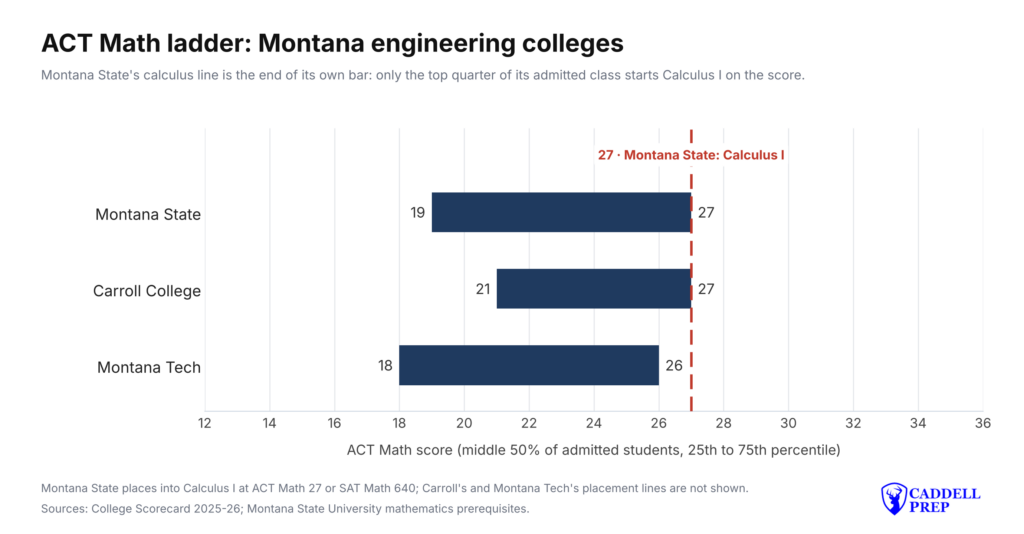
A student can see where his ACT Math score sits against the calculus line in the image above, and that the line is the end of the land-grant’s bar.
Want to Know What 5 Topics Will Improve Your SAT Score the Most?
Sample Feedback from our Diagnostic Test:

Montana State University
Montana State University’s Norm Asbjornson College of Engineering in Bozeman holds ABET accreditation in disciplines including chemical, civil, computer, electrical, environmental, industrial and mechanical engineering, and Montana State requires an ACT Math of 27 or an SAT Math of 640 to start in Calculus I on a test score.
ACT composite 21 to 27, ACT Math 19 to 27. Reading & Writing 540 to 645, Math 525 to 640. The top quarter of admitted students scored at or above 27 on the ACT, 27 on ACT Math and 640 on SAT Math. Cost of attendance $25,905, with tuition and fees at $8,460 in state and $33,287 out of state. 14,451 undergraduates, 82% admitted.
Montana State is the largest school on the page by a factor of ten and the land-grant university of the state. Its calculus prerequisite equals its 75th percentile on both tests, and its in-state tuition is $120 above Montana Tech’s.
Carroll College
Carroll College’s engineering department in Helena holds ABET accreditation in civil engineering, and Carroll has the highest ACT Math floor on the page.
ACT composite 21 to 27, ACT Math 21 to 27. Reading & Writing 540 to 660, Math 510 to 640. The top quarter of admitted students scored at or above 27 on the ACT and 640 on SAT Math. Cost of attendance $55,626, with tuition and fees at $41,484 for all students. 1,092 undergraduates, 71% admitted.
Carroll is a Catholic college, the smallest school on the page, the most expensive by more than $29,000, and the most selective. It holds one accredited engineering degree, and its ACT Math floor of 21 is two points above the land-grant’s.
Montana Technological University
Montana Technological University in Butte holds ABET accreditation in disciplines including civil, electrical, environmental, general, geological, geophysical, mechanical, metallurgical and materials, mining and petroleum engineering, and Montana Tech has the lowest tuition on the page for a resident and for a non-resident.
ACT composite 19 to 25, ACT Math 18 to 26. Reading & Writing 510 to 630, Math 530 to 630. The top quarter of admitted students scored at or above 25 on the ACT, 26 on ACT Math and 630 on SAT Math. Cost of attendance $22,786, with tuition and fees at $8,340 in state and $26,150 out of state. 1,480 undergraduates, 91% admitted.
Montana Tech is the least selective school on the page, the cheapest on every measure, and the holder of the state’s only mining, petroleum, metallurgical and geophysical engineering degrees. Its ACT Math ceiling of 26 is a point under the land-grant’s calculus line, and its SAT Math floor of 530 is five points above the land-grant’s.
Three ranges say who got in. At the land-grant, one number says who starts in calculus, and the next section is about it.
What Score Do You Need to Start in Calculus at Montana State?
A student starts in Calculus I at Montana State on an ACT Math of 27 or an SAT Math of 640, or on placement level 500 on the university’s math placement exam, or on a C- or better in M 151 Precalculus, and Montana State’s admitted ranges on the two tests end at exactly 27 and 640.
The Department of Mathematical Sciences lists the prerequisites for M 171, Calculus I, as any one of those four and adds that “these prerequisites will be enforced.” The admitted ACT Math range is 19 to 27. The admitted SAT Math range is 525 to 640. So the calculus line is the 75th percentile of the admitted class on both tests, and the sentence under the table that says a quarter of admitted students scored at or above the upper number is, at Montana State, the same sentence as a quarter of admitted students start in calculus on their score. The other three quarters take the placement exam, the MPLEX, or start in precalculus. A student who passes M 161, the university’s survey of calculus, is allowed one attempt at the MPLEX if he is seeking admission to M 171.
The admission rule makes the line do more work, not less. Montana State’s admissions page says the Montana Board of Regents has ended the ACT and SAT requirement, so scores are not required for admission or for scholarships, and the university admits on a 2.5 cumulative GPA, or a 22 on the ACT, or an 1120 on the SAT, or a rank in the upper half of the class, with a college preparatory curriculum of four years of English, three of math through algebra II, three of social studies and two of lab science. The same page lists a math readiness standard for beginning a University Academic Plan at an ACT Math of 22. So a Montana student can be admitted to the land-grant with no score at all, the state’s own math readiness line is five points below the engineering college’s first course, and the one score the university still reads for an engineering student is the one that decides whether his first semester has calculus in it.
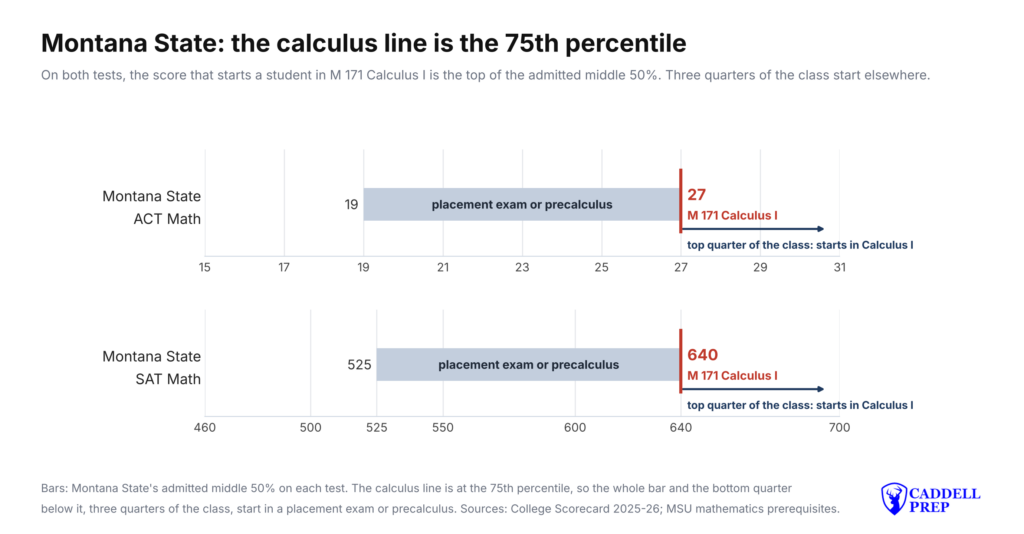
The image above shows that the calculus line is the ceiling, on both tests.
The series has had calculus lines near the top of a range before. Hawaii’s flagship set its bypass at 730, above its 75th percentile of 640, on our page on engineering colleges in Hawaii. Maine’s flagship set its line at 670 and published no range to set it against, on our page on engineering colleges in Maine. Montana is the clean case. The line and the ceiling are the same number on two different tests, at a university that admits 82% of applicants and asks none of them for a score to get in.
Take a student with a 26 composite and a 26 on ACT Math. He is in the top third of Montana State’s admitted composite range and one point under the calculus line. He is admitted, because the university does not read the score for admission, and he takes the MPLEX. A level 500 puts him in M 171 in the fall. A 450 puts him in M 151 for a semester, and in M 171 in the spring, one semester behind the engineering college’s four-year plan. At Montana Tech the same student is at or above the ceiling of the admitted range on both tests, and Tech places him by his ACT or SAT score or by the ALEKS PPL exam, which Tech requires for calculus or precalculus placement when a qualifying score is not on file, at $25 and up to four retakes with 48 hours and three hours of review between them. Tech does not publish the ACT or SAT score that places into M 171 on its placement page, and this page does not supply one.
Carroll and Tech are the other two doors. Carroll holds one accredited degree, civil engineering, at a college of 1,092 whose ACT range matches the land-grant’s and whose tuition is $41,484. Tech holds the state’s mining, petroleum, metallurgical, geophysical and environmental engineering degrees in Butte, admits 91%, and charges a resident $8,340 and a non-resident $26,150, the lowest figures on the page. A student who wants to work in the Bakken or in hard-rock mining has one school in the state, and it is the cheapest one. The University of Montana in Missoula awards no engineering degree, and a reader looking for the flagship on this page will not find it.
The honest version is that a placement line is not a wall. Montana State admits 82% and reads no score for admission. The MPLEX is the second door and precalculus is the third, and a student who places into M 151 and passes it is in M 171 the next semester. The 640 is the current SAT section score. Montana State’s page also lists a 32 on the old subject-test scale, and this page quotes only the 640. Three quarters of admitted students being under the line is not a judgment about them. It is where the university drew the line and where the Scorecard says its class sits.
Families reading Montana State’s admissions page frequently ask whether a test is needed at all.
Which Montana Colleges Have ABET-Accredited Engineering Programs?
Three Montana colleges hold ABET-accredited engineering bachelor’s degrees, two public and one private, and all three are in the table above.
In Bozeman, Montana State’s Norm Asbjornson College of Engineering holds seven disciplines, with the Gallatin Valley’s optics and photonics firms the largest engineering employers in the state’s fastest-growing county. In Butte, Montana Tech holds ten, including the mining, petroleum, metallurgical and geophysical engineering degrees the school was founded to teach in 1900. In Helena, Carroll College holds civil engineering.
Accreditation matters for a reason that is easy to miss at seventeen. Licensure as a professional engineer normally requires a degree from an ABET-accredited engineering program. The University of Montana awards no engineering degree, and Missoula College’s technology programs are accredited under a separate ABET commission. Montana State Billings, Montana State Northern, Montana Western, Rocky Mountain College and the University of Providence award none.
Nothing on this page ranks the three. The table’s order is a stated, verifiable number, and the choice among accredited programs comes down to cost, discipline and where a student’s score places him.
What If Your Score Is Below the Line You Want?
In Montana admission asks for no score, so the only line in the state is 27 on ACT Math or 640 on SAT Math, and three quarters of Montana State’s own admitted students are under it. The MPLEX is the second door and precalculus is the third, and a student who knows that before he arrives can decide which door he wants to use.
The gap from a 24 or 25 on ACT Math to a 27 is two or three questions, and the material those questions test, functions, trigonometry and the algebra underneath both, is the material the MPLEX asks about and the material M 171 assumes. A summer on it moves both scores. A New York student has three ranges and out-of-state tuition from $26,150 at Montana Tech to $33,287 at Montana State, and the Western Undergraduate Exchange rate that cuts those figures for students from fifteen western states does not apply to him.
The first step is finding out where the score actually is, section by section. A free diagnostic SAT gives a Math score that can be set against the 640 and converted to the 27.
The Math section rewards the same handful of topics on every test date, and a student who knows which of them he is missing can close a gap of 50 to 100 points in weeks rather than months. The method is on our page on improving your SAT Math score, and the topics are the ones the MPLEX asks about.
How to Read These Score Ranges
Every range on this page covers the middle 50% of admitted students who submitted that test. The lower number is the 25th percentile and the upper number is the 75th, so a quarter of admitted students scored at or above it.
When a placement line equals a 75th percentile, “a quarter scored at or above it” and “a quarter start in calculus on their score” are the same sentence. The range describes who got in. At Montana State it also describes who skipped the placement exam.
Because most colleges are now test-optional, the ranges that are published describe only the students who chose to submit at all. Students with strong scores submit and students with weak ones don’t, so a published range sits higher than the range for everyone who was actually admitted. More on what SAT score you need for college and on test-optional colleges.
Should You Take the SAT Instead?
Montana is an ACT state. Six Montana institutions report an ACT range and four report SAT sections, most Montana students take the ACT, and Montana State writes its calculus line on both scales, 27 and 640.
That is why the table on this page carries ACT columns and is sorted by them. All three colleges accept either test, and a student from outside Montana who holds an SAT should read the SAT columns and the 640.
Engineering Programs in Nearby States
Montana borders Idaho, Wyoming, North Dakota and South Dakota, and Montana students apply across those lines in numbers, because three accredited programs is one of the shortest lists in the country.
See engineering colleges in Idaho, engineering colleges in Wyoming, and engineering colleges in North Dakota.
Engineering Colleges in Other States
We publish the same breakdown for engineering programs in every state.
See engineering colleges by state for the full list.

Glyn Caddell
Glyn Caddell holds a BS in Mechanical Engineering from NJIT and has been tutoring New York City students since 2008. He founded Caddell Prep in 2012 and is the author of Digital SAT Math Secrets: Lessons & Tricks to Quickly Improve to a Perfect 800 on the Math Test, which contains over 900 practice problems and is used in Caddell Prep’s SAT math classes. He is founding president of the Staten Island Technical High School alumni association and teaches every lesson on this site personally.
Finally, an SAT course that students actually understand
Every question has a video explanation. Not most — every one.
The on-demand Digital SAT course covers all 17 math topics and 15 reading and writing topics, with 5 full-length practice tests and a 100-point score increase guarantee. Keep access for the rest of high school. No subscription.
Want to Know What 5 Topics Will Improve Your SAT Score the Most?
Sample Feedback from our Diagnostic Test: