
Home » College SAT Score Ranges, Costs, and Programs by Major and State » Engineering Colleges by State: SAT Scores, ACT Scores, Costs, and ABET Programs » Engineering Colleges in Idaho: SAT Scores, Costs, and Programs
By Glyn Caddell, BSME · Author of Digital SAT Math Secrets · Tutoring since 2008 — Updated October 23, 2026
Five Idaho universities offer ABET-accredited engineering degrees, and this page lists what they cost and the SAT scores of the students they admit.
Idaho admits every high school senior with a 3.0 GPA to all three of its public engineering colleges without a test score, and then uses the score to decide whether he starts in calculus. Both halves of that are covered below the table.
Scores are given by section and the table is sorted by Math, because that is the section engineering programs use, and two of the three public universities report none.
Table of Contents
- Idaho Engineering Colleges by SAT Math Score
- Does Idaho Require the SAT for Engineering Admission?
- Which Idaho Universities Have ABET-Accredited Engineering Schools?
- What If Your Math Score Is Below the Calculus Line?
Idaho Engineering Colleges by SAT Math Score
The five universities below are the ones in Idaho that hold an ABET-accredited bachelor’s degree in an engineering discipline. They are sorted by the midpoint of the SAT Math range, with the two that report no range at the bottom.
| College | SAT Reading & Writing | SAT Math | Cost of attendance | Undergraduates | Admit rate |
|---|---|---|---|---|---|
| Northwest Nazarene University | 515 to 630 | 490 to 610 | $55,163 | 1,024 | 65% |
| University of Idaho | 500 to 630 | 490 to 600 | $23,738 | 7,747 | 76% |
| Brigham Young University-Idaho | 490 to 610 | 480 to 590 | $15,246 | 44,397 | 96% |
| Boise State University | Does not report SAT data | Does not report SAT data | $28,224 | 17,674 | 87% |
| Idaho State University | Does not report SAT data | Does not report SAT data | $21,527 | 7,583 | Not reported |
Each range covers the middle 50% of admitted students who submitted the SAT. A quarter scored below the lower number, and the top quarter scored at or above the upper one. Being under the lower number does not rule a student out, and being just above it is not as safe as it looks.
Only universities with an ABET-accredited engineering bachelor’s degree are listed. BYU-Idaho’s cost of attendance is built on the tuition rate for members of the Church of Jesus Christ of Latter-day Saints, and non-members pay approximately twice that tuition. Every Idaho senior with a 3.0 GPA is admitted to the three public universities through the state’s direct-admissions program.
Three things about that table are worth pausing on.
Boise State, the largest public university in the state, reports no score range on either test, and neither does Idaho State. A student can compare himself to the University of Idaho’s class and to nothing at the other two public engineering colleges.
Northwest Nazarene’s Math midpoint sits five points above the University of Idaho’s, at more than twice the cost of attendance. The flagship and the private college in Nampa admit students who score the same, and the price gap is $31,425.
BYU-Idaho’s 44,397 undergraduates are more than the three public engineering universities combined, which enroll 33,004 between them, and it admits 96% of applicants.
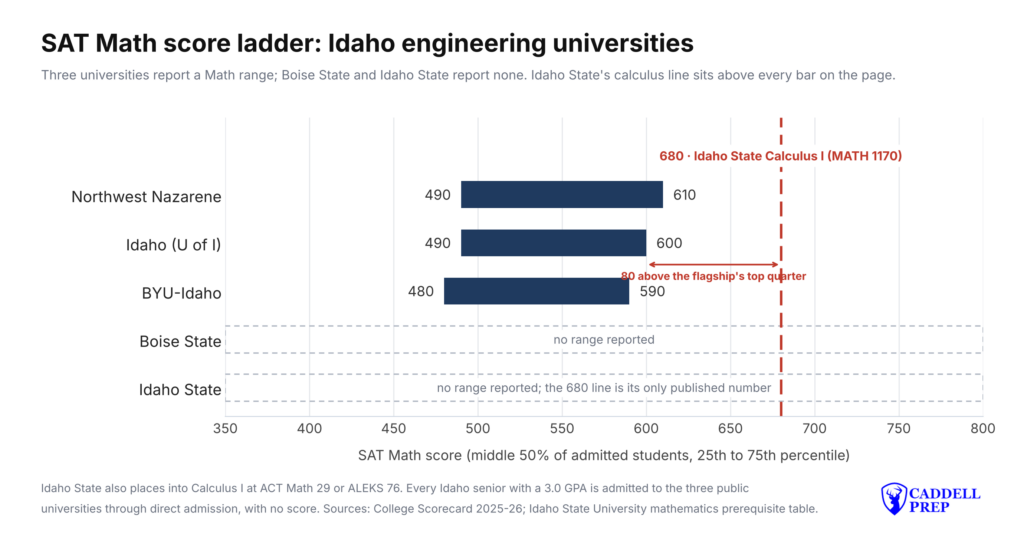
A student can see where his Math score sits on this list, and how far it sits from Idaho State’s calculus line, in the image above.
Want to Know What 5 Topics Will Improve Your SAT Score the Most?
Sample Feedback from our Diagnostic Test:

Northwest Nazarene University
Northwest Nazarene University’s engineering program in Nampa holds ABET accreditation, and Northwest Nazarene has the highest Math range on this page by five points at the midpoint.
Reading & Writing 515 to 630, Math 490 to 610. The top quarter of admitted students scored at or above 630 and 610. Cost of attendance $55,163, with tuition and fees at $40,794 for all students. 1,024 undergraduates, 65% admitted.
Northwest Nazarene is the smallest school on the page, the most expensive and the most selective, and it is affiliated with the Church of the Nazarene.
University of Idaho
The University of Idaho’s College of Engineering in Moscow is the state’s land-grant engineering school, and the University of Idaho is the only public engineering university in Idaho that reports a score range.
Reading & Writing 500 to 630, Math 490 to 600. The top quarter scored at or above 630 and 600. Cost of attendance $23,738, with tuition and fees at $9,084 in-state and $28,320 out-of-state. 7,747 undergraduates, 76% admitted.
An Idaho senior with a 3.0 GPA is admitted to the University of Idaho through the state’s direct-admissions program before he applies. Its Math ceiling of 600 is the number the next section sets against the state’s calculus lines.
Brigham Young University-Idaho
Brigham Young University-Idaho in Rexburg holds ABET-accredited engineering degrees in civil and mechanical engineering, and BYU-Idaho is the largest university in the state.
Reading & Writing 490 to 610, Math 480 to 590. The top quarter scored at or above 610 and 590. Cost of attendance $15,246, with tuition and fees reported at $4,800. 44,397 undergraduates, 96% admitted.
BYU-Idaho is owned by the Church of Jesus Christ of Latter-day Saints, and the reported tuition is the rate for church members, approximately $4,900 a year for two semesters in 2024-25. Non-members pay approximately twice that, approximately $9,900, above Idaho State’s in-state tuition by approximately $1,300 and above the University of Idaho’s and Boise State’s by less than $900.
Boise State University
Boise State University’s College of Engineering is the engineering school in the state capital and the largest public university in Idaho, and Boise State reports no admitted score range.
Cost of attendance $28,224, with tuition and fees at $9,048 in-state and $27,788 out-of-state. 17,674 undergraduates, 87% admitted.
Boise State sits beside Micron, the largest engineering employer in the state, and admits Idaho seniors through direct admissions at a 3.0 GPA. It places students into math from the state test, the SAT, the ACT, Accuplacer or its own assessment, and publishes those cutoffs on its registrar’s site.
Idaho State University
Idaho State University’s College of Science and Engineering in Pocatello holds ABET-accredited degrees that include the state’s nuclear engineering program, and Idaho State reports neither a score range nor an admit rate.
Cost of attendance $21,527, with tuition and fees at $8,610 in-state and $27,720 out-of-state. 7,583 undergraduates.
Idaho State has the lowest in-state tuition of the three public engineering universities, admits Idaho seniors through direct admissions at a 2.25 GPA, and publishes the calculus placement line that the next section is built on.
Five rows, and the thing that matters most to an Idaho applicant is not in any of them, because the state decides admission before the universities do.
Does Idaho Require the SAT for Engineering Admission?
Idaho does not require the SAT or ACT for admission to any of its public universities, because every Idaho senior with a 3.0 unweighted GPA, or with an ISAT at level 3 or higher in math and English, is admitted to all of them through the state’s direct-admissions program, and the score is used instead to place him in his first math course.
The State Board of Education’s admission standards set three tiers. A verified unweighted GPA of 3.0, or ISAT Math and ELA/Literacy at level 3 or higher, earns admission to all Idaho public institutions, and that includes the University of Idaho, Boise State and Idaho State, the three with engineering colleges. A GPA between 2.25 and 2.99 earns admission to the community colleges, Lewis-Clark State and Idaho State. A GPA below 2.25 earns admission to the community colleges. The offers go out under the Idaho Campus Choice program to every graduating senior, run from October 1 to June 30 of senior year, and rest on the student’s verified GPA, his 11th-grade ISAT and his completion of Idaho’s graduation requirements. The SAT and ACT are not among the criteria.
The same program says what the score is for. Idaho’s public colleges use a student’s highest score from the ACT, the SAT or the 11th-grade ISAT to place him in college-level English and math, or he may take the college’s own placement exam instead. Each university sets its own cutoffs. Idaho State publishes its table: MATH 1170, Calculus I, needs an ALEKS score of 76, an ACT Math of 29 or an SAT Math of 680. MATH 1144, Precalculus Trigonometry, needs 61, 27 or 640. MATH 1143, Precalculus Algebra, needs 46, 23, 560 or an ISAT level 4.
| Idaho State University course | ALEKS | ACT Math | SAT Math | ISAT |
|---|---|---|---|---|
| MATH 1170 Calculus I | 76 | 29 | 680 | |
| MATH 1144 Precalculus Trigonometry | 61 | 27 | 640 | |
| MATH 1143 Precalculus Algebra | 46 | 23 | 560 | level 4 |
From Idaho State University’s mathematics prerequisite table. The University of Idaho and Boise State publish their own cutoffs, and the ISAT places into algebra but not into calculus at Idaho State.
Take an Idaho senior with a 3.2 GPA and a 600 SAT Math. In October he is admitted to all three public engineering colleges without sending the score. In August he reports to Idaho State, and the 600 places him into Precalculus Algebra, two courses below Calculus I, unless he takes the ALEKS assessment and scores 76. The same student with a 680 starts in Calculus I. The score he did not need to get in is the score that decides his first year.
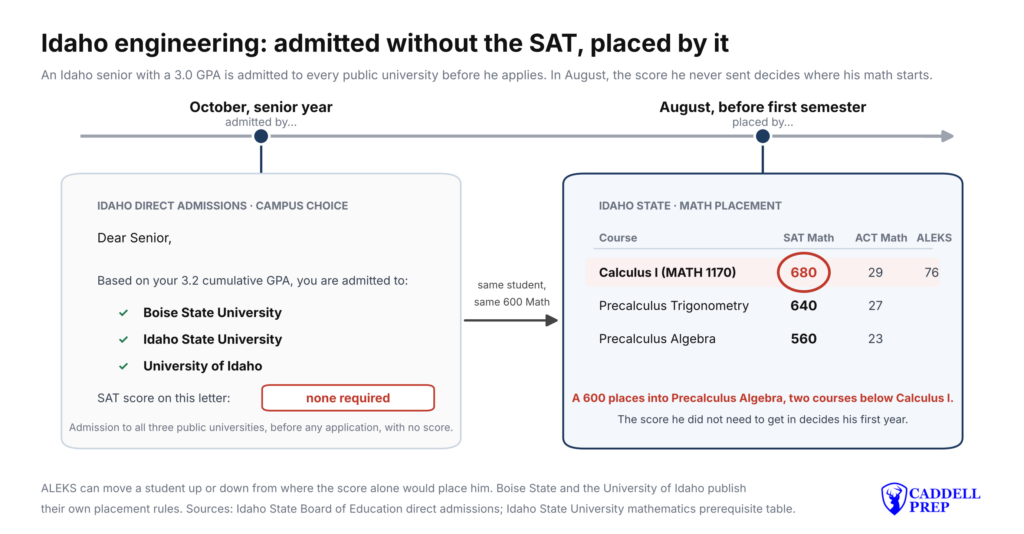
The image above shows a student admitted without the score and placed by it.
Three things keep the arithmetic honest. The ALEKS assessment and the campuses’ own exams override a test score in both directions, so a student at 600 who has done precalculus well can place into calculus without a 680. Boise State’s and Idaho State’s admitted ranges are unreported, so the page cannot show where their own students sit against their own lines. And the one public university that does report, the University of Idaho, has a Math 75th percentile of 600. That is 80 points below Idaho State’s calculus line and 40 below its trigonometry line, so if the flagship’s cutoffs sit near Idaho State’s, most of its admitted engineering students start below calculus unless an assessment moves them.
Alaska is the comparison. Its two universities are open admission and place by ALEKS alone, so the SAT does nothing there, as our page on engineering colleges in Alaska sets out. Idaho’s are direct admission and place by the SAT among other measures, so the SAT does one thing, and it is the thing an engineering student cares about.
Families who have read the table frequently ask why two of the three public universities have no range on it.
Why Do Boise State and Idaho State Report No Score Range?
Boise State and Idaho State report no admitted test score range to the Department of Education, and under direct admissions neither needs a score to admit an Idaho senior.
The consequence is that a student cannot place himself against either university’s class. Idaho State’s calculus line is the only published number it offers, and the University of Idaho is the one public engineering university whose admitted class can be set against a placement line at all. A blank at a direct-admissions university means it reported nothing, not that it ignores the score.
Admission and placement are the state’s rules. The degrees are the universities’, and the next section lists them.
Which Idaho Universities Have ABET-Accredited Engineering Schools?
Five Idaho universities hold ABET-accredited engineering bachelor’s degrees, three public and two private, and all five are in the table above.
In the north and west, the University of Idaho’s College of Engineering in Moscow holds the land-grant programs across the standard disciplines, and Boise State’s College of Engineering holds civil, electrical, materials science and mechanical engineering beside Micron’s headquarters and fabrication plants. In the east, Idaho State’s College of Science and Engineering in Pocatello holds civil, electrical, mechanical and nuclear engineering, with the Idaho National Laboratory an hour north in Idaho Falls, where both Idaho State and the University of Idaho run programs. The two private universities are church-affiliated: BYU-Idaho in Rexburg holds civil and mechanical engineering, and Northwest Nazarene in Nampa holds an accredited engineering program.
Accreditation matters for a reason that is easy to miss at seventeen. Licensure as a professional engineer normally requires a degree from an ABET-accredited engineering program, and that is why the College of Idaho and Lewis-Clark State, both four-year institutions in the state, are not on the page.
Nothing on this page ranks the five. The table’s order is a stated, verifiable number, and the choice among accredited programs comes down to cost, discipline and where a student’s score places him in his first semester.
What If Your Math Score Is Below the Calculus Line?
An Idaho engineering applicant is admitted to the public universities either way, so the score’s whole job is the first semester, and the gap between the flagship’s top quarter and Idaho State’s calculus line is the gap most Idaho engineering students face.
That gap is 80 points on one section, from 600 to 680, and there are two doors through it. The first is the SAT Math section before the test date. The second is the ALEKS assessment after admission, where a 76 does what a 680 does. A student can prepare for both at once, because ALEKS tests the same algebra, functions and trigonometry the Math section does, and the topics he is missing on one are the topics he is missing on the other. A New York student has one number, the University of Idaho’s range, and out-of-state tuition of approximately $27,700 to $28,300 at the three publics that the score does not change.
The first step on either path is finding out where the score actually is, section by section. A free diagnostic SAT gives a Math score that can be set against the 680 and the 640 directly.
The Math section rewards the same handful of topics on every test date, and a student who knows which of them he is missing can close an 80-point gap in weeks rather than months. The method is on our page on improving your SAT Math score.
How to Read These Score Ranges
Every range on this page covers the middle 50% of admitted students who submitted the SAT. The lower number is the 25th percentile and the upper number is the 75th, so a quarter of admitted students scored at or above it.
A blank at a direct-admissions university means it reported nothing to the Department of Education, not that it does not use the score. Idaho’s public universities use it for placement, and a placement line is a fixed number set by a mathematics department rather than a percentile of anyone.
Because most colleges are now test-optional, the ranges that are published describe only the students who chose to submit at all. Students with strong scores submit and students with weak ones don’t, so a published range sits higher than the range for everyone who was actually admitted. More on what SAT score you need for college and on test-optional colleges.
Should You Take the ACT Instead?
Idaho’s placement tables accept SAT Math, ACT Math and the 11th-grade ISAT, and Idaho State draws its calculus line at 680 on the SAT and 29 on the ACT.
The ISAT, which every Idaho public school junior takes, places into Precalculus Algebra at level 4 and no higher at Idaho State, so an Idaho student with only the state test cannot place into calculus from it. A student should take whichever of the SAT and ACT he scores higher on, and should take one of them if calculus in the first semester is the goal.
Engineering Programs in Nearby States
Idaho borders Washington, Oregon, Nevada, Utah, Wyoming and Montana, and Idaho students apply across those lines in numbers even with five accredited programs at home.
See engineering colleges in Washington, engineering colleges in Utah, and engineering colleges in Montana.
Engineering Colleges in Other States
We publish the same breakdown for engineering programs in every state.
See engineering colleges by state for the full list.

Glyn Caddell
Glyn Caddell holds a BS in Mechanical Engineering from NJIT and has been tutoring New York City students since 2008. He founded Caddell Prep in 2012 and is the author of Digital SAT Math Secrets: Lessons & Tricks to Quickly Improve to a Perfect 800 on the Math Test, which contains over 900 practice problems and is used in Caddell Prep’s SAT math classes. He is founding president of the Staten Island Technical High School alumni association and teaches every lesson on this site personally.
Finally, an SAT course that students actually understand
Every question has a video explanation. Not most — every one.
The on-demand Digital SAT course covers all 17 math topics and 15 reading and writing topics, with 5 full-length practice tests and a 100-point score increase guarantee. Keep access for the rest of high school. No subscription.
Want to Know What 5 Topics Will Improve Your SAT Score the Most?
Sample Feedback from our Diagnostic Test: