
Home » College SAT Score Ranges, Costs, and Programs by Major and State » Engineering Colleges by State: SAT Scores, ACT Scores, Costs, and ABET Programs » Engineering Colleges in Alaska: Costs, Programs, and What the SAT Is Worth
By Glyn Caddell, BSME · Author of Digital SAT Math Secrets · Tutoring since 2008 — Updated October 22, 2026
Two Alaska universities offer ABET-accredited engineering degrees, eleven programs between them, and this page lists what each one costs and which disciplines each one has.
Neither reports the test scores of the students it admits, both are open admission, and both place students into their first math course by an assessment rather than by the SAT or ACT, so there are no score ranges on this page. The SAT is still worth up to $7,000 a year to an Alaska student, and that is covered below the table.
Table of Contents
- Alaska Engineering Colleges by Cost
- What Is the SAT Worth to an Alaska Engineering Student?
- Which Engineering Disciplines Does Each Alaska Campus Offer?
- What If the Engineering Degree You Want Is Not Offered in Alaska?
Alaska Engineering Colleges by Cost
The two universities below are the only ones in Alaska that hold an ABET-accredited bachelor’s degree in an engineering discipline. They are listed by full cost of attendance.
| College | Cost of attendance | Tuition and fees, in-state / out-of-state | Undergraduates | ABET engineering programs |
|---|---|---|---|---|
| University of Alaska Fairbanks | $22,407 | $8,736 / $22,320 | 4,207 | 7 |
| University of Alaska Anchorage | $24,096 | $7,738 / $21,322 | 7,212 | 4 |
Neither university reports admitted score ranges to the Department of Education, and both are open admission, so there is no middle 50% to publish. Cost of attendance includes room and board. Figures are from the 2025-26 College Scorecard.
Two things about that table are worth pausing on.
UAF is cheaper by full cost of attendance and UAA is cheaper by tuition. The $1,689 gap in cost of attendance comes from housing and fees rather than from the price of the classes, and a student living at home in Anchorage is in a different position from one in a Fairbanks dormitory.
UAF holds seven accredited engineering programs to UAA’s four, and three of UAF’s exist at no other campus in the state. For a student who already knows his discipline, that fact can settle the choice before cost enters it.
Want to Know What 5 Topics Will Improve Your SAT Score the Most?
Sample Feedback from our Diagnostic Test:

University of Alaska Fairbanks
The University of Alaska Fairbanks’ College of Engineering and Mines in Fairbanks is the older of the state’s two engineering colleges and the one with the wider range of programs.
Cost of attendance $22,407, with tuition and fees at $8,736 in-state and $22,320 out-of-state. 4,207 undergraduates. Seven ABET-accredited engineering degrees: civil, computer, electrical, geological, mechanical, mining and petroleum.
UAF is the smaller campus and the cheaper one by cost of attendance.
University of Alaska Anchorage
The University of Alaska Anchorage’s College of Engineering in Anchorage is the state’s larger engineering college by enrollment and sits in the city where most of Alaska’s engineering employers are based.
Cost of attendance $24,096, with tuition and fees at $7,738 in-state and $21,322 out-of-state. 7,212 undergraduates. Four ABET-accredited engineering degrees: civil, computer systems, electrical and mechanical.
UAA has the lowest in-state tuition in the state, and the scholarship covered next pays the same amount at either campus.
What Is the SAT Worth to an Alaska Engineering Student?
The SAT is worth up to $7,000 a year to an Alaska student through the Alaska Performance Scholarship, and nothing at all for admission or math placement at UAA or UAF.
The nothing comes first, because a test prep company has to say it plainly. Both universities are open admission, so there is no score to clear. Both place every incoming student into a first math course by the ALEKS placement assessment, taken after admission, and neither looks at an SAT or ACT Math score when doing it. An Alaska engineering student who starts in Calculus I does so because of the assessment, not because of the test he took in high school.
The scholarship is where the score counts. The Alaska Performance Scholarship pays Alaska residents who graduate from an Alaska high school, having completed a rigorous curriculum set out on the state’s APS checklist, and it can be used at UAA, UAF and other participating Alaska institutions. It has three levels.
| Level | Award per year | High school GPA | or SAT | or ACT | or WorkKeys |
|---|---|---|---|---|---|
| 1 | $7,000 | 3.5 | 1210 | 25 | 18 |
| 2 | $5,250 | 3.0 | 1130 | 23 | 15 |
| 3 | $3,500 | 2.5 | 1060 | 21 | 12 |
A student qualifies for a level by GPA or by a test score, not both. The award is capped at $28,000 and can be drawn over eight full-time disbursements within eight years of graduation. Source: Alaska Commission on Postsecondary Education, current as of [DATE].
The word that matters in that table is “or”. A student’s level is the higher of the level his GPA earns and the level his test score earns. A 3.2 GPA sits at Level 2. A 1210 SAT sits at Level 1. The student with both gets Level 1, because the state takes whichever qualifies him for more.
Take two Alaska students with 3.2 GPAs who enroll in engineering at UAF. One took the SAT and scored 1210. The other did not take it. Over four years the first receives $28,000 and the second receives $21,000, and nothing else about their applications differed. The 80 points between the Level 2 line and the Level 1 line were worth $7,000.
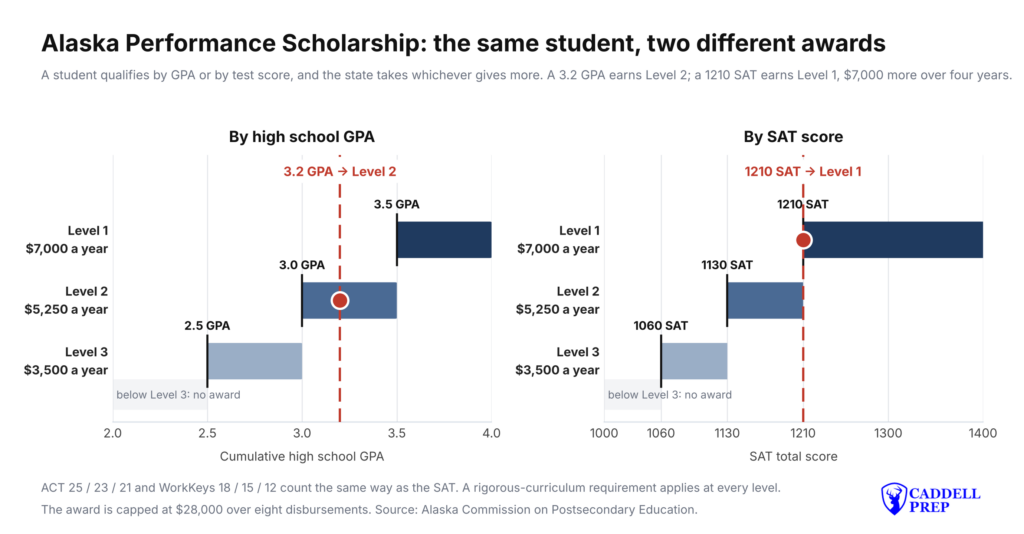
The image above shows the same student, two different awards, depending on which number the state reads.
Against tuition, Level 1 at $7,000 covers approximately 80% of UAF’s in-state tuition and fees and approximately 90% of UAA’s. Level 3 at $3,500 covers approximately 40% and 45%. At neither campus does the scholarship cover tuition in full, and it covers none of the cost of living.
Students reading that table frequently ask whether the test is required at all.
Does a Student Need to Take the SAT for the Alaska Performance Scholarship?
A student does not need to take the SAT for the Alaska Performance Scholarship. A qualifying GPA alone is enough, and the ACT and the WorkKeys assessment count the same way the SAT does.
The test is the only way to reach a level higher than the one the GPA gives, and it is the only route in for a student whose GPA is below 2.5. A student at a 3.4 is one tenth of a point from Level 1 by grades, and a 1210 gets him there without the tenth. The method for finding those points is on our page on how to improve your SAT score.
The scholarship pays the same at both campuses. What differs between them is the degree a student can take there.
Which Engineering Disciplines Does Each Alaska Campus Offer?
UAF offers seven ABET-accredited engineering degrees and UAA offers four, and three of UAF’s, petroleum, mining and geological engineering, exist at no other Alaska campus.
The University of Alaska Fairbanks’ College of Engineering and Mines holds civil, computer, electrical, geological, mechanical, mining and petroleum engineering. The three that UAA does not have map onto the state’s resource employers on the North Slope and at its mines, and the Fairbanks campus houses the Geophysical Institute and the Cold Climate Housing Research Center, both of which take undergraduates into research.
The University of Alaska Anchorage’s College of Engineering holds civil, computer systems, electrical and mechanical engineering. Anchorage is where the state’s engineering consulting firms, utilities and the Alaska Department of Transportation are concentrated, so the internships a civil or mechanical student takes during the degree are normally within the city.
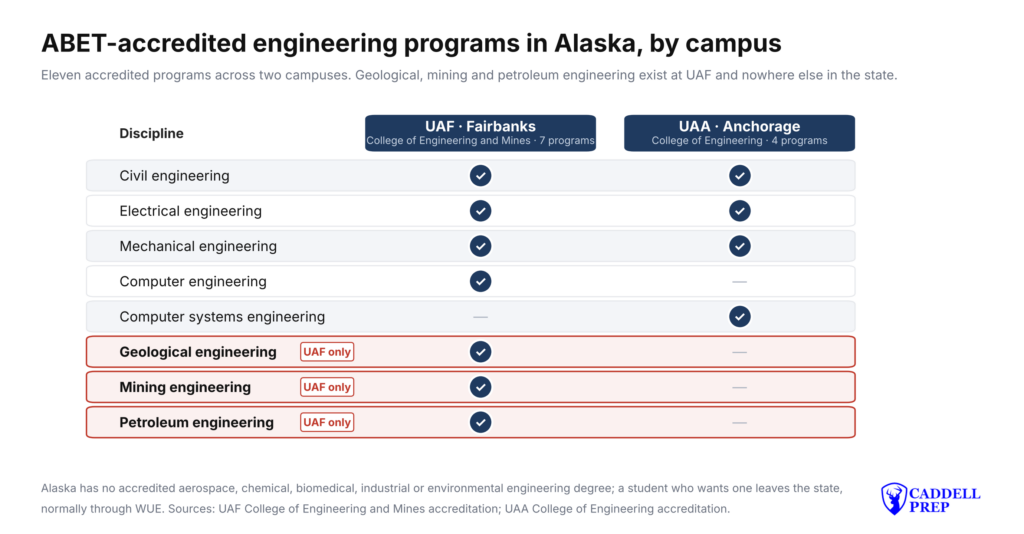
The grid above shows which campus has your discipline, and for seven of the eleven programs the answer is only one of them.
The choice between the two turns on discipline first, because three disciplines exist at only one campus. Cost comes second, and the difference is approximately $1,700 a year in cost of attendance. The scholarship is identical at both, so it does not enter the choice at all.
Eleven programs is the whole of Alaska’s engineering offer. Several common disciplines are not among them.
What If the Engineering Degree You Want Is Not Offered in Alaska?
An Alaska student who wants an engineering degree the state does not offer applies out of state, and that is where his SAT stops being a scholarship number and goes back to being an admission number.
Aerospace, chemical, biomedical, industrial and environmental engineering are not offered at any Alaska campus. A student who wants one of them normally applies to the Pacific Northwest or further down the coast, and at those universities his score is read the way it is read everywhere else: against a published range of admitted students, for admission and for merit aid.
The Western Undergraduate Exchange reduces the cost. Through WUE, coordinated by the Western Interstate Commission for Higher Education, an Alaska resident pays approximately 150% of resident tuition rather than the full out-of-state rate at participating universities across fifteen western states and the Northern Mariana Islands. The discount is program-specific, the large flagships limit how many WUE seats they offer, and engineering is among the programs most often excluded or capped, so a student checks the specific program on the WICHE site before counting on it.
For an application outside Alaska the first step is finding out where the score actually is, section by section. A free diagnostic SAT gives a Math and a Reading & Writing score that can be set against the ranges on the state pages linked below.
The Math section rewards the same handful of topics on every test date, and a student who knows which of them he is missing can close a gap of 50 to 100 points in weeks rather than months. That method is the same one that moves an Alaska student from a Level 2 to a Level 1 award, and it is on the improving your SAT score page.
Why Are There No SAT Ranges on This Page?
Neither UAA nor UAF reports admitted score ranges to the Department of Education, and open admission means there is no selected class whose middle 50% could be reported. The absence is not a gap in the data. It is what open admission looks like.
On every other state page in this series, a range covers the middle 50% of admitted students who submitted that test, with the lower number at the 25th percentile and the upper at the 75th. Because most colleges are now test-optional, a published range describes only the students who chose to submit, and it sits higher than the range for everyone admitted. More on what SAT score you need for college and on test-optional colleges.
Should You Take the ACT Instead?
For the scholarship it does not matter. The state treats an SAT of 1210, an ACT of 25 and a WorkKeys of 18 as the same Level 1 qualification, and a student takes whichever one he scores higher on.
For out-of-state applications the SAT is more common on the West Coast and the ACT in the Mountain West, and both are accepted everywhere a student from Alaska is likely to apply.
Engineering Programs in Nearby States
Alaska borders no state, and Washington, Oregon and Idaho are the nearest ones with engineering programs and the usual destinations for Alaska students who leave.
See engineering colleges in Washington, engineering colleges in Oregon, and engineering colleges in Idaho.
Engineering Colleges in Other States
We publish the same breakdown for engineering programs in every state.
See engineering colleges by state for the full list.

Glyn Caddell
Glyn Caddell holds a BS in Mechanical Engineering from NJIT and has been tutoring New York City students since 2008. He founded Caddell Prep in 2012 and is the author of Digital SAT Math Secrets: Lessons & Tricks to Quickly Improve to a Perfect 800 on the Math Test, which contains over 900 practice problems and is used in Caddell Prep’s SAT math classes. He is founding president of the Staten Island Technical High School alumni association and teaches every lesson on this site personally.
Finally, an SAT course that students actually understand
Every question has a video explanation. Not most — every one.
The on-demand Digital SAT course covers all 17 math topics and 15 reading and writing topics, with 5 full-length practice tests and a 100-point score increase guarantee. Keep access for the rest of high school. No subscription.
Want to Know What 5 Topics Will Improve Your SAT Score the Most?
Sample Feedback from our Diagnostic Test: