
Home » College SAT Score Ranges, Costs, and Programs by Major and State » Engineering Colleges by State: SAT Scores, ACT Scores, Costs, and ABET Programs » Engineering Colleges in Oregon: SAT Scores, Costs, and Programs
By Glyn Caddell, BSME · Author of Digital SAT Math Secrets · Tutoring since 2008 — Updated October 25, 2026
Five Oregon universities offer ABET-accredited engineering degrees, and this page lists what they cost and the test scores of the students they admit.
The state’s flagship is not one of the five, because the University of Oregon awards no engineering bachelor’s degree, and in September 2026 it announced a $1 billion gift to build a college of engineering that does not exist yet.
SAT scores are given by section rather than as a total, because a student at 680 Reading & Writing and 560 Math is in a different position from a student at 560 and 680.
Table of Contents
- Oregon Engineering Colleges by SAT Score
- Why Is the University of Oregon Not on This List?
- Which Oregon Universities Have ABET-Accredited Engineering Schools?
- What If Your Score Is Below the Range You Want?
Oregon Engineering Colleges by SAT Score
The five universities below are the ones in Oregon that hold an ABET-accredited bachelor’s degree in an engineering discipline. The four that report scores are sorted by the midpoint of the SAT Math range, so the order can be checked from the table itself, and there are no ties. Portland State reports no range and is listed last.
| College | SAT Reading & Writing | SAT Math | Cost of attendance | Undergraduates | Admit rate |
|---|---|---|---|---|---|
| University of Portland | 580 to 670 | 580 to 700 | $73,224 | 2,957 | 89% |
| Oregon State University | 580 to 700 | 560 to 700 | $31,653 | 30,743 | 77% |
| George Fox University | 560 to 680 | 510 to 660 | $58,644 | 2,699 | 94% |
| Oregon Institute of Technology | 500 to 650 | 500 to 620 | $27,524 | 2,892 | 95% |
| Portland State University | Does not report SAT data | Does not report SAT data | $21,590 | 13,182 | 91% |
Each range covers the middle 50% of admitted students who submitted that test. A quarter scored below the lower number, and the top quarter scored at or above the upper one. Being under the lower number does not rule a student out, and being just above it is not as safe as it looks.
Only universities with an ABET-accredited engineering bachelor’s degree are listed. The University of Oregon awards none and is discussed below. OSU-Cascades’ energy systems engineering degree is an Oregon State degree and is counted under Oregon State. Oregon Tech’s engineering technology degrees are accredited under a separate ABET commission, and its row rests on its engineering degrees. Portland State reports no SAT or ACT range to the Scorecard.
Three things about that table are worth pausing on.
The University of Oregon is not in it. The flagship awards no engineering bachelor’s degree, and on September 23, 2026 it announced a $1 billion gift to build a college that will. The next section is about it.
Oregon Tech charges a non-resident $37,196, $994 below Oregon State’s $38,190, on a Math range 60 points lower at the floor and 80 points lower at the ceiling. George Fox charges every student $42,750, $4,560 above Oregon State’s out-of-state figure.
Oregon State, at 30,743 undergraduates, is larger than the other four schools on the page combined, and Portland State, the one public that reports no range, has the lowest cost of attendance on the page at $21,590.
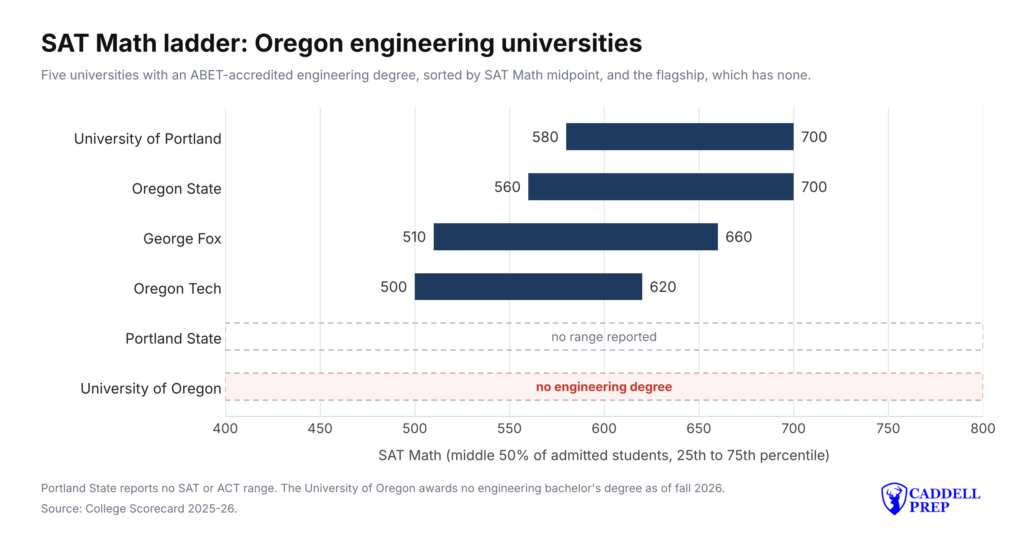
A student can see where his Math score sits on this list in the image above.
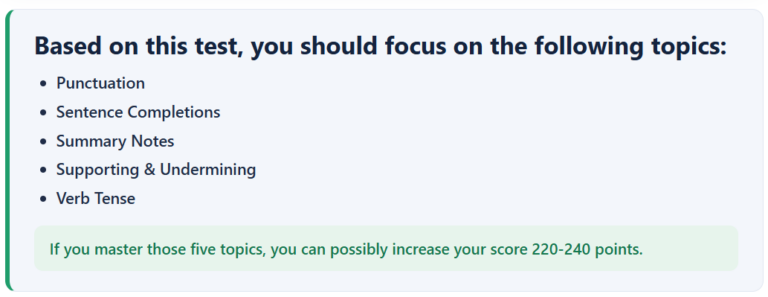
Want to Know What 5 Topics Will Improve Your SAT Score the Most?
Sample Feedback from our Diagnostic Test:
University of Portland
The University of Portland’s Shiley School of Engineering holds ABET accreditation in civil, computer, electrical and mechanical engineering [VERIFY on abet.org], and Portland has the highest Math midpoint on the page.
Reading & Writing 580 to 670, Math 580 to 700. The top quarter of admitted students scored at or above 700 on Math. Cost of attendance $73,224, with tuition and fees at $58,100 for all students. 2,957 undergraduates, 89% admitted.
Portland is a Catholic university of the Congregation of Holy Cross on a bluff above the Willamette, and its Math floor of 580 is the highest on the page by 20 points. Its tuition is $19,910 more than an out-of-state student pays Oregon State.
Oregon State University
Oregon State University’s College of Engineering in Corvallis holds ABET accreditation in disciplines including architectural, bioengineering, chemical, civil, computer, construction, ecological, electrical, energy systems, environmental, industrial, manufacturing, mechanical, nuclear and radiation health physics engineering [VERIFY list on abet.org], and Oregon State is the state’s engineering school by the state’s own decision.
Reading & Writing 580 to 700, Math 560 to 700. The top quarter of admitted students scored at or above 700 on Math. Cost of attendance $31,653, with tuition and fees at $14,400 in state and $38,190 out of state. 30,743 undergraduates, 77% admitted.
Oregon State is the most selective school on the page, the largest by a wide margin, and the only one that requires an engineering applicant to be ready for calculus before he enters the major, under a rule described in the next section. Its Math ceiling of 700 ties Portland’s.
George Fox University
George Fox University in Newberg holds ABET accreditation for its Bachelor of Science in Engineering [VERIFY degree name and concentrations on abet.org], and George Fox has the widest Math range on the page, 150 points.
Reading & Writing 560 to 680, Math 510 to 660. The top quarter of admitted students scored at or above 660 on Math. Cost of attendance $58,644, with tuition and fees at $42,750 for all students. 2,699 undergraduates, 94% admitted.
George Fox is a Quaker-founded Christian university whose flat tuition of $42,750 is above Oregon State’s out-of-state figure and $15,350 below Portland’s. Its Reading & Writing floor sits 50 points above its Math floor.
Oregon Institute of Technology
The Oregon Institute of Technology in Klamath Falls holds ABET accreditation in civil, electrical, embedded systems, mechanical and renewable energy engineering [VERIFY on abet.org], and Oregon Tech awarded the first renewable energy engineering bachelor’s degree in North America.
Reading & Writing 500 to 650, Math 500 to 620. The top quarter of admitted students scored at or above 620 on Math. Cost of attendance $27,524, with tuition and fees at $13,260 in state and $37,196 out of state. 2,892 undergraduates, 95% admitted.
Oregon Tech is the least selective reporting school on the page and has the lowest Math range, and it charges a non-resident within $1,000 of Oregon State. Its Portland-Metro campus in Wilsonville carries several of the same degrees. The renewable energy degree is dated in the next section.
Portland State University
Portland State University’s Maseeh College of Engineering and Computer Science holds ABET accreditation in civil, computer, electrical, environmental and mechanical engineering [VERIFY on abet.org], and Portland State reports no admitted score range.
Cost of attendance $21,590, with tuition and fees at $11,679 in state and $31,074 out of state. 13,182 undergraduates, 91% admitted.
Portland State is the second-largest school on the page, the cheapest for a resident and for a non-resident, and a downtown university whose students mostly commute. It reports no SAT or ACT range to the Scorecard.
Four ranges and one blank say who got in. The flagship is missing, and the next section says why.
Why Is the University of Oregon Not on This List?
The University of Oregon is not on this list because it awards no engineering bachelor’s degree, and a student who applies there for fall 2027 intending to major in engineering will find no major to apply to.
What the university does offer is narrow and recent. Its Knight Campus for Accelerating Scientific Impact, opened after a 2016 gift, “established the University of Oregon’s first engineering department,” in the university’s words. At the undergraduate level that department offers a bioengineering minor. At the graduate level it offers a bioengineering PhD jointly with Oregon State. No bachelor’s degree in any engineering discipline is listed in the university’s catalog or on the Knight Campus’s academics page.
On September 23, 2026 the university announced that Phil and Penny Knight “have committed $1 billion” to establish a College of Engineering at the Knight Campus, “to educate engineers and applied scientists in bioengineering and other high-demand disciplines.” The release names no degree programs and no opening term. It says the university will work through “appropriate state and shared governance processes to establish the college” and its degree programs. The university’s president, Karl Scholz, said the Knights “have a long history of believing in things before they exist.” A student reading this page in 2026 or 2027 should take that sentence literally. The college does not exist yet.
That matters for an engineering applicant in a way it would not for most majors. ABET accredits a program only after it has produced graduates, and accreditation is then applied back to a date the commission sets [VERIFY the wording of ABET’s policy on initial accreditation and retroactive coverage on abet.org]. The first students in any new engineering program enroll ahead of its accreditation and are relying on the university to earn it before they graduate. Licensure as a professional engineer normally requires an accredited degree. None of that is a reason to avoid a new program, and it is a reason to know what one is signing up for.
Oregon’s engineering has sat forty miles south of Eugene for almost a century. In 1932 the State Board of Higher Education divided the two universities’ fields and assigned engineering to the college in Corvallis that became Oregon State [VERIFY the year and the body]. In this series the arrangement has one parallel, on our page on engineering colleges in Montana, where the flagship in Missoula awards no engineering degree and Montana State holds all of them. Oregon is the only state on these pages where a gift of this size has just been announced to change the arrangement.
| University | SAT Math | Cost of attendance | Tuition, resident | Tuition, non-resident |
|---|---|---|---|---|
| University of Oregon | No engineering bachelor’s degree | $34,793 | $16,137 | $44,598 |
| Oregon State University | 560 to 700 | $31,653 | $14,400 | $38,190 |
| University of Portland | 580 to 700 | $73,224 | $58,100 | $58,100 |
| George Fox University | 510 to 660 | $58,644 | $42,750 | $42,750 |
| Oregon Institute of Technology | 500 to 620 | $27,524 | $13,260 | $37,196 |
| Portland State University | Does not report SAT data | $21,590 | $11,679 | $31,074 |
The University of Oregon charges a non-resident $44,598, $6,408 more than Oregon State, for a campus with no engineering major. Its row is in the table so a student searching “University of Oregon engineering” sees the price of the school he was looking at beside the prices of the five that have what he wants.
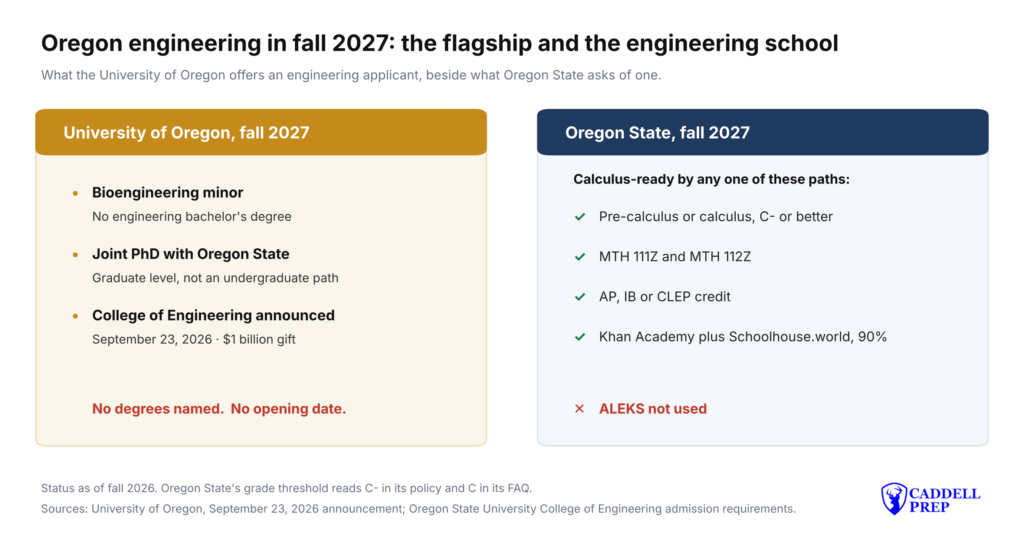
The image above sets what the flagship offers an engineering applicant beside what the state’s engineering school asks of one.
Take a New York student with a 600 on SAT Math. At the University of Oregon he has no engineering major to apply to. At Portland he is in the lower half of 580 to 700 and pays $58,100. At Oregon State he is in the lower half of 560 to 700, pays $38,190, and must show he is ready for calculus before he enters the college. At George Fox he is in the upper half of 510 to 660 and pays $42,750. At Oregon Tech he is in the upper half of 500 to 620 and pays $37,196. At Portland State there is no range to read, and he pays $31,074.
Oregon State’s requirement is the one worth reading closely, because it uses none of the numbers a New York family expects. Every engineering major at every Oregon State campus, except Outdoor Products at OSU-Cascades, Forest Engineering, Forest Civil Engineering and the post-baccalaureate computer science program, requires the applicant to be “calculus-ready.” A student clears it with high school pre-calculus or calculus at a C- or better, completed or in progress, or with college coursework equivalent to MTH 111Z and MTH 112Z at a C- or better, or with CLEP, AP or IB scores that earn credit for MTH 112Z or higher, or by completing Khan Academy’s pre-calculus course and scoring “a 90% or higher on the Schoolhouse.world Pre-Calculus certification test.” The page says in so many words that “ALEKS scores are not used to clear this requirement,” and it does not mention SAT or ACT Math at all. A student admitted to the university who has not cleared it is “invited to enroll initially as an undeclared student,” finishes MTH 111Z and 112Z at a C- or better with a 2.50 Oregon State GPA, and moves into engineering the following term. Set that beside our page on engineering colleges in Nevada, where the two universities place a student into calculus by ACT Math 28, SAT Math 650 or ALEKS 76. Oregon State uses none of the three. It asks what course the student passed.
Oregon Tech’s number is a date. In 2005 the university introduced what it describes as “the first Bachelor of Science degree focused on renewable energy,” at its Portland campus, and on September 23, 2011 it announced that the renewable energy engineering degree had received ABET’s final statement of accreditation, calling it “the first engineering program focused on renewable energy engineering to receive ABET accreditation.” The degree is now offered in Klamath Falls and the Portland area. OSU-Cascades in Bend announced on December 15, 2015 that its energy systems engineering degree, offered with Oregon State’s College of Engineering, had “become only the fourth of its kind in the nation to receive full accreditation from ABET.” Both are statements from the universities on those dates, and both degrees are on the page under the universities that award them.
The honest version is that the Knight gift is a commitment in a press release, not an open college, and this page can say only what the release says: $1 billion, a College of Engineering, bioengineering and other disciplines, governance processes to come. If the university names degrees or an opening term after this page is published, the section above is out of date on that day. Oregon State’s calculus-ready rule is an entry rule and not a selectivity rule, and the university admits 77% of applicants. And the fact that Oregon’s flagship awards no engineering degree is a description of where the state put its engineering school in 1932, not a judgment of the University of Oregon, whose students who want engineering have been driving to Corvallis for ninety years.
Families who have seen the Knight announcement frequently ask whether it changes what a 2027 applicant can study.
Can You Major in Engineering at the University of Oregon?
A student cannot major in engineering at the University of Oregon as of [DATE]. The university offers a bioengineering minor and a bioengineering PhD with Oregon State, and the College of Engineering announced on September 23, 2026 has no named degrees and no opening date.
A student who wants an engineering degree from an Oregon public university applies to Oregon State, Oregon Tech or Portland State. A student who wants to be in Eugene can minor in bioengineering alongside a science major, and should ask the Knight Campus directly what the new college will offer and when, because the answer will change.
The flagship’s gap is one fact about the state. The five schools that fill it are what the next section lists.
Which Oregon Universities Have ABET-Accredited Engineering Schools?
Five Oregon universities hold ABET-accredited engineering bachelor’s degrees, three public and two private, and all five are in the table above.
In Corvallis, Oregon State’s College of Engineering is the state’s engineering school and the largest on the page by a factor of ten over any private. In Portland, Portland State’s Maseeh College of Engineering and Computer Science is downtown and the University of Portland’s Shiley School of Engineering is on the north side of the city. Oregon Tech’s main campus is in Klamath Falls, near the California line, with a second campus in Wilsonville south of Portland. George Fox is in Newberg in the Willamette Valley wine country. OSU-Cascades in Bend offers Oregon State’s energy systems engineering degree. The University of Oregon in Eugene offers a bioengineering minor and, since September 2026, a plan.
Accreditation matters for a reason that is easy to miss at seventeen. Licensure as a professional engineer normally requires a degree from an ABET-accredited engineering program, and that is why Oregon Tech’s engineering technology degrees do not count toward its row and why a student in the first class of a new college is relying on accreditation that has not arrived. Reed, Lewis & Clark, Willamette, Linfield, Pacific, Southern Oregon, Western Oregon, Eastern Oregon, Corban, Bushnell and Warner Pacific award no engineering degree.
Nothing on this page ranks the five. The table’s order is a stated, verifiable number where one exists, and the choice among accredited programs comes down to cost, discipline and where a student’s score places him.
What If Your Scores Are Below the Range You Want?
In Oregon five schools cover Math ranges from a 500 floor to a 700 ceiling, three of them are public, and a New York student’s price runs from $31,074 to $58,100. The flagship is not an option, and at the state’s engineering school the question is not a score but a course.
The gap from a 600 to the upper half at Portland or Oregon State is 30 or 40 points of SAT Math, two or three questions, and the student who closes it is in the upper half everywhere on the page. The student who does not is already inside every range on it, and his choice comes down to price and to whether he has pre-calculus on his transcript.
The first step is finding out where the score actually is, section by section. A free diagnostic SAT gives a score that can be set against the Math column in the table.
The Math section rewards the same handful of topics on every test date, and a student who knows which of them he is missing can close a gap of 50 to 100 points in weeks rather than months. The method is on our page on improving your SAT Math score, and the topics it covers are the ones a pre-calculus class assumes.
How to Read These Score Ranges
Every range on this page covers the middle 50% of admitted students who submitted that test. The lower number is the 25th percentile and the upper number is the 75th, so a quarter of admitted students scored at or above it.
A range describes a class and an announcement describes a plan, and neither one is a degree. Oregon State’s range describes students who were also calculus-ready, and the University of Oregon’s announcement describes a college that has not admitted anyone. A student should read each for what it is.
Because most colleges are now test-optional, the ranges that are published describe only the students who chose to submit at all. Students with strong scores submit and students with weak ones don’t, so a published range sits higher than the range for everyone who was actually admitted. More on what SAT score you need for college and on test-optional colleges.
Should You Take the ACT Instead?
Oregon gives neither the SAT nor the ACT as a statewide test, and no Oregon college requires either [VERIFY the state-test status with the Oregon Department of Education]. Four of the five universities on this page report an SAT range and four report an ACT range, so the table could have been built either way.
The table uses the SAT because the Oregon pages on this site do, and because a student from outside Oregon normally holds one. All five universities accept either test, and a student who holds an ACT should convert it and read the same columns.
Engineering Programs in Nearby States
Oregon borders Washington, California, Idaho and Nevada, and Oregon students who want the flagship experience with an engineering degree normally look north to Seattle or south to California.
See engineering colleges in California, engineering colleges in Idaho, and engineering colleges in Nevada.
Engineering Colleges in Other States
We publish the same breakdown for engineering programs in every state.
See engineering colleges by state for the full list.

Glyn Caddell
Glyn Caddell holds a BS in Mechanical Engineering from NJIT and has been tutoring New York City students since 2008. He founded Caddell Prep in 2012 and is the author of Digital SAT Math Secrets: Lessons & Tricks to Quickly Improve to a Perfect 800 on the Math Test, which contains over 900 practice problems and is used in Caddell Prep’s SAT math classes. He is founding president of the Staten Island Technical High School alumni association and teaches every lesson on this site personally.
Finally, an SAT course that students actually understand
Every question has a video explanation. Not most — every one.
The on-demand Digital SAT course covers all 17 math topics and 15 reading and writing topics, with 5 full-length practice tests and a 100-point score increase guarantee. Keep access for the rest of high school. No subscription.
Want to Know What 5 Topics Will Improve Your SAT Score the Most?
Sample Feedback from our Diagnostic Test: