
Home » College SAT Score Ranges, Costs, and Programs by Major and State » Engineering Colleges by State: SAT Scores, ACT Scores, Costs, and ABET Programs » Engineering Colleges in California: SAT Scores, Costs, and Programs
By Glyn Caddell, BSME · Author of Digital SAT Math Secrets · Tutoring since 2008 — Updated October 22, 2026
Thirty-six California universities offer ABET-accredited engineering degrees, and this page lists what they cost and, where it exists, the SAT scores of the students they admit.
The scores exist for the private universities only. The University of California and the California State University do not consider the test, so the public campuses are listed by admit rate instead, and the two most selective private engineering schools in the state require the score. Both facts are covered below the tables.
Scores are given by section, and the private table is sorted by Math because that is the section engineering programs use.
Table of Contents
- California Private Engineering Colleges by SAT Math Score
- California Public Engineering Campuses by Admit Rate
- Does the SAT Matter for Engineering Admission in California?
- Which California Universities Have ABET-Accredited Engineering Schools?
- What If Your Score Is Below the Private Ranges You Want?
California Private Engineering Colleges by SAT Math Score
The ten universities below are the private ones in California that hold an ABET-accredited bachelor’s degree in an engineering discipline. They are sorted by the midpoint of the SAT Math range, with the three that report no range at the bottom.
| College | SAT Reading & Writing | SAT Math | Cost of attendance | Undergraduates | Admit rate |
|---|---|---|---|---|---|
| Stanford University | 740 to 780 | 770 to 800 | $87,833 | 7,554 | 4% |
| Harvey Mudd College | 730 to 770 | 770 to 800 | $90,165 | 921 | 13% |
| University of Southern California | 710 to 760 | 740 to 790 | $90,300 | 20,443 | 10% |
| Santa Clara University | 670 to 730 | 680 to 760 | $82,026 | 6,552 | 48% |
| University of the Pacific | 590 to 710 | 593 to 770 | $71,515 | 3,204 | 71% |
| Loyola Marymount University | 640 to 720 | 620 to 710 | $83,943 | 7,094 | 45% |
| University of San Francisco | 610 to 700 | 580 to 690 | $80,141 | 5,287 | 62% |
| California Institute of Technology | Does not report SAT data | Does not report SAT data | $86,886 | 987 | 3% |
| University of San Diego | Does not report SAT data | Does not report SAT data | $78,720 | 5,671 | 52% |
| California Baptist University | Does not report SAT data | Does not report SAT data | $54,038 | 8,179 | 85% |
Each range covers the middle 50% of admitted students who submitted the SAT. A quarter scored below the lower number, and the top quarter scored at or above the upper one. Being under the lower number does not rule a student out, and being just above it is not as safe as it looks.
Stanford and Harvey Mudd share a Math range, and Stanford is listed first on the Reading & Writing midpoint. Only universities with an ABET-accredited engineering bachelor’s degree are listed. Harvey Mudd and Caltech have fewer than 1,000 undergraduates and are included anyway.
Three things about that table are worth pausing on.
The top three are the three highest Math ranges on any page in this series. Harvey Mudd’s and Stanford’s top quarter scored a perfect 800 on Math, and USC’s top quarter scored at or above 790. A student who is comfortably inside the range at any other state’s flagship is at the bottom of these three.
Pacific’s Math ceiling of 770 is above Loyola Marymount’s 710 and Santa Clara’s 760, with a floor of 593 that is far below both. Pacific admits a wider spread of students than the schools around it on the list, and a student at either end of his own range is in a different position there.
Caltech requires the SAT or ACT and reports no range. It restored the requirement on April 11, 2024, for the class entering in fall 2025, and the Scorecard figures lag that by more than a cycle. A blank at Caltech means the data is behind, not that the test is unread.
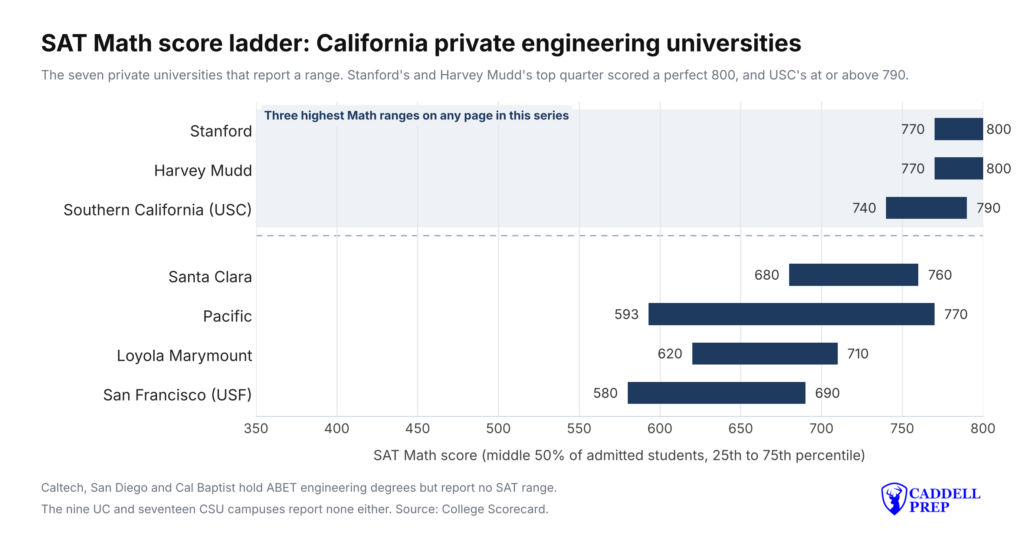
A student can see where his Math score sits among the privates in the image above
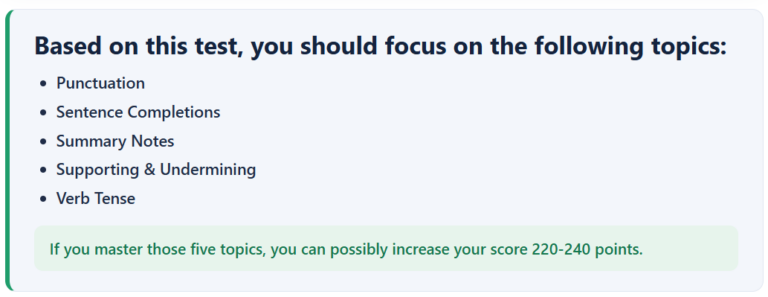
Want to Know What 5 Topics Will Improve Your SAT Score the Most?
Sample Feedback from our Diagnostic Test:
Stanford University
Stanford University’s School of Engineering in Stanford holds ABET accreditation in chemical, civil and mechanical engineering, and Stanford requires the SAT or ACT from applicants for fall 2026 onward.
Reading & Writing 740 to 780, Math 770 to 800. The top quarter of admitted students scored at or above 780 and a perfect 800. Cost of attendance $87,833, with tuition and fees at $65,910 for all students. 7,554 undergraduates, 4% admitted.
Stanford is the most selective university on the page that reports a range, and its engineering school sits at the north end of Silicon Valley.
Harvey Mudd College
Harvey Mudd College in Claremont awards a single ABET-accredited Bachelor of Science in Engineering, and Harvey Mudd is the smallest school on the page that reports scores.
Reading & Writing 730 to 770, Math 770 to 800. The top quarter scored at or above 770 and 800. Cost of attendance $90,165, with tuition and fees at $68,613 for all students. 921 undergraduates, 13% admitted.
Harvey Mudd’s test-optional pilot runs through the 2026 cycle, and a student applying after it should check the current policy. It is the second most expensive school on the page by cost of attendance.
University of Southern California
The University of Southern California’s Viterbi School of Engineering in Los Angeles holds ten ABET-accredited engineering degrees, more than any other private university in the state, and USC is test-optional.
Reading & Writing 710 to 760, Math 740 to 790. The top quarter scored at or above 760 and 790. Cost of attendance $90,300, with tuition and fees at $72,097 for all students. 20,443 undergraduates, 10% admitted.
USC is the most expensive university on the page and the largest private one, and it admits one applicant in ten.
Santa Clara University
Santa Clara University’s School of Engineering in Santa Clara holds ABET accreditation in civil, computer science and engineering, electrical and mechanical engineering, and Santa Clara is a Jesuit university at the center of Silicon Valley.
Reading & Writing 670 to 730, Math 680 to 760. The top quarter scored at or above 730 and 760. Cost of attendance $82,026, with tuition and fees at $61,293 for all students. 6,552 undergraduates, 48% admitted.
Santa Clara admits nearly half its applicants with a Math range whose top overlaps USC’s bottom.
University of the Pacific
The University of the Pacific’s School of Engineering and Computer Science in Stockton holds ABET accreditation in bioengineering, civil, computer, electrical, mechanical and engineering physics, and Pacific runs a cooperative education program in which engineering students work full-time placements before graduating.
Reading & Writing 590 to 710, Math 593 to 770. The top quarter scored at or above 710 and 770. Cost of attendance $71,515, with tuition and fees at $57,080 for all students. 3,204 undergraduates, 71% admitted.
Pacific is the cheapest university on the page among those that report a range, by approximately $8,600 against USF.
Loyola Marymount University
Loyola Marymount University’s Seaver College of Science and Engineering in Los Angeles holds ABET accreditation in civil, electrical and mechanical engineering, and Loyola Marymount is a Jesuit university.
Reading & Writing 640 to 720, Math 620 to 710. The top quarter scored at or above 720 and 710. Cost of attendance $83,943, with tuition and fees at $62,357 for all students. 7,094 undergraduates, 45% admitted.
Loyola Marymount’s Reading & Writing range sits above its Math range at both ends, the only school on this page where that is true.
University of San Francisco
The University of San Francisco’s engineering program awards an ABET-accredited Bachelor of Science in Engineering, and USF is the newest engineering program on the page, a Jesuit university whose engineering degree began in 2019.
Reading & Writing 610 to 700, Math 580 to 690. The top quarter scored at or above 700 and 690. Cost of attendance $80,141, with tuition and fees at $60,492 for all students. 5,287 undergraduates, 62% admitted.
USF has the lowest Math range among the private universities that report one.
California Institute of Technology
The California Institute of Technology in Pasadena holds ABET accreditation for its mechanical engineering option only, and Caltech requires the SAT or ACT from every applicant.
Cost of attendance $86,886, with tuition and fees at $65,898 for all students. 987 undergraduates, 3% admitted.
Caltech is the most selective university in California by admit rate. Its other engineering options are not ABET-accredited, which does not affect their standing and does affect the route to a professional engineer’s license, covered below.
University of San Diego
The University of San Diego’s Shiley-Marcos School of Engineering holds ABET accreditation in electrical, industrial and systems, and mechanical engineering, and USD reports no score range.
Cost of attendance $78,720, with tuition and fees at $59,486 for all students. 5,671 undergraduates, 52% admitted.
USD is a Catholic university and the only private engineering school in San Diego.
California Baptist University
California Baptist University’s College of Engineering in Riverside holds ABET accreditation in biomedical, chemical, civil, electrical and computer, and mechanical engineering, and Cal Baptist reports no score range.
Cost of attendance $54,038, with tuition and fees at $41,228 for all students. 8,179 undergraduates, 85% admitted.
Cal Baptist is the cheapest private university on the page by more than $17,000 and admits the largest share of applicants.
Ten private universities, and seven ranges. The public universities are the other list, and they come with no ranges at all.
California Public Engineering Campuses by Admit Rate
The twenty-six campuses below are the University of California and California State University campuses that hold an ABET-accredited engineering bachelor’s degree. They are sorted by admit rate, lowest first, because at a campus that does not consider test scores the admit rate is the only published measure of selectivity.
| College | Admit rate | Cost of attendance | Tuition and fees, in-state / out-of-state | Undergraduates |
|---|---|---|---|---|
| UC Los Angeles | 9% | $38,614 | $15,203 / $49,403 | 33,475 |
| UC Berkeley | 11% | $45,619 | $16,347 / $50,547 | 33,068 |
| UC San Diego | 27% | $38,701 | $16,758 / $50,958 | 34,948 |
| UC Irvine | 29% | $38,632 | $15,722 / $49,922 | 30,197 |
| Cal Poly San Luis Obispo | 31% | $32,265 | $13,596 / $34,665 | 21,996 |
| UC Santa Barbara | 33% | $41,573 | $16,414 / $50,614 | 23,113 |
| San Diego State University | 36% | $27,780 | $8,728 / $21,328 | 35,377 |
| UC Davis | 42% | $41,238 | $16,774 / $50,974 | 32,253 |
| Cal State Long Beach | 46% | $22,679 | $7,350 / $19,950 | 35,924 |
| UC Santa Cruz | 66% | $41,179 | $16,005 / $50,205 | 17,940 |
| Cal Poly Pomona | 75% | $23,955 | $7,780 / $20,380 | 25,042 |
| UC Riverside | 76% | $38,942 | $15,606 / $49,806 | 22,593 |
| San Jose State University | 85% | $26,593 | $8,410 / $21,010 | 27,601 |
| Cal State Fullerton | 91% | $18,269 | $7,470 / $20,070 | 38,546 |
| UC Merced | 91% | $39,665 | $15,623 / $49,823 | 8,372 |
| Cal State Los Angeles | 91% | $18,403 | $7,160 / $19,760 | 19,562 |
| Cal State Chico | 93% | $26,283 | $8,472 / $21,072 | 13,631 |
| Cal State Northridge | 93% | $20,485 | $7,458 / $20,058 | 32,691 |
| Cal State San Bernardino | 94% | $17,427 | $8,093 / $20,693 | 15,023 |
| Cal State Bakersfield | 94% | $19,522 | $8,090 / $20,690 | 8,577 |
| Cal State Sacramento | 94% | $22,945 | $8,018 / $20,618 | 28,350 |
| Cal Poly Maritime Academy | 95% | $29,853 | $9,944 / $22,544 | 804 |
| Cal State Fresno | 95% | $20,095 | $7,350 / $19,950 | 21,605 |
| San Francisco State University | 96% | $26,488 | $7,950 / $20,550 | 18,639 |
| Cal State East Bay | 97% | $22,850 | $7,583 / $20,183 | 9,809 |
| Cal Poly Humboldt | 98% | $25,170 | $8,250 / $20,850 | 5,612 |
Neither the University of California nor the California State University considers SAT or ACT scores in admission, and the Scorecard shows no range for any of these campuses. Campuses with the same rounded admit rate are in order of the unrounded figure. These are campus-level admit rates. Engineering admit rates at UC campuses are lower, often by half, and each campus publishes its own by major. Cal Poly Maritime Academy has 804 undergraduates and one accredited engineering degree.
Two things about that table are worth pausing on.
The two most selective campuses in California by admit rate are public, and neither has ever read the SAT score of a student it admitted since 2020. UCLA admits 9% and Berkeley 11%, below every private university on the page except Caltech and Stanford, on grades, coursework and essays alone.
The cost gap is the number a reader from outside California needs. In-state cost of attendance at a UC campus runs from approximately $38,600 to $45,600, and at a CSU campus from approximately $17,400 to $32,300. For an out-of-state student a UC campus costs approximately $73,000 to $80,000 once the out-of-state tuition is substituted, within $10,000 to $15,000 of the private table, and a CSU campus approximately $30,000 to $53,000.
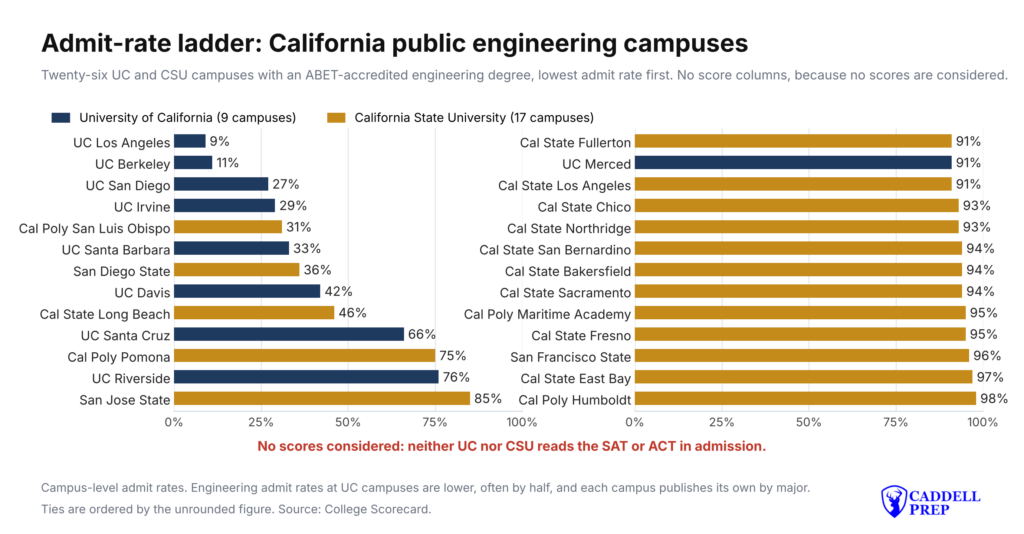
The image above shows the only selectivity number a test-blind campus publishes.
Two tables, one with scores and one without, and the reason there are two is the thing an applicant most needs to understand about engineering in California.
Does the SAT Matter for Engineering Admission in California?
The SAT does not matter for admission to any public engineering school in California, because the University of California and the California State University do not consider it, and it is required at Caltech and Stanford and read at every other private engineering school in the state.
Both public systems dropped the test in 2020. The University of California’s regents removed it from admissions that year and reaffirmed the decision in 2021, and a legal settlement in May 2021 barred UC from using SAT or ACT scores in admissions or scholarships. A score sent to Berkeley, UCLA, UC San Diego or Cal Poly is not read. UC does not use it for scholarships either.
The private universities are different, and two of them have moved the other way. Caltech restored its requirement on April 11, 2024, for students entering in fall 2025. Stanford requires scores from applicants for fall 2026 onward. Harvey Mudd’s test-optional pilot runs through 2026, and USC, Santa Clara, Loyola Marymount, Pacific, USF, USD and Cal Baptist are test-optional, meaning a submitted score is read and an unsubmitted one is not held against the applicant.
Take a student with a 780 SAT Math. At Harvey Mudd he is in the middle of the admitted range. At USC he is in the top quarter. At UCLA his score is not opened. The same 780, read twice and ignored once.
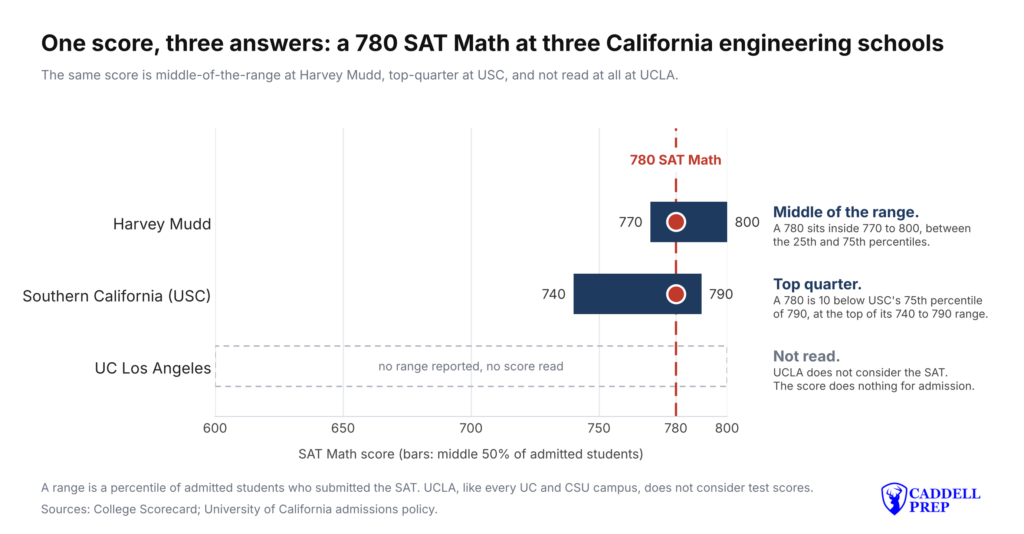
The image above shows the same 780, read twice and ignored once, and that is the whole of the California question for a student choosing where to send a score.
The public systems still use scores for one thing, and it is small. The California State University’s multiple-measures placement puts a student with an SAT Math of 570 or above, or an ACT Math of 23 or above, straight into general-education mathematics without a support course, under the 2026-28 Cal Poly catalog and the systemwide rule it follows. That is a general-education line, not a calculus line. Placement into calculus for an engineering major is by campus exam, the MAPE at Cal Poly San Luis Obispo and the equivalent elsewhere, and UC campuses place by their own tests or by ALEKS. The SAT’s one remaining public use in California is below what an engineering student needs.
So the honest answer is in five parts. Nothing at the public universities for admission. Nothing at UC for scholarships. One small thing at CSU for placement. Required at the two most selective private engineering schools and read at the rest. And read at every university a California student applies to outside the state. The next question is whether the first part will stay true.
Will the University of California Bring Back the SAT?
The University of California has not decided whether to bring back the SAT, and it has said when it will. In June 2026 the UC Academic Senate committed to a comprehensive review of standardized testing in admissions, and the chair of the Board of Regents has said the review will finish no later than the end of the 2026-27 academic year, around June 2027. Only the regents can reinstate the test, and they would do so by a vote at a later meeting after the Senate reports.
The pressure comes from the faculty. More than 2,000 UC professors in science, technology, engineering and mathematics signed a petition asking for an SAT or ACT requirement for STEM majors by fall 2027, and nearly 1,000 professors in other fields signed a letter seeking full reinstatement. Engineering is the field where the push is strongest, and an engineering applicant should read that as it stands: a review with a date, and no decision. This page will be updated when there is one.
Whatever UC decides, the thirty-six universities on this page will still be the ones with accredited engineering degrees, and that is the next section.
Which California Universities Have ABET-Accredited Engineering Schools?
Thirty-six California universities hold ABET-accredited engineering bachelor’s degrees: nine University of California campuses, seventeen California State University campuses, and ten private universities, and all thirty-six are in the two tables above.
The three most selective private engineering schools in the state are Stanford, Caltech and Harvey Mudd. Stanford’s School of Engineering holds ABET accreditation in chemical, civil and mechanical engineering and sits at the north end of Silicon Valley. Caltech in Pasadena holds it for mechanical engineering only, and its campus is beside NASA’s Jet Propulsion Laboratory, which Caltech manages. Harvey Mudd in Claremont awards one accredited engineering degree without departments.
USC’s Viterbi School holds ten accredited engineering degrees in Los Angeles, the most of any private university in the state. The three Jesuit universities, Santa Clara, Loyola Marymount and USF, hold accredited engineering degrees in Santa Clara, Los Angeles and San Francisco, and USD, a Catholic university, holds three in San Diego. Pacific in Stockton holds six and runs a cooperative education program. Cal Baptist in Riverside holds five.
The nine University of California campuses all hold accredited engineering degrees. Berkeley holds the state’s nuclear engineering degree and UC San Diego its nanoengineering and structural engineering degrees. UC Davis holds biological systems engineering. UCLA, Irvine, Santa Barbara and Riverside each hold between four and ten accredited degrees across the standard disciplines. UC Santa Cruz holds electrical engineering, and UC Merced, the newest campus, holds environmental, materials science and mechanical engineering.
Seventeen California State University campuses hold accredited engineering degrees. Cal Poly San Luis Obispo holds thirteen, the most of any public campus in the state, and San Jose State holds ten at the south end of Silicon Valley. Cal Poly Pomona, San Diego State, Long Beach, Chico, Northridge, Sacramento, Fresno and San Francisco State each hold between four and nine. Fullerton, Los Angeles, Bakersfield and East Bay hold two to four, San Bernardino holds computer engineering, Cal Poly Humboldt holds environmental resources engineering, and the Maritime Academy holds mechanical engineering. Aerospace and defense employers in Los Angeles and San Diego, and the semiconductor, software and hardware firms in Santa Clara County, sit beside the campuses in those regions.
Accreditation matters for a reason that is easy to miss at seventeen. Licensure as a professional engineer in California normally requires a degree from an ABET-accredited engineering program, and a graduate of a program without one, including most of Caltech’s engineering options, qualifies for the exams through additional years of documented experience instead. Pomona, Claremont McKenna, Scripps, Pitzer, Occidental and Pepperdine report some of the highest score ranges in the state and are not on this page because none holds an engineering degree. Chapman’s engineering programs are not yet accredited, and Chapman says the earliest they could be is 2027.
Nothing on this page ranks the thirty-six. Each table’s order is a stated, verifiable number, and the choice among accredited programs comes down to cost, discipline and, at the private universities only, where a student’s score places him.
What If Your Score Is Below the Private Ranges You Want?
A California engineering applicant has two lists, and the SAT serves only one of them.
For the public list the score does nothing, and the work is grades, the a-g course sequence and the essays. For the private list, and for every application outside California, the score is read against a range, and the private ranges on this page are the highest in this series. A student at 700 Math is below the bottom of the range at Stanford, Harvey Mudd and USC and inside it at Santa Clara, Pacific, Loyola Marymount and USF. The gap to the top three is normally larger than on other state pages, and the reason to close it is the same.
The first step is finding out where the score actually is, section by section. A free diagnostic SAT gives a Math score that can be set against the private ranges above and against the ranges on every out-of-state page in this series.
The Math section rewards the same handful of topics on every test date, and a student who knows which of them he is missing can close a gap of 50 to 100 points in weeks rather than months. The method is on our page on improving your SAT score.
How to Read These Score Ranges
Every range on this page covers the middle 50% of admitted students who submitted the SAT. The lower number is the 25th percentile and the upper number is the 75th, so a quarter of admitted students scored at or above it.
This page has three kinds of blank. A blank in the public table means the campus does not consider the test. The blank at Caltech means the university requires the test and the federal data has not caught up. The blanks at USD and Cal Baptist mean the university reported nothing, and a reader should check those two universities’ own pages.
Because most colleges are now test-optional, the ranges that are published describe only the students who chose to submit at all. Students with strong scores submit and students with weak ones don’t, so a published range sits higher than the range for everyone who was actually admitted. More on what SAT score you need for college and on test-optional colleges.
Should You Take the ACT Instead?
California is an SAT state. Twenty-two California universities report SAT sections and nineteen report an ACT range, every one of them private, and Caltech and Stanford accept either test.
For the public universities neither test is read, so the choice is irrelevant there. For the private universities and for out-of-state applications a student should take whichever he scores higher on.
Engineering Programs in Nearby States
California borders Oregon, Nevada and Arizona, and California students apply across those lines in numbers because the in-state public engineering campuses are among the most competitive in the country.
See engineering colleges in Oregon, engineering colleges in Nevada, and engineering colleges in Arizona.
Engineering Colleges in Other States
We publish the same breakdown for engineering programs in every state.
See engineering colleges by state for the full list.

Glyn Caddell
Glyn Caddell holds a BS in Mechanical Engineering from NJIT and has been tutoring New York City students since 2008. He founded Caddell Prep in 2012 and is the author of Digital SAT Math Secrets: Lessons & Tricks to Quickly Improve to a Perfect 800 on the Math Test, which contains over 900 practice problems and is used in Caddell Prep’s SAT math classes. He is founding president of the Staten Island Technical High School alumni association and teaches every lesson on this site personally.
Finally, an SAT course that students actually understand
Every question has a video explanation. Not most — every one.
The on-demand Digital SAT course covers all 17 math topics and 15 reading and writing topics, with 5 full-length practice tests and a 100-point score increase guarantee. Keep access for the rest of high school. No subscription.
Want to Know What 5 Topics Will Improve Your SAT Score the Most?
Sample Feedback from our Diagnostic Test: