
Home » The Digital SAT: What’s Tested, How It’s Scored, and How to Improve Your Score » SAT Scores: How Scoring Works, What’s a Good Score, and How to Raise Yours » How to Get an 800 on SAT Math: Lesson, Study Plan & Topic Breakdown
By Glyn Caddell, BSME · Author of Digital SAT Math Secrets · Tutoring since 2008 — Published August 23, 2026
An 800 on the Digital SAT math section is achievable for most students scoring above 650. However, it requires a different approach than getting to a 700.
At the top of the scale, most students aren’t losing points because they don’t know the math. They’re losing points to careless errors on questions they know how to do.
This page covers how many questions you can miss, which of the 17 math topics to study first, how many hours it takes, and what separates a 750 from an 800.
Table of Contents
- Can You Miss Any Questions and Still Get an 800?
- What Percentile Is an 800 in SAT Math?
- How Long Does It Take to Get an 800?
- Which Math Topics Should You Study First?
- What Separates a 750 From an 800?
- A Study Plan to Get an 800
- Common Mistakes Students Make Going for an 800
- Frequently Asked Questions
- Take a Free Diagnostic SAT
Can You Miss Any Questions and Still Get an 800?
Normally yes, but fewer than most students expect. The exact number changes from test to test. Normally, you cannot miss any questions. Sometimes you can miss one question and still get an 800.
The Digital SAT is section-adaptive. The math section has two modules. Every student gets the same first module. Your performance on the first module determines whether the second module is the harder version or the easier version.
Getting routed to the harder second module is required for an 800. If a student is routed to the easier second module, the highest score they can earn is below 800, no matter how many questions they answer correctly. To illustrate, if you answer 14 correct on math module 1 (normally the most you can get right and still get the easier module 2), you’ll only end up with approximately a 660 on math if you answer all of math module 2 correct.
Each test form has its own raw score to scaled score conversion, so there is no single answer to how many questions you can miss. Based on the forms we’ve analyzed, an 800 normally allows between 0 and 1 missed questions.
The best approach is to plan on missing zero. A student who plans to miss two will normally miss four.
Use our free SAT score calculator to see how a raw score converts to a scaled score.
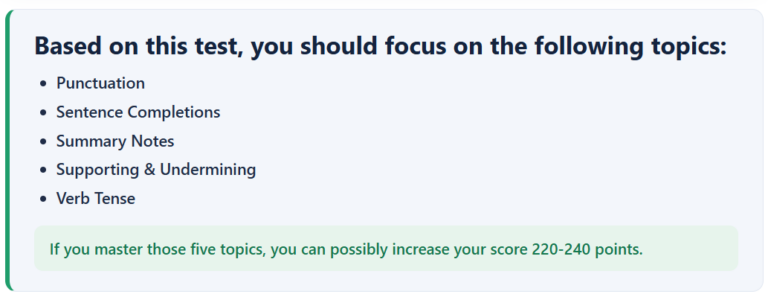
Want to Know What 5 Topics Will Improve Your SAT Score the Most?
Sample Feedback from our Diagnostic Test:
What Percentile is an 800 in SAT Math?
According to data from the College Board, an 800 on Math is in the 99+ percentile. A 760 is considered the 99 percentile.
It’s also worth knowing what an 800 does for a college application. At the most selective schools, an 800 in math is close to the middle of the range of admitted students. It’s a strong score, but it normally doesn’t stand out on its own at those schools. That’s not a reason to skip it. It’s a reason to be realistic about how much time it deserves compared to the rest of your application.
How Long Does It Take to Get an 800?
Based on the students we’ve worked with since 2008:
- To improve 70-130 points, students need approximately 40 hours of effective studying.
- To improve 130-250 points, students need approximately 80 hours of effective studying.
Working backwards from an 800:
| Current math score | Points needed | Approximate hours |
|---|---|---|
| 700-730 | 70-100 | ~40 |
| 650-690 | 110-150 | 40-80 |
| 600-640 | 160-200 | ~80 |
There are two things to understand about these numbers.
First, effective studying is not the same as studying. Watching a lesson is not effective studying. Reading a solution is not effective studying. Effective studying means attempting problems under test conditions, getting some wrong, and then figuring out why. One hour of that is worth about three hours of reading.
Second, the last 50 points take longer than the first 50 points. Going from 600 to 700 means fixing content gaps, and content gaps are easy to find. Going from 750 to 800 means fixing errors that only show up once every few tests. Those are harder to find, and they don’t get fixed by doing more practice problems. They get fixed by reviewing differently.
Which Math Topics Should You Study First?
You don’t need to study all 17 topics equally.
We categorized every question on the ten full-length practice tests released by the College Board. The five most common topics make up about 56% of the math section.
| Rank | Topic | % of test |
|---|---|---|
| 1 | Linear Functions | 15.0% |
| 2 | Combining Like Terms & Solving Equations | 11.7% |
| 3 | Angles, Polygons & 3-D Shapes | 10.4% |
| 4 | Quadratic Functions | 9.6% |
| 5 | Functions | 8.9% |
If any of these five is a weakness, that’s where the first block of studying should go. A student who is inconsistent on linear functions is missing about one out of every seven questions on the test.
Don't Skip the Least Common Topics
This is where studying for an 800 is different from studying for a 700.
A student going for a 700 can afford to be weak on a topic that appears in 1% of the questions. A student going for an 800 cannot, because one question is the difference.
| Topic | % of test |
|---|---|
| Trigonometry | 2.0% |
| Solving for a Variable in Terms of Others | 1.9% |
| Exponents | 1.3% |
| Common Math Tricks | 0.9% |
| No Solution & Infinite Solutions | 0.9% |
These five topics are about 7% of the test, which is normally about three questions.
They’re also the fastest topics to learn, because each one covers a small amount of material. Exponents is a handful of rules. No solution and infinite solutions is one concept applied a few different ways. A student can get through all five in a few hours. For an 800, that’s some of the best time you can spend.
The topics in the middle need to be solid too. Data & Probability is 8.7%, System of Equations is 8.1%, Ratios & Proportions is 5.7%, Exponential Growth/Decay is 5.6%, Circles is 3.5%, Percent is 3.1%, and Transforming Functions is 2.6%.
For an 800, there is no topic you get to skip. The frequency data tells you what to study first, not what to ignore.
See all 17 Digital SAT math topics with lessons and practice problems
Finally, an SAT course that students actually understand
Every question has a video explanation. Not most — every one.
The on-demand Digital SAT course covers all 17 math topics and 15 reading and writing topics, with 5 full-length practice tests and a 100-point score increase guarantee. Keep access for the rest of high school. No subscription.
What Separates a 750 From an 800?
By 750, most students already know the math. Four things are normally left, and only one of them is math.
1. Careless Errors
This is the biggest one, and students consistently underestimate it. Common examples:
- Solving for x when the question asks for x + 3
- Losing a negative sign partway through the work
- Answering the first part of a two-part question and stopping
- Reading “which of the following is NOT” as “which of the following is”
- Entering a correct answer in the wrong format on a student-response question
None of these are math mistakes. They’re reading mistakes, and they get fixed with a habit, not with more practice. Before selecting an answer, reread the last line of the question and make sure you answered what it actually asked.
2. Pacing on the Second Module
Students who’ve scored a 750 on Math must have had the harder second module. The questions are more difficult but you get the same amount of time. Students who score above 700 normally lose their first points here on the second module. It’s not that they can’t do the questions. It’s that they spend four minutes on one question and then rush three others.
Practice with a target pace and a rule for when to move on. If you’re 90 seconds into a question with no path forward, flag it and come back. You can get the question back. You can’t get the time back.
3. Using Desmos
The Desmos calculator is built into the Bluebook application and is available during both math modules. Students going for an 800 often underuse it because doing the algebra by hand feels more thorough. It isn’t. It’s slower, and it creates more chances for the careless errors described above.
The skill isn’t knowing how to use Desmos. It’s knowing when to use it. Graphing a system to find where two equations intersect, entering an equation to see how many solutions it has, or checking a factored form against the original all take a few seconds and remove a chance to make a mistake. Every one of our math topic lessons covers the Desmos method along with the algebraic method.
4. Reviewing Mistakes the Right Way
“Review your mistakes” is common advice, but it doesn’t tell you what to look for.
Here’s the method. After every practice test, put each missed question into one of three categories:
- Content — I didn’t know how to do it
- Careless — I knew how to do it and made a mistake
- Pacing — I ran out of time or rushed
Then count them.
Most students at 750 find that seven out of eight misses are careless or pacing, and only one is content. That changes what they should do with the next 20 hours of studying. Most of them would have spent those hours reviewing content.
Want to Know What 5 Topics Will Improve Your SAT Score the Most?
Sample Feedback from our Diagnostic Test:
A Study Plan to Get an 800
This assumes a starting score above about 650 and about 8 to 12 weeks.
- Take a diagnostic test. Get a baseline score and find out which topics are costing you the most points. Take a free diagnostic SAT
- Study the five most common topics. These are about 56% of the test. This normally takes two to three weeks.
- Get through the five least common topics. Trigonometry, solving for a variable, exponents, common math tricks, and no solution & infinite solutions. A few hours total, and it removes five ways to lose a point.
- Take full-length practice tests, timed. Timed, in one sitting, in Bluebook if possible. Untimed practice doesn’t prepare you for the second module.
- Categorize every missed question after every test. Content, careless, or pacing. Keep track of the counts over time.
- Spend the last few weeks on whichever category is biggest. For most students at this level, it’s careless errors and pacing, not content.
If you’re starting below 650, there’s more content work to do and the plan takes longer.
Common Mistakes Students Make Going for an 800
1. Only Studying Hard Questions
It feels productive to work on the hardest problems. But if you’re missing a linear functions question every test because of a sign error, that’s the point between you and an 800. Not the hardest question on the test.
2. Studying with Outdated Material
There was a significant change in content between the old SAT and the Digital SAT. For example, questions with imaginary numbers appeared on the old version of the test, but haven’t appeared on the Digital SAT. A student using a pre-2024 book is spending hours on material that won’t be on the test.
3. Practicing Untimed
Untimed practice tells you whether you can do the math. The test measures whether you can do it in 35 minutes per module.
If you are practicing problems to learn the material, then you shouldn’t worry about timing. Your focus should be on answering questions correctly. However, you must take timed practice tests to get the pace for the test.
4. Not Taking Advantage of Desmos
Desmos is provided during the test. Using it isn’t cutting corners. There will be students who don’t grasp the content as well as you, but are able to answer the questions because they use Desmos. Use Desmos.
5. Reviewing the Answer Instead of the Reasoning
Knowing the answer was C doesn’t teach you anything. Knowing why you picked B, and what you misread in the question, is what carries over to the next test.
Frequently Asked Questions
Is an 800 on SAT math hard to get?
It’s difficult but achievable. For most students it’s more achievable than an 800 on Reading & Writing, because the math content is a defined set of 17 topics. The hard part at the top is consistency, not knowledge.
How many questions can you miss and still get an 800?
It changes by test form, and the margin is small. The safest approach is to plan on answering everything correctly. Sometimes you can’t get any questions wrong, and sometimes you can get one question wrong to score an 800 on math.
Do I need to know calculus for SAT math?
No. The Digital SAT math section covers algebra, advanced math, problem-solving and data analysis, and geometry and trigonometry. There is no calculus on the test.
Is an 800 in math better than an 800 in Reading & Writing?
Colleges see both section scores and the total score. For students applying to STEM programs, a strong math score carries some extra weight, but a balanced total score matters more.
Can I get an 800 in three months?
Starting from above a 700, normally yes. That’s about 40 hours of effective studying. Starting from a 600, three months is possible, but it takes about 80 hours, which is a real weekly commitment.
Does superscoring help if I get an 800 in math?
Many colleges superscore, which means they take your highest section scores across different test dates. If you get an 800 in math on one date, that score can carry while you focus on Reading & Writing for the next one. Check each college’s policy, because it varies.
Take a Free Diagnostic SAT
The best way to find out which topics are costing you points is to take a diagnostic test with a full assessment. Students can take a free practice SAT with Caddell Prep to get an accurate score based on College Board scoring, along with an assessment showing exactly which math topics to study.
If you’d rather work through the material on your own schedule, our on-demand Digital SAT course covers all 17 math topics with a video explanation for every practice problem, and it comes with a 100-point score increase guarantee.

Glyn Caddell
Glyn Caddell holds a BS in Mechanical Engineering from NJIT and has been tutoring New York City students since 2008. He founded Caddell Prep in 2012 and is the author of Digital SAT Math Secrets: Lessons & Tricks to Quickly Improve to a Perfect 800 on the Math Test, which contains over 900 practice problems and is used in Caddell Prep’s SAT math classes. He is founding president of the Staten Island Technical High School alumni association and teaches every lesson on this site personally.
Need Help Preparing for the SAT?
Use the only SAT prep course built with an engineer’s approach and taught in a way that students actually understand.
100-point score increase guarantee
Take a Free Diagnostic SAT
Discover the 5 Topics That Could Make the Biggest Difference in Your Score.
Take our free diagnostic and receive a personalized assessment showing exactly what to study next.