
Give us a call (917) 722-0677

You can excel with Caddell!

By Glyn Caddell, BSME · Author of Digital SAT Math Secrets · Tutoring since 2008 — Updated August 18, 2026

Digital SAT Exponential Growth & Decay

Exponential Growth/Decay questions on the Digital SAT test students’ knowledge of the exponential function A=A_0(1 \pm r)^t, including the initial value, ratio, exponent, and its accompanying graph. Exponential growth/decay questions appear on approximately 5.6% of the Digital SAT. Exponential growth/decay falls under Advanced Math according to the College Board. 

Exponential Growth/Decay Lesson

The lesson covers the types of exponential growth/decay questions that show up on the Digital SAT. This lesson covers exponential growth, exponential decay, doubling, and half-life.

These problems involve quantities that increase or decrease by the same percentage rate over equal time intervals.

The general formula is:

A=A_0(1\pm r)^t

Where:

  • A_0 = initial amount

  • r = rate of growth/decay (as a decimal)

  • t = number of time periods

  • + = growth

  • - = decay

What Do Exponential Growth/Decay Questions Look Like?

Here are some examples of Exponential Growth/Decay questions from the Digital SAT.

  • For the function q, the value of q (x) decreases by 45% for every increase in the value of x by 1. If q(0)=14, which equation defines q?
  • Given an exponential function, which of the following is the best interpretation of the y-intercept of the graph in this context?
  • How much time, in minutes, does it take for the number of bacteria in the population to double?
  • Given an exponential function, the population is predicted to increase by 4% every n months. What is the value of n?

1. Exponential Growth

Exponential growth is typically caused by growth that is based on a percentage or ratio.

To better understand the difference, compare exponential growth to linear growth.

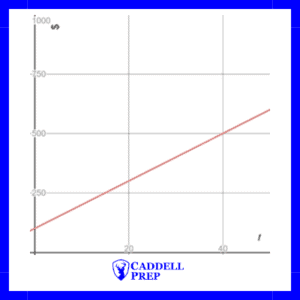
Suppose you deposited $100 in the bank and received $10 every year from the bank for keeping your money there. The amount of money in your account would increase linear because it would increase at a constant rate: $10/year.

The amount of money in the account could be represented by the function f(t)=10t+100.

Graph of Linear Growth

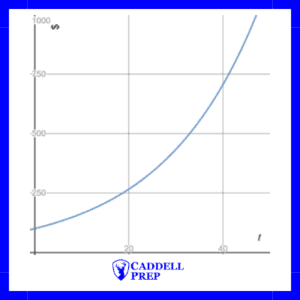
Suppose you deposited $100 in a different bank and received 5% interest each year. The first year you would only receive $5 because 5% of $100 is $5. However, the next year you would receive $5.25 because you would get 5% of $105. The following year, you would receive 5% of $110.25, which is $5.51. The amount of money you receive each year is bigger than the previous year’s amount. This is exponential growth.

More precisely, since it is growing by 5%, each year will be 105% of the previous year, so each year will be a multiple of 1.05 of the previous year.

The amount of money in the account could be represented by the function g(t)=100(1.05)^t.
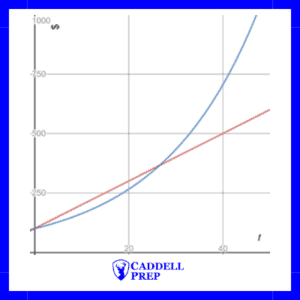
Here is a comparison of the two.  As you can see from the graph, exponential growth results in a graph that is curved upward.

Graph of Linear vs Exponential Growth

The function g(t)=100(1.05)^t is models growth of  an initial value of $100 increasing by 5% each year. It is based on the general formula:

A=A_0 (1+r)^t

where A is the value, A_0 is the initial value (in this case $100), r is the rate (in this case .05 for 5%), and t is time (in this case in years)

Since we add the rate to 1, we end up with growth.

Example:

A population of 500 rabbits increases by 6% each year. How many rabbits after 3 years?

Explanation:

A = 500 (1 + 0.06) ^3

Evaluating gives

A=595.5

So about 596 rabbits.

2. Exponential Decay

Like exponential growth, exponential decay is typically based on a percentage or ratio. However, since it is decaying (decreasing) the ratio is less than one.

Let’s look at an example. Suppose the population of an organism was initially 10,000 and the population decreases by 5% each year. The first year, the population would decrease by 5% of 10,000, which is 500. The population next year would start at 9,500 and would decrease by 5% again that year, so it would decrease by 475. Each year, the population decreases by 5%.

More precisely, since it is decreasing by 5%, each year will be 95% of the previous year, so each year will be a multiple of 0.95 of the previous year.

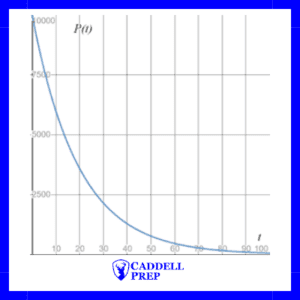
The population of the organisms could be represented by the function P(t)=10,000(0.95)^t.
Here is a graph of P(t).

Graph of Exponential Decay

The function P(t)=10,000(0.95)^t is based on an initial value of 10,000 that decreases by 5% each year. It is based on the general formula:

A=A_0 (1-r)^t
where A is the value, A_0 is the initial value (in this case 10,000), r is the rate (in this case .05 for 5%), and t is time (in this case in years)

Since we subtract the rate from 1, we end up with decay.

Example:

A car worth $20,000 depreciates 15% each year. What’s its value after 2 years?

Explanation:

A = 20000 (1 - 0.15) ^2

Evaluating gives

A = 14,450

So the car is worth $14,450 after 2 years.

3. Doubling & Half-Life

  • Doubling: If a population doubles every certain time period, t, the multiplier is 2.
A=A_0(2)^t
  • Half-life: If something halves every certain time period, t, the multiplier is \dfrac{1}{2}.
A = A_0(\dfrac{1}{2}) ^t

4. How to Use Annual Rates with Time Intervals Different Than Years

If the percent increase or decrease is annual, then the exponent has to represent the number of years.

If the question wants you to use a variable that represents a time interval other than years, you have to convert it to years.

For example, a question may ask to represent the formula in terms of m months.

To convert months to years, you have to divide by 12 (12 months equal one year, and 36 months equal three years). Therefore, the exponent should be \dfrac{m}{12}.

Tips

  1. Always convert the percent to a decimal (15% → 0.15).
  2. Make sure t matches the time period in question (years, months, days).
  3. For questions involving doubling or halving each year, it may be easier to just write out the numbers each year than use a formula.
  4. Watch out for successive changes: you multiply, not add.
  5. If you struggle to understand how increasing or decreasing by a percentage works, review the percent lesson.

Example

The function P(t)=52,000(1.05)^t models the population of a city t years after a census was taken. Which function best models the population of the city m months after the census was taken?
 
A) P(m)=52,000(1.05)^m
 
B) P(m)=52,000(1.05m)^{12}
 
C) P(m)=52,000(1.05)^{\dfrac{m}{12}}
 
D) P(m)=52,000(\dfrac{1.05}{12})^m

Video Explanation

Text Explanation

Answer: C
 
Text Explanation:
Since t represents years and m represents months, m months is equivalent to \dfrac{m}{12} year. Substitute \dfrac{m}{12} for t in the original function:
 
P(m)=52,000(1.05)^{\dfrac{m}{12}}
 

Practice Problems with Video Explanations

Here is a set of practice Digital SAT Exponential Growth/Decay practice problems. After selecting an answer, press “See Answer” to see the correct answer and a video explanation showing how to properly solve the questions. At the end of the set, after you press “Submit”, you’ll be able to see all of the questions, answers, and video explanations to review.

For more practice like this, enroll in our on-demand SAT prep course here: https://caddellprep.com/sat/prep/on-demand/

1. A laptop was purchased for $960. Its value decreases by 15% each year after it is purchased. Which function models the value V, in dollars, of the laptop t years after it is purchased?

Question 1 of 3

2. The function P(t)=4,200(1.04)^{\dfrac{t}{5}} models the population of a wildlife preserve t years after a study began. Which statement best describes the population according to this model?

Question 2 of 3

3. The function A(t)=18,000(1.1025)^{\dfrac{t}{2}} models the amount, in dollars, in an investment account t years after the account was opened. According to this model, by what percent does the amount in the account increase every 8 years?

Question 3 of 3


Common Mistakes

Four common mistakes students make when answering exponential growth/decay questions include using the actual year for t, using only the decimal equivalent of a percent instead of 1 plus or 1 minus the decimal, using the wrong conversion for the exponent, and incorrectly changing from a percentage to a decimal.

Using the actual year instead of the number of years from a starting point

A common mistake for exponential growth/decay questions is using the actual year for t instead of the number of years from a certain point.

For example, if the question states a federal park had 500 buffalo in 2002, but the population declines by 5% each year, and it asked to find the population in 2030, a mistake would be to use 2030 for t. The correct value for t would be 28 because it would be 28 years from the starting point, 2002.

Using only the percentage as a decimal, r instead of 1+r or 1-r

A common mistake on the Digital SAT for exponential growth/decay questions is inputting the percent as a decimal, r, instead of 1+r or 1-r.

For example, if a population increases by 20% each year, the formula should resemble

A=A_0(1+.20)^t or A=A_0(1.20)^t

A common mistake is to not account for the 1 and only enter A=A_0(.20)^t

Using the wrong conversion for the exponent

A common mistake is using the wrong conversion for the exponent. The exponent should represent the number of time intervals in units that match the units specified for the compounding change. For example, if the amount decays by 10% per year, then the exponent should represent the number of years. Likewise, if the amount decays 10% each month, then the exponent should represent the number of months.

A common type of question that shows up on the Digital SAT involves a percent change per year, but the formula has to be in terms of m months. Students know there are 12 months in a year, so some students make the exponent 12m, which is wrong. 12 times the number of months doesn’t give the number of years. The number of months needs to be divided by 12 to give the number of years, so the exponent should be \dfrac{m}{12}

Incorrectly changing a percentage to a decimal

A common mistake for exponential growth/decay questions is to incorrectly write a percentage as a decimal. Most students don’t make a mistake switching a two-digit percentage to a decimal, such as 24% to 0.24. However, some students tend to make a mistake with single-digit percentages, such as 3%, which they incorrectly write as 0.3 instead of 0.03.

Frequently Asked Questions

Here are three frequently asked questions that I get from students when reviewing exponential growth/decay.

What is the formula for exponential growth/decay?

The general formula is A=A_0(1\pm r)^t.

For exponential growth, the percentage is added to 1.

A=A_0(1+ r)^t

For exponential decay, the percentage is subtracted from 1.

A=A_0(1- r)^t

Do I need to know how to use logarithms (log) for the Digital SAT?

No, you do not need to know how to use logarithms (log) for the Digital SAT. Logarithms are used to solve for an exponent, which you will not have to do on the test. If you have seen lessons or practice problems on other websites that include logarithms, they are wrong. They likely wrote a general guide from an exponential growth/decay lesson that wasn’t originally made specifically for the Digital SAT.

Do I need to know how to do regressions in my calculator?

No, you do not need to know how to do regressions in your calculator. If you came across lessons or sample questions on a different website that stated you need to know regressions, they are wrong. Regressions are not tested on the Digital SAT. However, it is possible to use regressions to get the answer a different way than necessary.

Related Topics

Percent and exponents are related to exponential growth/decay.

Percent

Exponential growth and decay questions often involve percent increases and percent decreases. For example, a question may state that a population increases by 8% each year or that the value of an item decreases by 12% over a certain period of time. In these questions, students need to understand that a percent increase or decrease can be written as a growth or decay factor. Therefore, practicing percent questions can help students improve on exponential growth and decay questions.

Exponents

Exponential growth and decay questions require students to understand exponents. In these questions, the exponent often represents the number of time periods, such as years, months, or days. Students need to know how repeated multiplication works and how changing the exponent affects the value of an expression. Therefore, practicing exponent questions can help students better understand exponential growth and decay.

All Math Topics

All of our math topics are available here: https://caddellprep.com/sat/math/ for you to review and improve on your SAT. There are lessons, practice problems, and video explanations for you. If you need more help, try our on-demand SAT course with video lessons, practice tests, and sets of questions for each topic: https://caddellprep.com/sat/prep/on-demand/

Glyn Caddell

Glyn Caddell holds a BS in Mechanical Engineering from NJIT and has been tutoring New York City students since 2008. He founded Caddell Prep in 2012 and is the author of Digital SAT Math Secrets: Lessons & Tricks to Quickly Improve to a Perfect 800 on the Math Test, which contains over 900 practice problems and is used in Caddell Prep’s SAT math classes. He is founding president of the Staten Island Technical High School alumni association and teaches every lesson on this site personally.