Home » The Digital SAT: What’s Tested, How It’s Scored, and How to Improve Your Score » The 17 Digital SAT Math Topics: How Often Each Is Tested and What to Study First » SAT Trigonometry: Lesson, Practice Problems & Video Explanations
By Glyn Caddell, BSME · Author of Digital SAT Math Secrets · Tutoring since 2008 — Updated August 18, 2026
Trigonometry questions test students’ knowledge of sine, cosine, and tangent in a right triangle or in similar triangles. Trigonometry questions appear on approximately 2.0% of the Digital SAT. Trigonometry falls under Geometry and Trigonometry according to the College Board.
Trigonometry Lesson for the Digital SAT
The lesson will prepare you for the trigonometry questions that show up on the Digital SAT. This lesson covers what SOH-CAH-TOA is and that sine of an angle is equal to cosine of its complement.
What Do Trigonometry Questions Look Like?
Here are some examples of Trigonometry questions from the Digital SAT.
- What is the value of
?
- What is the value of
?
- What is the value of
?
- What is the value of
?
- In the triangle shown, what is the value of
?
- Which of the following expressions is equivalent to
?
1. What is SOH-CAH-TOA?
SOH-CAH-TOA is an acronym to help us remember the three basic trigonometric ratios.
- SOH stands for Sine = Opposite/Hypotenuse
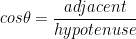
- CAH stands for Cosine = Adjacent/Hypotenuse
- TOA stands for Tangent = Opposite/Adjacent
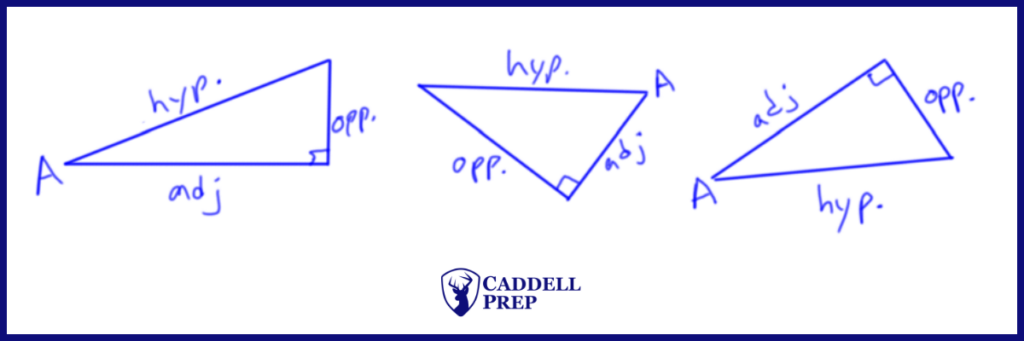
Hypotenuse – the hypotenuse of a right triangle is the longest side in a right triangle; it is also always across from the right angle
Opposite side – the opposite side is the side across from (opposite of) the selected angle
Adjacent side – the adjacent side is the side next to the selected angle; it’s the side that isn’t the hypotenuse or the opposite side
Note: The opposite side and adjacent side are always in reference to the angle.
Here are some examples labeled in reference to angle A.
Sine, Cosine, and Tangent are Ratios
If , it doesn’t mean that the length of the adjacent side is 2 and the length of the hypotenuse is 5; it just means that the ratio of length of the adjacent side to the length of the hypotenuse is 2:5.
If two triangles are similar, they have congruent angles and their side lengths are proportionate. Also, sine of one angle will equal sine of the corresponding angle in the other triangle.
For example, If is similar to
, it means:
The order that the vertices are written is how the vertices match up with each other.
Since the angles are congruent, then
And the same is true for the other trigonometric ratios also, such as .
2. Sin(A) = Cos(90-A)
In other words, sine of an angle is equal to cosine of the complement.
This is an important concept to answer some trigonometry questions quickly and correctly.
Also, a related concept is often tested.
If , then
SAT Tips
- Always identify the reference angle in the triangle.
- Make sure you label opposite, adjacent, hypotenuse correctly relative to the angle.
Example
Video Explanation
Text Explanation
Practice Problems with Video Explanations
Here is a set of practice Digital SAT trigonometry practice problems. After selecting an answer, press “See Answer” to see the correct answer and a video explanation showing how to properly solve the questions. At the end of the set, after you press “Submit”, you’ll be able to see all of the questions, answers, and video explanations to review.
For more practice like this, enroll in our on-demand SAT prep course here: https://caddellprep.com/sat/prep/on-demand/
Please wait…![]()
Common Mistakes
Two common mistakes students make when answering trigonometry questions are mixing up the trigonometric ratios and mixing up the opposite and adjacent sides in a right triangle.
Mixing Up the Trigonometric Ratios
For some reason, some students say SOH-COH-TOA instead of SOH-CAH-TOA. As a result, they incorrectly set up the cosine ratio as instead of
.
Mixing Up the Opposite and Adjacent Sides in the Right Triangle
A common mistake is mixing up the opposite and adjacent sides in a right triangle. Some students get in the habit of always making the bottom (horizontal) side the adjacent side, but that’s not always the adjacent side.
The designation of each side depends on which angle we are applying a trigonometric function to.
Frequently Asked Questions
Here are three frequently asked questions that I get from students when reviewing trigonometry.
Do I Need to Know How to Use Inverse Trigonometry?
No, you do not need to know how to use inverse trigonometry. The questions on the SAT never require you to use inverse trigonometry to find the measure of an angle.
Do I Need to Know Trig Identities?
No, you do not need to know any of the trig identities.
Are Any Formulas Given for Trigonometry on the SAT?
No, there are no formulas specific to trigonometry that are provided on the Digital SAT reference sheet.
The only thing you have to memorize is SOH-CAH-TOA and know how to apply the three associated trigonometric ratios.
There are some formulas and relationships provided that can be used on some trigonometry questions, but the formulas and relationships aren’t directly a part of trigonometry. Specifically, Pythagorean theorem and special right triangles are provided and can sometimes be used in trigonometry questions.
Related Topics
Ratios & Proportions and Angles, Polygons, & 3-D Shapes are topics related to Trigonometry.
Ratios & Proportions
Trigonometry questions on the SAT are based on ratios. Sine, cosine, and tangent each compare two sides of a right triangle. Since these side lengths are proportional in similar right triangles, understanding ratios and proportions can help students identify the correct trigonometric relationship. Therefore, practicing ratio and proportion questions can help students improve on trigonometry questions.
Angles, Polygons & 3-D Shapes
Trigonometry on the SAT is limited to right triangles, which often appear within other geometry questions. Students may need to use angle relationships, triangle properties, or the Pythagorean theorem before using sine, cosine, or tangent. Sometimes a right triangle is part of a larger polygon or 3-D figure. Therefore, practicing angles, polygons, and 3-D shapes can help students recognize when trigonometry should be used.
All Math Topics
All of our math topics are available here: https://caddellprep.com/sat/math/ for you to review and improve on your SAT. There are lessons, practice problems, and video explanations for you. If you need more help, try our on-demand SAT course with video lessons, practice tests, and sets of questions for each topic: https://caddellprep.com/sat/prep/on-demand/
Glyn Caddell
Glyn Caddell holds a BS in Mechanical Engineering from NJIT and has been tutoring New York City students since 2008. He founded Caddell Prep in 2012 and is the author of Digital SAT Math Secrets: Lessons & Tricks to Quickly Improve to a Perfect 800 on the Math Test, which contains over 900 practice problems and is used in Caddell Prep’s SAT math classes. He is founding president of the Staten Island Technical High School alumni association and teaches every lesson on this site personally.