
Home » College SAT Score Ranges, Costs, and Programs by Major and State » Best Pre-Med Colleges » Pre-Med Colleges in Oregon: SAT Scores, Costs, and Programs
By Glyn Caddell, BSME · Author of Digital SAT Math Secrets · Tutoring since 2008 — Updated October 16, 2026
Fifteen Oregon colleges with pre-med programs, what they cost, and the SAT scores of the students they admit.
No Oregon college requires the SAT or ACT, one of them will not look at a score even when a student sends it, and none of Oregon’s state aid uses one. What carries weight here instead is where a student takes his degree, because the state’s only medical school says so in writing.
Scores are given by section rather than as a single total, because a student at 680 Reading & Writing and 560 Math is in a different position from a student at 560 and 680.
Table of Contents
- Oregon Pre-Med Colleges by SAT Score
- No Oregon College Requires a Test, and One Will Not Look at It
- So What Is a Test Score Still Worth in Oregon?
- At OHSU, Where You Took Your Degree Counts
- Oregon Has One Medical School and One Osteopathic College
- What If Your Scores Are Below the Range You Want?
Oregon Pre-Med Colleges by SAT Score
The table below covers Oregon’s four-year non-profit institutions enrolling more than 700 undergraduates. The one exclusion is Oregon Health & Science University, which enrolls 836 undergraduates in nursing and allied health, reports no cost or tuition figures, and has no traditional undergraduate college.
Colleges are sorted by the midpoint of their two section ranges, with ties broken on the Math 75th percentile. The six colleges reporting no scores go last, ordered by size.
| College | Reading & Writing | Math | Cost of attendance | Undergraduates | Admit rate |
|---|---|---|---|---|---|
| Reed College | 680 to 750 | 610 to 770 | $86,376 | 1,320 | 25% |
| Willamette University | 640 to 730 | 600 to 710 | $67,501 | 1,592 | 77% |
| Oregon State University | 580 to 700 | 560 to 700 | $31,653 | 30,743 | 77% |
| University of Portland | 580 to 670 | 580 to 700 | $73,224 | 2,957 | 89% |
| University of Oregon | 580 to 690 | 550 to 670 | $34,793 | 20,497 | 88% |
| Oregon State University-Cascades | 605 to 670 | 538 to 648 | $29,798 | 1,044 | 63% |
| George Fox University | 560 to 680 | 510 to 660 | $58,644 | 2,699 | 94% |
| Oregon Institute of Technology | 500 to 650 | 500 to 620 | $27,524 | 2,892 | 95% |
| Pacific University | 480 to 630 | 420 to 610 | $72,374 | 1,516 | 90% |
| Portland State University | Not reported | Not reported | $21,590 | 13,182 | 91% |
| Western Oregon University | Not reported | Not reported | $25,062 | 3,103 | 98% |
| Southern Oregon University | Not reported | Not reported | $27,636 | 2,751 | 89% |
| Eastern Oregon University | Not reported | Not reported | $26,718 | 2,172 | 98% |
| Lewis & Clark College | Not reported | Not reported | $79,987 | 2,120 | 78% |
| Linfield University | Not reported | Not reported | $65,935 | 1,621 | 85% |
Each range covers the middle 50% of admitted students who submitted scores. A quarter scored below the lower number, and the top quarter scored at or above the upper one. Being under the lower number does not rule a student out, and being just above it is not as safe as it looks.
Four things in that table are worth stopping on.
Six of the fifteen report no scores at all, and one of the six is Portland State, the third largest campus in Oregon with 13,182 undergraduates. Lewis & Clark and Linfield, two of the state’s better-known private colleges, report nothing either. For those six there is no published figure to compare a score against.
The college at the top of the table does not use test scores. Reed reports the highest ranges in Oregon and admits 25% of applicants, the lowest rate in the state, and it says plainly that it will not look at a score. The next section explains what that means for reading the rest of this table.
Oregon State University-Cascades admits 63% of applicants against Oregon State’s 77%, so the branch campus in Bend is more selective than the main campus in Corvallis. Nothing published explains that, and this page is not going to guess.
Out-of-state students pay a great deal more at every Oregon public. The gap between resident and non-resident tuition runs from $14,355 at Eastern Oregon to $28,461 at the University of Oregon. Two states covered earlier on this site run the opposite way, with North Dakota charging every public university’s out-of-state students less than $16,000 in total and one Oklahoma university charging a $30 premium.
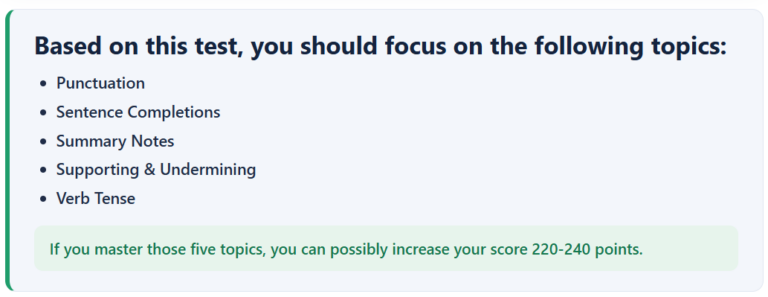
Want to Know What 5 Topics Will Improve Your SAT Score the Most?
Sample Feedback from our Diagnostic Test:
Reed College
Reed College is a liberal arts college in Portland with 1,320 undergraduates, and it admits 25% of applicants, the lowest rate in Oregon. Admitted students scored 680 to 750 in Reading & Writing and 610 to 770 in Math, so the top quarter were at or above 750 and 770. Tuition and fees are $69,350 and total cost of attendance is $86,376, the highest figure on this page. Reed does not use SAT or ACT results in its admission review, which makes those ranges mean something different from every other row in this table.
Willamette University
Willamette University is a private liberal arts university in Salem with 1,592 undergraduates. The admitted range runs 640 to 730 in Reading & Writing and 600 to 710 in Math, with the top quarter at or above 730 and 710. Willamette charges $51,156 in tuition and fees against a total cost of attendance of $67,501, and admits 77% of applicants. Its score ranges are the second highest in the state at an admit rate three times Reed’s.
Oregon State University
Oregon State University is the largest campus in Oregon with 30,743 undergraduates in Corvallis. Admitted students scored 580 to 700 in Reading & Writing and 560 to 700 in Math, so the top quarter were at or above 700 in both sections. In-state tuition and fees are $14,400 and out-of-state tuition is $38,190, against a total cost of attendance of $31,653. Oregon State admits 77% of applicants and awards its automatic freshman scholarships on grade point average alone.
University of Portland
The University of Portland is a Catholic university with 2,957 undergraduates overlooking the Willamette River. Admitted students scored 580 to 670 in Reading & Writing and 580 to 700 in Math, with the top quarter at or above 670 and 700. Tuition and fees are $58,100 and total cost of attendance is $73,224. It admits 89% of applicants, and its Math 75th percentile of 700 matches Oregon State’s at more than twice the price.
University of Oregon
The University of Oregon enrolls 20,497 undergraduates in Eugene and admits 88% of applicants. The admitted range runs 580 to 690 in Reading & Writing and 550 to 670 in Math, so the top quarter were at or above 690 and 670. In-state tuition and fees are $16,137, the highest resident figure among Oregon publics, and out-of-state tuition is $44,598. Total cost of attendance is $34,793. The $28,461 gap between those two tuition figures is the largest in the state.
Oregon State University-Cascades
Oregon State University-Cascades is Oregon State’s campus in Bend, with 1,044 undergraduates, the smallest in this table. It admits 63% of applicants, a lower share than any other public university in Oregon and lower than Oregon State’s own main campus. Admitted students scored 605 to 670 in Reading & Writing and 538 to 648 in Math, with the top quarter at or above 670 and 648. In-state tuition and fees are $13,566 and out-of-state tuition is $37,356, against a total cost of attendance of $29,798.
George Fox University
George Fox University is a Christian university in Newberg with 2,699 undergraduates, and it admits 94% of applicants. The admitted range runs 560 to 680 in Reading & Writing and 510 to 660 in Math, so the top quarter were at or above 680 and 660. George Fox charges $42,750 in tuition and fees and costs $58,644 in total.
Oregon Institute of Technology
The Oregon Institute of Technology is the state’s public polytechnic, based in Klamath Falls with 2,892 undergraduates, and it admits 95% of applicants. Admitted students scored 500 to 650 in Reading & Writing and 500 to 620 in Math, with the top quarter at or above 650 and 620. Tuition and fees run $13,260 in-state and $37,196 out-of-state, and total cost of attendance is $27,524.
Pacific University
Pacific University is a private university in Forest Grove with 1,516 undergraduates and a 90% admit rate. Its Math range runs 420 to 610, a spread of 190 points and the widest single section range in this table. Reading & Writing runs 480 to 630, so the top quarter were at or above 630 and 610. Pacific charges $56,374 in tuition and fees and costs $72,374 in total. A range that wide normally means a college drawing from a broad spread of high schools rather than a narrow band of applicants.
Portland State University
Portland State University is the third largest campus in Oregon with 13,182 undergraduates in downtown Portland, and it reports the lowest total cost of attendance on this page at $21,590. It reports no SAT or ACT data in the 2025-26 release, so there is no published score figure for it. In-state tuition and fees are $11,679 and out-of-state tuition is $31,074. Portland State admits 91% of applicants.
Western Oregon University
Western Oregon University is a public university in Monmouth with 3,103 undergraduates, and it admits 98% of applicants. It reports no test data of any kind. Tuition and fees are $11,879 in-state and $32,534 out-of-state, against a total cost of attendance of $25,062.
Southern Oregon University
Southern Oregon University is a public university in Ashland with 2,751 undergraduates and an 89% admit rate. It reports neither test. Southern Oregon charges $12,762 in-state and $31,887 out-of-state in tuition and fees, against a total cost of attendance of $27,636.
Eastern Oregon University
Eastern Oregon University is a public university in La Grande with 2,172 undergraduates, and it admits 98% of applicants, the same share Western Oregon reports. It publishes no score data. Eastern Oregon charges $11,076 in-state, the lowest resident tuition on this page, and $25,431 out-of-state. The $14,355 between them is the smallest out-of-state gap among Oregon publics. Total cost of attendance is $26,718.
Lewis & Clark College
Lewis & Clark College is a liberal arts college in Portland with 2,120 undergraduates, and it reports the second highest cost of attendance in the state at $79,987. It reports no SAT or ACT data. Tuition and fees are $64,828 and Lewis & Clark admits 78% of applicants.
Linfield University
Linfield University is a private university in McMinnville with 1,621 undergraduates and an 85% admit rate. It reports neither test. Linfield charges $50,850 in tuition and fees, against a total cost of attendance of $65,935.
No Oregon College Requires a Test, and One Will Not Look at It
Oregon’s official college access portal states that all of Oregon’s public universities and most private colleges are test optional, and that no Oregon colleges require the SAT or ACT for admission. That is the state itself saying the test is mandatory nowhere within its borders.
Reed College goes further than optional. Its admission page says that “Reed will neither require nor use testing results from the SAT or ACT in our admission review.” Applicants may self-report a score if they want to, and Reed says neither test “will be used in our evaluation.”
Now look back at the table.
In-article image 1 Placement: directly after the paragraph below What it shows: Reed’s reported SAT bands drawn at the top of the Oregon table exactly as the Scorecard gives them, beside a second panel showing what Reed used in its admission review, namely nothing Image annotation phrase required in the adjacent sentence: Reed’s published ranges describe the students who enrolled, not a standard Reed applied Alt text: Reed College’s reported score ranges set against its stated policy of not using test results File name: reed-published-ranges-versus-test-blind-policy Size: 2760×1440
Reed sits at the top of it with the highest ranges in Oregon and the lowest admit rate in the state, and those two facts have nothing to do with each other, because Reed’s published ranges describe the students who enrolled, not a standard Reed applied. Students who happened to have strong scores reported them. Reed did not read them.
That is the clearest demonstration available anywhere of what a published score range actually is. Every other range on this page works the same way, with the single difference that the other colleges would at least have looked at a score if one arrived.
Nothing else in Oregon attaches a number to a test either.
The Oregon Opportunity Grant is need-based. It requires twelve months of Oregon residency, demonstrated financial need and a FAFSA or ORSAA, and for 2026-27 it carries a Student Aid Index limit of 8,000 and a May 15, 2026 cutoff. Awards at four-year institutions run from $1,800 to $8,352 a year. No test score appears anywhere in it.
Oregon State’s automatic freshman scholarships use grade point average alone. The Presidential Scholarship pays up to $10,000 a year to Oregon residents with a 3.85 unweighted or 4.20 weighted average who apply by February 2, and the Finley Academic Excellence Scholarship pays up to $5,000 a year at approximately a 3.50 unweighted average. Neither one looks at a test.
Oregon students do not need a test to graduate from high school either. The State Board of Education has suspended assessment of the Essential Skills as a diploma requirement through the 2027-28 school year. The requirement is suspended rather than removed, and suspended is the word the Department of Education uses.
Oregon also has no BS/MD program and no early assurance route into medical school. Nothing in this state is decided from high school.
At OHSU, Where You Took Your Degree Counts
Oregon Health & Science University gives admissions preference under a written policy with four criteria, and an applicant needs to meet only one of them.
The first is graduating from any Oregon high school having attended at least two years at a high school in Oregon. The second is graduating from any regionally accredited college or university in Oregon, having attended at least two years, no more than seven years before applying. The third is having at least one parent or legal guardian resident in Oregon at the time of application. The fourth is holding Oregon residency as OHSU defines it.
In-article image 2 Placement: directly after the paragraph below What it shows: the four Oregon Heritage criteria drawn as four doors into the same preference, with the undergraduate-degree door marked with its two-year and seven-year conditions, and a separate marker noting that the policy does not confer tuition residency Image annotation phrase required in the adjacent sentence: a degree taken in Oregon is one of four ways to reach the preference Alt text: the four criteria that qualify an applicant for Oregon Heritage preference at OHSU File name: ohsu-oregon-heritage-four-criteria Size: 2760×1440
The second criterion is the one worth dwelling on, because a degree taken in Oregon is one of four ways to reach the preference and it is the only one a student can still choose at seventeen. A student from anywhere who enrolls at an Oregon college and graduates qualifies, whatever state he grew up in.
Two limits belong in the same breath as that.
The policy says it applies to admissions only and does not establish tuition residency. A student who qualifies this way still pays non-resident tuition at the undergraduate stage, and the out-of-state figures in the table above are what that costs.
Preference is also not admission. OHSU publishes a minimum AMCAS total grade point average of 2.80 and a minimum MCAT score of 497 for the 2027 cycle, and it interviews 20 to 40 applicants a week online from mid-September through February. It publishes no class size and no resident percentage. Those two minimums are floors for being considered rather than targets to aim at.
Three States, Three Different Versions of the Same Idea
This site has now found the same idea in three consecutive states, and the differences between them matter more than the similarity.
North Carolina’s Brody School of Medicine uses a binary gate. North Carolina residency or a UNC System bachelor’s degree earned within five years, with no third door, and applicants meeting neither may not apply at all.
North Dakota’s University of North Dakota treats a North Dakota university degree as one tie among several, inside a preference order that still ranks North Dakota high school graduates above everyone who arrived later.
Oregon’s OHSU writes four criteria into a numbered policy, any one of which qualifies, and what they produce is preference rather than eligibility.
Brody’s rule is the strongest of the three, OHSU’s the next, and North Dakota’s the weakest. A student should read the actual policy of the school he is interested in rather than carry across what he learned about another state. See pre-med colleges in North Carolina and pre-med colleges in North Dakota.
Oregon Has One Medical School and One Osteopathic College
The Oregon Health & Science University School of Medicine in Portland is the only MD program in Oregon accredited by the Liaison Committee on Medical Education, and it holds full accreditation. One MD program in the state is the reason the policy above carries as much weight as it does, because there is no second door in Oregon.
The osteopathic college sits in Lebanon, in the Willamette Valley, and it has recently changed its name. It operated as COMP-Northwest, a location of Western University of Health Sciences, and Western University announced that it would be renamed the Heatherington College of Osteopathic Medicine, honoring Jeff Heatherington, alongside a Heatherington Foundation gift of 150 acres of riverfront land in Lebanon for a planned new campus. A student searching for either name is looking at the same school.
Having those two nearby is worth knowing about and it is not by itself a reason to choose an Oregon college. Medical school applications are national, and proximity helps with shadowing, clinical volunteering and research during the undergraduate years rather than with admission.
OHSU is the exception to that sentence, and it is the exception the section above exists to explain. At OHSU the undergraduate college is not a soft advantage. It is one of four written criteria for the preference.
What If Your Scores Are Below the Range You Want?
Being below a published range matters less in Oregon than in any state covered so far, for the simple reason that no Oregon college requires a score and a student may decline to send one.
Admission is reachable almost everywhere in the state. Oregon State admits 77%, the University of Oregon 88%, Portland State 91%, and Western Oregon and Eastern Oregon both admit 98%. A student below a range still has somewhere to go, and at most of these colleges he has his first choice.
So the real question for an Oregon student is not whether to send a score. It is whether to have one.
A student who is confident he will apply only within Oregon can reasonably decide the test is not where his effort should go, and put that time into grades and coursework instead. Oregon State’s largest automatic scholarship is decided on grade point average, and a tenth of a point there is worth more to him than fifty SAT points.
A student who may apply out of state, or who wants merit aid at a private college, is in a different position. He needs a score, and he needs it early enough to improve it, because the states on his list may price the test in ways Oregon does not.
For a student who does decide to test, the number worth aiming for is the upper end of a college’s range, the one the top quarter cleared, rather than the middle. The reasoning behind that is on what SAT score you need for college.
Based on the students we have worked with since 2008, a 70 to 130 point improvement takes approximately 40 hours of effective studying and a 130 to 250 point improvement takes approximately 80. How to improve your SAT score covers the method, including how to find which topics are costing points instead of guessing at them. If there is no recent score to measure against, a free diagnostic SAT gives one, broken down by section and by topic.
How to Read These Score Ranges
Reed is the best example on this site of what a published range is, so start there. Reed appears at the top of this table with the highest ranges in Oregon and does not use test scores in its admission review. Its numbers describe students who enrolled and chose to report a score. They are not a bar Reed set, because Reed never looked.
Every other range on this page works the same way, with the difference that those colleges would have looked if a score arrived.
The mechanics are the same throughout. Each range covers the middle 50% of admitted students who submitted that test. The lower number is the 25th percentile and the upper number is the 75th, which means a quarter of admitted students scored at or above it.
Because submitting is optional everywhere in Oregon, every published range describes submitters rather than everyone admitted. Students with strong scores send them and students with weak ones do not, so each range sits higher than the true range for the admitted class. More on test-optional colleges.
Six colleges in this table report neither test, so for those there is no published figure of any kind to measure a score against.
Why This Page Shows the SAT and Not the ACT
Nine of the fifteen colleges here report SAT section ranges and eight report an ACT composite, close enough to even that the usual rule barely settles it.
What settles it is that every college reporting an ACT composite also reports SAT sections. No college appears on the ACT and nowhere else, so leaving the ACT column out costs the reader nothing.
For a student the choice is open. Both tests are accepted everywhere in Oregon that accepts either, and neither is worth more here, because almost nothing in the state attaches a number to a score. The decision comes down to which format suits him.
A student applying out of state should check which test the states on his list are written in. Some of them publish their thresholds in ACT points and convert to the SAT afterwards, and a student working in the same units the state uses has an easier time reading what he is aiming at.
Pre-Med Programs in Nearby States
Oregon borders Washington, Idaho, California and Nevada, and plenty of Oregon students leave for all four.
A test score is worth more the moment a student crosses a state line. Oklahoma publishes ACT thresholds by institution tier and attaches awards to them that one of its universities values in five figures. New York publishes SAT floors that decide who may hold a reserved medical school seat. Neither of those exists in Oregon, and a student who finds out about them in October of senior year has left it too late to do much about it.
Leaving also costs an Oregon student the second Oregon Heritage criterion at OHSU, since that one turns on taking a degree in Oregon. He keeps the first if he went to an Oregon high school for two years, so a student leaving for college does not lose the preference altogether.
See pre-med colleges in Idaho, pre-med colleges in California, and pre-med colleges in Nevada.
Pre-Med Colleges in Other States
We publish the same breakdown for pre-med programs in every state.
See pre-med colleges by state for the full list.

Glyn Caddell
Glyn Caddell holds a BS in Mechanical Engineering from NJIT and has been tutoring New York City students since 2008. He founded Caddell Prep in 2012 and is the author of Digital SAT Math Secrets: Lessons & Tricks to Quickly Improve to a Perfect 800 on the Math Test, which contains over 900 practice problems and is used in Caddell Prep’s SAT math classes. He is founding president of the Staten Island Technical High School alumni association and teaches every lesson on this site personally.
Finally, an SAT course that students actually understand
Every question has a video explanation. Not most — every one.
The on-demand Digital SAT course covers all 17 math topics and 15 reading and writing topics, with 5 full-length practice tests and a 100-point score increase guarantee. Keep access for the rest of high school. No subscription.
Want to Know What 5 Topics Will Improve Your SAT Score the Most?
Sample Feedback from our Diagnostic Test: