
Home » College SAT Score Ranges, Costs, and Programs by Major and State » Engineering Colleges by State: SAT Scores, ACT Scores, Costs, and ABET Programs » Engineering Colleges in Vermont: SAT Scores, Costs, and Programs
By Glyn Caddell, BSME · Author of Digital SAT Math Secrets · Tutoring since 2008 — Updated October 26, 2026
Two Vermont universities offer ABET-accredited engineering degrees, and this page lists what they cost and the test scores of the students they admit.
The public one charges a non-resident $45,502, more than any public engineering school in this series outside California and Michigan except Colorado School of Mines, and about three-quarters of its students pay that column.
SAT scores are given by section rather than as a total, because a student at 730 Reading & Writing and 630 Math is in a different position from a student at 630 and 730.
Table of Contents
- Vermont Engineering Colleges by SAT Score
- Why Does the University of Vermont Charge a Non-Resident $45,502?
- Which Vermont Universities Have ABET-Accredited Engineering Schools?
- What If Your Score Is Below the Range You Want?
Vermont Engineering Colleges by SAT Score
The two universities below are the ones in Vermont that hold an ABET-accredited bachelor’s degree in an engineering discipline. They are sorted by the midpoint of the SAT Math range, so the order can be checked from the table itself.
| College | SAT Reading & Writing | SAT Math | Cost of attendance | Undergraduates | Admit rate |
|---|---|---|---|---|---|
| University of Vermont | 660 to 730 | 630 to 710 | $35,649 | 11,743 | 65% |
| Norwich University | 540 to 650 | 520 to 670 | $67,357 | 2,428 | 74% |
Each range covers the middle 50% of admitted students who submitted that test. A quarter scored below the lower number, and the top quarter scored at or above the upper one. Being under the lower number does not rule a student out, and being just above it is not as safe as it looks.
Only universities with an ABET-accredited engineering bachelor’s degree are listed. Vermont State University’s Randolph campus awards engineering technology degrees accredited under a separate ABET commission and no engineering degree, and is not listed. Norwich reports no ACT range.
Three things about that table are worth pausing on.
Vermont charges a non-resident $45,502, more than any public engineering school in this series outside California and Michigan except Colorado School of Mines, and about three-quarters of its undergraduates are non-residents. The next section is about it.
Norwich charges every student $49,740, $4,238 more than Vermont charges a non-resident, on a Math range 110 points lower at the floor and 40 lower at the ceiling, and it was the first private institution in the country to teach civil engineering.
Vermont reports an ACT range of 30 to 32 and a Reading & Writing range of 660 to 730, both well above Norwich’s, and admits 65%. The state has two accredited engineering schools and no second public one.
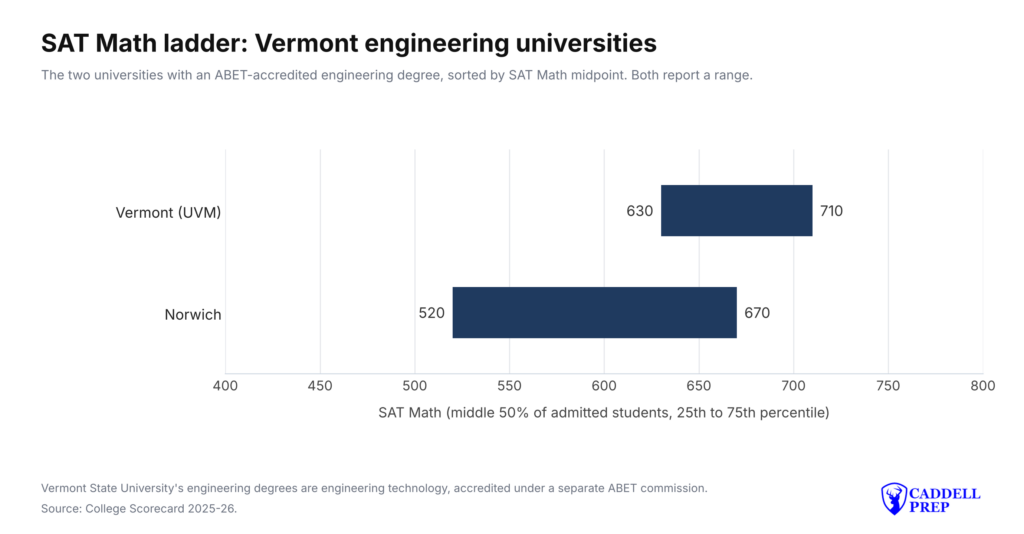
A student can see where his Math score sits on this list in the image above.
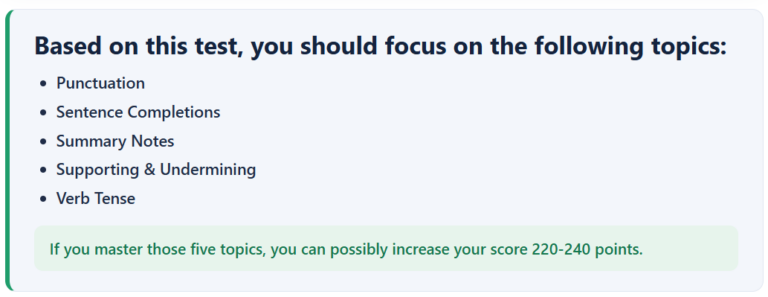
Want to Know What 5 Topics Will Improve Your SAT Score the Most?
Sample Feedback from our Diagnostic Test:
University of Vermont
The University of Vermont’s College of Engineering and Mathematical Sciences in Burlington holds ABET accreditation in biomedical, civil, electrical, environmental and mechanical engineering [VERIFY list on abet.org], and Vermont is the state’s only public university with an accredited engineering degree.
Reading & Writing 660 to 730, Math 630 to 710. The top quarter of admitted students scored at or above 710 on Math. Cost of attendance $35,649, with tuition and fees at $19,058 in state and $45,502 out of state. 11,743 undergraduates, 65% admitted.
Vermont is the larger school on the page by a factor of nearly five, the more selective, and the one whose price depends on which column a student is in. The cost of attendance in the table is a Vermonter’s, and a non-resident’s comes to approximately $62,100 once the higher tuition is substituted. The next section is about why.
Norwich University
Norwich University’s David Crawford School of Engineering in Northfield holds ABET accreditation in civil, electrical and computer, and mechanical engineering, renewed for six years in September 2021, and Norwich is the oldest private military college in the country.
Reading & Writing 540 to 650, Math 520 to 670. The top quarter of admitted students scored at or above 670 on Math. Cost of attendance $67,357, with tuition and fees at $49,740 for all students. 2,428 undergraduates, 74% admitted.
Norwich enrolls a Corps of Cadets and civilian students on the same campus, charges both $49,740 [VERIFY that the Corps and civilian rates are the same], and reports no ACT range. Its history is in the next section.
Two ranges say who got in. One price says why a New York student should read the public university’s second column, and the next section is about it.
Why Does the University of Vermont Charge a Non-Resident $45,502?
The University of Vermont charges a non-resident $45,502 because most of its students are non-residents and the state funds a small share of its budget, so the non-resident column is the one that carries the university.
The figure sits high in this series. Among the public engineering universities on these pages outside California and Michigan, where the nine University of California campuses charge a non-resident between $49,403 and $50,974 and Michigan charges $60,946, only Colorado School of Mines, at $45,824, charges a non-resident more than Vermont’s $45,502. Colorado Boulder is $44,918, Texas $44,908, UConn $43,712 and Michigan Tech $42,988. Vermont’s resident figure of $19,058 is the tenth-highest at a public engineering school in the series.
The reason is who pays it. In fall 2022, about 23 percent of Vermont’s undergraduates were from Vermont, by Seven Days’ reporting in August 2023, and in fiscal 2023 the state gave the university $52.5 million against a $776 million operating budget, in a state the paper described as “one of the states that appropriates the least amount of money for higher education.” The university froze in-state tuition in 2019 and held it until 2025-26, when it raised in-state tuition 2 percent and out-of-state tuition 4.5 percent, from $42,724 to $44,647 before fees, by the same paper’s reporting in October 2024. Three-quarters of the undergraduates pay the column that went up 4.5 percent.
For a New York engineering applicant that changes what the word public means. A student with a Math score inside Vermont’s range of 630 to 710 is inside the range at Buffalo, on our page on engineering colleges in New York, where he pays in-state tuition, and inside the range at Rutgers, on our page on engineering colleges in New Jersey, where he pays $37,441. Vermont charges him $45,502 for a public university whose students are mostly in his position.
| University | Resident | Non-resident |
|---|---|---|
| Colorado School of Mines | $21,914 | $45,824 |
| University of Vermont | $19,058 | $45,502 |
| University of Colorado Boulder | $15,666 | $44,918 |
| University of Texas at Austin | $11,688 | $44,908 |
| University of Connecticut | $21,044 | $43,712 |
| Michigan Technological University | $19,123 | $42,988 |
| Rutgers University-New Brunswick | $17,929 | $37,441 |
| University at Buffalo |
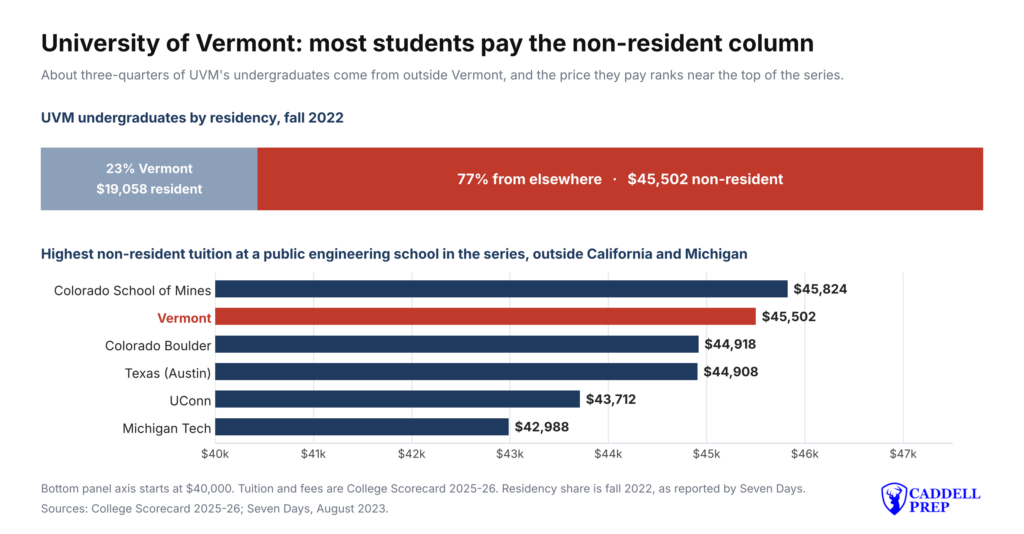
The image above shows who pays which column at Vermont and where the non-resident column sits in the series.
Take a New York student with a 650 on SAT Math. At Vermont he is in the lower half of 630 to 710 and pays $45,502, with a cost of attendance of approximately $62,100. At Norwich he is in the upper half of 520 to 670 and pays $49,740. At New Hampshire, on our New Hampshire page, he is inside the range and pays $39,852. At Buffalo he is in the lower half of 610 to 700 and pays $10,936. The two Vermont schools are the two most expensive options on that list, and the one with the public name is the second most expensive.
Norwich’s number is a year. Alden Partridge, a former superintendent of West Point, founded the American Literary, Scientific and Military Academy in Norwich, Vermont, in 1819, and the American Society of Civil Engineers calls it “the first private institution in the United States to offer formal courses in civil engineering,” taught continuously since its founding. The university’s civil, electrical and computer, and mechanical engineering programs received a six-year ABET accreditation in September 2021. Norwich is one of the six senior military colleges, with The Citadel on our page on engineering colleges in South Carolina, and it is the oldest of them.
Vermont State’s number is zero. The state’s second public university, at its Randolph campus that was Vermont Technical College, lists architectural, electrical, electromechanical and mechanical engineering technology degrees and a software engineering degree, and no engineering degree accredited by ABET’s Engineering Accreditation Commission [VERIFY software engineering on abet.org]. A Vermonter who wants an accredited engineering degree at a public university in his own state has one choice, at $19,058, the tenth-highest resident figure in the series.
The honest version is that $45,502 is the Scorecard’s 2025-26 tuition-and-fees figure and $44,647 is the university’s own 2025-26 tuition before fees, and the page gives both with their sources. The 23 percent is fall 2022 and the $52.5 million is fiscal 2023, the most recent figures this page could read, and the university’s 2025 Sourcebook should replace them [VERIFY]. Vermont is test-optional and admits 65%, and its range describes the students who submitted. Norwich’s split between the Corps and civilian students is not in the Scorecard. And the page does not say Vermont is overpriced. It says who pays which column and why the column reads as it does.
Families from New York frequently ask the question the price raises.
Is the University of Vermont a Public University?
The University of Vermont is a public university. It is the state’s university and land-grant institution, chartered by Vermont, with a state appropriation of $52.5 million against a $776 million budget in fiscal 2023 and about 23 percent of its undergraduates from Vermont in fall 2022.
The public name describes the charter and the resident column. It does not describe the price most of its students pay, and a New York family should read the non-resident column as the university’s price.
The column is Vermont’s. The degrees are what the next section lists.
Which Vermont Universities Have ABET-Accredited Engineering Schools?
Two Vermont universities hold ABET-accredited engineering bachelor’s degrees, one public and one private, and both are in the table above.
In Burlington, Vermont’s College of Engineering and Mathematical Sciences is on the hill above Lake Champlain. In Northfield, Norwich’s David Crawford School of Engineering is on the campus Alden Partridge’s academy moved to in 1866, forty miles southeast of Burlington, and civil engineering has been taught at Norwich since 1819. The two are the state’s only accredited engineering schools, and Vermont State University’s Randolph campus, between them, holds engineering technology degrees.
Accreditation matters for a reason that is easy to miss at seventeen. Licensure as a professional engineer normally requires a degree from an ABET-accredited engineering program, and that is why Vermont State’s engineering technology degrees do not put it on the list. Middlebury, Champlain, Saint Michael’s, Bennington and Sterling award no engineering degree.
Nothing on this page ranks the two. The table’s order is a stated, verifiable number, and the choice among accredited programs comes down to cost, discipline and where a student’s score places him.
What If Your Score Is Below the Range You Want?
In Vermont two schools cover Math ranges from a 520 floor to a 710 ceiling, one of them is public, and a New York student’s price runs from $45,502 to $49,740. The score decides Vermont or Norwich. The price decides whether either one is worth the drive past Buffalo.
The gap from a 650 to the upper half at Vermont is 20 points of SAT Math, one or two questions, and the student who closes it is in the upper half at both Vermont schools. The gap from a 650 to Vermont’s top quarter is 60 points.
The first step is finding out where the score actually is, section by section. A free diagnostic SAT gives a score that can be set against the Math column in the table.
The Math section rewards the same handful of topics on every test date, and a student who knows which of them he is missing can close a gap of 50 to 100 points in weeks rather than months. The method is on our page on improving your SAT Math score.
How to Read These Score Ranges
Every range on this page covers the middle 50% of admitted students who submitted that test. The lower number is the 25th percentile and the upper number is the 75th, so a quarter of admitted students scored at or above it.
A public university’s price depends on which column most of its students are in. Vermont’s range describes a class that is mostly from out of state, and the non-resident column describes what most of that class pays. A student should read the range for admission and the second column for the price.
Because most colleges are now test-optional, the ranges that are published describe only the students who chose to submit at all. Students with strong scores submit and students with weak ones don’t, so a published range sits higher than the range for everyone who was actually admitted. More on what SAT score you need for college and on test-optional colleges.
Should You Take the ACT Instead?
Vermont gives neither the SAT nor the ACT as a statewide test [VERIFY with the Agency of Education], and both universities on this page report an SAT range. Norwich reports no ACT range.
That is why the table carries SAT columns and is sorted by Math. Both universities accept either test, and a student who holds an ACT should convert it and read the same columns.
Engineering Programs in Nearby States
Vermont borders New York, New Hampshire and Massachusetts, and most of Vermont’s engineering students came from one of the three.
See engineering colleges in New York, engineering colleges in New Hampshire, and engineering colleges in Massachusetts.
Engineering Colleges in Other States
We publish the same breakdown for engineering programs in every state.
See engineering colleges by state for the full list.

Glyn Caddell
Glyn Caddell holds a BS in Mechanical Engineering from NJIT and has been tutoring New York City students since 2008. He founded Caddell Prep in 2012 and is the author of Digital SAT Math Secrets: Lessons & Tricks to Quickly Improve to a Perfect 800 on the Math Test, which contains over 900 practice problems and is used in Caddell Prep’s SAT math classes. He is founding president of the Staten Island Technical High School alumni association and teaches every lesson on this site personally.
Finally, an SAT course that students actually understand
Every question has a video explanation. Not most — every one.
The on-demand Digital SAT course covers all 17 math topics and 15 reading and writing topics, with 5 full-length practice tests and a 100-point score increase guarantee. Keep access for the rest of high school. No subscription.
Want to Know What 5 Topics Will Improve Your SAT Score the Most?
Sample Feedback from our Diagnostic Test: