
Home » College SAT Score Ranges, Costs, and Programs by Major and State » Engineering Colleges by State: SAT Scores, ACT Scores, Costs, and ABET Programs » Engineering Colleges in West Virginia: SAT Scores, Costs, and Programs
By Glyn Caddell, BSME · Author of Digital SAT Math Secrets · Tutoring since 2008 — Updated October 26, 2026
Three West Virginia universities offer ABET-accredited engineering degrees, all of them public, and this page lists what they cost and the test scores of the students they admit.
The flagship’s engineering college admits an applicant at the College Algebra line, an SAT Math of 540, and places him into calculus at 660, a score above the top quarter of its own admitted class, so most of the students it admits to engineering start one or two courses below the first calculus course.
SAT scores are given by section rather than as a total, because a student at 620 Reading & Writing and 490 Math is in a different position from a student at 490 and 620.
Table of Contents
- West Virginia Engineering Colleges by SAT Score
- What Math Score Gets a Student Into WVU’s Engineering College?
- Which West Virginia Universities Have ABET-Accredited Engineering Schools?
- What If Your Score Is Below the Range You Want?
West Virginia Engineering Colleges by SAT Score
The three universities below are the ones in West Virginia that hold an ABET-accredited bachelor’s degree in an engineering discipline. They are sorted by the midpoint of the SAT Math range, so the order can be checked from the table itself, and there are no ties.
| College | SAT Reading & Writing | SAT Math | Cost of attendance | Undergraduates | Admit rate |
|---|---|---|---|---|---|
| West Virginia University | 520 to 620 | 490 to 600 | $26,415 | 17,385 | 89% |
| Marshall University | 480 to 590 | 430 to 560 | $22,022 | 7,266 | 96% |
| WVU Institute of Technology | 460 to 570 | 420 to 550 | $18,907 | 981 | 37% |
Each range covers the middle 50% of admitted students who submitted that test. A quarter scored below the lower number, and the top quarter scored at or above the upper one. Being under the lower number does not rule a student out, and being just above it is not as safe as it looks.
Only universities with an ABET-accredited engineering bachelor’s degree are listed. WVU Institute of Technology is a divisional campus of West Virginia University in Beckley with its own Scorecard row and its own accredited programs, and is listed on its own. Fairmont State’s and Bluefield State’s engineering technology degrees are accredited under a separate ABET commission and do not qualify them for the list. WVU Tech’s admit rate is printed as the Scorecard reports it.
Three things about that table are worth pausing on.
WVU admits an engineering applicant at the College Algebra line, ACT Math 22 or SAT Math 540, and places him into calculus at 28 or 660, a line above its own 75th percentile. The next section is about the gap between the two.
Marshall charges a non-resident $20,342 and WVU Tech $21,072, $8,266 and $7,536 less than WVU, on Math ranges 40 and 50 points lower at the ceiling. WVU Tech’s resident figure of $8,424 is the lowest on the page.
All three schools are public, and no private college in West Virginia holds an accredited engineering degree. WVU is the largest by a factor of more than two over Marshall and more than seventeen over WVU Tech.
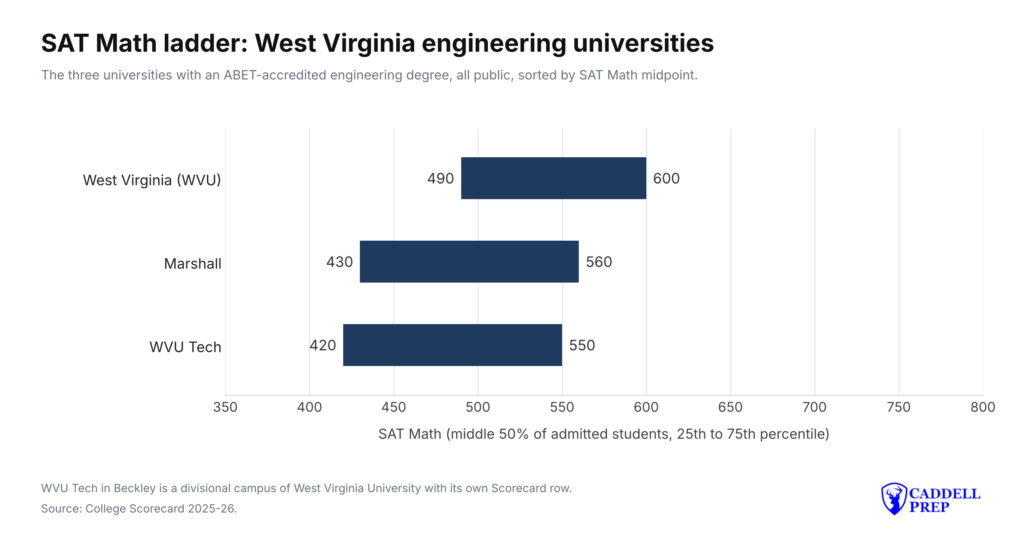
A student can see where his Math score sits on this list in the image above.
Want to Know What 5 Topics Will Improve Your SAT Score the Most?
Sample Feedback from our Diagnostic Test:

West Virginia University
West Virginia University’s Benjamin M. Statler College of Engineering and Mineral Resources in Morgantown holds ABET accreditation in disciplines including aerospace, biomedical, chemical, civil, computer, electrical, industrial, mechanical, mining and petroleum and natural gas engineering [VERIFY list on abet.org], and WVU publishes the Math score that admits a student and the Math score that starts him in calculus as two different numbers.
Reading & Writing 520 to 620, Math 490 to 600. The top quarter of admitted students scored at or above 600 on Math. Cost of attendance $26,415, with tuition and fees at $10,104 in state and $28,608 out of state. 17,385 undergraduates, 89% admitted.
WVU is the state’s flagship and land-grant university, the largest school on the page, and the one whose engineering college’s entry line sits inside its own admitted range. Its two lines are the next section.
Marshall University
Marshall University’s College of Engineering and Computer Sciences in Huntington holds ABET accreditation in civil, electrical and computer, and mechanical engineering [VERIFY on abet.org], and Marshall charges a non-resident less than any other school on the page.
Reading & Writing 480 to 590, Math 430 to 560. The top quarter of admitted students scored at or above 560 on Math. Cost of attendance $22,022, with tuition and fees at $9,162 in state and $20,342 out of state. 7,266 undergraduates, 96% admitted.
Marshall admits 96%, charges a New Yorker $20,342, and sits on the Ohio River at the state’s western edge, closer to Columbus and Lexington than to Morgantown. Its Math ceiling of 560 is 40 points below WVU’s.
WVU Institute of Technology
WVU Institute of Technology’s Leonard C. Nelson College of Engineering and Sciences in Beckley holds ABET accreditation in civil, computer, electrical and mechanical engineering [VERIFY on abet.org, and whether the programs are listed under WVU Tech or WVU], and WVU Tech is a divisional campus of West Virginia University with its own row in the Scorecard.
Reading & Writing 460 to 570, Math 420 to 550. The top quarter of admitted students scored at or above 550 on Math. Cost of attendance $18,907, with tuition and fees at $8,424 in state and $21,072 out of state. 981 undergraduates, 37% admitted.
WVU Tech is the smallest school on the page, with the lowest cost of attendance and the lowest resident tuition, and its admit rate of 37% is printed as the Scorecard reports it [VERIFY against the campus’s own figures]. It moved from Montgomery to Beckley in 2017.
Three ranges say who got in. At the flagship, the number that gets a student in and the number that starts him in calculus are 120 points apart, and the next section is about the space between them.
What Math Score Gets a Student Into WVU's Engineering College?
An SAT Math of 540, an ACT Math of 22 or an ALEKS score of 45 gets a student into WVU’s Statler College of Engineering and Mineral Resources, or a 3.0 high school GPA does, and the college reads the highest Math sub-score he submits from either test.
The criteria are the college’s own. The Statler College’s admissions page says an engineering applicant needs “a 3.0 cumulative high school GPA or meet entry requirements to College Algebra (MATH 126),” and that “admissions will be based on the highest math sub-score submitted (ACT or SAT).” The entry requirement to College Algebra is an ACT Math of 22, an SAT Math of 540 or an ALEKS score of 45. A student clears the gate with the GPA or with the score.
The same page publishes two more lines, and they are placements rather than requirements. An ACT Math of 26, an SAT Math of 610 or an ALEKS of 65 places a student into Pre-Calculus, MATH 129. An ACT Math of 28, an SAT Math of 660 or an ALEKS of 75 places him into Calculus 1, MATH 155, the first course on the engineering degree’s math line. “Once admitted, students work with their academic advisor to create their degree plan and semester schedules,” based on where the placement put them.
Set the three lines against the class. WVU reports an admitted Math range of 490 to 600. The admission line, 540, sits inside it. The Pre-Calculus line, 610, sits 10 points above the 75th percentile. The Calculus 1 line, 660, sits 60 points above it. A student in the top quarter of WVU’s admitted class, by the Scorecard’s figure, has not reached the Pre-Calculus line, and most of the students the college admits to engineering start in College Algebra or Pre-Calculus, one or two semesters of math before the first calculus course.
| Line | ACT Math | SAT Math | ALEKS | What it does | Where WVU’s range sits |
|---|---|---|---|---|---|
| College Algebra, MATH 126 | 22 | 540 | 45 | Admission to the college (or a 3.0 GPA) | Inside the range, 490 to 600 |
| Pre-Calculus, MATH 129 | 26 | 610 | 65 | Placement, one course below calculus | 10 points above the 75th percentile |
| Calculus 1, MATH 155 | 28 | 660 | 75 | Placement into the first engineering calculus course | 60 points above the 75th percentile |
On every other page in this series the calculus line has been the gate. On our page on engineering colleges in Nevada, Reno and Las Vegas place a student into Calculus I at an ACT Math of 28 or an SAT Math of 650, and neither university’s range reaches the line. At Oregon State the gate is a course, pre-calculus at a C- or better, and a student without it enrolls undeclared. At WVU the gate is the algebra line, the calculus line is a placement, and a student with a 560 is in the college and in College Algebra on the same day.
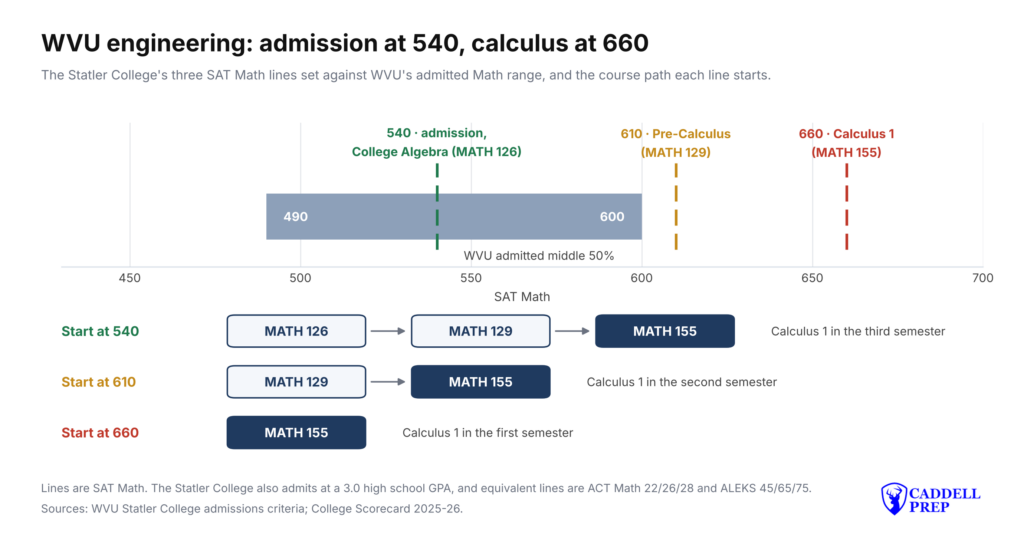
The image above sets the three Statler College math lines against the class WVU admits and the course path each line starts.
Take a New York student with a 560 on SAT Math. At WVU he is inside the range of 490 to 600, above the 540 entry line and below the 610 Pre-Calculus line, so he is admitted to the Statler College and placed in College Algebra, at $28,608 a year, with Pre-Calculus and then Calculus 1 ahead of him before the first engineering calculus course. Give the same student a 620 and he is placed in Pre-Calculus. Give him a 660 and he is placed in Calculus 1. At Marshall he is at the ceiling of 430 to 560 and pays $20,342. At WVU Tech he is 10 points above the ceiling of 420 to 550 and pays $21,072. The score decides the course he starts in at the flagship and the price at the other two.
West Virginia’s second number is a pair of prices. WVU Tech, forty minutes south of Charleston in Beckley, charges a non-resident $21,072 and a resident $8,424, the lowest resident figure on the page, on a Math range of 420 to 550. Marshall, in Huntington on the Ohio River, charges a non-resident $20,342, the lowest non-resident figure on the page, on 430 to 560. A New York student pays $7,536 less at WVU Tech and $8,266 less at Marshall than at WVU, for accredited engineering degrees at universities whose Math ceilings sit 50 and 40 points below the flagship’s.
WVU’s third number is its own price against its neighbors. WVU charges a non-resident $28,608. Every flagship engineering school in a state that borders West Virginia charges a New Yorker more: Kentucky $34,140, Ohio State $40,022, Maryland $41,186, Pitt $41,430 and Penn State $41,790 on our page on engineering colleges in Pennsylvania, and Virginia $59,512 for the university and $73,582 for its engineering school. A New York student who drives past Pittsburgh to Morgantown pays $12,822 a year less than he would have paid in Pittsburgh.
The honest version is that the algebra line is an admission line and the calculus line is a placement line, and the page keeps them apart because the college does. A student who starts in MATH 126 takes College Algebra, then Pre-Calculus, then Calculus 1, and the page does not know how many WVU engineering students who start there finish an engineering degree in four years [VERIFY the college’s published figures and whether it publishes a plan for MATH 126 starters]. WVU admits 89% and its range describes the students who submitted a score. WVU Tech’s 37% is the Scorecard’s figure. And West Virginia gives the SAT to every junior, so a West Virginian arrives with a Math sub-score whether he planned to or not, and the college reads the highest one he has.
Families who have read other states’ calculus rules frequently ask whether West Virginia has one.
Does WVU Require Calculus Readiness for Engineering Admission?
WVU does not require calculus readiness for engineering admission. The Statler College admits at a 3.0 high school GPA or at the College Algebra entry line, an ACT Math of 22, an SAT Math of 540 or an ALEKS of 45, and the Calculus 1 line of 28, 660 or 75 is a placement, not a requirement.
A student admitted below the calculus line is in the college and starts in College Algebra or Pre-Calculus, and his advisor builds the degree plan from there. The score decides where he starts, not whether he is in.
The lines are WVU’s. The degrees are what the next section lists.
Which West Virginia Universities Have ABET-Accredited Engineering Schools?
Three West Virginia universities hold ABET-accredited engineering bachelor’s degrees, all public, and all three are in the table above.
In Morgantown, WVU’s Statler College is the state’s engineering school, an hour south of Pittsburgh. In Huntington, Marshall’s College of Engineering and Computer Sciences is at the state’s western edge on the Ohio River. In Beckley, WVU Tech’s Leonard C. Nelson College of Engineering and Sciences is in the southern coalfields, on a campus the university moved to in 2017. The three form a triangle with 150 miles on its longest side.
Accreditation matters for a reason that is easy to miss at seventeen. Licensure as a professional engineer normally requires a degree from an ABET-accredited engineering program, and that is why Fairmont State’s and Bluefield State’s engineering technology degrees do not put those universities on the list. West Virginia State, Shepherd, West Liberty, Concord, Glenville State, Charleston, Wheeling, West Virginia Wesleyan, Davis & Elkins and Bethany award no engineering degree.
Nothing on this page ranks the three. The table’s order is a stated, verifiable number, and the choice among accredited programs comes down to cost, discipline and where a student’s score places him.
What If Your Scores Are Below the Range You Want?
In West Virginia three schools cover Math ranges from a 420 floor to a 600 ceiling, all three are public, and a New York student’s price runs from $20,342 to $28,608. The score decides very little about admission here. At WVU it decides which math course a student takes first, and that decides how long the degree takes.
The gap from a 560 to WVU’s Pre-Calculus line is 50 points of SAT Math, three or four questions, and the student who closes it skips a semester of College Algebra. The gap from a 560 to the Calculus 1 line is 100 points, and the student who closes that one starts the engineering math sequence in his first semester, where the college’s four-year plan starts.
The first step is finding out where the score actually is, section by section. A free diagnostic SAT gives a score that can be set against the three Statler lines as well as the table.
The Math section rewards the same handful of topics on every test date, and a student who knows which of them he is missing can close a gap of 50 to 100 points in weeks rather than months. The method is on our page on improving your SAT Math score, and the topics it covers are the ones MATH 126 and MATH 129 teach, and that is the point.
How to Read These Score Ranges
Every range on this page covers the middle 50% of admitted students who submitted that test. The lower number is the 25th percentile and the upper number is the 75th, so a quarter of admitted students scored at or above it.
An admission line and a placement line are two numbers, and a range can sit between them. WVU’s 490 to 600 describes who got into the university, its 540 describes who got into the engineering college, and its 660 describes who started in calculus, and a student should read all three.
Because most colleges are now test-optional, the ranges that are published describe only the students who chose to submit at all. Students with strong scores submit and students with weak ones don’t, so a published range sits higher than the range for everyone who was actually admitted. More on what SAT score you need for college and on test-optional colleges.
Should You Take the ACT Instead?
West Virginia gives the SAT to every public school junior as the state test [VERIFY with the West Virginia Department of Education], and all three universities on this page report an SAT range and an ACT range.
That is why the table carries SAT columns and is sorted by Math. All three universities accept either test, the Statler College reads the highest Math sub-score from either, and a student who holds an ACT should read the ACT Math column of the lines in the section above.
Engineering Programs in Nearby States
West Virginia borders Pennsylvania, Ohio, Kentucky, Virginia and Maryland, and every one of those states’ flagships charges a New Yorker more than WVU does.
See engineering colleges in Pennsylvania, engineering colleges in Ohio, and engineering colleges in Virginia.
Engineering Colleges in Other States
We publish the same breakdown for engineering programs in every state.
See engineering colleges by state for the full list.

Glyn Caddell
Glyn Caddell holds a BS in Mechanical Engineering from NJIT and has been tutoring New York City students since 2008. He founded Caddell Prep in 2012 and is the author of Digital SAT Math Secrets: Lessons & Tricks to Quickly Improve to a Perfect 800 on the Math Test, which contains over 900 practice problems and is used in Caddell Prep’s SAT math classes. He is founding president of the Staten Island Technical High School alumni association and teaches every lesson on this site personally.
Finally, an SAT course that students actually understand
Every question has a video explanation. Not most — every one.
The on-demand Digital SAT course covers all 17 math topics and 15 reading and writing topics, with 5 full-length practice tests and a 100-point score increase guarantee. Keep access for the rest of high school. No subscription.
Want to Know What 5 Topics Will Improve Your SAT Score the Most?
Sample Feedback from our Diagnostic Test: