
Home » College SAT Score Ranges, Costs, and Programs by Major and State » Engineering Colleges by State: SAT Scores, ACT Scores, Costs, and ABET Programs » Engineering Colleges in Louisiana: ACT Scores, SAT Scores, Costs, and Programs
By Glyn Caddell, BSME · Author of Digital SAT Math Secrets · Tutoring since 2008 — Updated October 23, 2026
Seven Louisiana universities offer ABET-accredited engineering degrees, and this page lists what they cost and the test scores of the students they admit.
Three of the seven charge an out-of-state student less than $17,000 a year in tuition, and one of them charges him less than LSU charges a Louisiana resident, a comparison worked out below the table.
The table is sorted by ACT composite because Louisiana tests every public-school junior on the ACT and every school on the page reports it.
Table of Contents
- Louisiana Engineering Colleges by ACT and SAT Score
- How Much Does an Out-of-State Student Pay for Engineering in Louisiana?
- Which Louisiana Universities Have ABET-Accredited Engineering Schools?
- What If Your Score Is Below the Range You Want?
Louisiana Engineering Colleges by ACT and SAT Score
The seven universities below are the ones in Louisiana that hold an ABET-accredited bachelor’s degree in an engineering discipline. They are sorted by the midpoint of the ACT composite range, so the order can be checked from the table itself.
| College | ACT composite | SAT Reading & Writing | SAT Math | Cost of attendance | Undergraduates | Admit rate |
|---|---|---|---|---|---|---|
| Tulane University | 31 to 34 | 700 to 750 | 700 to 770 | $87,004 | 7,767 | 14% |
| Louisiana State University | 24 to 30 | 600 to 680 | 580 to 660 | $34,705 | 30,594 | 73% |
| University of Louisiana at Lafayette | 23 to 28 | 570 to 630 | 550 to 610 | $24,884 | 12,428 | 87% |
| Louisiana Tech University | 21 to 27 | 550 to 630 | 550 to 680 | $24,280 | 8,312 | 86% |
| McNeese State University | 18 to 23 | 490 to 610 | 450 to 588 | $22,810 | 5,005 | 78% |
| University of New Orleans | 17 to 23 | 480 to 616 | 455 to 625 | $23,431 | 4,638 | 74% |
| Southern University and A&M College | 15 to 19 | 410 to 530 | 380 to 490 | $26,341 | 5,519 | 35% |
Each range covers the middle 50% of admitted students who submitted that test. A quarter scored below the lower number, and the top quarter scored at or above the upper one. Being under the lower number does not rule a student out, and being just above it is not as safe as it looks.
Only universities with an ABET-accredited engineering bachelor’s degree are listed. Grambling State’s, Southeastern Louisiana’s, Northwestern State’s and Nicholls State’s technology degrees are accredited under a separate ABET commission and do not qualify them for the list. Xavier’s students reach an engineering degree through a dual-degree arrangement with another university and Xavier is not listed.
Three things about that table are worth pausing on.
Tulane’s cost of attendance, $87,004, is more than two and a half times LSU’s and nearly four times McNeese’s, and its ACT floor of 31 is a point above LSU’s ceiling. The bottom quarter of Tulane’s admitted class scored where no one in LSU’s middle 50% did.
Southern University admits 35% of applicants, the most selective public university on the page by admit rate and the only one under 70%, and it reports the lowest range on the page on all three tests. The Scorecard reports both numbers and explains neither, and this page does the same.
McNeese State’s out-of-state tuition, $9,989 in the Scorecard, is below LSU’s in-state tuition of $11,954. A student from New York pays less at McNeese’s engineering college than a student from Baton Rouge pays at the flagship, and the next section works through what that buys.
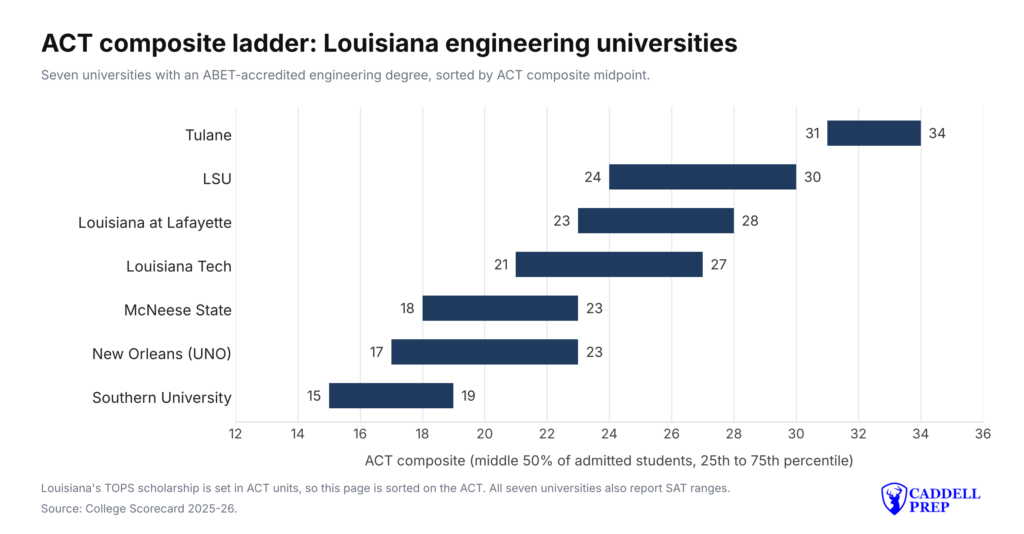
A student can see where his ACT score sits on this list in the image above.
Want to Know What 5 Topics Will Improve Your SAT Score the Most?
Sample Feedback from our Diagnostic Test:

Tulane University
Tulane University’s School of Science and Engineering in New Orleans holds ABET accreditation in disciplines including biomedical, chemical and engineering physics, and Tulane has the highest range on the page on every test.
ACT composite 31 to 34. Reading & Writing 700 to 750, Math 700 to 770. The top quarter of admitted students scored at or above 34 on the ACT and 770 on Math. Cost of attendance $87,004, with tuition and fees at $68,678 for all students. 7,767 undergraduates, 14% admitted.
Tulane is the only private university on the page, the most expensive by a factor of two and a half, and the most selective. It is also the only school on the page whose tuition is the same for every student, because a private university charges no resident rate.
Louisiana State University
Louisiana State University’s College of Engineering in Baton Rouge holds ABET accreditation in disciplines including biological, chemical, civil, computer, electrical, environmental, industrial, mechanical and petroleum engineering, and LSU has the highest range among the public universities on the page.
ACT composite 24 to 30. Reading & Writing 600 to 680, Math 580 to 660. The top quarter of admitted students scored at or above 30 on the ACT and 660 on Math. Cost of attendance $34,705, with tuition and fees at $11,954 in state and $28,631 out of state. 30,594 undergraduates, 73% admitted.
LSU is the largest school on the page by a wide margin and the most expensive public. Its in-state tuition is the figure the next section measures the rest of the state against.
University of Louisiana at Lafayette
The University of Louisiana at Lafayette’s College of Engineering holds ABET accreditation in disciplines including chemical, civil, electrical, mechanical and petroleum engineering, and UL Lafayette has the second-highest ACT range among the publics.
ACT composite 23 to 28. Reading & Writing 570 to 630, Math 550 to 610. The top quarter of admitted students scored at or above 28 on the ACT and 610 on Math. Cost of attendance $24,884, with tuition and fees at $10,418 in state and $24,146 out of state. 12,428 undergraduates, 87% admitted.
UL Lafayette is the least selective school on the page by admit rate and the second-largest. Its ACT floor of 23 is the ceiling at McNeese and UNO, and its out-of-state tuition is the second-highest among the publics.
Louisiana Tech University
Louisiana Tech University’s College of Engineering and Science in Ruston holds ABET accreditation in disciplines including biomedical, chemical, civil, cyber, electrical, industrial, mechanical and nanosystems engineering, and Louisiana Tech has the highest SAT Math ceiling among the public universities on the page.
ACT composite 21 to 27. Reading & Writing 550 to 630, Math 550 to 680. The top quarter of admitted students scored at or above 27 on the ACT and 680 on Math. Cost of attendance $24,280, with tuition and fees at $10,125 in state and $16,866 out of state. 8,312 undergraduates, 86% admitted.
Louisiana Tech’s Math ceiling of 680 is 20 points above LSU’s, on an ACT range that sits three points below LSU’s at both ends. Its out-of-state tuition is the third-lowest on the page.
McNeese State University
McNeese State University’s College of Engineering and Computer Science in Lake Charles holds ABET accreditation in chemical, civil, electrical and mechanical engineering, and McNeese has the lowest tuition on the page for a resident and for a non-resident.
ACT composite 18 to 23. Reading & Writing 490 to 610, Math 450 to 588. The top quarter of admitted students scored at or above 23 on the ACT and 588 on Math. Cost of attendance $22,810, with tuition and fees at $8,489 in state and $9,989 out of state in the Scorecard. McNeese’s own 2025-26 fee schedule gives $9,084 for a resident and $10,584 for a non-resident. 5,005 undergraduates, 78% admitted.
McNeese is the cheapest school on the page on every measure and the only one whose out-of-state tuition is under $10,000 in the Scorecard. Its non-resident charge is $1,500 a year above its resident charge on the university’s own schedule.
University of New Orleans
The University of New Orleans’ College of Engineering holds ABET accreditation in civil, electrical, mechanical and naval architecture and marine engineering, and UNO has the lowest ACT floor among the schools on the page that admit more than half of their applicants.
ACT composite 17 to 23. Reading & Writing 480 to 616, Math 455 to 625. The top quarter of admitted students scored at or above 23 on the ACT and 625 on Math. Cost of attendance $23,431, with tuition and fees at $9,172 in state and $14,008 out of state. 4,638 undergraduates, 74% admitted.
UNO is the smallest school on the page and holds the only naval architecture and marine engineering degree in Louisiana. Its Math ceiling of 625 is above UL Lafayette’s on an ACT range six points lower at the floor.
Southern University and A&M College
Southern University and A&M College’s College of Sciences and Engineering in Baton Rouge holds ABET accreditation in civil, electrical and mechanical engineering, and Southern has the lowest range on the page on every test.
ACT composite 15 to 19. Reading & Writing 410 to 530, Math 380 to 490. The top quarter of admitted students scored at or above 19 on the ACT and 490 on Math. Cost of attendance $26,341, with tuition and fees at $9,922 in state and $17,272 out of state. 5,519 undergraduates, 35% admitted.
Southern is the only historically Black university on the page and the most selective public by admit rate. Its ACT ceiling of 19 is a point below the floor at UL Lafayette’s neighbor in the table, and its cost of attendance is the second-highest among the publics.
Seven ranges say who got in. The prices say who can afford to, and in Louisiana the prices run the other way from most states.
How Much Does an Out-of-State Student Pay for Engineering in Louisiana?
An out-of-state student pays $9,989 a year in tuition and fees at McNeese State, $14,008 at the University of New Orleans and $16,866 at Louisiana Tech on the Scorecard’s figures, and LSU charges a Louisiana resident $11,954. Three accredited engineering schools in the state charge a non-resident less than $17,000, and the cheapest of them charges him less than the flagship charges its own.
The table below is every out-of-state figure on the page, with LSU’s in-state tuition as the line to read them against.
| University | Out-of-state tuition and fees | In-state tuition and fees |
|---|---|---|
| McNeese State University | $9,989 | $8,489 |
| LSU, resident rate for reference | $11,954 | |
| University of New Orleans | $14,008 | $9,172 |
| Louisiana Tech University | $16,866 | $10,125 |
| Southern University and A&M College | $17,272 | $9,922 |
| University of Louisiana at Lafayette | $24,146 | $10,418 |
| Louisiana State University | $28,631 | $11,954 |
| Tulane University | $68,678 | $68,678 |
McNeese publishes the current version of its own number. Its 2025-26 schedule charges a full-time resident $9,084 and a full-time non-resident $10,584, so the out-of-state premium at McNeese is $1,500 a year, and the non-resident figure is still $1,370 below what LSU charges a Louisiana student. At LSU the premium is $16,677. At UL Lafayette it is $13,728. At McNeese it is the price of a used laptop.
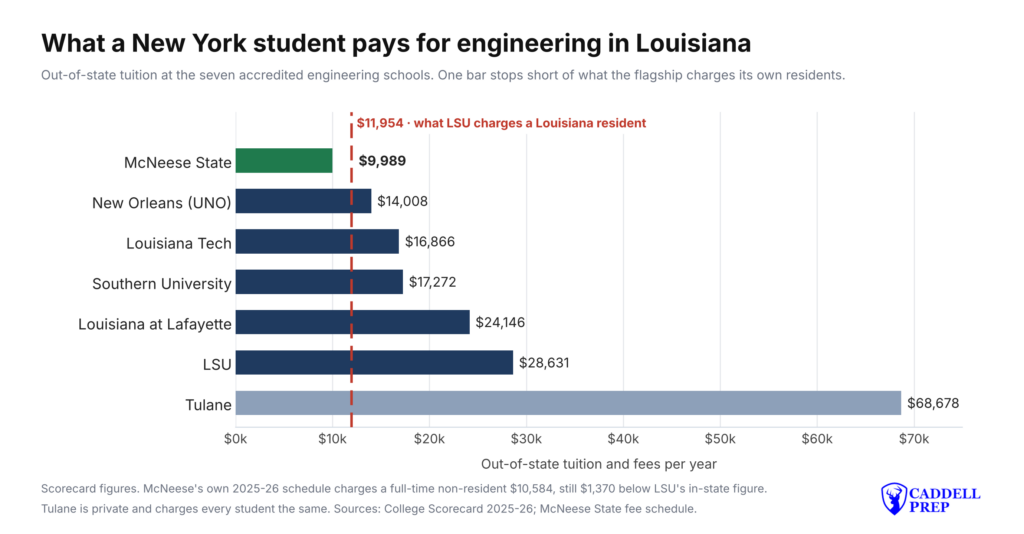
The image above shows what a New York student pays at each one, and the single bar that stops short of the flagship’s resident price.
McNeese’s $9,989 is the lowest out-of-state tuition at a public engineering school in this series so far. The lowest before it was Southern Illinois Edwardsville’s $12,922, and the lowest on the Kansas page was Wichita State’s $19,869, approximately twice McNeese’s figure.
Take a New York student with a 23 on the ACT. At LSU he is a point below the floor of 24 and the tuition is $28,631. At Louisiana Tech he is in the middle of the range and the tuition is $16,866. At UNO he is at the ceiling of 23 and the tuition is $14,008. At McNeese he is at the ceiling of 23 and the tuition is $10,584 on the current schedule. The score that leaves him under the flagship’s floor puts him in the top quarter of two accredited engineering colleges, and both of them charge him less than LSU charges a resident of Louisiana.
For a Louisiana resident the engineering question is a different one, because the state’s TOPS scholarship pays tuition at every public university on this page and its thresholds are written in ACT points. Those thresholds and what they pay are on our page on pre-med colleges in Louisiana, and they are the same for an engineering student.
The flagship has a second number worth knowing. LSU’s Department of Mathematics places first-year students by a rule that took effect in December 2025. An ACT Math of 25, an SAT Math of 590 or an ALEKS score of 61 earns credit for MATH 1021, college algebra. Placement into MATH 1550, the first calculus course in every engineering curriculum, is by an ALEKS score of 76 or higher only, and the placement page says in a footnote that prior coursework and high ACT scores are not sufficient for calculus. LSU’s Engineering Residential College, the first-year housing program for declared engineering majors, uses the same 25, 590 or 61 as its entry line. So at LSU the ACT buys college algebra credit and a dormitory, and nothing on the test buys the first engineering math course. Auburn’s rule on our page on engineering colleges in Alabama has the same shape.
The honest version of the Louisiana price is that it buys admission and not a shorter degree. McNeese and UNO admit classes whose ACT ceiling is 23, and a student who arrives at 18 is placed into algebra at either one and reaches calculus a semester or two later than a classmate who arrived ready for it. The $10,584 degree is the same length as the $28,631 degree only for the student who starts both in the same course, and the Scorecard’s tuition figures run a year behind the universities’ own, so the current schedule is the number to carry to a decision.
Louisiana families reading that table frequently ask whether McNeese’s price beats LSU’s for a resident as well.
Is McNeese Cheaper Than LSU for a Louisiana Student Too?
McNeese is cheaper than LSU for a Louisiana student too, $8,489 against $11,954 in the Scorecard, approximately $3,500 a year, and TOPS pays at both.
The difference for a resident is not the price. LSU holds accredited degrees in nine engineering disciplines and McNeese holds four, and a student who wants petroleum, biological, environmental or industrial engineering finds it in Baton Rouge and not in Lake Charles. A student who wants chemical, civil, electrical or mechanical engineering has both, at two prices, with the same scholarship.
The prices are the universities’ own. The degrees are what the next section lists.
Which Louisiana Universities Have ABET-Accredited Engineering Schools?
Seven Louisiana universities hold ABET-accredited engineering bachelor’s degrees, six public and one private, and all seven are in the table above.
In Baton Rouge, LSU’s College of Engineering holds the state’s petroleum and environmental engineering programs along the Mississippi River petrochemical corridor, and Southern University’s College of Sciences and Engineering holds civil, electrical and mechanical engineering across town. In Ruston, Louisiana Tech’s College of Engineering and Science holds eight disciplines including cyber and nanosystems engineering. In Lafayette, UL Lafayette’s College of Engineering holds five, with petroleum engineering among them. In New Orleans, Tulane’s School of Science and Engineering holds biomedical and chemical engineering, and UNO’s College of Engineering holds the state’s naval architecture and marine engineering degree, a few miles from the NASA Michoud assembly facility and the shipyards downriver. In Lake Charles, McNeese’s College of Engineering and Computer Science holds four disciplines beside the liquefied natural gas terminals on the Calcasieu Ship Channel.
Accreditation matters for a reason that is easy to miss at seventeen. Licensure as a professional engineer normally requires a degree from an ABET-accredited engineering program, and that is why Grambling State’s, Southeastern Louisiana’s, Northwestern State’s and Nicholls State’s technology degrees do not put those universities on the list. Xavier’s dual-degree students finish their engineering degree at another university, and Loyola, Dillard, Centenary, LSU Shreveport, LSU Alexandria and UL Monroe award no engineering degree.
Nothing on this page ranks the seven. The table’s order is a stated, verifiable number, and the choice among accredited programs comes down to cost, discipline and where a student’s score places him.
What If Your Scores Are Below the Range You Want?
In Louisiana the score does two different jobs depending on where the student lives. For a resident it is scholarship money and math placement, and LSU has written down both lines: a 25 on ACT Math for college algebra credit, and an ALEKS score, not a test score, for calculus. For a New York student the score decides which of three engineering schools under $17,000 he is inside the range of, and none of the three charges him a penalty price for crossing the state line.
The gap most Louisiana engineering students face is the one between the algebra credit at 25 and the calculus placement on ALEKS, and the same algebra, functions and trigonometry close it in either state. A student at 21 who spends the summer on those topics arrives at a different ALEKS score and a different first semester, and the tuition he pays for that semester is the same either way.
The first step is finding out where the score actually is, section by section. A free diagnostic SAT gives a Math score that can be set against the table, and the SAT columns on this page are there for the student who holds that test.
The Math section rewards the same handful of topics on every test date, and a student who knows which of them he is missing can close a gap of 50 to 100 points in weeks rather than months. The method is on our page on improving your SAT Math score, and the topics are the ones ALEKS asks about.
How to Read These Score Ranges
Every range on this page covers the middle 50% of admitted students who submitted that test. The lower number is the 25th percentile and the upper number is the 75th, so a quarter of admitted students scored at or above it.
A price is not a range. A university’s tuition says nothing about where a student will be placed once he arrives, and the two cheapest schools on this page admit classes whose ceiling is a 23, so a student choosing on price should read the range beside it.
Because most colleges are now test-optional, the ranges that are published describe only the students who chose to submit at all. Students with strong scores submit and students with weak ones don’t, so a published range sits higher than the range for everyone who was actually admitted. More on what SAT score you need for college and on test-optional colleges.
Should You Take the SAT Instead?
Louisiana is an ACT state. Every public-school junior takes the ACT, eighteen Louisiana institutions report an ACT range against seventeen for the SAT, and TOPS is written in ACT points, with SAT equivalents published beside them.
That is why the table on this page carries an ACT composite column and is sorted by it. Every university on the page accepts either test, LSU’s placement rule reads either one, and a student from outside Louisiana who holds an SAT should read the SAT columns and submit the test he scores higher on.
Engineering Programs in Nearby States
Louisiana borders Texas, Arkansas and Mississippi, and TOPS does not travel, so a resident who applies across the line gives it up while a non-resident who applies into Louisiana finds the lowest out-of-state engineering tuition in this series.
See engineering colleges in Texas, engineering colleges in Arkansas, and engineering colleges in Mississippi.
Engineering Colleges in Other States
We publish the same breakdown for engineering programs in every state.
See engineering colleges by state for the full list.

Glyn Caddell
Glyn Caddell holds a BS in Mechanical Engineering from NJIT and has been tutoring New York City students since 2008. He founded Caddell Prep in 2012 and is the author of Digital SAT Math Secrets: Lessons & Tricks to Quickly Improve to a Perfect 800 on the Math Test, which contains over 900 practice problems and is used in Caddell Prep’s SAT math classes. He is founding president of the Staten Island Technical High School alumni association and teaches every lesson on this site personally.
Finally, an SAT course that students actually understand
Every question has a video explanation. Not most — every one.
The on-demand Digital SAT course covers all 17 math topics and 15 reading and writing topics, with 5 full-length practice tests and a 100-point score increase guarantee. Keep access for the rest of high school. No subscription.
Want to Know What 5 Topics Will Improve Your SAT Score the Most?
Sample Feedback from our Diagnostic Test: